
Why Routine Shackling in Court Is Problematic
A closer look at why courts must decide restraints individually, not by blanket rule.
Understanding the Limits on Shackling Defendants
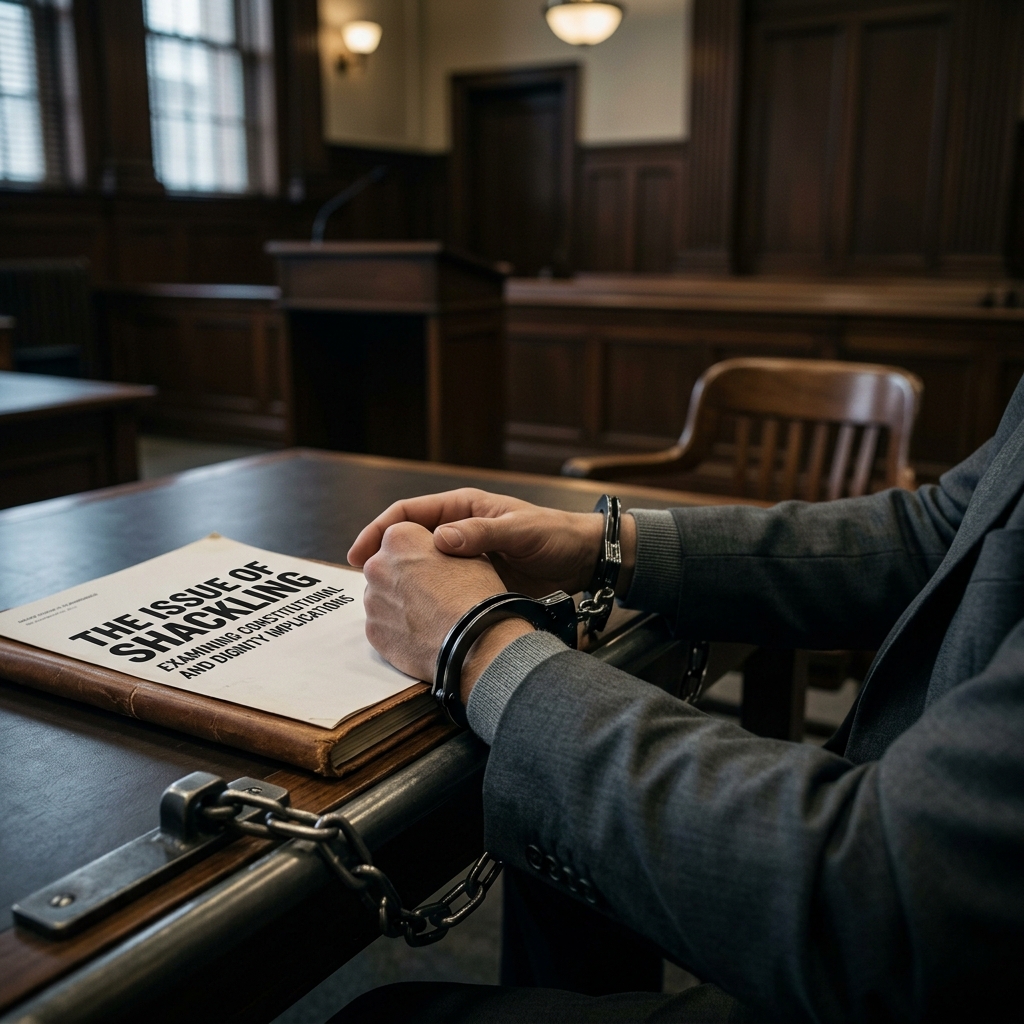
Courts do not have free rein to place every criminal defendant in restraints simply because the person is in custody. The constitutional rule, reflected in Supreme Court and appellate decisions, is that shackling must be justified by a particular need tied to the individual defendant rather than by a blanket policy that treats all defendants the same.
This matters because visible restraints can influence how judges, jurors, and even courtroom participants perceive a defendant. The legal system is built on the idea that a person is presumed innocent until proven guilty, and routine shackling can conflict with that principle when it is used without a case-specific security rationale.
What the Ninth Circuit Rejected
The dispute addressed by the Ninth Circuit involved a district-wide practice of routinely shackling pretrial detainees in the courtroom. The court rejected the idea that all detainees could be automatically restrained, even during proceedings without a jury, and required an individualized assessment instead.
According to the rulings summarized in the search results, the government must first justify restraints with specific security concerns for that defendant. The judge, not the security personnel, must ultimately decide whether those concerns outweigh the defendant’s liberty interest.
The Constitutional Principle Behind the Rule
The legal foundation comes from due process. The Supreme Court has long said that visible shackles during the guilt phase of a criminal trial are generally forbidden unless an essential state interest justifies them, such as courtroom security specific to that defendant.
The same principle extends beyond jury trials in the Ninth Circuit’s view. That court held that the right to be free from unwarranted restraints applies during pretrial proceedings, trial, and sentencing, whether a jury is present or not.
Why Judges Cannot Use Blanket Shackling Policies
Blanket policies are disfavored because they assume risk instead of proving it. A rule that all defendants must appear in full restraints ignores the possibility that many people pose no special danger, no escape risk, and no threat to courtroom order.
The constitutional problem is not merely the existence of restraints. It is the absence of individualized justification. Courts must ask whether a compelling governmental interest exists and whether shackles are the least restrictive way to meet that need.
Common Reasons a Court May Consider Restraints
Although routine shackling is not allowed, courts may still order restraints in appropriate cases. The traditional concerns are security, escape prevention, and courtroom decorum.
- Safety: preventing violence against court staff, witnesses, jurors, or the defendant.
- Escape risk: reducing the chance that a defendant will flee during proceedings.
- Order: preserving the ability of the court to conduct the hearing without disruption.
These concerns are legitimate, but they must be tied to facts about the particular defendant rather than general assumptions about people who are detained.
What Courts Look At Before Approving Shackles
Courts may consider factors traditionally associated with security and flight risk, but they must still make a tailored decision. Examples mentioned in the source materials include a history of courtroom violence, repeated disruptive behavior, or escape-related conduct.
That means one defendant may properly be restrained because of a documented threat, while another defendant in the same courthouse may appear unshackled if there is no comparable risk. The legal standard turns on the specific record, not on the general category of defendant.
Why Visible Shackles Raise Fairness Concerns
Visible restraints can suggest to the courtroom that the defendant is dangerous, untrustworthy, or already guilty. That impression can affect how jurors interpret the evidence and may undermine the neutrality the justice system is supposed to preserve.
Because of that risk, courts have long treated visible shackling as something exceptional rather than routine. The concern is especially strong when jurors can see the restraints, but the due process analysis in the Ninth Circuit also extends to nonjury settings.
When Shackling Might Still Be Allowed
The rule against routine restraints does not mean defendants may never be shackled. The decisions in the search results make clear that shackles can be used when the court finds a compelling need and determines that no less restrictive measure will adequately protect the proceedings.
In practical terms, a judge may approve restraints if the record shows a credible escape risk, a documented history of violence, or another individualized security concern. The key point is that the justification must come first, and the restraint must follow only after a judicial finding.
Why Delegating the Decision Is Not Enough
The Ninth Circuit also rejected the idea that courtroom security officers can make the decision for the judge. Security staff may provide information, but they cannot replace the court’s constitutional duty to decide whether shackling is truly necessary.
This separation matters because the constitutional issue belongs to the judiciary. If restraints are imposed simply because a security agency uses a standard practice, the individualized review required by due process disappears.
How This Fits with Earlier Supreme Court Law
The Ninth Circuit’s reasoning is consistent with earlier Supreme Court precedent recognizing that visible shackling in criminal proceedings is generally disfavored. The older rule is that restraints may be used only when an essential state interest specific to the defendant supports them.
That framework does not eliminate courtroom security. Instead, it requires courts to balance security needs against the defendant’s constitutional rights. The result is a case-by-case process rather than a one-size-fits-all policy.
Practical Effects for Defendants and Counsel
For defense attorneys, the issue is important because shackling can affect both courtroom presentation and legal rights. Counsel should be alert to any policy that appears automatic, and should ask the court to place its reasoning on the record if restraints are proposed.
For defendants, the ruling means that being in custody does not automatically justify visible restraints. The court still has to make a reasoned decision about whether the particular facts support shackling.
Shackling at Different Stages of a Case
The search results show that the constitutional analysis is not limited to trial alone. The Ninth Circuit treated the right to be free from unwarranted restraints as applying during pretrial hearings, trial, and sentencing, even when no jury is present.
That broader approach is significant because many courtroom appearances happen before a jury is ever seated. Even then, a defendant’s liberty interest does not disappear, and the judge must still evaluate whether restraints are truly needed.
Comparison of Routine and Individualized Shackling
| Approach | What It Means | Legal Problem or Benefit |
|---|---|---|
| Routine shackling | All or most defendants are restrained by default | Conflicts with due process because it ignores individual circumstances |
| Individualized shackling | The court reviews the specific defendant’s risks | Fits constitutional standards and allows restraints only when justified |
| No shackles | The defendant appears without visible restraints | Best protects the presumption of innocence when security concerns are absent |
What a Proper Court Record Should Show
When a court authorizes shackles, the record should reflect why the decision was made. The opinions in the search results emphasize specific findings, including the reasons restraints are necessary and why lesser options would not be enough.
That record is important for review on appeal. Without it, the restraint order can look like an automatic practice rather than a carefully considered judicial decision.
Frequently Asked Questions
Can a court shackle every defendant who is in custody?
No. The cases in the search results reject routine or blanket shackling and require an individualized justification for each defendant.
Does the rule apply only when a jury is present?
No. The Ninth Circuit held that the right to be free of unwarranted restraints applies to pretrial proceedings, trial, and sentencing, with or without a jury.
Who decides whether shackles are necessary?
The judge must make the decision. Security personnel may provide information, but they cannot make the constitutional call for the court.
What reasons can justify shackling?
Traditional justifications include safety, escape prevention, and courtroom order, but they must be tied to the facts of the specific defendant’s case.
Does being a detainee automatically make someone a security risk?
No. The legal standard requires more than custody status alone; the court must find a particularized need before ordering restraints.
Key Takeaways for Criminal Court Practice
- Shackling cannot be imposed as a default policy for all defendants.
- Courts must assess whether there is a compelling government interest in the specific case.
- The restraint must be the least restrictive means of meeting the security need.
- Visible shackles can undermine the presumption of innocence and fairness of the proceeding.
References
- 2017 (11) AELE Mo. LJ 301 Jail & Prisoner Law Section — AELE. 2017. https://www.aele.org/law/2017all11/2017-11MLJ301.pdf
- Vol. 32 No. 13 Ninth Circuit Court of Appeal Hold That Federal District-Wide Courtroom Shackling Policy Is Unconstitutional — Jones Mayer. 2017. https://jones-mayer.com/vol-32-no-13-ninth-circuit-court-of-appeal-hold-that-federal-district-wide-courtroom-shackling-policy-is-unconstitutional/
- United States v. Sanchez-Gomez — United States Court of Appeals for the Ninth Circuit. 2017-05-31. https://cdn.ca9.uscourts.gov/datastore/opinions/2019/06/28/16-16077.pdf
- Shackling Convicted Prisoners During Civil Trial Proceedings — Journal of the American Academy of Psychiatry and the Law. 2020. https://jaapl.org/content/48/1/117
- Analyzing the Shackling of Criminal Defendants in Nonjury Proceedings — Penn State Law Review. 2020. https://www.pennstatelawreview.org/wp-content/uploads/2020/11/Comment-3-Mallory-Maxwell-Format-2.pdf
- A “view” from the courtroom: Judicial restraint — SCOTUSblog. 2018-03-26. https://www.scotusblog.com/2018/03/view-courtroom-judicial-restraint/
Similar Articles








Read full bio of Sneha Tete




