Why the Label on a Crime Matters
In criminal law, the name attached to an offense is more than a technical label. Classification helps determine how prosecutors charge the case, what process the court must follow, and how serious the possible punishment may be. A small difference in grading can change whether a person faces jail, prison, a fine, or only a civil penalty, and it can also affect what constitutional protections apply during the case.
Crime classification exists because the legal system does not treat every unlawful act the same way. Legislatures and courts use categories to sort conduct by seriousness, public harm, and punishment range. That sorting makes criminal law more predictable and gives judges, prosecutors, defendants, and juries a framework for decision-making.
The Main Ways Crimes Are Grouped
One common method is to classify crimes by severity. In many jurisdictions, the familiar hierarchy includes felonies, misdemeanors, and lower-level offenses such as infractions or violations. Another way to organize offenses is by subject matter, such as crimes against people, property crimes, drug offenses, traffic offenses, or financial crimes.
| Classification | Typical punishment | Common examples |
|---|---|---|
| Felony | More than one year in custody; sometimes much more | Serious violent crimes, major theft, arson, burglary |
| Misdemeanor | Up to one year in jail, often with fines or probation | Lower-level assaults, simple theft, first-time minor offenses |
| Infraction / violation | Usually a fine or citation; no jail | Minor traffic offenses, certain regulatory violations |
That table is only a general guide, because state law varies. An offense that is treated as a felony in one jurisdiction may be charged differently in another, and some states create multiple subcategories within the same grade.
Felonies and Their Broader Reach
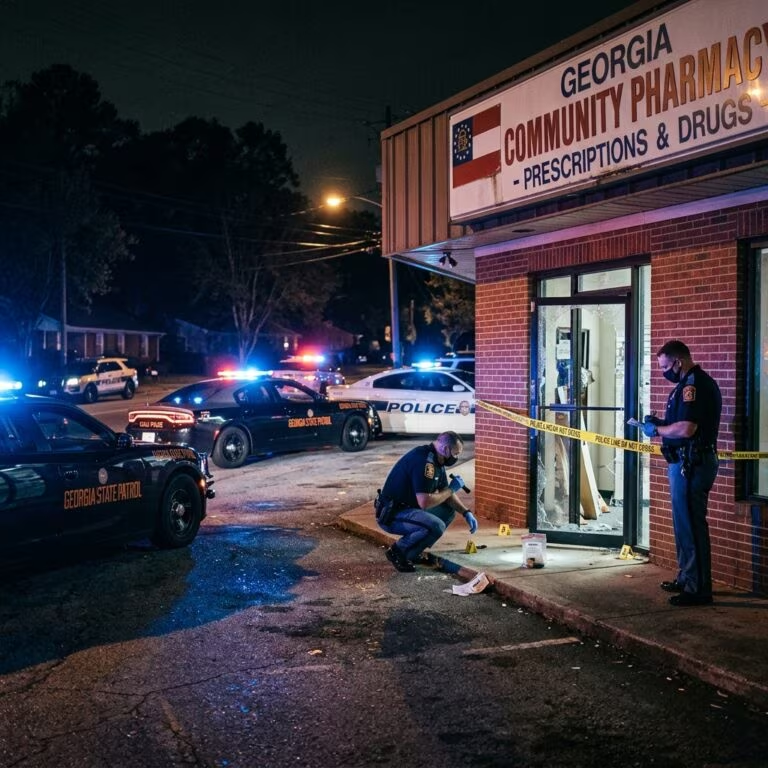
Felonies are the most serious class of ordinary criminal offenses. Under federal law and in many states, a felony is generally punishable by more than one year of imprisonment. The sentence may include lengthy prison terms, large fines, probation after release, restitution, and collateral consequences that extend far beyond the courtroom.
Because felonies are considered serious threats to public safety, the criminal process often includes stronger procedural safeguards. In federal cases, a defendant facing certain felony charges has the right to indictment by a grand jury, and felony prosecutions generally provide the right to a jury trial. Defendants who cannot afford counsel may also be entitled to appointed representation.
The consequences of a felony conviction can affect daily life long after any sentence ends. Common collateral effects may include difficulty finding work, barriers to professional licensing, loss of firearm rights, immigration problems, and limits on civic participation such as jury service or holding public office.
Misdemeanors: Less Serious, Still Significant
Misdemeanors fall below felonies in severity, but they are still criminal offenses and can carry meaningful penalties. A misdemeanor usually means potential incarceration of less than one year, though the exact definition depends on the jurisdiction. Courts may also impose fines, probation, community service, counseling, or restitution.
Many people underestimate misdemeanor cases because they are “less serious” than felonies. That is a mistake. A misdemeanor conviction can still create a permanent record, interfere with employment, affect housing applications, and increase penalties for later offenses. In some systems, repeated misdemeanors may also be used to justify harsher treatment in future prosecutions.
Misdemeanor cases often move faster than felony cases, but the defendant still has important rights. In many jurisdictions, defendants facing jail time are entitled to a jury trial and, if eligible, government-funded counsel. Even when a sentence is short, the legal and practical consequences may last much longer.
Infractions and Other Low-Level Offenses
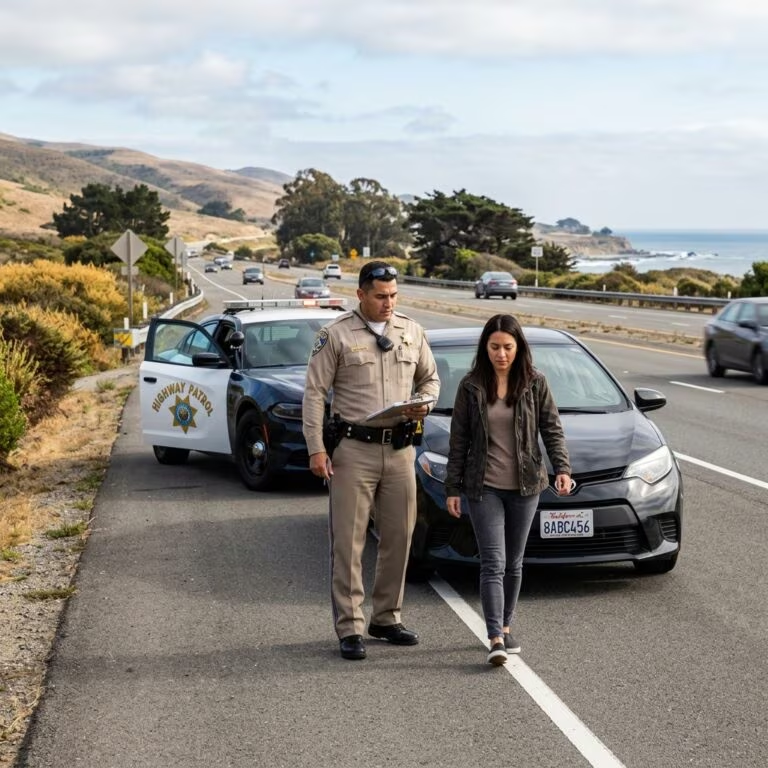
At the lowest level are infractions, sometimes called violations, petty offenses, or citable offenses. These are usually not punishable by jail and are often resolved with a fine, administrative penalty, or corrective action such as traffic school.
Although infractions are minor compared with crimes that carry imprisonment, they still matter. Multiple violations can lead to license consequences, higher insurance costs, court fees, or a pattern that supports enhanced enforcement later. In some jurisdictions, the line between a true criminal offense and a civil penalty is especially thin, so the classification itself can control whether the state must provide the same courtroom protections it would provide in a more serious prosecution.
How Classification Changes the Criminal Process
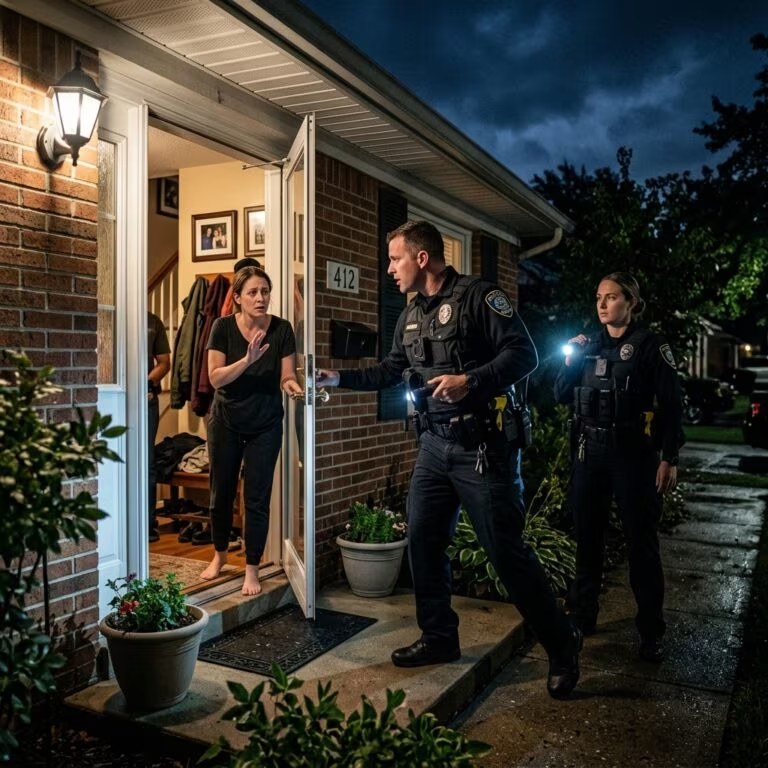
The effect of classification is not limited to punishment. It also shapes the way a case is handled from start to finish. A more serious charge may trigger arrest procedures, bail conditions, preliminary hearings, grand jury review, or more formal plea negotiations.
By contrast, lower-level matters may be handled more quickly and with less procedural complexity. Some minor cases are resolved through citations or administrative hearings, and prosecutors may not be involved in the same way as they would be in felony litigation. The classification therefore influences not only the possible sentence but the entire structure of the case.
That difference matters because procedure affects leverage. A defendant charged with a felony may have more at stake, but the state also must satisfy more steps before a conviction can occur. A defendant charged with a lower offense may face less formal process, but may also have fewer opportunities to challenge the charge before resolution.
Degrees, Classes, and “Wobbler” Offenses
Many jurisdictions divide offenses into degrees or classes to reflect gradations within the same crime. For example, first-degree conduct is usually treated as more serious than second-degree conduct because it may involve planning, greater harm, use of a weapon, or a vulnerable victim. This internal ranking allows lawmakers to distinguish between conduct that is technically similar but morally or practically different.
Some jurisdictions also recognize offenses that can be charged either as a felony or as a misdemeanor depending on the facts. These are often called “wobblers.” In those cases, the prosecutor may have discretion at charging, or the judge may reduce the offense at sentencing based on the circumstances, the defendant’s record, or mitigation evidence.
Wobbler offenses are important because they show that classification is not always fixed. The same conduct may fall into a higher or lower category depending on intent, amount of harm, prior record, or the way the case is resolved.
What Usually Drives the Classification
Legislatures typically classify crimes based on seriousness, harm, and social risk. The more injury a crime can cause to a person, property, the public, or the justice system, the more likely lawmakers are to place it in a higher category. Punishment range is the practical expression of that judgment.
- Harm caused: Physical injury, financial loss, or danger to public safety often increases the grade of the offense.
- Intent: Deliberate or knowing conduct is usually treated more severely than accidental conduct.
- Method: Weapons, deception, violence, or planning may raise the level of the charge.
- Repeat conduct: Prior convictions can affect charging decisions and sentencing exposure.
- Public impact: Offenses that threaten the broader community may be graded more harshly.
These factors help explain why one state may treat a conduct pattern as a misdemeanor while another treats similar conduct as a felony. Classification is therefore a policy choice as much as a legal one.
The Long Shadow of a Conviction
The criminal sentence is only part of the outcome. A conviction can also create collateral consequences that are not announced in the courtroom but are deeply felt in daily life. Employment applications, background checks, licensing boards, immigration authorities, landlords, schools, and even family court may treat the classification of the offense as a significant factor.
For that reason, two charges with similar facts can have very different life consequences depending on whether the state labels them as a felony, misdemeanor, or infraction. In practice, classification affects bargaining power during plea negotiations, eligibility for diversion programs, and the possibility of later relief such as expungement or record sealing, where those remedies exist under local law.
What Defendants and Families Should Ask Early
When someone is charged with a crime, the first question should not be only “What happened?” It should also be “How is the offense classified?” That answer helps identify the maximum exposure, the likely procedure, and the most realistic defenses.
- What is the exact charge?
- Is it a felony, misdemeanor, or infraction?
- Can the charge be reduced or reclassified?
- What rights apply at this level?
- What collateral consequences could follow a conviction?
Getting those answers early can shape the defense strategy. A charge that appears minor may still warrant careful review if it carries immigration risk, licensing consequences, or the possibility of enhancement in a later case.
FAQs
Is a felony always worse than a misdemeanor?
Usually yes, because felonies carry more severe potential punishment and broader collateral consequences. However, the practical impact of a misdemeanor can still be serious, especially if the offense affects work, housing, or future sentencing.
Can the same act be charged in different ways?
Yes. Depending on the facts, evidence, prior history, and state law, one incident may be charged as a misdemeanor, a felony, or a wobbler offense that can move between the two categories.
Do infractions count as criminal cases?
Sometimes they are treated as criminal violations, and sometimes they are handled more like civil matters. The local law controls whether the offense is considered a crime and what procedures apply.
Why do states classify the same conduct differently?
Each legislature sets its own policy priorities. Differences in local views about deterrence, public safety, and punishment lead to different grading choices across jurisdictions.
Can classification change after conviction?
In some cases, yes. Certain offenses can be reduced at sentencing or later reclassified under specific legal procedures, especially where a jurisdiction treats the offense as a wobbler.
Why Legal Advice Depends on Classification
Criminal defense strategy depends heavily on classification because the offense grade determines the procedural path, the sentencing ceiling, and the range of negotiated outcomes. A defense lawyer will usually start by identifying the classification, then analyzing whether the evidence supports that level of charge or whether the conduct should be treated more lightly under the governing law.
Understanding classification also helps defendants avoid two common mistakes: underestimating minor charges and overgeneralizing from one state’s rules to another’s. The same behavior may lead to very different legal results depending on the jurisdiction, the statute, and the facts proven in court.
References
- Implications of Crime Classifications – FindLaw — FindLaw. 2026-07-09. https://www.findlaw.com/criminal/criminal-law-basics/implications-of-a-crime-s-classification.html
- Classification and Definition of Crimes — Northwestern University Scholarly Commons. 1931. https://scholarlycommons.law.northwestern.edu/cgi/viewcontent.cgi?article=1338&context=jclc
- 1.4 Classification of Crimes — Lumen Learning. 2026-07-09. https://courses.lumenlearning.com/suny-criminallaw/chapter/1-4-classification-of-crimes/
- Types of Criminal Offenses Under the Law — Thomson Reuters. 2026-07-09. https://legal.thomsonreuters.com/blog/types-of-criminal-law/
- Felonies, Misdemeanors, and Infractions: Classifying Crimes — Carelon Wellbeing. 2026-07-09. https://hd.carelonwellbeing.com/hd/find-legal-support/resources/criminal-law/legal-assist/felonies-misdemeanors-and-infractions-classifying-crimes
- Types of Criminal Offenses — Justia. 2026-07-09. https://www.justia.com/criminal/offenses/
- Classifications of Crimes — Damico & Stockstill, Attorneys at Law. 2026-07-09. https://www.thomasdamico.com/criminal-law_pc/classifications-of-2-criminal-law_pc/