
Avoid Wikipedia for Legal Research Risks
Discover critical reasons lawyers must skip Wikipedia in legal work and embrace verified sources for reliable outcomes.
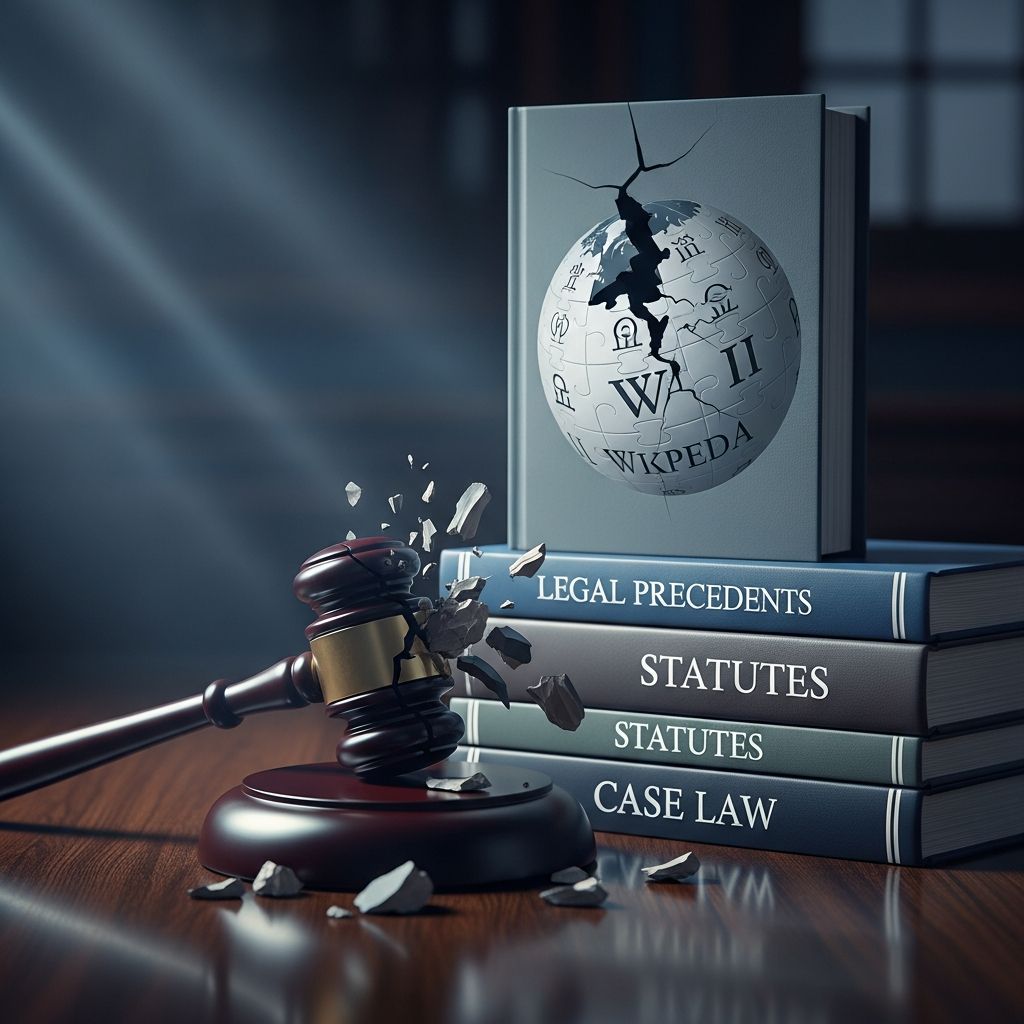
Legal research demands precision, verifiability, and authority, qualities that Wikipedia inherently lacks due to its crowd-sourced, editable nature. Relying on it can undermine case outcomes, professional credibility, and judicial integrity, as evidenced by empirical studies and court rulings.
The Editable Nature of Wikipedia Undermines Trust
Wikipedia operates as a collaborative platform where anyone can edit entries, leading to potential inaccuracies, biases, or manipulations that compromise its suitability for high-stakes legal work. This open-edit policy means content lacks a fixed provenance, making it impossible to confirm the reliability of information at any given moment.
Unlike peer-reviewed journals or official court reporters, Wikipedia prohibits original research, requiring all material to stem from reliable published sources with verifiable citations. However, even when sourced, the synthesis or selection of facts by anonymous editors introduces risks of subjective interpretation, which courts have repeatedly flagged as problematic.
Professionals in law face ethical obligations under rules like those from the American Bar Association, which emphasize citing only authoritative materials. Using Wikipedia violates these by introducing unvetted content that could sway arguments without accountability.
Empirical Evidence: Wikipedia’s Influence on Judges
A groundbreaking randomized controlled trial involving 154 Irish Supreme Court cases demonstrated Wikipedia’s tangible impact on lower court decisions. Researchers created Wikipedia summaries for 77 cases (treatment group) and withheld them for the other 77 (control). Post-upload analysis revealed treatment cases were cited significantly more often in subsequent rulings, indicating judges or staff consulted Wikipedia for precedent summaries.
This influence manifested in both citation frequency and argumentative framing, where Wikipedia’s contextual phrasing echoed in judicial opinions. Notably, higher courts like the Court of Appeal and Supreme Court showed no such effect, likely due to stricter procedural norms and resources. The study suggests time-pressured lower courts turn to Wikipedia despite its risks, highlighting a public policy gap for authoritative alternatives.
| Aspect | Treatment Group (Wikipedia Added) | Control Group (No Wikipedia) |
|---|---|---|
| Citation Frequency in Lower Courts | Higher | Lower |
| Influence on Argument Structure | Present (echoed phrasing) | Absent |
| Higher Court Impact | None significant | None significant |
This table summarizes the trial’s key findings, underscoring Wikipedia’s subtle but real sway on legal reasoning.
Court Rejections of Wikipedia Citations
U.S. courts have explicitly cautioned against Wikipedia. The Supreme Court of Texas in a 2017 ruling stated its unreliability precludes use as legal authority. In vaccine litigation, a special master’s heavy reliance on Wikipedia led to reversal, with the court decrying its editability.
- In Bruesewitz v. Wyeth-related matters, reliance on Wikipedia for child welfare decisions was overturned, as it lacks ‘circumstantial guarantees of trustworthiness’.
- Criminal cases like United States v. Lawson reversed convictions where jurors accessed Wikipedia for statutory definitions, emphasizing its inadequacy.
- Appellate courts have dismissed Wikipedia as ‘not a valid legal authority’ editable by any user.
References in judicial opinions have risen since 2004, yet courts increasingly recognize the pitfalls, from hearsay issues to vanishing content.
Risks for Lawyers and Expert Witnesses
Attorneys citing Wikipedia risk sanctions or malpractice claims. An unscrupulous party could edit entries to favor their side, then cite them, eroding trust in filings. Blogs and legal commentators warn that such citations signal sloppy research, potentially harming advocacy.
Expert witnesses fare worse: courts exclude opinions grounded in Wikipedia. In product liability cases, experts using it for ‘industry standards’ or scientific definitions saw their testimony Daubert-excluded for lacking legitimacy. For instance:
- A medical device case rejected Wikipedia-based defect analysis as unreliable.
- Employment discrimination experts relying on it were critiqued for methodological flaws.
These exclusions highlight how Wikipedia fails Federal Rule of Evidence 702 standards for reliable methodology.
Why Wikipedia Lacks Legal Authority
Legal research prioritizes primary sources: statutes from .gov sites, case law via Westlaw/Lexis, and secondary treatises from verified publishers. Wikipedia aggregates but cannot replace them due to:
- No Peer Review: Edits lack expert vetting, unlike law reviews.
- Potential Bias: Edit wars or agendas distort neutral presentation.
- Impermanence: Content changes without archival stability.
- No Attribution Chain: Inline citations may link to primaries, but editors’ selections introduce error.
While useful for general orientation, like grasping historical context, it must never underpin briefs or opinions.
Superior Alternatives for Rigorous Legal Research
Lawyers should prioritize these authoritative tools:
| Source Type | Examples | Strengths |
|---|---|---|
| Primary Law | govinfo.gov, PACER, state legislatures | Official, unaltered texts |
| Case Reporters | Westlaw, LexisNexis, Google Scholar (cases) | Comprehensive, annotated precedents |
| Secondary Analysis | Law reviews (HeinOnline), treatises (ALR) | Expert-vetted interpretations |
| Official Encyclopedias | American Jurisprudence, Corpus Juris Secundum | Structured, cited reliably |
Free options like Cornell LII or Fastcase offer robust access without subscription barriers. AI tools like Casetext (now Thomson Reuters) provide verified summaries, bridging accessibility and authority gaps noted in studies.
Incorporate verification workflows: cross-check all facts against primaries, track citation histories, and document research paths for transparency.
Ethical and Professional Implications
Bar rules mandate competent representation, including diligent research (ABA Model Rule 1.1). Citing Wikipedia breaches this, exposing firms to ethics complaints. Judges’ growing scrutiny amplifies risks, as seen in rising exclusions.
Public policy urges solutions: professional oversight for legal Wikipedia pages or enhanced official databases. Until then, eschew Wikipedia entirely in formal work.
Frequently Asked Questions (FAQs)
Can Wikipedia ever be used in legal practice?
No, not as authority. Use it solely for initial topic familiarization, then verify with primaries.
Has Wikipedia swayed actual court decisions?
Yes, a MIT-backed study proved it influences lower Irish courts via increased citations.
What happens if a lawyer cites Wikipedia?
Courts may disregard it, exclude evidence, or reverse rulings; experts risk disqualification.
Are there reliable free legal research sites?
Yes: Library of Congress, Google Scholar cases, and state judicial sites provide authoritative access.
Why do judges still reference Wikipedia sometimes?
Despite warnings, citations persist (up since 2004), often in footnotes, but are critiqued.
Building a Bulletproof Research Strategy
To sidestep Wikipedia traps:
- Start with official statutes and regulations.
- Use annotated codes for legislative history.
- Leverage Shepardizing/KeyCiting for precedent validity.
- Consult peer-reviewed journals for analysis.
- Document all steps for audit trails.
This approach ensures defensible, accurate work. As legal tech evolves, tools mimicking Wikipedia’s ease with authority—like AI-vetted platforms—may fill voids, but for now, tradition prevails.
References
- User-Generated Content Shapes Judicial Reasoning: Evidence from Wikipedia and Missing Precedents — Information Systems Research (INFORMS). 2023. https://pubsonline.informs.org/doi/10.1287/isre.2023.0034
- Wikipedia:No original research — Wikipedia. Accessed 2026. https://en.wikipedia.org/wiki/Wikipedia:No_original_research
- Pitfalls Of Judges, Lawyers, And Experts Citing Wikipedia — Drug and Device Law Blog. 2017-01. https://www.druganddevicelawblog.com/2017/01/pitfalls-of-judges-lawyers-and-experts-citing-wikipedia.html
- Scientists Conclude that Wikipedia Influences Judges’ Legal Reasoning — LawNext. 2022-07. https://www.lawnext.com/2022/07/scientists-conclude-that-wikipedia-influences-judges-legal-reasoning.html
- Reliability of Wikipedia — Wikipedia. Accessed 2026. https://en.wikipedia.org/wiki/Reliability_of_Wikipedia
Similar Articles








Read full bio of medha deb


