
The Reality of Modern Elections: Why Accurate Vote Counting Takes Time
Why delayed election results signal a secure voting process, not a flawed one.
The Demands of Democracy in the Digital Age
For decades, Americans have shared a collective civic tradition: gathering around television screens on a Tuesday night in November, watching national maps illuminate in red and blue, and expecting a definitive answer to the nation’s political future before the local news airs at midnight. This deeply ingrained cultural expectation is increasingly colliding with the logistical realities of modern democratic processes. As the American electorate has grown exponentially, and as the methods by which citizens cast their ballots have dynamically evolved, the timeline required to deliver accurate, finalized election results has naturally expanded.
The demand for instantaneous gratification, a hallmark of our hyper-connected digital age, is fundamentally at odds with the meticulous, multi-tiered procedures required to ensure that every single legally cast vote is thoroughly authenticated and counted. Rather than viewing delayed results as a symptom of a flawed, inefficient, or compromised system, it is vital to recognize that taking time is actually the ultimate indicator of a secure, accurate, and working democracy. A delay in the final tally is not a bug in the system; it is a deliberately designed feature that prioritizes absolute accuracy over the demands of the 24-hour news cycle.
The Shift in Voter Behavior and Ballot Types
Historically, casting a ballot was largely a uniform, localized event. Citizens arrived at their designated precinct, stood in line, and registered their preferences on mechanical lever machines or directly fed paper ballots into precinct-based optical scanners. Because this physical process was heavily centralized and the verification of the voter’s identity happened instantly at the check-in desk, tabulating the final tallies was a relatively swift administrative task.
However, voter behavior has undergone a massive transformation over the past two decades. The electorate has embraced a variety of convenience voting methods, leading to a significant surge in absentee voting, early in-person voting, and the use of secure mail-in drop boxes. This shift fundamentally alters the logistical requirements of an election. When a voter casts a ballot by mail, they are submitting a complex package that requires intense, formalized scrutiny before it can ever reach the tabulation phase.
The paradigm shift from a single day of voting to a prolonged voting season means that election administrators are now managing an influx of physical materials that must be sorted, verified, securely transported, and audited across a timeline spanning several weeks. This evolution has fundamentally rewritten the procedural playbook for how and when votes are actually counted in modern elections.
The Rigorous Anatomy of Ballot Processing
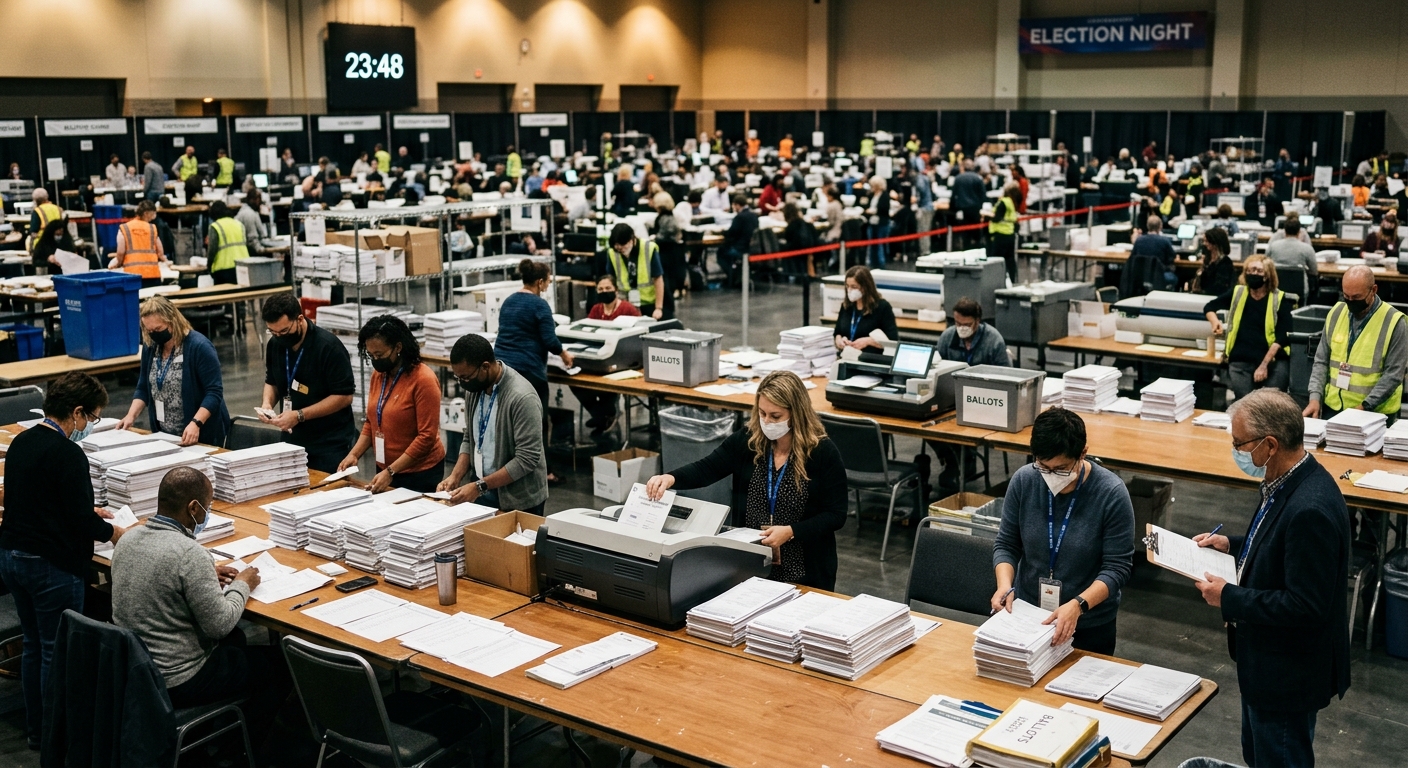
Processing non-traditional ballots is not simply a matter of opening envelopes and feeding paper into a machine. It is a highly regulated, labor-intensive procedure designed strictly to protect voter anonymity while preventing any possibility of systemic fraud. When a mail-in ballot arrives at an election facility, it embarks on a lengthy administrative journey:
- Intake and Sorting: Every incoming envelope is meticulously logged into a state tracking system. This crucial step prevents double-voting, ensuring that if a voter already mailed a ballot, they cannot also cast a standard ballot in person on Election Day.
- Signature Verification: This is arguably the most time-consuming step in the entire counting procedure. The signature on the exterior envelope must be meticulously compared against the signature on the voter’s official registration record. This requires trained bipartisan teams or highly calibrated verification software to confirm authenticity.
- The Curing Process: If a signature is missing or appears mismatched, many states legally require election officials to contact the voter to ‘cure’ the discrepancy. Giving voters the opportunity to prove their identity and rectify mistakes ensures no legitimate voter is disenfranchised, but this legally mandated waiting period can add several days to the final count.
- Extraction and Flattening: Once the identity is fully verified, the outer envelope is finally opened. The inner secrecy sleeve—which ensures the voter’s choices cannot be tied back to their personal identity—is carefully removed. Finally, the ballot itself is extracted. Because these papers have been folded for mailing, election workers must manually flatten them so they do not jam the sensitive optical scanners.
- Duplication of Damaged Ballots: If a ballot is torn, wrinkled, or stained, a bipartisan team must manually duplicate the voter’s exact choices onto a fresh, machine-readable ballot, further extending the processing time.
State-by-State Discrepancies in Pre-Processing Laws
One of the primary reasons for the massive disparity in reporting times across different states lies in their varying legislative approaches to ‘pre-processing.’ Pre-processing refers to the legally permissible window in which election workers can begin the labor-intensive steps of verifying signatures, opening envelopes, and preparing ballots for the electronic scanners.
According to data from the National Conference of State Legislatures (NCSL), state governments fall into completely different categories regarding this crucial administrative timeline, which profoundly affects public perception on election night.
| Pre-Processing Policy | Impact on Result Timelines |
|---|---|
| Early Pre-Processing Allowed | States that allow officials to open and verify mail-in ballots weeks ahead of Election Day can usually tabulate and report these totals very shortly after polls close, leading to extremely fast initial result drops. |
| Election Day Processing Only | States that legally prohibit election officials from touching mail-in ballots until the morning of Election Day face an immediate, massive backlog, guaranteeing that final, accurate results will take days to formulate. |
When critical swing states have strict laws that forbid early processing, the media and the public are often left waiting, staring at incomplete data while election workers heroically pull all-nighters to process hundreds of thousands of envelopes entirely by hand.
Understanding the ‘Blue Shift’ and the ‘Red Mirage’
Because different types of ballots are processed at drastically different speeds, the initial numbers released on election night can be highly deceptive. This structural reality has given rise to phenomena that political scientists and researchers at the MIT Election Data and Science Lab refer to as the ‘blue shift’ or the ‘red mirage.’
Typically, in-person votes cast on Election Day are the fastest to tabulate. In recent election cycles, these in-person voters have skewed heavily conservative. As a result, early evening reports often show Republican candidates with massive, seemingly insurmountable leads—the ‘red mirage.’
However, as the night turns into the following days, election officials steadily begin to tabulate the massive backlog of mail-in, absentee, and early ballots, which have historically skewed heavily progressive. As these massive tranches of votes are methodically added to the total, the results predictably shift toward Democratic candidates—the ‘blue shift.’
This shift is not a statistical anomaly, nor is it evidence of late-night ballot tampering. It is merely the mathematical and administrative reality of a bifurcated voting system where the fastest ballots to count belong to one demographic group, and the most time-consuming ballots to verify belong to another.
The Critical Canvass and Certification Phase
The numbers blasted across television screens on election night are completely unofficial media projections, not binding legal outcomes. The actual, legally binding conclusion of an election is determined by a rigorous administrative and auditing procedure known as the canvass and certification.
The U.S. Election Assistance Commission (EAC) explicitly notes that the canvass is the post-election process wherein officials systematically aggregate and confirm that every valid ballot is accurately included in the final results. During the canvass, administrators resolve any lingering discrepancies, process provisional ballots, and ensure that the total number of recorded votes precisely matches the number of voters who checked in at the polls.
Provisional ballots—which are cast by individuals whose eligibility was uncertain at the precinct—must be individually and exhaustively investigated to determine if the voter was legitimately registered in the correct jurisdiction. Only after the canvass is flawlessly completed and post-election audits (which test the accuracy of the voting machines) are finalized, does a state government legally certify its election.
Security First: The Trade-off Between Speed and Accuracy
At the heart of the vote-counting timeline is a conscious, necessary trade-off: society must choose between the peril of immediate but potentially flawed results and the certainty of delayed, painstakingly accurate ones. Election administrators overwhelmingly prioritize the latter, prioritizing the integrity of the republic over the impatience of the electorate.
Demanding instant results creates a chaotic environment where human error can thrive. Rushing the count could easily lead to unverified signatures slipping through the cracks, scanners malfunctioning without notice, or legally eligible provisional voters being unjustly discarded. Taking the time to execute risk-limiting audits, strictly enforce chain-of-custody protocols for every ballot box, and guarantee bipartisan oversight at every table is the foundational definition of election integrity.
We must fundamentally shift our perspective. The days spent counting should not be viewed as a period of suspicious delay, but rather as the active, observable machinery of a functioning democracy working tirelessly to ensure that no legitimate voter’s voice is lost to administrative haste.
Managing Public Expectations in the Digital Age
In an era rife with political polarization and rapidly spreading misinformation, managing the expectations of the electorate is a matter of critical national importance. When voters lack a foundational understanding of the intricate mechanics operating behind the curtain, they become highly susceptible to conspiracy theories that actively weaponize the silence of the counting room.
The responsibility to rectify this lies not only with election officials but also with the mass media and local community leaders, who must proactively educate the public about the legal and logistical realities of modern elections. It is time to retire the antiquated, unrealistic concept of ‘Election Night’ and embrace the modern reality of ‘Election Week.’ A healthy, enduring republic requires civic patience, robust media literacy, and a steadfast commitment to the truth that absolute accuracy must always eclipse the desire for speed.
Frequently Asked Questions (FAQs)
Why do some states declare winners on election night while others take weeks?
Reporting speeds are strictly dictated by individual state legislation. States that explicitly allow ‘pre-processing’ can verify and open mail-in ballots weeks before Election Day, allowing them to tally and report votes almost immediately after polls close. Conversely, states that strictly restrict processing until Election Day face massive backlogs that take significant time to clear.
What exactly is a provisional ballot?
A provisional ballot is provided to a voter whose legal eligibility is in question on Election Day (for example, they do not appear on the local registration roll, or they lack the required identification). These specific ballots are kept physically separate and are only formally counted during the post-election canvass once the voter’s legal eligibility is thoroughly confirmed by state officials.
Does a delay in result reporting indicate election fraud?
No. In fact, a delay usually indicates the exact opposite of fraud. Taking days or even weeks to finalize results means that local election workers are strictly adhering to mandated security protocols, meticulously double-checking signatures, formally auditing voting machines, and ensuring absolute accuracy rather than rushing out unverified and potentially flawed numbers.
What is the difference between unofficial results and certified results?
Unofficial results are the preliminary, highly speculative numbers reported by media outlets and pundits on election night, which are often missing hundreds of thousands of mail-in or provisional ballots. Certified results, however, are the final, legally binding vote totals issued by the state government only after the comprehensive canvass, strict reconciliation, and mandatory auditing processes are fully completed.
References
- The Purpose of Pre-Processing Ballots — National Conference of State Legislatures (NCSL). 2024-06-20. https://www.ncsl.org/elections-and-campaigns/elections-defined-the-purpose-of-pre-processing-ballots
- The Blue Shift in the 2020 Election — MIT Election Data + Science Lab. 2021-04-27. https://electionlab.mit.edu/articles/blue-shift-2020-election
- Election Results, Canvass, and Certification — U.S. Election Assistance Commission (EAC). 2025-12-23. https://www.eac.gov/election-officials/election-results-canvass-and-certification
Similar Articles








Read full bio of Sneha Tete


