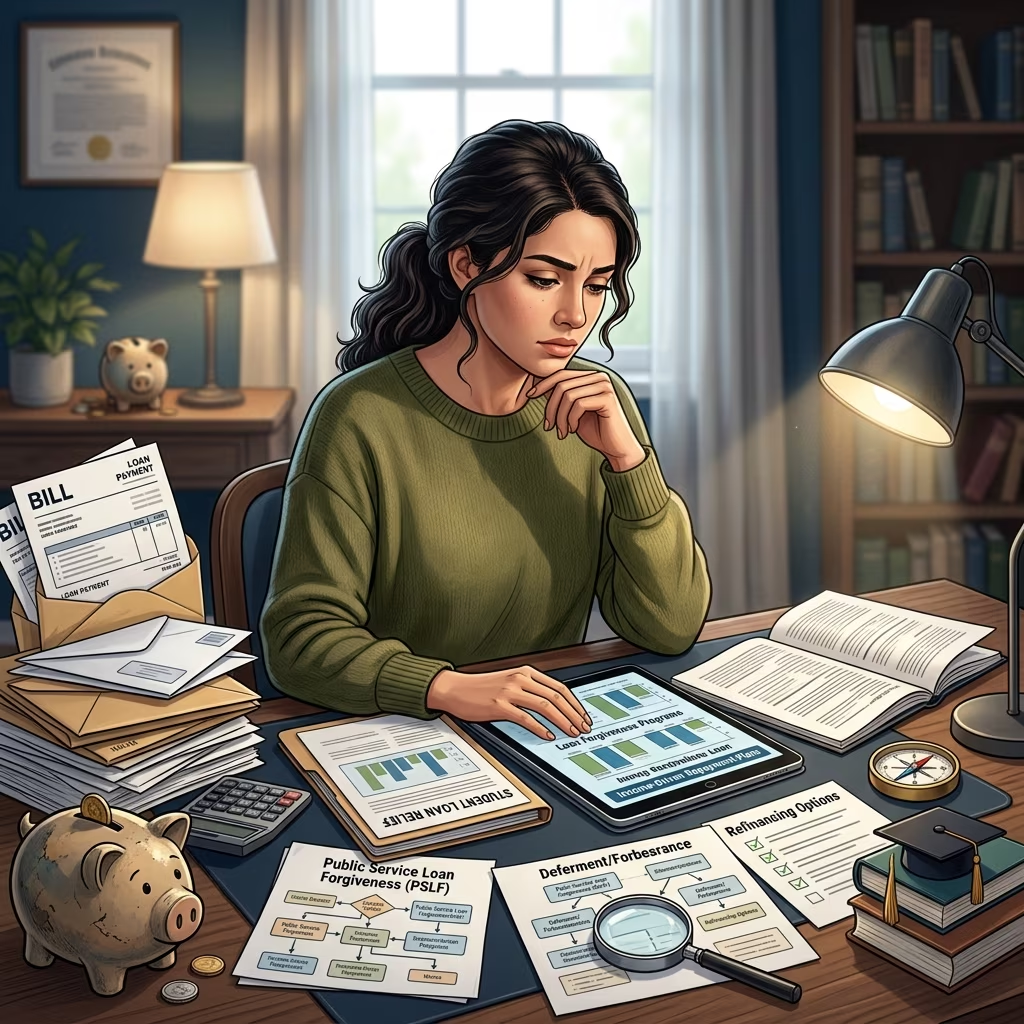
Student loans are often the largest debt many people carry, and when finances tighten, those payments can quickly become unmanageable. The good news is that federal law offers a range of repayment options, forgiveness programs, and even limited bankruptcy relief that can help you regain control of your situation.
This guide explains what to do when you can’t afford your student loans anymore, focusing on federal programs, legal remedies, and how to avoid common traps. It is informational only and not a substitute for personalized legal or financial advice.
First Steps When Your Student Loans Become Unaffordable
Before you fall behind, it is critical to act quickly. Missing payments can lead to delinquency and default, which brings aggressive collection actions and long-term credit damage.
- Review your loan type – Confirm whether your loans are federal, private, or a mix. Federal loans provide the broadest relief options.
- Log in to your federal account – Use your account at the official federal student aid website to see balances, servicer information, and repayment plan options.
- Contact your loan servicer – Explain your financial hardship and ask about income-driven repayment and other options before you miss payments.
- Create a basic budget – Identify what you can realistically afford each month, even if it is far less than your current payment.
Taking these steps early gives you more room to use federal programs designed to prevent default rather than trying to fix the damage later.
Understanding Federal Repayment Plans
Federal student loans offer multiple repayment plans, with some tying your monthly payment directly to your income. Choosing the right plan is often the single most important step when you cannot afford your current bill.
| Plan Type | How Payment Is Calculated | Typical Repayment Term | Potential for Forgiveness |
|---|---|---|---|
| Standard | Fixed monthly payment to fully repay in ~10 years | Up to 10 years | No specific forgiveness; loan repaid in full |
| Graduated | Starts lower and increases every 2 years | Up to 10–30 years (depending on loan amount) | No direct forgiveness, but can be combined with PSLF in some cases |
| Extended | Lower fixed or graduated payments over a longer term | Up to 25 years | Generally no specific forgiveness; extended instead of forgiven |
| Income-Driven Plans (IDR) | Percentage of discretionary income and family size | Typically 20–25 years | Remaining balance may be forgiven at end of term |
Income-Driven Repayment (IDR): Lower Payments Based on Income
Income-driven repayment plans are often the primary relief tool when you can’t afford standard payments. These plans calculate your bill as a percentage of your income and family size rather than your loan balance.
- Discretionary income is defined by federal law and is based on your adjusted gross income and household size.
- Common IDR plans include options such as Income-Based Repayment, Pay As You Earn, Income-Contingent Repayment, and newer plans that may replace older programs.
- After making qualifying payments for roughly 20–25 years, any remaining balance on eligible federal loans can be forgiven under IDR.
In some cases, your income may be low enough that your calculated IDR payment is zero dollars, which still counts as a qualifying payment toward eventual forgiveness.
Newer Repayment Frameworks and Policy Changes
Federal repayment systems have been evolving, with new plans introduced and older ones phased out. New frameworks may, for example, require borrowers who take out loans after certain dates to use streamlined plans such as a standard repayment or a single repayment assistance approach.
- Policy changes may consolidate multiple IDR options into fewer plans to simplify choices for new borrowers.
- Existing borrowers often have transition deadlines for switching into new qualifying plans if they want to continue earning forgiveness.
- Official federal guidance is the most reliable source for current rules; always verify on the U.S. Department of Education website or with your servicer.
Loan Forgiveness, Cancellation, and Discharge Programs
Beyond income-driven repayment, several programs allow borrowers to have part or all of their federal student loans forgiven, canceled, or discharged, depending on their employment or personal circumstances.
Public Service Loan Forgiveness (PSLF)
Public Service Loan Forgiveness is one of the most widely known forgiveness programs for federal student loans. It benefits people working full-time for government or qualifying nonprofit employers.
- You must work full-time for a government agency or eligible non-profit organization.
- You must have qualifying federal Direct Loans and repay them under an eligible repayment plan, often an income-driven plan.
- You need to make 120 qualifying monthly payments while working eligible public-service employment.
- After meeting these requirements, any remaining balance can be forgiven tax-free under current federal rules.
The Department of Education provides an online PSLF tool that helps you confirm employer eligibility, track progress, and generate forms to certify your employment.
Forgiveness for Long-Term IDR Payments
Borrowers who have made payments on federal loans for 20–25 years under qualifying income-driven plans can receive forgiveness of whatever balance remains at the end of that term.
- This forgiveness applies even if you were not working in public service and is based solely on time in qualifying repayment and your plan type.
- Periods in default, certain deferments, or forbearances may not count, so it is essential to understand how your history affects eligibility.
Special Discharge and Cancellation Situations
Certain situations allow you to have your federal loans canceled or discharged under specific legal criteria.
- Borrower defense to repayment – If your school misled you or engaged in misconduct related to your enrollment, you may seek discharge through borrower defense procedures.
- Total and permanent disability – Borrowers who are unable to work due to a qualifying physical or mental disability may have their federal loans discharged.
- Closed school discharge – If your school closed while you were enrolled or shortly after you withdrew, you may be eligible to have loans related to that program canceled.
- False certification and unpaid refund – Certain paperwork errors or school failures to return required funds can also lead to cancellation of some federal loan obligations.
Each of these programs has detailed eligibility rules and documentation requirements; the official federal student aid site provides forms and instructions.
If You Are Already Behind: Delinquency and Default
Missing payments can cause your loan status to change from current to delinquent and, eventually, to default. Default on federal student loans carries significant consequences, including collection fees, wage garnishment, and offsets of federal tax refunds.
- Delinquency generally begins as soon as you miss a payment; your loan servicer will report late payments to credit bureaus after a certain period.
- Default on many federal loans occurs once payments are overdue beyond a set number of days (often 270 days for certain loan types), triggering more severe collection actions.
- Even if you are in default, you can often use programs like rehabilitation, consolidation, or certain cancellation options to restore good standing and regain access to income-driven plans.
Staying in contact with your servicer and responding promptly to communications is essential; ignoring notices tends to make your situation worse and limits your options.
Can Student Loans Be Discharged in Bankruptcy?
Unlike most unsecured debts, student loans are treated differently in bankruptcy. They are not automatically wiped out when you file. Instead, borrowers generally must prove that repaying the loans would cause “undue hardship” under the legal test applied by the court.
- Bankruptcy for student loans usually requires filing an adversary proceeding, a separate lawsuit within the bankruptcy case, specifically addressing your loans.
- Courts often look at factors such as whether you have tried to repay, your current and future ability to earn income, and whether your hardship is likely to persist.
- Recent policy discussions have explored making bankruptcy relief for student loans more accessible, but the basic structure still requires a significant legal showing of hardship.
Because bankruptcy law is complex and fact-specific, anyone considering bankruptcy for student loans should consult a qualified attorney to discuss their options under current law.
Options for Private Student Loans
Most of the relief described so far applies to federal loans. Private student loans—issued by banks, credit unions, or other private lenders—generally do not offer federal forgiveness or official income-driven repayment options.
- Some private lenders may offer temporary hardship programs, interest-only periods, or modified payments, but these are usually discretionary policies rather than rights guaranteed by law.
- Private loans can sometimes be included in broader debt settlement negotiations, but this may involve credit damage and tax consequences.
- Bankruptcy treatment of private student loans depends on your jurisdiction and the court’s interpretation of which debts qualify as “educational” loans under the law.
Because private loans vary widely in terms, it is important to carefully review your promissory note and speak directly with the lender or servicer regarding relief options.
Avoiding Student Debt Relief Scams
Borrowers under financial stress are frequently targeted by companies that promise quick fixes, guaranteed forgiveness, or secret programs—often for substantial fees. State and federal regulators warn that many of these offers are misleading or fraudulent.
- Red flags to watch for:
- Requests for large upfront fees for “enrollment” into federal programs you can access for free.
- Guarantees of immediate loan forgiveness regardless of your situation.
- High-pressure sales tactics relying on “limited-time” offers or threats.
- Requests for your Federal Student Aid ID or Social Security number to take control of your account.
- Requests that you sign a power of attorney giving them authority to act without your informed consent.
- Check before you pay:
- Confirm whether any company is affiliated with the U.S. Department of Education or a state agency.
- Ask for proof of licensing and the right to conduct business in your state.
- Search for enforcement actions or bans; the Federal Trade Commission publishes lists of companies barred from offering debt relief services.
Official programs to manage federal loans or apply for forgiveness are available directly through the U.S. Department of Education and its portals at no cost. Paying third-party companies is rarely necessary and often risky.
Practical Strategies to Manage Student Loan Stress
While legal programs and repayment plans are essential, day-to-day strategies can also make student loan obligations more manageable.
- Prioritize essential expenses – Ensure housing, food, healthcare, and basic utilities are covered before allocating money to loan payments.
- Consider side income – Even modest additional earnings can help you stay current while you transition into a more affordable repayment plan.
- Use employer benefits – Some employers offer student loan repayment assistance as part of their compensation package.
- Stay organized – Keep records of communications with your servicer, copies of submitted forms, and notes on deadlines for program eligibility and recertification.
Frequently Asked Questions
1. What should I do first if I know I can’t make my next payment?
Immediately contact your loan servicer and ask about income-driven repayment or temporary relief such as forbearance or deferment. Acting before your payment is late gives you more options and can prevent damage to your credit profile.
2. Can my student loans ever be fully forgiven?
Yes, in several circumstances. Federal loans may be forgiven after long-term income-driven repayment, through Public Service Loan Forgiveness, or via special discharge programs such as total and permanent disability or borrower defense. Whether you qualify depends on your employment, repayment history, and personal circumstances.
3. Does enrolling in an income-driven plan hurt my credit?
Simply switching to an income-driven plan does not harm your credit score. The key factor is whether you make the required payments on time under the new plan. Income-driven plans are designed to help you stay current by lowering your required monthly payment.
4. Is there any cost to apply for forgiveness or income-driven repayment?
No. Official applications for federal forgiveness programs and income-driven repayment are free when submitted directly through the U.S. Department of Education or your loan servicer. Companies that charge fees to submit these forms are providing services you can perform yourself at no cost.
5. How do I know if my employer qualifies for Public Service Loan Forgiveness?
You can use the federal PSLF tool to check your employer’s eligibility and track progress toward forgiveness. Generally, government agencies and qualifying nonprofit organizations meet the criteria, but private for‑profit companies do not.
6. If I defaulted years ago, is it too late to fix my situation?
It is rarely too late. Federal programs allow many borrowers to rehabilitate or consolidate defaulted loans, restoring access to income-driven plans and, in some cases, future forgiveness options. However, collection actions and negative credit reporting that occurred in the past remain part of your history.
7. Should I stop paying my loans if I plan to seek bankruptcy relief?
Bankruptcy and student loan treatment are complex issues that depend on your jurisdiction and circumstances. You should consult a qualified bankruptcy attorney before changing your payment behavior. This guide does not constitute legal advice.
References
- Student Loans, Forgiveness — U.S. Department of Education. 2024-05-01. https://www.ed.gov/higher-education/manage-your-loans/student-loans-forgiveness-us-department-of-education
- Federal Student Loan Repayment Plans — Federal Student Aid, U.S. Department of Education. 2024-03-15. https://studentaid.gov/manage-loans/repayment/plans
- Cancellation & Forgiveness Options — National Consumer Law Center & Student Loan Borrower Assistance. 2023-11-10. https://studentloanborrowerassistance.org/for-borrowers/dealing-with-student-loan-debt/loan-cancellation-forgiveness-bankruptcy/cancellation-forgiveness-options/
- Loan Forgiveness — FinAid. 2024-02-20. https://finaid.org/loans/forgiveness/
- 14 Student Loan Forgiveness Programs for 2026: Do You Qualify? — NerdWallet. 2024-06-01. https://www.nerdwallet.com/student-loans/learn/student-loan-forgiveness
- What are Student Debt Relief Companies? — California Department of Financial Protection and Innovation. 2023-07-12. https://dfpi.ca.gov/news/insights/what-are-student-debt-relief-companies/
- $50K & Beyond: Pathways to Access PSLF and Other Forms of Student Loan Debt Relief — NAACP. 2024-01-30. https://naacp.org/campaigns/50k-beyond