
When Trees Fall: How Home Insurance Handles Damage
Understand who pays, what’s covered, and how negligence, location, and policy limits affect insurance claims when a tree comes down.
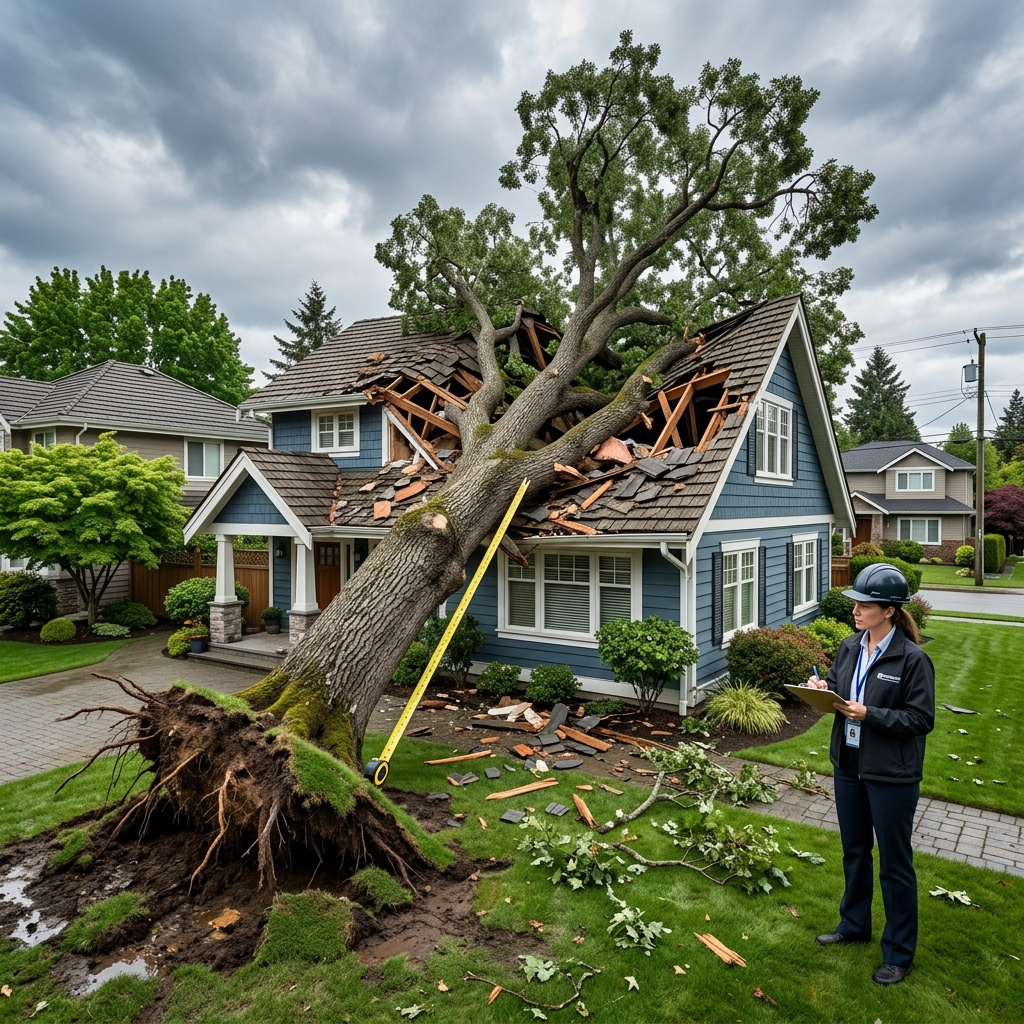
Falling trees are a common source of property damage during storms and high winds, but the insurance rules that apply are not always intuitive. A tree can fall from your yard onto a neighbor’s home, or from municipal land onto your garage, and each scenario may trigger different coverage, responsibilities, and claim processes. This guide explains how homeowners insurance typically treats fallen trees, when negligence matters, and what you can expect to pay out of pocket.
Core Principle: Damage Follows the Property, Not the Tree
Across most standard homeowners policies, the basic rule is that the owner of the damaged property uses their own insurance to address the loss, regardless of where the tree originally stood. When a healthy tree falls due to wind or another covered peril, insurers generally consider the event an act of nature, meaning liability is not automatically assigned to the tree’s owner.
In practice, this means:
- If your neighbor’s healthy tree falls on your house during a storm, you typically file a claim with your homeowners insurer.
- If your tree falls on your neighbor’s fence because of high winds, the neighbor usually turns to their homeowners policy for repairs.
- If a city-owned tree falls on your detached garage, it is normally your policy that responds, not the municipality’s, unless local law or clear negligence changes the analysis.
What Homeowners Insurance Usually Covers
Homeowners insurance is designed to cover sudden and accidental damage from specified causes of loss, known as covered perils. Wind, storms, and lightning are typically covered perils in standard policies.
When a covered peril causes a tree to fall, your policy may provide protection in several key areas:
- Damage to the main dwelling – Repair costs for the structure of your home (roof, walls, attached garage) when a tree falls onto it.
- Damage to other structures – Coverage for detached buildings such as sheds, fences, or separate garages, up to the limits listed for “other structures” in your policy.
- Damage to personal property – Replacement or repair of belongings inside the home that are damaged by the falling tree, subject to your personal property coverage limits and deductibles.
- Tree removal related to structural damage – Payment to remove the fallen tree from covered structures and to move debris, often limited to a specific dollar amount (commonly in the range of $500–$1,000).
These protections generally apply whether the tree grew on your property, a neighbor’s lot, or land owned by a municipality, as long as the cause of the fall is covered and your policy is in force.
When Negligence Changes Who Pays
The main exception to the “each owner uses their own policy” rule is negligence by the tree’s owner. Negligence involves failing to take reasonable care to prevent foreseeable harm. In the context of tree damage, insurers and courts often look for evidence that the tree was dead, diseased, or clearly dangerous and that the owner knew—or reasonably should have known—about its condition.
Negligence may be found when:
- The tree had visible rot, extensive dead limbs, or leaning that clearly threatened neighboring structures.
- Neighbors documented and communicated concerns to the owner, such as with written notices or photographs.
- A professional arborist recommended removal or significant pruning and the advice was ignored.
If negligence is established, the tree owner’s liability insurance within their homeowners policy can be triggered, allowing the neighbors’ insurer to pursue reimbursement or the neighbor to assert a direct liability claim. This process, known as subrogation, allows one insurer to recover payouts from the party ultimately deemed responsible.
Proving Negligence in Practice
Demonstrating negligence is often challenging. Insurers and courts are reluctant to label an event as negligent when ordinary storms are involved and the tree appeared generally healthy before it fell. Property owners who suspect risk usually need substantial documentation, such as:
- Dated letters, emails, or certified mail to the neighbor expressing concern about the tree.
- Photographs showing the deteriorating condition of the tree over time.
- Reports or invoices from arborists noting disease, rot, or structural instability.
Without this kind of evidence, most incidents are treated as unavoidable outcomes of weather or other natural forces, leaving each affected homeowner to work through their own policy.
Tree Removal Coverage vs. Pure Debris Cleanup
A common point of confusion is when insurance pays for removal of a fallen tree that does not cause structural damage. Policies often distinguish between tree removal linked to damage to covered structures and general debris cleanup.
Typical rules include:
- If a tree falls and damages a covered structure, your policy may pay to remove the tree from the structure and for related debris removal, subject to specific sub-limits.
- If a tree falls onto your property but does not damage any insured building, coverage for removal is far more limited and may not apply at all, depending on your policy.
- If the fallen tree blocks a driveway or handicap access ramp, some policies provide limited coverage for removal to restore access.[10]
| Scenario | Is Removal Typically Covered? | Key Notes |
|---|---|---|
| Tree falls on your house during a windstorm | Yes | Covered as part of dwelling repair; removal often subject to a monetary limit. |
| Tree falls on detached garage or fence | Usually | Paid under “other structures” coverage; removal sub-limits still apply. |
| Tree falls in yard and damages nothing | Often no | Many policies do not cover pure debris removal without structural damage. |
| Tree blocks driveway or accessible ramp | Sometimes | Some insurers extend limited coverage to restore essential access routes.[10] |
| Preventive removal of a dangerous tree | No | Preventive tree work is generally considered a maintenance expense, not an insured loss. |
Special Case: Cars Damaged by Fallen Trees
When a tree falls on a car, the claim rarely goes through homeowners insurance. Instead, the damage is typically addressed under the vehicle owner’s comprehensive auto insurance coverage. Comprehensive coverage insures against non-collision risks such as falling objects, vandalism, and certain weather-related incidents.
Key points for vehicle damage include:
- If a tree falls on your car, your auto insurer usually handles the claim, not your home insurer.
- The location of the tree (your yard, neighbor’s lot, or city property) generally does not change which policy responds.
- Negligence by a tree owner could still matter if there is strong evidence, but in most cases the event is treated like other comprehensive losses.
How Local Laws and Ordinances Influence Responsibility
In addition to policy language, local laws can affect who bears responsibility for dangerous or neglected trees. Some jurisdictions recognize that a property owner may be liable if a tree presents an obvious danger to neighboring land and the owner knew or should have known about the risk. Local regulations may also define when municipalities are responsible for maintaining trees along public rights-of-way.
Because these rules vary widely, homeowners should:
- Review local statutes or municipal codes addressing tree maintenance and property damage.
- Consult an attorney for disputes involving significant damage or contested liability.
- Coordinate with city or county offices when public trees appear hazardous.
Preventive Steps to Reduce Tree-Related Losses
While insurance addresses financial losses, preventive care can reduce the likelihood of serious damage and avoid complicated liability disputes. Insurers generally expect reasonable maintenance and may deny coverage if a loss clearly resulted from long-term neglect.
Effective preventive measures include:
- Regular inspections – Have large or mature trees evaluated periodically by qualified professionals, especially after major storms.
- Prompt pruning and removal – Remove dead limbs, diseased trees, or those with structural defects that pose clear risks to buildings or power lines.
- Documenting observations – Keep records of tree work, photos of changes in condition, and any recommendations from arborists to help show diligence.
- Open communication with neighbors – Raise concerns early about potentially hazardous trees near property boundaries and follow up in writing if the risk appears serious.
Claim Strategies When a Tree Falls
When a tree has already fallen and caused damage, taking organized steps can make the claims process smoother and help preserve your rights. Insurers typically expect prompt notification and accurate documentation of losses.
Consider the following actions:
- Protect life and safety first – Address immediate hazards, such as downed power lines or structural instability, and contact emergency services if necessary.
- Photograph the damage – Take clear photos of the fallen tree, affected structures, and any relevant pre-existing condition (such as obvious rot) before major cleanup begins.
- Notify your insurer quickly – Report the incident as soon as practical, following your policy’s requirements for claim notification.
- Track expenses – Keep receipts for temporary repairs, cleanup costs, and any professional assessments required by your insurer.
- Ask about sub-limits – Clarify how much your policy will pay specifically for tree removal and debris handling versus structural repairs.
Frequently Asked Questions
Does my homeowners insurance cover any fallen tree on my property?
Not necessarily. Homeowners insurance typically covers fallen trees when they damage insured structures or block key access routes, and when the fall is caused by a covered peril. A tree that simply falls in your yard without harming buildings may not be covered for removal under many policies.
If my tree falls on my neighbor’s house, do I automatically have to pay?
In most cases, you do not automatically pay. The neighbor ordinarily turns to their own homeowners policy for coverage, unless there is clear evidence that you negligently ignored a dangerous tree. If negligence is proven, your liability coverage may become involved.
What if I don’t have homeowners insurance and a neighbor’s tree damages my home?
If no negligence is established and you lack homeowners insurance, you are generally responsible for your own repairs. Insurance is designed to protect policyholders from these kinds of unexpected losses.
Are diseased or rotting trees treated differently by insurers?
Yes. Many policies exclude damage that results from neglect or maintenance-related issues, including trees that were clearly rotting or unstable before a storm. In such cases, insurers may deny coverage or pursue recovery from the property owner whose neglect contributed to the loss.
Can I get insurance to pay for removing a dangerous tree before it falls?
Preventive removal of dangerous trees is usually considered a maintenance responsibility and is not covered by standard homeowners insurance. However, investing in professional evaluations and timely removal can reduce future risks and potential disputes with neighbors.
References
- Whose homeowners insurance pays for damage from a fallen tree? — Insurance.com. 2023-05-01. https://www.insurance.com/home-and-renters-insurance/natural-disasters/my-tree-fell-on-my-neighbors-porch-whose-home-insurance-covers-the-damage.aspx
- If a Neighbor’s Tree Falls on Your House, Who Pays? — Christensen Group Insurance. 2022-08-15. https://www.christensengroup.com/article/if-a-tree-falls-who-pays
- Fallen Tree Damage and Homeowners Insurance — Allstate. 2023-03-10. https://www.allstate.com/resources/home-insurance/tree-falls-house-damage
- Does Home Insurance Cover Fallen Trees? — Progressive. 2023-07-20. https://www.progressive.com/answers/does-home-insurance-cover-fallen-trees/
- Storm Damage FAQs — Maryland People’s Law Library. 2021-09-30. https://www.peoples-law.org/storm-damage-faqs
- Does Homeowners Insurance Cover Tree Removal? — Nationwide. 2022-11-05. https://www.nationwide.com/lc/resources/home/articles/does-insurance-cover-tree-removal
- Does insurance cover fallen tree branches? — Texas Department of Insurance. 2020-06-18. https://www.tdi.texas.gov/blog/fallen-tree-branches-and-insurance.html
Similar Articles








Read full bio of Sneha Tete




