
When to Call a Workers’ Comp Lawyer in Missouri
Practical signs that a Missouri work injury claim needs legal help.
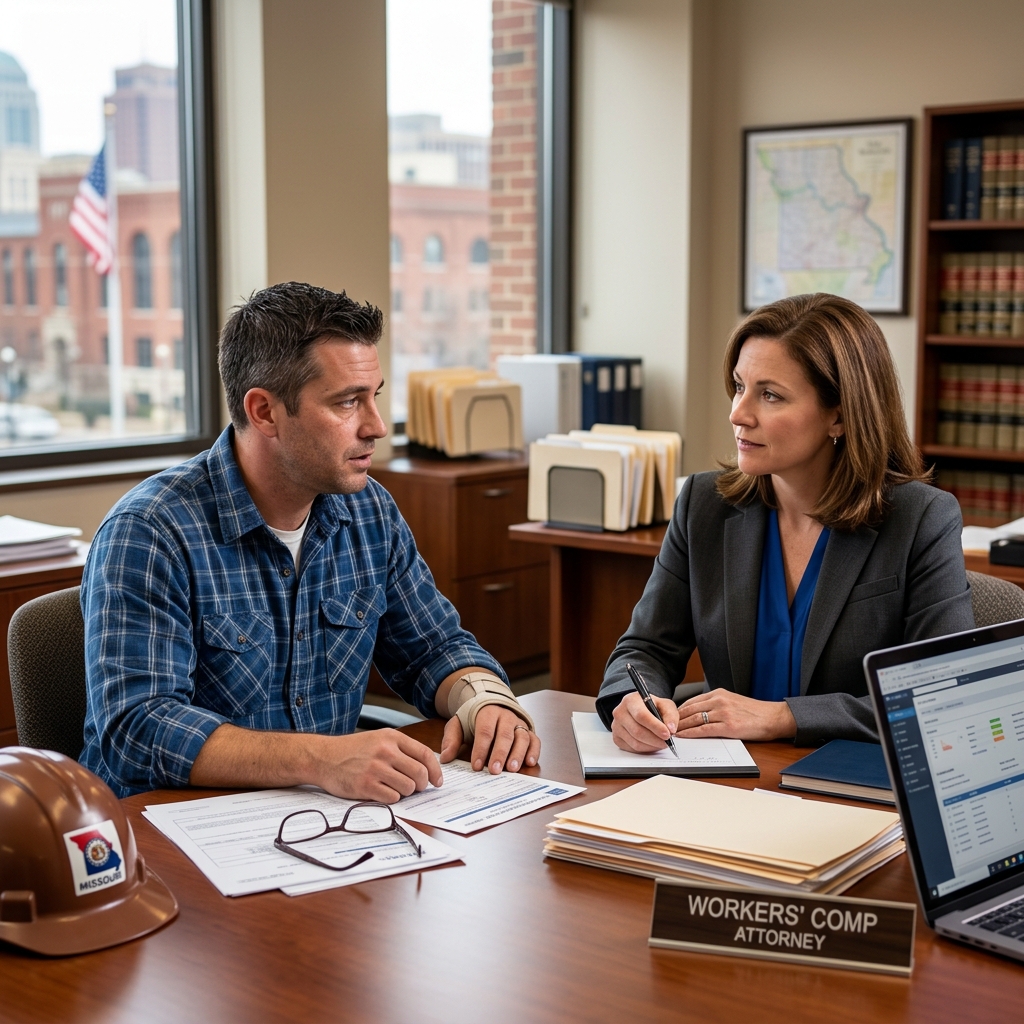
A workplace injury can disrupt your income, medical care, and long-term plans all at once. In Missouri, workers’ compensation is designed to provide medical treatment and wage-related benefits after a job-related injury or occupational disease, but the claims process can become complicated quickly when an employer, insurer, or medical provider disputes the claim.
The question is not only whether you can file a claim, but whether you can get the full benefits the law allows. In some situations, a claim moves forward without major conflict. In others, legal help becomes important because deadlines, medical disputes, or benefit denials threaten the outcome.
How Missouri workers’ compensation generally works
Missouri workers’ compensation law applies to injuries and occupational diseases that arise out of and in the course of employment. Covered employers generally must carry workers’ compensation insurance if they have five or more employees, and construction employers are subject to coverage rules even with one or more employees.
The system is meant to provide benefits without requiring the worker to prove ordinary negligence by the employer. Instead, the central questions usually involve whether the injury was work-related, whether notice was given on time, and what benefits are medically and legally supported.
- Medical treatment for reasonable and necessary care related to the work injury.
- Wage replacement benefits when the injury keeps the employee from working.
- Payment for permanent disability when a work injury leaves lasting impairment.
- Death benefits for eligible dependents after a fatal workplace accident.
Situations that often justify calling a lawyer
Some claims are straightforward, but many are not. A lawyer can help when the facts, the medical evidence, or the insurance response make it hard to move the claim forward alone. Missouri employees are allowed to consult an attorney at any point in the process, and waiting until a problem becomes serious can make the case harder to correct.
Your claim is denied or delayed
If the insurer refuses to accept the injury as work-related, delays authorization for treatment, or stops wage benefits without a clear explanation, legal review may be needed. Claims often turn on whether the injury happened in the course and scope of employment and whether work was the prevailing factor in causing the condition.
Disputes sometimes arise over repetitive-use injuries, preexisting conditions, or whether a nonwork activity caused the problem. These disputes often require medical records, witness statements, and a careful explanation of how the injury happened.
You are being sent to a doctor you do not trust
In Missouri, the employer generally has the right to choose the treating doctor or medical facility for the compensable injury. That rule can matter a great deal because the treating provider’s opinions often affect whether treatment continues, whether work restrictions are issued, and whether permanent disability is assessed.
If you believe the approved treatment is incomplete, too limited, or inconsistent with your symptoms, a lawyer can help determine whether the case should be reviewed, whether a second opinion is possible at your own expense, or whether the insurer is failing to meet its obligations.
Your injuries involve permanent restrictions
A claim becomes more complex when the injury leaves lasting limitations. Permanent partial disability and permanent total disability claims require proof that the injury has created a long-term loss of function or earning ability. Those cases often depend on medical opinions, impairment ratings, and vocational evidence.
If your doctor says you cannot return to your old job, can only work with restrictions, or may never fully recover, an attorney can help evaluate whether a settlement offer is fair and whether the disability classification matches the evidence.
You are being pressured to return too soon
An employer may want an injured worker back quickly, but a premature return can make a condition worse or put a worker in danger. If your medical restrictions are not being respected, or if you are told to resume duties that exceed your limits, legal help may be useful.
Workers’ compensation benefits are intended to continue while the doctor has not fully released the worker or has imposed restrictions that prevent ordinary work. If the job no longer matches the medical limits, an attorney can help address the conflict.
The injury report or deadline may be at risk
Missouri law requires an injured worker to report the injury to the employer within 30 days to protect the claim. The state also has a separate filing deadline for formal claims, generally measured from the date of accident or the last payment of benefits, with some exceptions.
When deadlines are close, legal advice matters. A missed notice deadline can create avoidable problems, and a missed claim deadline can end the right to recover benefits.
What a lawyer can help you do
A workers’ compensation lawyer does not simply file forms. In a disputed or serious case, the attorney may help gather evidence, identify the proper benefits, communicate with the insurer, and push the claim toward a fair resolution. That assistance can be especially valuable when the employer’s version of events conflicts with yours or when the insurer says the medical proof is insufficient.
- Review whether the injury qualifies as work-related under Missouri law.
- Track deadlines for notice, claim filing, and related claims.
- Collect medical records and treatment documentation.
- Challenge denials involving causation, disability, or treatment limits.
- Negotiate settlement terms involving permanent disability.
Why benefit categories matter
Understanding the type of benefit involved helps explain why some claims need legal intervention. Medical care, temporary wage replacement, permanent disability payments, and death benefits are different parts of the system, and each comes with its own proof issues.
| Benefit type | What it may cover | Where disputes often arise |
|---|---|---|
| Medical benefits | Reasonable and necessary treatment related to the injury | Doctor selection, treatment limits, and causation |
| Temporary wage benefits | Lost income while the worker cannot fully return | Work restrictions and wage calculation |
| Permanent disability | Lasting impairment or reduced earning ability | Severity, medical ratings, and settlement value |
| Death benefits | Benefits for dependents after a fatal work injury | Eligibility and dependency proof |
When one of these benefit categories is disputed, a lawyer can help match the facts to the correct legal standard.
Common warning signs that your claim needs attention
Some problems begin subtly. A claim that appears routine may still be headed toward a denial, underpayment, or premature closure. The sooner those warning signs are recognized, the easier they may be to address.
- You are told the injury is a preexisting condition even though symptoms began after a work event.
- Your medical treatment is being narrowed or cut off before you improve.
- Your checks are late, reduced, or stopped.
- Your employer says the injury was not reported in time.
- You are offered a settlement before the full extent of the injury is understood.
- Your doctor says you may never return to the same type of work.
Any one of these issues can make the claim more difficult, but several together usually justify a legal review.
How timing affects a Missouri claim
Missouri claims involve more than one clock. The injury must be reported promptly, and a formal claim must be filed within the applicable statute of limitations. In some situations, the filing deadline may be extended if the employer failed to file the required report of injury on time.
Timing also affects medical evidence. The sooner a worker documents the injury, obtains treatment, and keeps a record of symptoms, the easier it is to connect the condition to the workplace event.
Questions to ask before choosing representation
If you decide to speak with a lawyer, it helps to be prepared. A good workers’ compensation consultation usually focuses on the facts of the injury, the medical timeline, and the insurer’s current position.
- Did I report the injury within the required time?
- What benefits should the claim cover?
- Is the insurer disputing the work connection or the treatment?
- What evidence supports temporary or permanent disability?
- Are there deadlines I may still need to meet?
Clear answers to these questions help determine whether the claim is likely to resolve quickly or needs active legal intervention.
Frequently asked questions
Do I have to wait until my claim is denied to contact a lawyer?
No. Missouri workers may consult an attorney at any point in the process, including right after the injury or before the insurer makes a final decision.
Can I choose my own doctor?
Usually the employer controls the treating provider for the compensable injury, although a worker may seek a second opinion at personal expense or otherwise challenge the adequacy of care when necessary.
What if I missed the injury-report deadline?
Missing the 30-day notice period can harm the claim, but the effect depends on the facts. Because deadlines are central to compensation rights, a lawyer should review the issue as soon as possible.
Do all Missouri employers have workers’ compensation coverage?
Most employers with five or more employees must carry coverage, and construction employers are generally covered under stricter rules. Some categories of workers are exempt or covered under separate systems.
Can a workers’ compensation claim include permanent disability?
Yes. If a work injury leaves lasting impairment, Missouri law allows claims involving permanent partial disability or permanent total disability, depending on the medical and vocational facts.
Making a practical decision after a workplace injury
Not every injury requires immediate legal action, but many claims become more complicated than workers expect. If the insurer questions causation, delays treatment, cuts off wage benefits, or offers a settlement before the medical picture is clear, legal help can protect the claim’s value.
The most important point is not to assume the system will correct itself. Missouri workers’ compensation has specific rules, and those rules can affect notice, treatment, wage loss, and permanent disability in different ways.
References
- Missouri Workers’ Compensation – The Hartford Insurance — The Hartford. 2026-07-10. https://www.thehartford.com/workers-compensation/missouri
- Division of Workers’ Compensation — Missouri Department of Labor and Industrial Relations. 2026-07-10. https://labor.mo.gov/dwc
- Understanding Missouri Workers’ Compensation Rules: A Quick Guide — VanCamp Law Firm. 2026-07-10. https://vancamplawfirm.com/understanding-missouri-workers-compensation-rules-a-quick-guide/
- Missouri Workers’ Compensation Law Handbook — Schuchat, Cook & Werner. 2020-06-01. https://www.schuchatcw.net/wp-content/uploads/sites/1300588/2020/06/Handbook-on-Missouri-Workers-Compensation-Law-434673.pdf
- Your Rights Under the Missouri Workers’ Compensation Law — Legal Services of Missouri. 2026-07-10. https://www.lsmo.org/sites/lsmo.org/files/workers%20compensation.pdf
- Missouri Workers’ Compensation: The Basics — Missouri University Libraries. 2026-07-10. https://libraryguides.missouri.edu/c.php?g=556686&p=3827908
Similar Articles








Read full bio of medha deb




