
When Online Terms Fail: Lessons from the Zappos Case
What the Zappos browsewrap ruling teaches every online business about enforceable user agreements and digital contracts.
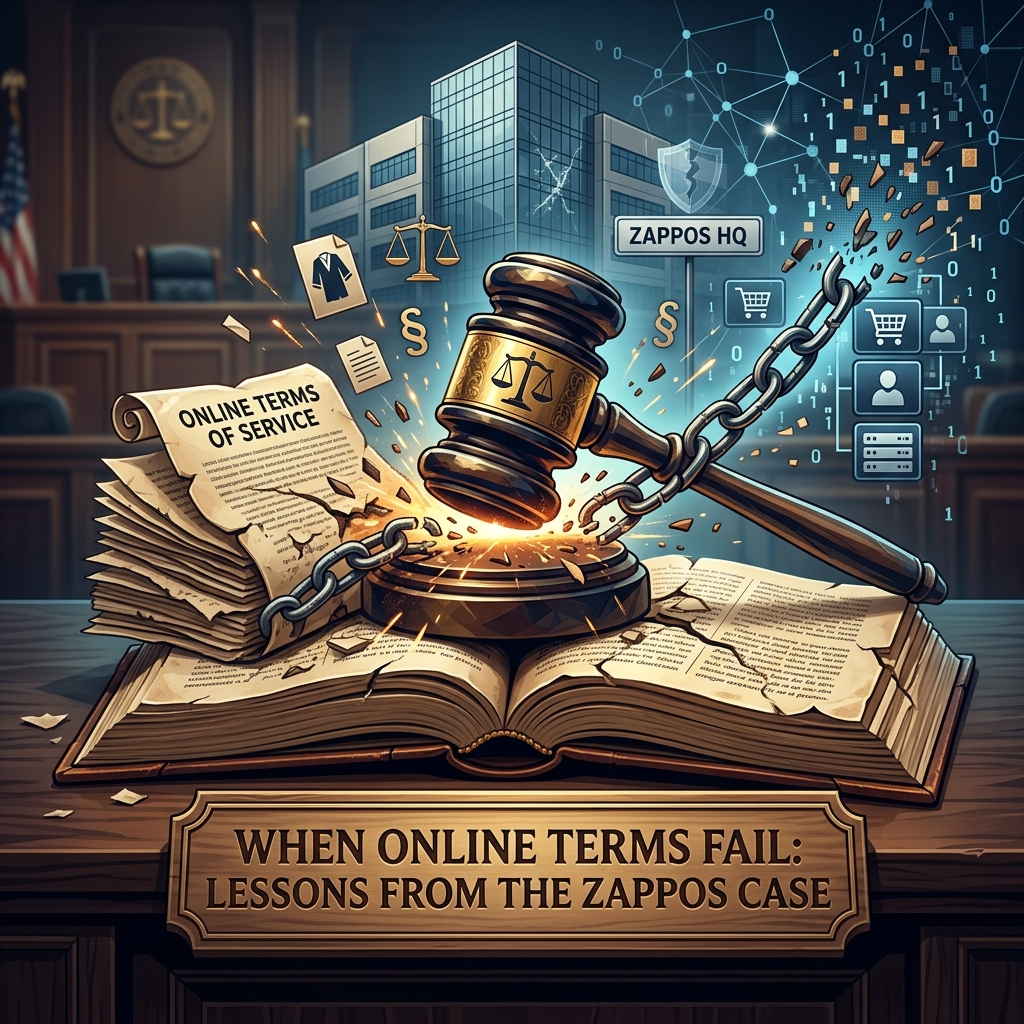
Online contracts sit at the heart of modern e‑commerce. Every time a customer opens an account, places an order, or uses a digital service, some form of legal agreement governs that relationship. The court battle over Zappos’ user agreement, however, shows what can happen when those terms are poorly implemented: a major company lost the ability to enforce its own arbitration clause and other protections against its customers.
This article uses the Zappos litigation as a practical case study to explain why certain online terms failed in court and what businesses can do to avoid the same mistakes. It focuses on the legal concepts of browsewrap, clickwrap, assent, notice, and unilateral amendment clauses, and offers concrete drafting and design recommendations grounded in widely accepted legal principles.
The Zappos Dispute in Plain Language
Zappos, an online retailer, faced a class action lawsuit after a customer data security breach. The company tried to rely on its website Terms of Use to push the dispute into arbitration and stop customers from suing in court. Customers argued those terms were not binding because they had never meaningfully agreed to them.
A federal district court in Nevada agreed with the customers and held that Zappos’ user agreement was unenforceable. The court refused to compel arbitration for two main reasons:
- Zappos could not show that customers had clearly assented to the Terms of Use.
- Zappos reserved the right to change those terms at any time, without notice, making key provisions such as the arbitration clause invalid.
This outcome left Zappos effectively “legally naked” in that lawsuit: it could not rely on the contract provisions it thought would protect it.
Browsewrap vs. Clickwrap: Why the Form Matters
One of the central issues in the case was the way Zappos presented its terms to users. Courts distinguish between several common types of online agreements.
| Type of online agreement | How it appears to users | Typical enforceability in court |
|---|---|---|
| Browsewrap | Terms are linked, often in the footer; use of the site is deemed acceptance. | Frequently challenged; often not enforced unless notice and design are very clear. |
| Clickwrap | Users must click “I agree”/check a box next to a link to terms before proceeding. | Generally enforceable when implemented correctly and presented conspicuously. |
| Sign‑in wrap / hybrid | Language near a button states that signing in or registering means agreeing to linked terms. | Enforceability depends on clarity of the notice, proximity to the button, and overall design. |
Zappos used a browsewrap approach: the terms were accessible via a hyperlink placed at the bottom of the pages. Users could shop, register, and enter personal information without ever seeing a prompt that required them to read or accept the Terms of Use.
The court found that this design did not provide adequate notice, and Zappos had no evidence that any specific customer had opened, read, or agreed to the terms. That was fatal to enforcing the arbitration clause and other important provisions.
Core Legal Concepts: Assent, Notice, and Contract Formation Online
Traditional contract law requires two basic elements: offer and acceptance. When terms are presented online, courts translate these concepts into questions about notice and assent.
What counts as sufficient notice?
For an online agreement to be binding, users need reasonably conspicuous notice of its existence. Courts evaluate factors such as:
- Where links to the terms appear (footer, near buttons, within forms).
- Formatting choices like font size, color contrast, capitalization, and headings.
- Whether the site explicitly states that using or registering means agreeing to the terms.
- How much clutter or competing information surrounds the notice.
In the Zappos case, the link to the Terms of Use was embedded in the bottom of pages, but nothing in the checkout or account creation process forced users to interact with or even notice it. The court considered this insufficient to signal that important contractual provisions were attached to the use of the site.
How do users show assent?
Assent is typically demonstrated through some affirmative action connected to the terms. The most common examples online are:
- Ticking a checkbox next to a statement such as “I agree to the Terms of Use.”
- Clicking a button where the label or nearby text makes clear that doing so accepts the terms.
- Completing a registration or purchase flow where terms are presented and acceptance is required.
Zappos lacked this kind of affirmative evidence. The court noted that the company could not point to any step where users actually agreed to the Terms of Use before providing information or making purchases. Without that confirmation, Zappos’ argument that mere use of the site bound customers to the terms failed.
The Unilateral Amendment Clause Problem
Even if Zappos had managed to prove assent, another feature of its Terms of Use would have undermined enforcement: a unilateral amendment clause giving the company the right to change the agreement at any time, without notice to users.
In the Zappos litigation, the court emphasized that such broad, notice‑free modification power made the arbitration provision illusory because Zappos could have altered or removed it at will. This undermined the mutuality and stability typically required for a contract to be enforceable.
Courts and commentators warn that clauses allowing a business to change terms at any time, especially without notice or renewed assent, create significant risk that the entire agreement—or at least particularly sensitive clauses like arbitration and waiver of class actions—will not be upheld.
Key Mistakes Highlighted by the Zappos Case
The Zappos decision identifies several practical missteps that other companies can learn from. Taken together, they offer a checklist of what not to do when designing and implementing website terms.
- Relying solely on browsewrap links: Important terms were buried in a footer link and not integrated into account creation or checkout.
- No affirmative acceptance step: Customers were never required to click “I agree” or check a box acknowledging the Terms of Use.
- Poor visibility and design: The link to the terms was not highlighted or positioned in a way that would draw users’ attention.
- Unrestricted unilateral changes: Zappos reserved the right to modify the agreement, including the arbitration clause, at any time without notice.
- Overreliance on arbitration clauses: The company placed heavy weight on arbitration as a shield from litigation, but did not ensure that the clause itself was bulletproof.
Practical Guidance: Building Enforceable Online Terms
Businesses can significantly reduce legal risk by following best practices that courts and legal scholars have recommended in response to cases like Zappos.
Prefer clickwrap or sign‑in wrap to browsewrap
Most experts advocate replacing pure browsewrap designs with mechanisms requiring explicit acceptance. In practice, this means:
- Adding a checkbox labeled with a clear statement that the user agrees to the terms, placed before a “Sign Up” or “Place Order” button.
- Ensuring a conspicuous, immediately adjacent link to the full Terms of Use.
- Designing flows so that a user cannot complete registration or checkout without indicating consent.
Such designs provide both better notice and stronger proof of assent, which courts tend to favor when asked to enforce arbitration clauses, limitations of liability, and other significant conditions.
Make terms easy to find and understand
Beyond the technicalities of assent, accessibility and clarity matter. Businesses should:
- Use plain language instead of dense legal jargon whenever possible.
- Organize terms with headings, bullet points, and summaries for complex sections.
- Highlight sensitive provisions like arbitration, class action waivers, and data collection practices.
- Maintain consistent locations for links to terms across pages and platforms.
Although the law does not require every user to read terms fully, presenting them transparently supports both enforceability and trust.
Limit and structure modification rights
To avoid the problem that arose in Zappos, businesses should rework unilateral amendment clauses so they are reasonable and transparent. Best practices include:
- Providing advance notice of material changes via email or in‑service notifications.
- Clearly dating each version of the terms and explaining what has changed.
- Requiring renewed assent for major updates, especially those affecting dispute resolution or user rights.
- Avoiding language suggesting the company can change the entire agreement at any time without limits.
These steps help preserve the stability courts expect in enforceable contracts and protect the integrity of provisions like arbitration clauses.
Implications for Arbitration Clauses and Class Action Waivers
Arbitration clauses and class action waivers are common in online terms, governed in the United States by statutes such as the Federal Arbitration Act and interpreted by numerous Supreme Court cases. In principle, courts often enforce such clauses when they are part of valid contracts and not unconscionable.
The Zappos decision illustrates that even in an environment where arbitration is generally favored, the clause will not be enforced if basic contract formation requirements are not met. A defective implementation can therefore expose a company to class action litigation instead of individual arbitration, with significantly higher potential costs.
For businesses, this means that careful integration of arbitration provisions within robust, properly accepted online contracts is as important as the wording of the clauses themselves.
Checklist for Website Owners and In‑House Counsel
Based on lessons from Zappos and related commentary, the following checklist can guide reviews of existing online terms:
- Acceptance mechanism
- Is there a required click or checkbox explicitly tied to the terms?
- Can users proceed without affirmatively accepting the agreement?
- Visibility
- Are links to terms prominently displayed near crucial actions?
- Is the design cluttered or confusing, potentially hiding key notices?
- Content of clauses
- Are modification rights reasonable and accompanied by notice?
- Are arbitration and waiver provisions highlighted and clearly explained?
- Version control
- Are dates and versions of terms tracked and documented?
- Is there a system to record when users accepted specific versions?
Addressing these items can significantly strengthen the enforceability of online user agreements and reduce exposure to litigation.
Frequently Asked Questions (FAQs)
1. What is a browsewrap agreement?
A browsewrap agreement is a type of online contract where the terms are available through a hyperlink, often in the footer, and the website states that simply using the site means accepting those terms. Users are not required to click or check anything to show they agree. Courts scrutinize browsewraps closely and may refuse to enforce them if the notice is not sufficiently clear or conspicuous.
2. Why did the court reject Zappos’ user agreement?
The Nevada federal court found Zappos’ Terms of Use invalid primarily because customers had not clearly assented to them and because the agreement allowed Zappos to change the terms at any time without notice. As a result, the court denied Zappos’ motion to compel arbitration.
3. Are clickwrap agreements always enforceable?
Clickwrap agreements—where users must affirmatively click “I agree” in proximity to the terms—are much more likely to be enforced than browsewraps when properly designed. However, they still need to be reasonable, understandable, and presented with clear notice. Courts may review them for unconscionability or other defects depending on the content of the terms.
4. How can a company safely change its online terms?
To change online terms safely, companies should communicate updates clearly, provide advance or prompt notice, identify what has changed, and sometimes obtain renewed assent for major modifications. Avoiding language that grants unlimited modification power without notice reduces the risk that a court will find the agreement illusory or unenforceable.
5. Does every user have to read the terms for them to be binding?
Contract law does not require every user to read the full terms before they become binding. What matters is whether the user had a fair opportunity to review the terms and clearly manifested assent. Well‑designed clickwrap or sign‑in wrap implementations provide that opportunity even if many users choose not to read every clause.
References
- How Zappos’ User Agreement Failed in Court and Left Zappos Legally Naked — Eric Goldman, Forbes. 2012-10-10. https://www.forbes.com/sites/ericgoldman/2012/10/10/how-zappos-user-agreement-failed-in-court-and-left-zappos-legally-naked/
- Zappos’ Focus on Fashion, and Not on Terms of Use, Leads to Contractual Faux Pas — CDAS. 2012-10-11. https://cdas.com/zappos-focus-on-fashion-and-not-on-terms-of-use-leads-to-contractual-faux-pas/
- In re Zappos.com, Inc., Customer Data Security Breach Litigation — U.S. District Court, District of Nevada (893 F. Supp. 2d 1058). 2012-07-02. https://btlg.us/wp-content/uploads/2022/11/In-re-Zappos.pdf
- Court Invalidates Zappos’ Browsewrap Agreement — Frankfurt Kurnit Klein & Selz. 2012-10-15. https://fkks.com/news/court-invalidates-zappos-browsewrap-agreement
- In re Zappos.com, Inc., Customer Data Security Breach Litigation — Summary, major online contract case entry. Last updated 2023. https://en.wikipedia.org/wiki/In_re_Zappos.com,_Inc.,_Customer_Data_Security_Breach_Litigation
Similar Articles








Read full bio of medha deb


