
When Facebook Posts Become Criminal Threats
Learn how Facebook messages and posts can cross the line from free speech into prosecutable criminal threats under modern laws.
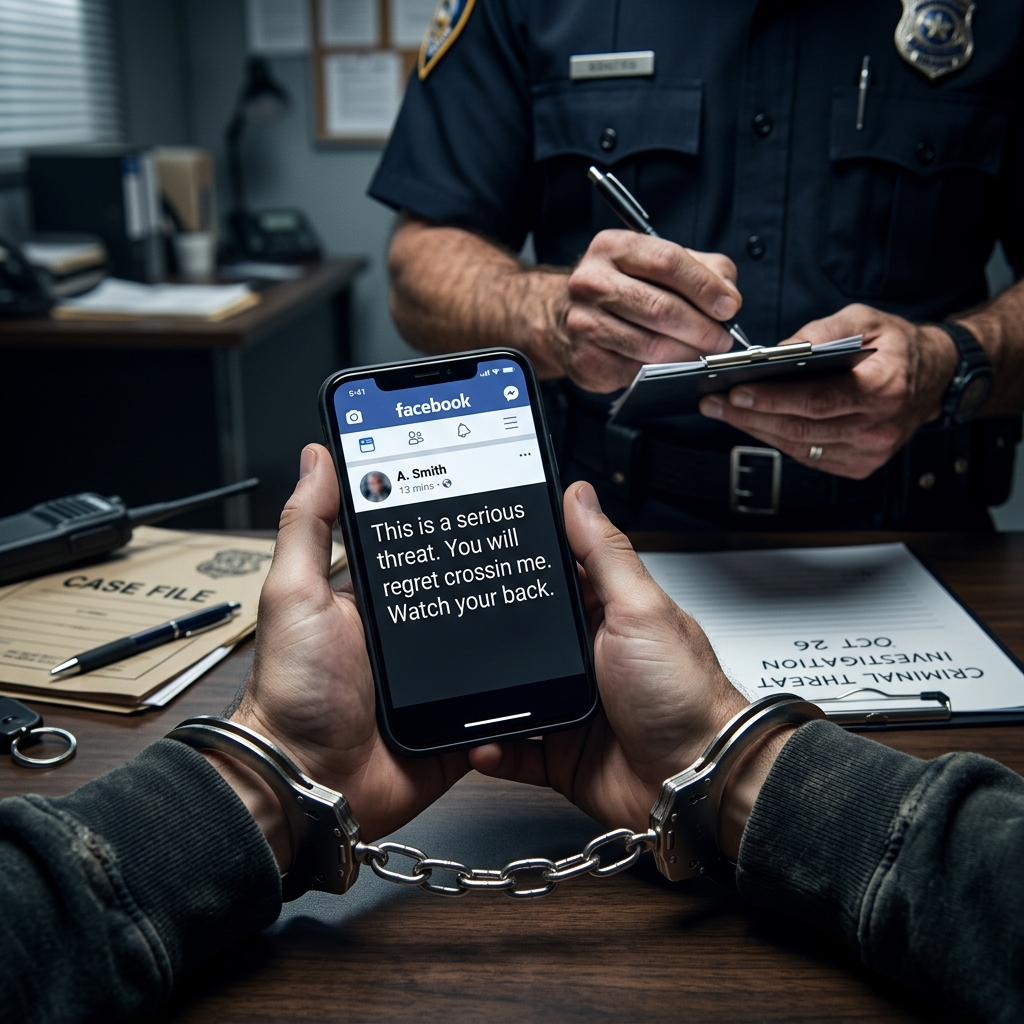
Facebook and other social media platforms make it easy to share thoughts in seconds, but that convenience comes with legal risk. Statements that look like jokes or emotional outbursts can, in some circumstances, be treated as criminal threats under state or federal law.
This article explains when Facebook posts and messages may be considered illegal threats, how courts balance free speech with public safety, what penalties can apply, and what to do if you are either accused of making a threat or are on the receiving end of an alarming post.
Free Speech vs. Criminal Threats: Where Is the Line?
Most online expression is protected by the First Amendment, which safeguards a wide range of opinions, criticism, and even offensive speech. However, there is an important exception for true threats—statements that communicate a serious intent to commit violence or cause significant harm.
- Protected speech generally includes satire, hyperbole, political rhetoric, and emotional venting that does not convey a serious intent to harm.
- Unprotected threats include statements that a reasonable person would interpret as a serious expression of an intent to inflict death, serious bodily injury, or other grave harm.
Courts have repeatedly recognized that true threats are not shielded by the First Amendment and may be prosecuted under criminal statutes. The difficulty in the social media era is distinguishing thoughtless or sarcastic remarks from genuine threats.
How Criminal Laws Apply to Facebook Communications
Most threat statutes were written before social media existed, but legislatures and courts have made clear that these laws apply to communications sent by electronic means, including Facebook posts, private messages, emails, and text messages.
| Medium of communication | Can it be a criminal threat? | Typical examples |
|---|---|---|
| Spoken statements | Yes | Face-to-face threats, phone calls |
| Written letters or notes | Yes | Letters demanding money or threatening harm |
| Electronic communications | Yes | Facebook posts, direct messages, emails, texts |
For example, California’s criminal-threat statute explicitly covers threats made “verbally, in writing, or by means of an electronic communication device,” and courts treat social media posts the same as in‑person threats if the legal elements are met.
Key Legal Elements of an Online Criminal Threat
Every jurisdiction defines criminal threats somewhat differently, but several core elements appear repeatedly in statutes and case law.
1. Serious Threat of Significant Harm
The law is usually concerned with threats of death or great bodily injury, or similarly severe harm. Vague insults or non-violent statements typically do not qualify.
- Threats must convey the possibility of serious physical violence or other grave consequences.
- Minor disputes, rude language, or non‑violent criticism usually fall outside criminal-threat statutes.
2. Communication to a Person or Readable Audience
The threatening statement must be communicated in a way that reaches another person—either directly (in a message) or indirectly (in a public post that the target can see).
- Direct messages sent to a specific person.
- Public posts naming or clearly targeting an individual or group.
3. Intent That the Statement Be Taken as a Threat
Recent Supreme Court decisions emphasize that a negligence standard—convicting someone based only on how a reasonable observer might react—is not enough for certain federal threat statutes. Courts generally require proof that the speaker had some culpable mental state, such as:
- Knowledge that the communication would be understood as threatening.
- Recklessness about whether others would perceive the statement as a serious threat.
This focus on mental state means that context, prior interactions, and the speaker’s conduct all become important in assessing Facebook threats.
4. Reasonable Fear in the Recipient
Many statutes require that the threat cause the recipient—or sometimes their immediate family—to experience actual and reasonable fear for their safety.
- Fear must be more than momentary alarm; in some states it must be “sustained” or ongoing.
- Reasonableness is judged against the circumstances: history between the parties, past conduct, and specificity of the threat.
5. Specificity and Apparent Possibility of Execution
Courts often look for some combination of specificity and immediacy. Threats that appear unequivocal, concrete, and realistically capable of being carried out are more likely to be criminal.
- Specific references to time, place, or method of harm.
- Plausible ability of the person to carry out the threat.
Potential Penalties for Facebook Threats
Penalties vary widely by jurisdiction, but making a criminal threat online can lead to significant consequences, including jail or prison time, fines, probation, and long‑term collateral effects.
- Misdemeanor charges may result in up to one year in local jail, fines, and probation conditions such as counseling or restrictions on internet use.
- Felony charges can bring multi‑year prison sentences and larger fines, especially when weapons, prior convictions, or multiple victims are involved.
- Protective orders can bar contact with the recipient and restrict future communication.
- Collateral consequences can include employment difficulties, professional licensing issues, and immigration problems.
Some federal statutes also allow penalties of several years’ imprisonment for serious threats transmitted in interstate commerce, which can include communications sent over the internet.
Common Situations Where Facebook Threats Arise
Facebook threats rarely arise in isolation. They are typically part of broader conflicts that spill onto social media. Common scenarios include:
- Domestic and relationship disputes where arguments continue online after separation or divorce.
- Workplace conflicts in which employees or former employees vent about supervisors or colleagues.
- School-related incidents involving students posting alarming comments about teachers, classmates, or campus safety.
- Community or political disagreements that escalate beyond heated debate into threatening language.
In each situation, the line between protected expression and criminal threat depends on the language used, the surrounding context, and how seriously the recipient and authorities take the statements.
How Law Enforcement Evaluates Online Threats
When a threatening Facebook message is reported, law enforcement officers must quickly assess whether the communication constitutes a crime and whether immediate safety steps are needed.
- They examine the exact wording of the message and any accompanying images or videos.
- They consider the relationship between the sender and the recipient, including any history of violence or prior threats.
- They evaluate whether the sender appears to have the means or opportunity to carry out the threat.
- They gather electronic evidence—screenshots, logs, and platform records—to preserve the communication.
In serious cases, threats may be referred to federal authorities, especially when they implicate federal criminal statutes or target public officials or institutions.
Practical Advice: If You Receive a Threat on Facebook
Receiving a threatening message or seeing a disturbing post directed at you can be frightening. Authorities recommend several practical steps to protect yourself and assist any investigation.
- Do not engage in a heated response. Avoid escalating the situation or issuing counter-threats.
- Document the threat. Take screenshots, note the date and time, and capture the sender’s profile information.
- Preserve electronic evidence. Do not delete the message; keep it accessible in case law enforcement or the platform needs to review it.
- Report the content to Facebook. Use the platform’s reporting tools to flag threatening or harassing material.
- Contact law enforcement. If you fear imminent danger, call emergency services. For other threats, contact local police or appropriate authorities.
Authorities may advise additional safety measures, such as adjusting privacy settings, blocking the sender, or temporarily limiting public posts.
Practical Advice: If You Posted Something That Might Be Viewed as a Threat
Many people accused of Facebook threats did not intend to harm anyone, but the law may still treat their statements seriously. If you are concerned about something you posted or have already been contacted by law enforcement, consider the following steps:
- Do not destroy evidence. Deleting posts or accounts can be interpreted negatively and may violate orders; preserving content can help show context.
- Exercise your right to counsel. Consult a qualified criminal defense attorney before making detailed statements to police.
- Be mindful of further online activity. Avoid additional posts about the situation, the alleged victim, or law enforcement.
- Gather context. Save prior conversations, screenshots, and evidence that may show the statement was a joke, satire, or part of a broader dialogue.
Defense attorneys often examine whether the alleged threat was ambiguous, whether the recipient actually experienced sustained fear, and whether the language was closer to protected hyperbole than to a true threat.
Defenses Commonly Raised in Social Media Threat Cases
Several defenses may be available when someone is accused of making criminal threats on Facebook, depending on the facts and the applicable law.
- Lack of intent: Arguing that the speaker did not intend the statement to be understood as a genuine threat, especially where sarcasm or exaggeration is obvious.
- Protected speech: Contending that the statement was political rhetoric, artistic expression, satire, or other protected speech under the First Amendment.
- Ambiguity and context: Highlighting context that shows the message was not unequivocal or serious, including prior joking exchanges or lack of hostile history.
- No reasonable fear: Showing that the recipient did not experience sustained or reasonable fear, particularly in situations where the parties regularly exchange harsh words.
- Misidentification or account misuse: Demonstrating that someone else used the account or that the sender has been impersonated or hacked.
Because each case is fact-specific, early legal advice is crucial in determining which defenses may be available and how best to present them.
Preventing Legal Trouble: Best Practices for Posting on Facebook
Many criminal investigations could be avoided with more cautious social media habits. Consider adopting the following best practices:
- Avoid violent language, even jokingly, toward specific individuals or groups.
- Think before posting, especially when angry, frustrated, or under the influence of alcohol or drugs.
- Be cautious with dark humor that references weapons, attacks, or self-harm, particularly if others could reasonably feel targeted.
- Review privacy settings so that personal disputes are not broadcast widely.
- Use direct, non-threatening communication to resolve conflicts rather than airing grievances publicly.
Although these steps cannot guarantee you will never face scrutiny, they reduce the risk that your online remarks will be interpreted as criminal threats.
Frequently Asked Questions About Facebook Threats
Do I have to be able to carry out the threat for it to be criminal?
No. Many statutes do not require proof that the person could or would carry out the threat; they focus on whether the statement communicates a serious intent and causes reasonable fear.
Can I be charged for a threat made in a private message?
Yes. Threat laws generally apply to both public posts and private communications. A direct message can be easier to prove because it clearly targets a specific recipient.
What if I say I was joking?
Courts look at context and intent rather than just the speaker’s after‑the‑fact explanation. If the language and circumstances suggest a serious threat, saying you were joking may not be enough.
Can law enforcement investigate even if no charges are filed?
Yes. Police and federal agencies investigate threats to assess risk and may take preventive measures even if prosecutors ultimately decline to bring charges.
Is deleting the post the right thing to do if I regret what I said?
Removing harmful content from public view can be responsible, but once an investigation has begun you should avoid altering or destroying potential evidence and speak with an attorney about next steps.
References
- Can You Face Criminal Charges for Threats on Facebook? (PC 422) — Wallin & Klarich. 2023-05-10. https://www.wklaw.com/can-face-criminal-charges-threats-facebook-pc-422/
- Is it illegal to make threats on Facebook? Supreme Court decides. — Brill Legal Group. 2015-06-02. https://www.brill-legal.com/media/is-it-illegal-to-make-threats-on-facebook-supreme-court-decides/
- Facebook Threats & Federal Law: HLAW’s 2025 Guide — Barnett Howard & Williams PLLC. 2025-01-15. https://www.bhwlawfirm.com/are-facebook-threats-actually-threats-under-federal-law/
- Criminal Threats on Social Media: Your Guide — My Rights Law. 2023-09-01. https://www.myrightslawgroup.com/blog/criminal-threats-social-media-defense-guide/
- Threat Intimidation Guide — Federal Bureau of Investigation. 2022-11-01. https://www.fbi.gov/investigate/counterintelligence/threat-intimidation-guide
- What are the legal consequences of threatening someone online? — Justia Ask a Lawyer. 2025-12-05. https://answers.justia.com/question/2025/12/05/what-are-the-legal-consequences-of-threa-1094658
Similar Articles








Read full bio of Sneha Tete


