
When Embezzlement Can Block a Bankruptcy Discharge
How embezzlement allegations can turn a debt into a nondischargeable obligation in bankruptcy.
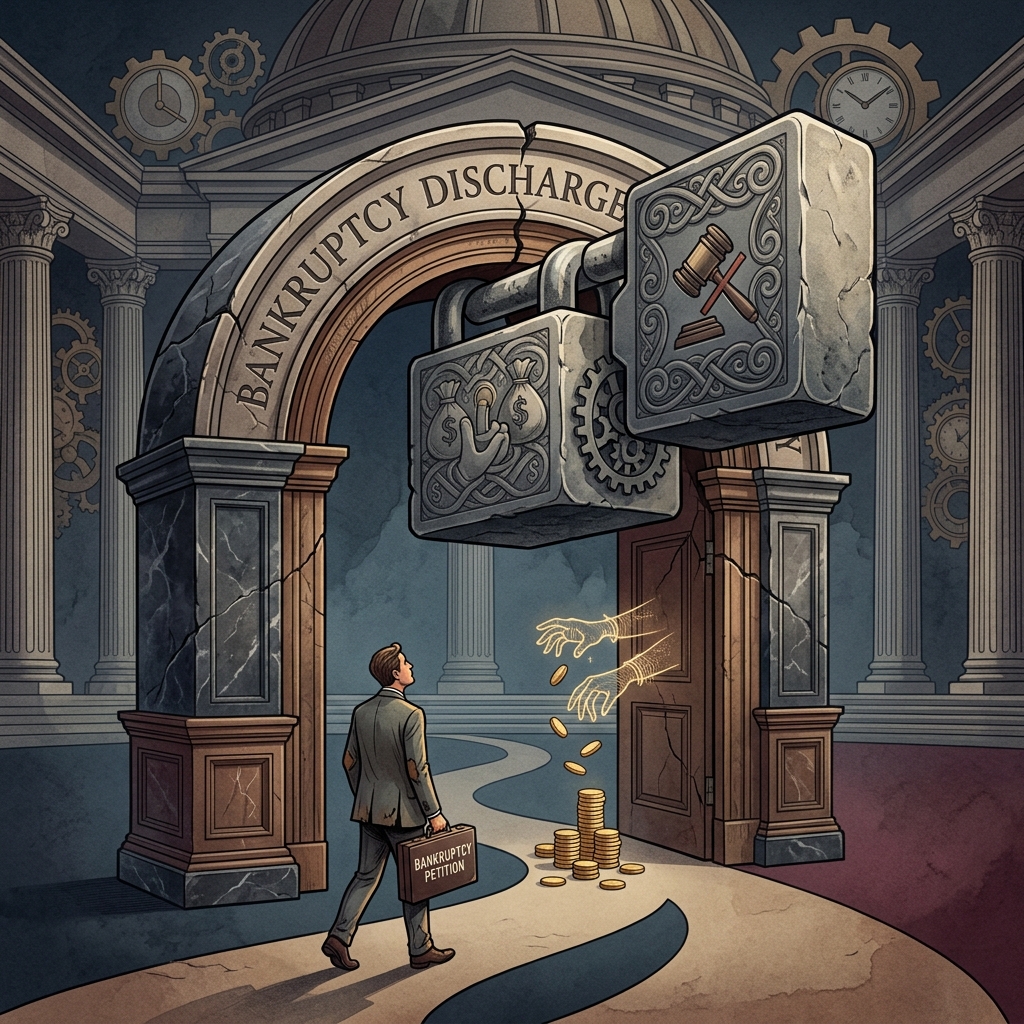
How Embezzlement Affects Bankruptcy Discharge
Bankruptcy is designed to give honest debtors a fresh start, but not every debt disappears when a case ends. Certain obligations survive the discharge because Congress decided they involve conduct too serious to reward with a clean slate. Embezzlement is one of the best-known examples of that rule.
When a debt is tied to embezzlement, a bankruptcy court may decide that the debt cannot be wiped out. That result matters because the creditor keeps the right to collect after the bankruptcy case closes, even if the debtor receives a general discharge on other debts.
- Bankruptcy discharge normally eliminates personal liability for eligible debts.
- Some debts are excluded from discharge by statute.
- Debts based on embezzlement can fall within those exclusions.
What a Bankruptcy Discharge Does and Does Not Do
A discharge is a court order that ends a debtor’s personal obligation to pay certain debts. It also stops collection activity on those discharged debts. However, the discharge is not a universal erase button. Federal law lists categories of debt that remain enforceable after bankruptcy.
The main source of these exceptions is 11 U.S.C. § 523. The statute describes debts that are not discharged in bankruptcy, including obligations arising from fraud, fiduciary misconduct, embezzlement, larceny, and willful injury. The United States Courts explain that some of these debts are not automatically excluded; instead, a creditor must ask the bankruptcy court to rule that the debt falls within an exception.
| Concept | Practical Effect |
|---|---|
| Discharge | Ends the debtor’s personal liability for discharged debts |
| Exception to discharge | Leaves a debt collectible after bankruptcy |
| Adversary proceeding | Separate court action used to decide whether a debt is excepted from discharge |
Why Embezzlement Receives Special Treatment
Embezzlement is treated seriously because it involves the misuse of property that was lawfully entrusted to the debtor. Unlike a simple unpaid bill, embezzlement involves a breach of trust and intentional wrongdoing. Bankruptcy law does not allow a person to convert someone else’s property or funds and then eliminate the resulting liability through discharge.
Under 11 U.S.C. § 523(a)(4), debts for “fraud or defalcation while acting in a fiduciary capacity, embezzlement, or larceny” are among the exceptions to discharge. The statute groups these wrongs together because each involves wrongful conduct connected to property or trust relationships. Courts and commentators consistently recognize that embezzlement fits squarely inside this exception.
What Creditors Must Show in an Embezzlement Case
Not every dispute over money becomes embezzlement. A creditor generally must show more than negligence, bad bookkeeping, or a failed business relationship. The creditor must prove the elements required for the exception to discharge, and exceptions are generally construed narrowly.
In practical terms, the creditor must show that the debtor wrongfully appropriated property or funds that were entrusted to the debtor or were lawfully in the debtor’s possession. The debt must also be linked to that wrongful conduct. Bankruptcy courts do not presume embezzlement simply because money is missing or a business deal went bad.
- The debtor had possession of property or funds belonging to another.
- The property was entrusted to the debtor or came into the debtor’s possession lawfully.
- The debtor used the property for an unauthorized purpose.
- The creditor’s claim arises from that misconduct.
The Role of Fiduciary Duty, Fraud, and Theft
Embezzlement is closely related to other nondischargeability grounds, but it is not identical to them. Section 523(a)(4) covers fraud or defalcation while acting in a fiduciary capacity, as well as embezzlement and larceny. That means the bankruptcy court may analyze whether the debtor owed a special trust duty, whether the debtor misused entrusted property, or whether the conduct amounted to theft under a different label.
Separate discharge exceptions also apply to debts obtained by false pretenses, false representation, or actual fraud under section 523(a)(2). The United States Courts note that debts involving fraud or maliciousness under sections 523(a)(2), (4), and (6) are not automatically excluded unless a creditor asks the court to make that determination. This procedure matters because a creditor who does not act in time may lose the chance to preserve the claim.
How Bankruptcy Courts Think About These Exceptions
Bankruptcy law aims to balance two competing goals: giving debtors relief and protecting victims of serious misconduct. For that reason, courts usually interpret exceptions to discharge narrowly while still enforcing them when the legal elements are met. This approach prevents creditors from stretching ordinary contract disputes into fraud cases, but it also ensures that embezzlement is not washed away by a routine discharge.
The burden of proof generally rests on the creditor. The creditor must establish the facts showing that the debt fits within the statutory exception. If the evidence is weak, the court may conclude that the debt is dischargeable even if the debtor behaved badly in a broader moral sense.
Examples of Situations That May Trigger Nondischargeability
Embezzlement issues appear in many settings, especially where one person handles another person’s money or property. A business employee might divert client funds into a personal account. A family member might use entrusted funds for personal expenses. A bookkeeper might pay personal bills from a company account after being given access to the account for limited reasons.
The common thread is unauthorized use after lawful possession. That feature helps separate embezzlement from ordinary breach of contract. A person who simply cannot pay a debt usually does not face nondischargeability on this basis. A person who takes entrusted property and uses it for a forbidden purpose may.
- Company funds used for personal expenses without permission
- Client money diverted to the debtor’s own account
- Property sold or transferred in violation of the owner’s instructions
- Trust assets used outside the agreed purpose
How the Bankruptcy Chapter Can Matter
The discharge rules vary somewhat depending on the chapter filed, but the general principle remains the same: certain misconduct-based debts can survive bankruptcy. The United States Courts explain that chapter 7 discharge is not automatic in the sense that objections and exceptions can be litigated, and the debtor must qualify under the law. Other chapters also preserve specific categories of debt from discharge.
Even when a debtor receives a discharge in the case as a whole, a debt found to be excepted under section 523 can remain collectible afterward. That result is why creditors often focus on the dischargeability of the claim, not just the amount of the debt.
Why Timing and Procedure Matter
Dischargeability disputes do not resolve themselves. Creditors who believe a debt arose from embezzlement must act within the bankruptcy process and ask the court for a determination. If they fail to do so, the debt may be discharged by default even if the underlying facts might have supported an exception.
This makes bankruptcy practice highly procedural. A creditor needs to identify the right statutory ground, file the proper complaint, and present evidence showing that the claim falls within the exception. Debtors, in turn, may contest both the facts and the legal theory, especially where the alleged conduct looks more like a failed business arrangement than intentional misuse of entrusted funds.
A Practical Comparison of Common Discharge Exceptions
| Exception | Core Idea | Typical Proof Issue |
|---|---|---|
| Fraud | Debt obtained through deception | Whether the debtor intended to deceive |
| Embezzlement | Wrongful use of entrusted property | Whether the property was lawfully possessed but later misused |
| Larceny | Wrongful taking of property | Whether the property was taken without consent |
| Willful and malicious injury | Intentional harm to person or property | Whether the debtor meant the injury or its consequences |
Frequently Asked Questions
Is every debt connected to missing money nondischargeable?
No. A debt must fit the legal definition of an exception to discharge. Missing funds, by themselves, do not automatically prove embezzlement.
Does the creditor have to file a lawsuit in bankruptcy court?
Yes, for many fraud-related exceptions the creditor must ask the court to decide the issue. The United States Courts explain that debts under sections 523(a)(2), (4), and (6) are not automatically excluded unless the creditor obtains a ruling.
Can a debtor discharge a debt if the dispute is really about poor business performance?
Possibly. If the claim is only about a failed deal, unpaid invoice, or accounting error, the creditor may have trouble proving embezzlement or another discharge exception.
Why does the law treat embezzlement differently from regular debt?
Because embezzlement involves misuse of property entrusted to the debtor. Bankruptcy relief is meant for honest but unfortunate debtors, not for people who intentionally convert another person’s property.
What Debtors and Creditors Should Take Away
For debtors, the key lesson is that bankruptcy does not erase every liability. If a debt arises from the misuse of entrusted property, the creditor may have a strong argument that the debt survives the case. For creditors, the lesson is equally important: the right facts are not enough unless they are raised in the correct bankruptcy procedure.
The statute, the case law, and the court rules all point in the same direction. Bankruptcy can relieve a debtor of many obligations, but embezzlement-based debts sit in a protected category because they arise from deliberate misuse rather than ordinary financial failure.
More FAQs
Can a bankruptcy judge deny discharge of only one debt?
Yes. The court can determine that a particular debt is nondischargeable while still granting a discharge for other eligible debts.
Does the type of bankruptcy matter?
Yes. Different chapters have different discharge rules, but misconduct-based exceptions remain important across chapters.
Is an express trust required for every section 523(a)(4) claim?
No. Section 523(a)(4) covers several separate grounds, including embezzlement and larceny, which do not depend on an express trust in the same way a fiduciary-fraud claim might.
References
- Three Kinds of Debts Survive Bankruptcy Discharge — Bankruptcy Soapbox. N.D. https://www.bankruptcysoapbox.com/debts-not-discharged/
- Discharge, Exceptions to Discharge, and Objections to Discharge — U.S. Congress / National Bankruptcy Review Commission report hosted by UNT. N.D. https://govinfo.library.unt.edu/nbrc/report/07consum.html
- 11 U.S. Code § 523 – Exceptions to discharge — Cornell Legal Information Institute. N.D. https://www.law.cornell.edu/uscode/text/11/523
- Discharge in Bankruptcy – Bankruptcy Basics — United States Courts. N.D. https://www.uscourts.gov/court-programs/bankruptcy/bankruptcy-basics/discharge-bankruptcy-bankruptcy-basics
- Chapter 12 Discharge — Justia. N.D. https://www.justia.com/bankruptcy/docs/basics/chapter-12/chapter-12-discharge/
Similar Articles








Read full bio of medha deb




