
When Contracts Need Notaries or Witnesses
Understand when notarization or witnesses are legally required, and when they simply add extra protection to your contracts.
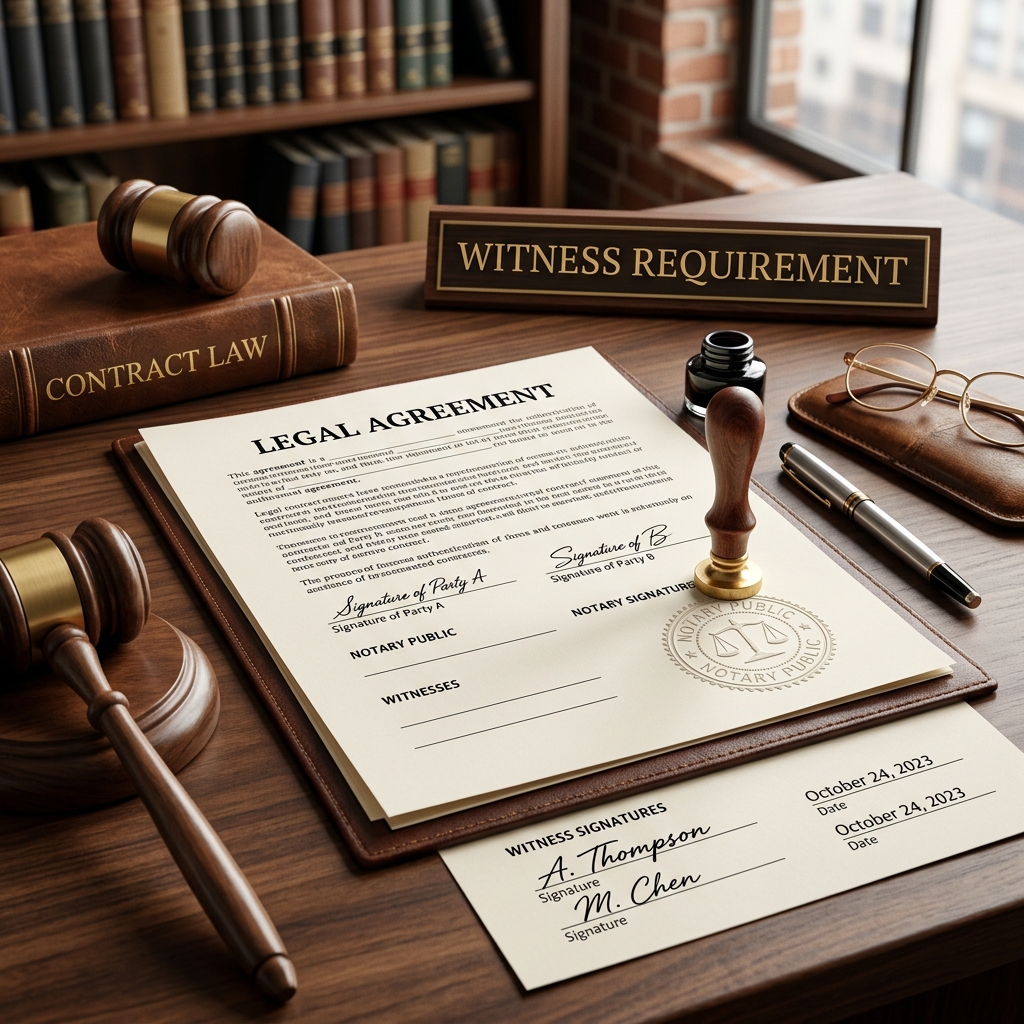
For most small business owners, the question of whether a contract must be notarized or witnessed comes up the moment parties sit down to sign. In general, a contract that meets basic legal requirements is binding even without a notary or witnesses, but there are important exceptions and practical reasons to use them.
This article explains when notarization or witnesses are legally required, how each works, and how they can strengthen your agreements even when the law does not mandate them.
What Makes a Contract Legally Binding?
Before deciding whether to involve a notary or witnesses, it is crucial to understand what actually makes a contract enforceable. The core elements are the same across U.S. jurisdictions, though details may vary by state.
| Element | Explanation |
|---|---|
| Offer | One party proposes specific terms, such as delivering goods or services at a stated price. |
| Acceptance | The other party clearly agrees to those terms, often by signing the written agreement. |
| Consideration | Each side gives or promises something of value, such as payment, services, or property. |
| Capacity | Parties must be legally able to contract (for example, of age and mentally competent). |
| Lawful purpose | The agreement cannot involve illegal activities or violate public policy. |
When these requirements are met, the contract is typically enforceable, whether or not anyone notarized or witnessed the signatures.
Notarization vs. Witnessing: What Is the Difference?
Although they are sometimes mentioned together, notarization and witnessing are distinct concepts with different legal effects.
- Notarization: A notary public verifies the identity of signers, confirms they signed voluntarily, and certifies the signature with a stamp or seal.
- Witnessing: One or more individuals observe the signing and then sign the document themselves to confirm that they saw the signature and can attest to the signer’s identity and intent.
A witness is generally a private individual, while a notary public is a state-authorized official with defined powers and responsibilities. Both can add credibility, but only a notary can issue a formal notarization certificate.
Are Contracts Valid Without a Notary or Witness?
In most business situations, a contract is valid even when the only people who sign it are the parties to the agreement.
- State laws typically do not require notarization for ordinary commercial contracts.
- Witnesses are generally not required for everyday business agreements, though certain categories of documents may be an exception.
- If the contract satisfies the elements of offer, acceptance, consideration, capacity, and lawful purpose, it is usually enforceable without notarization or witnesses.
As a result, many leases, service agreements, purchase contracts, and vendor arrangements are executed without any formal notarization or witnessing. That said, the absence of a notary or witness can complicate proof issues if a dispute arises later, which is where these tools become strategically useful.
When Notarization Is Required by Law
Although notarization is not the default requirement for contracts, certain documents must be notarized under state statutes or filing rules. The exact requirements differ by jurisdiction, but several categories are frequently affected.
- Real property documents – Deeds, mortgages, and long-term real estate leases often must be notarized before they can be recorded with a county clerk.
- Some financial instruments – Promissory notes, loan agreements, or other documents with significant financial consequences may require notarization for filing or enforcement in specific contexts.
- Affidavits and sworn statements – Documents that involve swearing to facts under oath commonly require notarization.
- Certain family law and property filings – For example, some states require notarized signatures when filing liens or documents affecting title to real or personal property.
Because these rules vary, small businesses should review the requirements in their state or consult counsel before executing any document that will be filed with a public office or affects rights in real property.
When Witnesses Are Required
Witness requirements usually arise from specific statutes or formalities tied to particular types of documents. While routine business contracts seldom need witnesses, some agreements and legal instruments do.
- Wills and some estate documents – Many states require two or more witnesses for wills, though approaches differ by jurisdiction.
- Certain notarized documents – In some states, witnesses may be needed in addition to a notary for specific transactions, such as real estate transfers.
- Sworn statements – Where a witness is required to authenticate signatures or content, their role is defined by local law.
In commercial practice, witnesses are sometimes used even when not legally required, simply to strengthen the evidentiary value of the contract.
Why Use a Notary When It Is Not Required?
Although business contracts rarely need notarization, many lawyers and notaries recommend it for higher-value or higher-risk agreements because it provides concrete legal advantages, particularly in litigation.
Key Benefits of Notarization
- Authentication of signatures – Courts often treat notarized signatures as automatically authenticated, eliminating the need for additional evidence that the signatures are genuine.
- Reduced fraud risk – The notary checks identification and confirms that signers are acting voluntarily, which deters forged signatures and coercion.
- Time and cost savings in disputes – Because authenticity is presumed, parties may spend less time and money litigating whether a document was properly signed.
- Added credibility – A notarized contract signals that the parties treated the agreement seriously and followed formal procedures.
In short, notarization is a practical risk-management tool. For relatively minor transactions, the extra step may not be worth the effort, but for agreements involving significant money, risk, or long-term obligations, notarization can be a cost-effective way to strengthen the contract.
When Should a Small Business Use Witnesses?
Witnesses serve a similar protective function to notaries, though they do not have official authority. Their presence can still be useful in contentious or high-stakes arrangements.
Best Practices for Choosing Witnesses
Legal rules for witnesses vary by jurisdiction, but common guidelines include:
- Witness should be an adult with legal capacity.
- Witness must be able to identify the signer and confirm they signed willingly.
- Witness should be a neutral third party who does not benefit from the contract.
Using neutral witnesses who have no stake in the agreement makes their testimony more persuasive if a disagreement arises. In some contexts, a notary can also serve as a witness, even when notarization is not legally mandated.
Digital Contracts and Electronic Signatures
Modern business activity increasingly relies on electronic signatures and online contracting platforms. In most jurisdictions, electronic signatures are legally valid if they satisfy statutory requirements, and there is no general rule that digital contracts must be notarized.
- Electronic agreements can be enforceable without notarization, as long as parties agree to the terms and applicable e-signature laws are followed.
- For higher-risk digital transactions, businesses may still choose to involve a notary (including remote online notarization where available) to add authenticity and reduce fraud.
As remote business practices expand, some states have adopted rules for online notarization, allowing notaries to verify identities via video and digital tools. Small businesses should check local regulations before relying on these methods.
Practical Steps to Strengthen Your Contracts
Notarization and witnesses are only part of a broader strategy for drafting enforceable, low-risk contracts. Several practical steps can further protect a business.
- Use clear, specific language – Avoid vague terms. Define payment amounts, deadlines, deliverables, and remedies in detail.
- Read and review thoroughly – Parties should read the entire agreement, ask questions, and clarify ambiguous clauses before signing.
- Confirm identities – Verify who you are contracting with, especially when dealing with new clients or counterparties.
- Document negotiations – Keep emails, proposals, and drafts that show how the final contract evolved.
- Include dispute-resolution clauses – Specify how disagreements will be resolved (litigation, arbitration, mediation) and where.
- Consider notarization or witnesses for major deals – Use these tools when the transaction involves substantial money or long-term commitments.
Frequently Asked Questions
1. Is a contract valid if only the parties sign it?
Yes, in most cases a contract is valid if both parties sign and the agreement meets core legal requirements. Notarization or witnesses are not generally required for ordinary business contracts.
2. Does notarization make a contract “more binding”?
Notarization does not usually change whether a contract is legally binding, but it can make it easier to prove authenticity and enforce the agreement in court by providing certified confirmation of signatures.
3. What happens if a required document is not notarized?
If a statute requires notarization for a specific document (such as a deed filed with a county clerk) and the notarization is missing or defective, the filing may be rejected or the document may be harder to enforce until the defect is corrected.
4. Can a defective notarization invalidate an otherwise valid contract?
For most contracts, the underlying agreement remains enforceable even if the notarization was flawed, because notarization is not what makes the contract binding. However, the defective notarization may prevent the notary from serving as a reliable witness or meeting filing requirements.
5. Do I need a lawyer every time I notarize a business contract?
No, a notary public is separate from legal counsel. That said, consulting an attorney for significant transactions can help ensure the contract’s terms are appropriate and that any required formalities, including notarization or witnesses, are properly handled.
References
- Do Contracts Have to Be Notarized? Key Facts and Legal Insights — UpCounsel. 2023-05-10. https://www.upcounsel.com/do-contracts-need-to-be-notarized
- Notary Signing Explained — TexasLawHelp.org. 2022-08-01. https://texaslawhelp.org/article/notary-signing-explained
- How to Sign and Execute Binding Contracts — LawDepot. 2021-11-15. https://www.lawdepot.com/us/contract/
- Why contracts and agreements should be notarized — DHP Law. 2014-08-20. https://www.dhplaw.com/blog/2014/08/why-contracts-and-agreements-should-be-notarized/
- Why Use a Notary — New York Mobile Notary Service. 2019-03-12. https://www.newyorkmobilenotaryservice.com/whynotary.html
- If a contract is signed between 2 parties and is not notarized or witnessed… is it still legally binding? — Lawyers.com Ask-a-Lawyer. 2018-07-03. https://ask-a-lawyer.lawyers.com/contracts/if-a-contract-is-signed-between-2-parties-and-is-not-notarized-or-witnessed-by-anyone-other-than-the-2-affected-parties-is-it-still-legal-binding-387285.html
- Is a contract legal if it is signed by a notary that did not witness the signing? — Avvo Legal Answers. 2016-02-22. https://www.avvo.com/legal-answers/is-a-contract-legal-if-its-signed-by-a-notary-that-2235075.html
Similar Articles








Read full bio of Sneha Tete


