
When Judges Reject Plea Agreements: What Defendants Must Know
Understanding when judges approve or reject plea agreements and what that means for defendants, prosecutors, and the justice system.
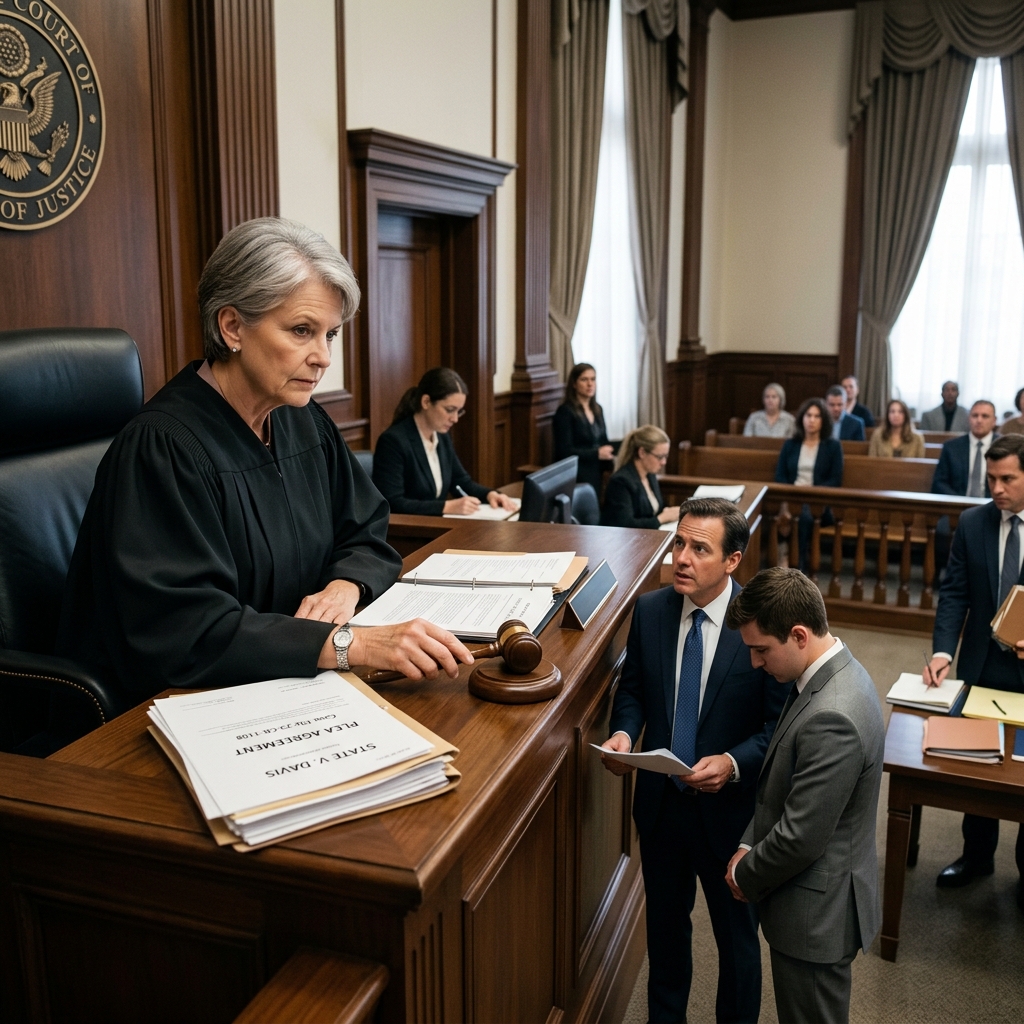
Plea bargaining dominates modern criminal justice, resolving the vast majority of cases without a full trial. Yet even when the prosecutor and defense agree on a deal, the plea does not take effect until a judge reviews it and decides whether to accept or reject it. Judges serve as gatekeepers to ensure that negotiated resolutions align with the law, protect the defendant’s rights, and promote the interests of justice.
This article explains when and why judges reject plea agreements, how that power varies by jurisdiction, and what happens procedurally if a plea deal is turned down. It is written for defendants, families, and anyone seeking a clear, practical overview of judicial control over plea bargains.
Core Idea: A Plea Deal Is Only a Proposal Until the Judge Approves It
A plea agreement is a negotiated resolution between the prosecutor and the defendant (usually through counsel) that determines how a criminal case will be resolved—often involving a guilty or no‑contest plea in exchange for concessions on charges or sentencing.
- Negotiated by the parties: Prosecutor and defense work out terms such as which charges the defendant will plead to and what sentence will be recommended.
- Not binding until presented to the court: The agreement becomes meaningful only when it is brought before a judge.
- Judicial review is mandatory: The judge must determine whether the plea and the proposed disposition are legally sound and appropriate.
Importantly, judges are not parties to the bargain. Their role is to independently evaluate the agreement, not to simply ratify what the prosecutor and defendant have decided.
Judicial Authority: Can a Judge Reject a Plea Deal?
In most systems, yes, a judge can reject a plea agreement. The judge has authority to accept or reject the deal and usually must explain the reasons for any rejection on the record in open court.
| Judicial Option | What It Means |
|---|---|
| Accept the plea agreement | The judge finds the plea knowing and voluntary, supported by evidence, and the terms acceptable. The conviction is entered and the case proceeds to sentencing consistent with the deal. |
| Reject the plea agreement | The judge declines to adopt the negotiated terms (often due to concerns about the sentence, charges, or fairness). The parties are not bound by the deal and must decide how to proceed. |
| Defer a decision | Some judges approve the plea conditionally but defer final acceptance until reviewing a pre‑sentence report or additional information. |
Judicial discretion is not unlimited. It is constrained by statute, court rules, precedent, and constitutional requirements such as the defendant’s right to enter a voluntary, informed plea supported by a factual basis.
Different Types of Plea Agreements and Judicial Power
Judicial authority can vary depending on the type of plea agreement and the jurisdiction’s rules.
Plea Agreements with Sentencing Recommendations
Many plea deals involve the prosecutor agreeing to recommend a specific sentence or sentencing range. In those cases, judges typically have broad discretion to accept or reject the negotiated sentence.
- The sentencing terms are usually treated as recommendations, not guarantees.
- Court rules may require judges to exercise independent judgment as to whether the proposed sentence is fair and lawful.
- If the judge rejects the sentence recommendation, the parties are notified and may renegotiate or proceed differently.
For example, Colorado law expressly states that sentencing concessions in a plea agreement are recommendations, and trial courts must independently decide whether to accept or reject them.
Plea Agreements Without Sentencing Recommendations
In some agreements, the prosecutor makes no specific sentencing recommendation. Instead, the defendant agrees to plead guilty to certain charges and leaves sentencing to the judge’s discretion.
In certain jurisdictions, when the State does not recommend a sentence, the judge’s power to reject the plea may be more limited. For example, North Carolina case law and statutes indicate that if:
- there is a factual basis for the plea, and
- the plea is the product of the defendant’s informed, voluntary choice,
then the court must accept the plea, even if the judge personally believes the outcome is ill‑advised. In that scenario, the State sets the terms of the deal and the judge cannot reject it solely because the judge disagrees with its wisdom.
Jurisdictions That Restrict Judicial Involvement
At the federal level and in several states, judges are barred from participating in plea negotiations themselves, meaning they cannot help craft or pressure parties into specific bargains. However, they generally retain power to approve or reject agreements once presented.
Scholarship has noted that in these jurisdictions judicial rejection of plea agreements is relatively rare, but when it occurs it serves as an important oversight tool.
Common Reasons Why Judges Reject Plea Deals
Judges must provide legally sound reasons for rejecting a plea agreement so that the parties and any reviewing court can understand the basis for the decision. While specific standards differ by jurisdiction, several recurring themes appear.
1. The Sentence Is Too Lenient or Too Harsh
One of the most frequent reasons for rejection is that the agreed‑upon sentence is inconsistent with the seriousness of the offense or the defendant’s criminal history.
- Deals may be viewed as too lenient for violent offenses, repeat offenders, or crimes with serious harm.
- Occasionally a plea may seem too severe relative to the evidence or legislative intent of the charged offense.
- Judges consider sentencing guidelines, statutory ranges, and community expectations.
In jurisdictions like Colorado, the judge is explicitly required to ensure that the proposed sentence is fair, appropriate, and in the interests of justice—otherwise, the plea’s sentencing terms may be rejected.
2. Insufficient Factual Basis for the Plea
Before accepting a guilty plea, judges must confirm there is a factual basis supporting each element of the offense.
- If the evidence described in court does not support the charges, the judge may reject the plea agreement.
- Concerns about possible innocence or weak proof can prompt rejection or require modification of the charges.
The requirement of a factual basis protects defendants from pleading guilty to crimes they did not commit and helps preserve the integrity of the record for appellate review.
3. Problems with Voluntariness or Understanding
A guilty plea must be knowing, voluntary, and intelligent. Judges typically conduct a detailed colloquy (questioning) to make sure the defendant:
- understands the charges and potential penalties,
- knowingly waives constitutional rights such as the right to trial, and
- is not acting under coercion, threats, or improper promises.
If the judge doubts the defendant’s understanding or voluntariness, the plea may be rejected and the case sent back to a posture where the defendant can reconsider their options.
4. Conflict with Law, Policy, or Public Interest
Judges may reject plea agreements that appear to conflict with:
- Statutory requirements or mandatory minimum sentencing laws.
- Legislative intent, especially if the deal would undermine the purposes behind certain offenses.
- Community or victim interests, where the process appears to exclude important stakeholders or fails to reflect the gravity of the harm.
Scholars have noted that some judges expressly invoke the public’s stake in the criminal legal system when choosing to reject or closely scrutinize plea agreements.
5. Procedural or Legal Defects
Judges also reject deals for technical reasons, such as:
- Illegal or unenforceable conditions in the agreement.
- Pleas that would produce a sentence outside the lawful range.
- Ambiguous or incomplete terms that could cause future disputes.
Because the court is responsible for administering the conviction and sentence, clarity and legality in the agreement are essential.
What Happens If a Judge Rejects a Plea Deal?
When a judge rejects a plea agreement, the consequences depend on the jurisdiction’s rules, but several common procedural steps occur.
Judicial Duty to Explain the Rejection
Judges generally must state clear reasons for rejection in open court and on the record. This explanation serves multiple purposes:
- It informs the defendant and prosecutor of the court’s concerns.
- It allows the parties to decide whether and how to renegotiate.
- It creates a record for any subsequent appellate review of the judge’s decision.
Effect on the Existing Agreement
Once rejected, the plea agreement is typically null and void. The parties are no longer bound by its terms.
- Charges may revert to their pre‑negotiation status.
- The prosecutor can decide whether to offer a new deal, proceed to trial, or adjust the charges.
- The defendant remains presumed innocent unless and until a valid guilty plea or conviction is entered.
Opportunity to Modify the Agreement
In some jurisdictions, when a judge rejects a plea agreement, they must give the parties an opportunity to modify it to address the court’s concerns.
For example, North Carolina law requires the judge to explain why the arrangement was rejected and allow the State and the defendant a chance to revise the agreement to meet the judge’s approval. The parties are not required to accept that invitation, but it offers a path to resolution without trial.
Defendant’s Right to Continue or Withdraw
Where a plea is rejected primarily due to sentencing terms, defendants often retain the option to:
- proceed with a guilty plea knowing the judge will impose a different sentence, or
- withdraw the plea and return to a pre‑trial posture.
Colorado’s rules, for instance, specify that when the judge does not follow a sentencing stipulation, the defendant—not the prosecutor—decides whether to accept the new sentence or withdraw the plea entirely.
Appeal of a Judge’s Rejection
Defendants sometimes ask whether they can appeal a judge’s refusal to accept a plea agreement. In practice, appealing a rejection is difficult:
- Trial courts generally have discretion over whether to accept or reject agreements, and appellate courts defer to that judgment unless there is an abuse of discretion.
- Some jurisdictions treat rejection of the plea itself as not directly appealable, although related issues may be raised later if the case proceeds to conviction.
Defendants concerned about a judge’s decision should consult counsel about any jurisdiction‑specific avenues for review.
Once a Plea Is Accepted: Can the Judge Change Their Mind?
Once a judge accepts a plea, determines it is voluntary and supported by a factual basis, and enters a conviction, the court generally cannot simply undo the plea agreement at will.
There are limited exceptions:
- If the agreement requires the defendant to complete future conditions—such as treatment or restitution—the court may retain jurisdiction and revisit the deal if those conditions are not fulfilled.
- Defendants may seek to withdraw pleas under specific rules (for example, where voluntariness is in question), but that is different from the judge unilaterally rejecting an already accepted agreement.
In general, the key decision point is before the plea is formally accepted and a conviction is entered.
Policy Debates: How Often Should Judges Reject Plea Deals?
Legal scholars continue to debate the appropriate scope of judicial discretion over plea agreements. On one side, there is concern that excessive judicial rejection could undermine efficient resolution of cases and interfere with prosecutorial discretion. On the other, limited oversight might permit unfair or overly lenient deals that erode public confidence.
Recent scholarship has proposed frameworks to make judicial rejection more predictable and transparent. One article suggests a two‑step approach:
- Adopt a presumption favoring rejection of plea agreements, recognizing the structural concerns surrounding plea bargaining.
- Allow parties to rebut that presumption by showing that the agreement respects prosecutorial prerogatives, the defendant’s autonomy, public participation, and victims’ interests.
Whatever framework is used, the underlying goal is to ensure plea deals are more than private bargains: they must meet standards of fairness, legality, and public legitimacy.
Practical Tips for Defendants Considering a Plea Deal
Defendants should approach plea agreements with the understanding that judicial approval is not automatic. While judges rarely reject deals outright, it can happen, particularly in serious or complex cases.
- Ask your attorney how your jurisdiction treats sentencing recommendations and what discretion the judge has.
- Discuss worst‑case scenarios, including how a judge’s rejection could affect charges, sentencing exposure, and trial strategy.
- Be honest about the facts, so your lawyer can assess whether there is a sufficient factual basis for the plea and advise against agreements that might be vulnerable to rejection.
- Prepare for the plea colloquy by reviewing the rights you are waiving and the consequences of a guilty plea.
The most important protection for a defendant is informed, competent legal advice in light of the specific rules and practices of the jurisdiction in which the case is pending.
Frequently Asked Questions (FAQs)
Do judges often reject plea agreements?
In many courts, outright rejection of plea agreements is relatively rare, especially when the deal falls within typical ranges of sentencing and the facts support the charges. However, judges may more frequently adjust or decline to follow sentencing recommendations, particularly in jurisdictions that treat those recommendations as non‑binding.
Can a judge change the terms of a plea deal instead of rejecting it?
Generally, a judge must either accept or reject the agreement as presented. Some jurisdictions allow limited changes to sentencing terms, but judges typically cannot rewrite the core bargain without the parties’ consent. If the judge finds the sentence unacceptable, the usual remedy is to reject the negotiated sentence and give the parties a chance to modify the agreement or proceed differently.
What if the judge thinks the sentence is too lenient?
If the judge believes a proposed sentence is too lenient for the offense or the defendant’s record, the court may reject the sentencing portion or the entire deal. The prosecutor can then decide whether to offer a different agreement or take the case to trial, and the defendant may choose whether to enter a new plea or contest the charges.
Can a defendant force the judge to accept a plea?
Usually, no. Judges are expected to exercise independent judgment, and acceptance of a plea agreement is typically discretionary. Some jurisdictions narrow that discretion in specific scenarios—for example, where there is no sentencing recommendation and the plea is knowing and supported by a factual basis—but even in those systems, the judge must still verify voluntariness and legality before accepting the plea.
Does the victim have a say in whether a plea is accepted?
Victims may have statutory rights to be heard at certain stages, including plea hearings and sentencing. Their views can influence the prosecutor’s negotiating position and may factor into the judge’s evaluation of the agreement, especially in jurisdictions that emphasize public and victim participation. However, victims do not typically hold a unilateral veto over the acceptance of a plea agreement.
What should I do if I’m worried the judge might reject my plea?
Speak with your attorney about the likelihood of judicial rejection in your court, the judge’s typical practices, and possible outcomes if the agreement is rejected. Your lawyer can help structure a plea that is more likely to be accepted, explain your choices clearly, and prepare you for the hearing.
References
- How Judges Accept and Reject Plea Deals — Nolo. 2023-05-10. https://www.nolo.com/legal-encyclopedia/can-the-judge-reject-plea-deal.html
- How Judges Review Plea Bargains in Criminal Law Cases — Justia. 2022-11-01. https://www.justia.com/criminal/plea-bargains/how-judges-review-plea-bargains/
- Plea Bargaining — U.S. Department of Justice. 2020-09-30. https://www.justice.gov/usao/justice-101/pleabargaining
- When May a Trial Judge Reject a Plea Entered Pursuant to a Plea Agreement? — UNC School of Government. 2025-03-21. https://nccriminallaw.sog.unc.edu/2025/03/21/when-may-a-trial-judge-reject-a-plea-entered-pursuant-to-a-plea-agreement/
- In the Shadow of the Bench: Judicial Discretion to Reject Plea Agreements — Columbia Journal of Law & Social Problems. 2024-08-14. https://jlsp.law.columbia.edu/2024/08/14/in-the-shadow-of-the-bench-judicial-discretion-to-reject-plea-agreements/
- When Can a Court Reject a Plea Agreement in Colorado? — Denver DUI Attorney Blog. 2023-04-05. https://www.denverduiattorneyblog.net/when-can-a-court-reject-a-plea-agreement-in-colorado/
Similar Articles








Read full bio of medha deb




