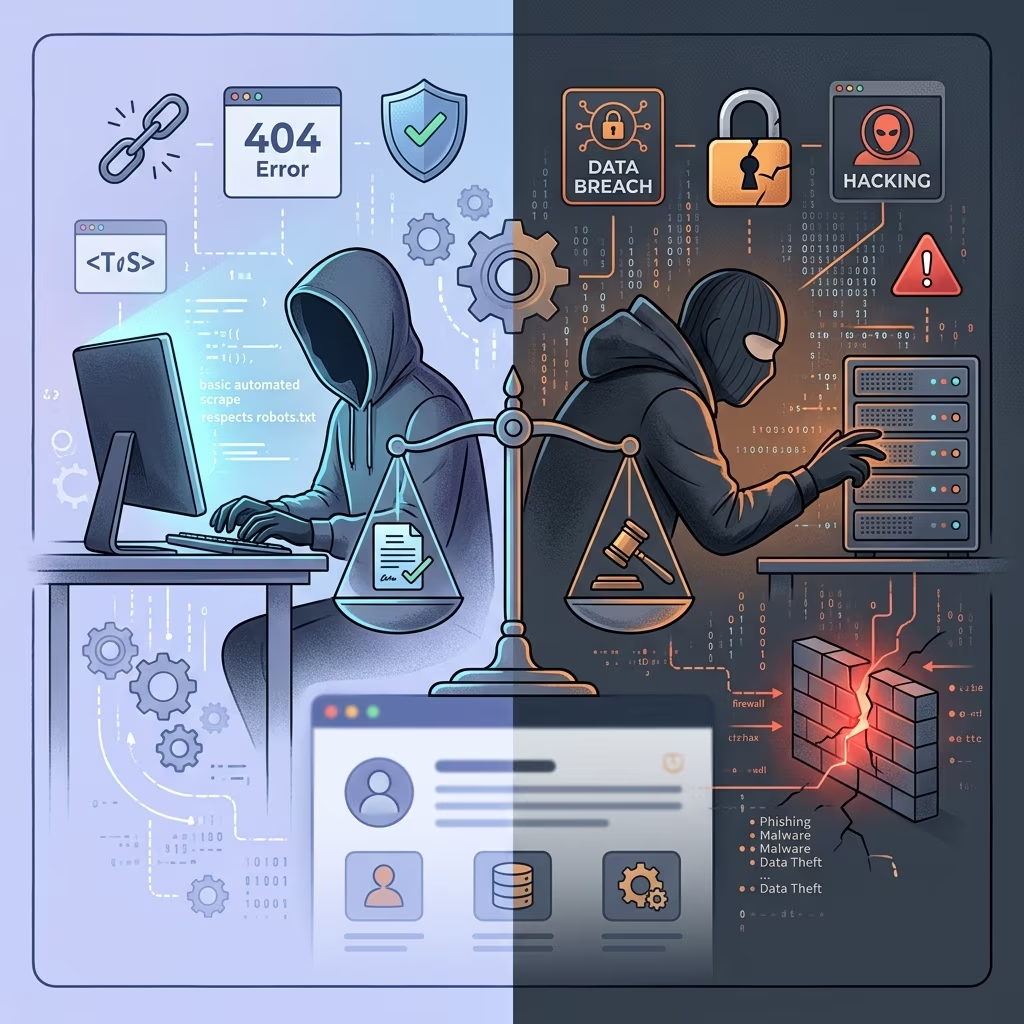
Every modern website comes with a wall of text: terms of service, terms of use, or user agreements that most people scroll past and accept without reading. Violating those rules may get your account banned, but in the United States it usually does not make you a criminal. The difference between a mere breach of contract and computer crime turns on how courts interpret statutes like the Computer Fraud and Abuse Act (CFAA).
This article explains why courts have rejected the idea that violating website terms of service alone can trigger federal criminal liability, while still recognizing that such violations can create civil consequences and other legal risks. It draws on major U.S. decisions, including Supreme Court guidance, and places them in the broader context of online contracts and data access rules.
Understanding Website Terms of Service
Terms of service (ToS) define the rules for using a website or online service. They are typically treated as a contract between the site operator and the user. In practice, they perform several functions at once:
- Set usage rules, such as prohibiting spam, harassment, copyright violations, or automated scraping.
- Limit liability for outages, errors, or third‑party content.
- Clarify intellectual property rights, including what users may do with site content and how they must respect trademarks and copyright.
- Reference privacy practices and link to a separate privacy policy required by data protection laws.
- Define governing law and jurisdiction for disputes, ensuring a predictable legal forum.
From a legal standpoint, ToS act primarily as contracts. If you break them, the default consequence is a claim for breach of contract, not criminal prosecution. The challenge arises when criminal statutes refer to “authorization” or “permission” to access computers or data, raising the question: can private contract language redefine what counts as a crime?
Why Courts Resist Criminalizing Contract Violations
The U.S. Computer Fraud and Abuse Act, enacted in 1986 and amended multiple times since, makes it a crime to access a computer “without authorization” or to “exceed authorized access” in certain circumstances.[CFAA] For years, some prosecutors and private parties argued that violating a site’s ToS qualifies as “exceeding authorized access,” especially when automated tools or scraping are involved.[10]
U.S. appellate courts and the Supreme Court have moved sharply away from this expansive view. Their core concerns include:
- Overcriminalization of everyday behavior
Turning ToS violations into crimes could make ordinary users potential felons for misrepresenting their age, sharing passwords, or running harmless scripts on sites that technically forbid them.[CFAA][10] - Delegating criminal law to private companies
Letting each website owner define “authorization” through ToS would give private actors the power to decide what is criminal in their online spaces, contrary to rule‑of‑law principles.[CFAA] - Vagueness and lack of notice
Terms are often lengthy, technical, and frequently updated. Treating them as criminal rules creates serious notice and due‑process problems.
In Van Buren v. United States, the Supreme Court adopted a narrow reading of “exceeds authorized access,” holding that the CFAA targets “breaking into” parts of a computer that are off‑limits, not merely violating rules about why or how you use data you are allowed to reach.[CFAA] This decision strongly supports the position that ToS violations, on their own, generally fall outside criminal CFAA liability.
Public Websites vs. Restricted Systems
A key distinction in modern case law is between:
| Type of Access | Typical Legal View | Role of Terms of Service |
|---|---|---|
| Publicly available websites | Accessing visible pages without bypassing technical barriers is generally considered authorized, even if ToS are violated.[CFAA][10] | ToS mainly create civil contract obligations and can support civil claims or bans, but not criminal liability by themselves. |
| Password‑protected or restricted systems | Bypassing authentication or using stolen credentials can be “without authorization” and trigger CFAA or other criminal statutes.[CFAA] | ToS may clarify acceptable use, but technical access controls and permission structures are more legally decisive. |
| Circumventing technological barriers | Evading IP blocks, rate limiting, or other defensive measures can support claims of unauthorized access or other computer crimes.[10] | ToS often warn against such conduct, but the criminal focus remains on circumvention of technical controls, not on contract language alone. |
Where courts see a user crossing a clear technical boundary—such as accessing data that is not publicly visible, using hacked credentials, or conducting a denial‑of‑service attack—criminal statutes may apply regardless of ToS.[CFAA][10] When users stay on the public side of the firewall and merely ignore contractual conditions, the legal response usually shifts to civil law.
Civil Consequences of Violating Terms of Service
Although violating ToS is usually not criminal, it can still carry significant civil and practical consequences.
- Breach of contract claims
Site owners can sue for damages if they can show that the violation caused financial or operational harm—for example, large‑scale scraping that undermines a paid database. - Intellectual property disputes
Using content beyond what ToS allow (e.g., copying images or text for commercial reuse) may lead to copyright or database‑rights claims, especially in jurisdictions that provide special protection for databases. - Unfair competition and tort claims
Systematic misuse of data or services can support claims of unfair competition or general tort liability, if a competitor takes a free ride on another party’s investment. - Account termination and technical blocking
Owners can revoke access, ban accounts, block IP addresses, or adjust defenses like CAPTCHAs and rate limits.
In Europe, for example, scraping commercial databases without consent may infringe the sui generis database right, leading to injunctive relief and damages. In the U.S., copyright and contract claims can be combined to protect data and content, even when criminal statutes are not available.
Web Scraping, Bots, and Automated Access
Web scraping tools automatically extract data from websites. Legality depends on several factors, including the nature of the data, applicable data protection and copyright rules, and compliance with ToS.[10]
From a legal perspective, key considerations include:
- Data type
Scraping publicly accessible, non‑personal data is generally less problematic than harvesting personal information or sensitive data, which may trigger privacy and data protection rules. - Respect for technical measures
Ignoring robots.txt files, CAPTCHAs, or IP blocks may show an intent to evade protective measures, strengthening claims of unauthorized access in some jurisdictions.[10] - Contractual restrictions
Many sites explicitly prohibit scraping or using bots in their ToS. Violating such clauses is usually treated as a contractual breach, not a criminal act, but may support other legal claims. - Scale and impact
High‑volume scraping that disrupts service or burdens infrastructure can resemble a denial‑of‑service attack, which is criminal under various computer misuse statutes.[10]
Courts often distinguish between reading publicly available webpages with automated tools, which resembles conventional browsing, and breaking into protected portions of a system or deliberately overloading it, which may trigger criminal liability.[CFAA][10] ToS play a supporting role, but the decisive factor is typically whether the conduct bypasses technological boundaries or causes significant harm.
Designing Terms of Service with Legal Clarity
Even though ToS violations alone are not usually criminal, well‑drafted terms remain crucial for managing risk and preserving legal options. Effective website terms generally:
- Describe permitted and prohibited uses
Clearly list forbidden activities, such as spam, harassment, copyright infringement, automated scraping, and attempts to bypass security measures. - Link to a privacy policy
Explain how user data is collected, stored, and processed, and cross‑reference mandatory privacy disclosures. - Clarify intellectual property ownership
State who owns site content and what users may do with it, including any licenses or restrictions on reuse. - Limit liability and disclaim warranties
Set boundaries for responsibility regarding uptime, accuracy of information, and third‑party interactions, within the limits of applicable law. - Specify governing law and forum
Indicate which jurisdiction’s laws apply and where disputes must be brought, fostering predictability and reducing forum shopping.
For operators concerned about scraping or automated access, legal guidance typically recommends combining contractual provisions with technical controls:
- Including explicit anti‑scraping clauses in ToS.
- Using click‑wrap or similar mechanisms that require active acceptance.
- Deploying robots.txt, CAPTCHAs, IP blocking, and rate limiting to signal and enforce access boundaries.
This layering of contract, technology, and, where appropriate, statutory rights creates a more robust protection scheme than relying on criminal law alone.
Practical Guidance for Users and Developers
For everyday users and developers, understanding the difference between civil and criminal consequences helps calibrate risk. The following bullet points offer practical guidelines:
- Assume ToS are enforceable contracts: Ignoring them may lead to account bans or civil claims, even if you are not committing a crime.
- Do not bypass technical barriers: Using stolen credentials, hacking access controls, or evading active blocks can cross into criminal territory.[CFAA][10]
- Be cautious with scraping: Review ToS, respect robots.txt and rate limits, and avoid personal or sensitive data without proper legal basis.[10]
- Separate legal and ethical questions: Conduct that is lawful may still be unwelcome or harmful; company policies and professional standards may impose stricter obligations.
- Seek legal advice for large‑scale or commercial projects: Complex data uses, especially across borders, raise multiple overlapping legal issues.
Frequently Asked Questions (FAQs)
Is violating a website’s terms of service a crime by itself?
In most U.S. scenarios, no. Courts have rejected reading the Computer Fraud and Abuse Act so broadly that any ToS breach becomes criminal. Violations are generally treated as contract issues unless they involve hacking, bypassing technical controls, or other independently unlawful conduct.[CFAA][10]
Can I be sued for breaking terms of service even if I’m not prosecuted?
Yes. A site owner may bring a civil lawsuit for breach of contract, intellectual property infringement, or related claims if it can show harm caused by the violation. Criminal law and civil liability operate independently.
Is web scraping legal if a website forbids it in the terms?
Scraping that ignores a clear contractual prohibition is likely a contract breach, and may support claims related to database rights, copyright, or unfair competition in some jurisdictions.[10] Whether it is criminal depends on whether you bypass technical access controls or cause system damage, not merely on the presence of a clause in the ToS.[CFAA]
Do I have to publish terms of service for my own website?
Most jurisdictions do not legally require ToS pages for websites, but they are strongly recommended because they define use rules, limit liability, and protect intellectual property. Privacy notices, by contrast, are often mandatory under data protection laws.
How should websites protect themselves against abusive access?
Legal guidance suggests combining clear ToS, active acceptance mechanisms, and technical safeguards like robots.txt, CAPTCHAs, IP blocking, and rate limiting. This approach reinforces contractual restrictions, supports civil claims, and, where warranted, complements criminal enforcement.
References
- Computer Fraud and Abuse Act, 18 U.S.C. § 1030 — United States Congress. 1986 (as amended). https://uscode.house.gov/view.xhtml?req=granuleid:USC-prelim-title18-section1030
- Van Buren v. United States, 593 U.S. ___ (2021) — Supreme Court of the United States. 2021-06-03. https://www.supremecourt.gov/opinions/20pdf/19-783_k53l.pdf
- Il tuo sito web ha davvero bisogno dei termini di utilizzo? — Mailchimp. 2023-03-01. https://mailchimp.com/it/resources/website-terms-of-use/
- Come scrivere i termini e le condizioni per un sito web in Italia — myPOS. 2022-05-10. https://www.mypos.com/it-it/blog/guida-imprese/come-scrivere-i-termini-e-le-condizioni-per-un-sito-web-in-italia
- Come proteggersi dal web scraping: aspetti legali per difendersi — Studio Legally. 2023-09-15. https://studiolegally.com/diritto-digitale/strumenti-legali-per-web-scraping/
- Termini di servizio — Google. 2024-07-30 (announced update). https://policies.google.com/terms