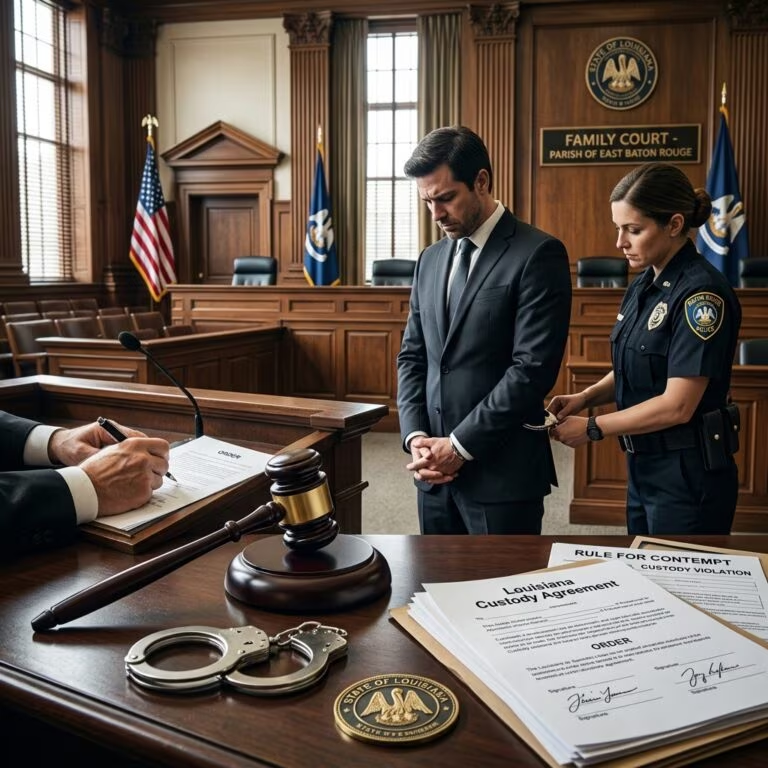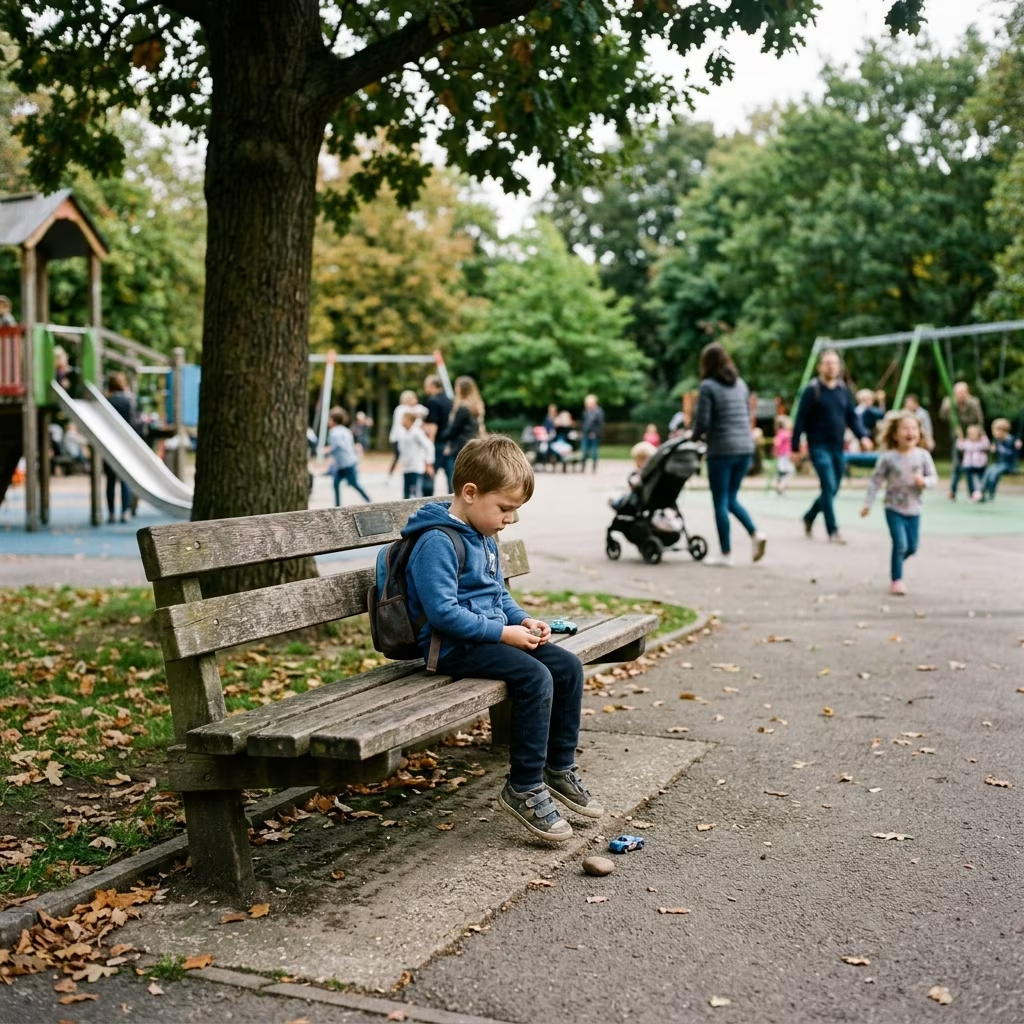
Cases involving children left without adult supervision often trigger strong reactions because they sit at the intersection of safety, poverty, parenting, and criminal law. A situation that may look harmless to one observer can, to authorities, look like neglect or abandonment. The legal question is rarely whether a parent made a perfect choice; it is whether the child was exposed to a foreseeable and unreasonable risk of harm.
Public debate around these incidents is often emotional because the facts can be more complicated than they first appear. A parent may be trying to work, arrange childcare, or make a difficult decision under pressure. At the same time, police and child-protection agencies are tasked with acting when a child appears vulnerable. The result can be a harsh clash between everyday parenting realities and a criminal system that prefers bright lines over nuance.
Why these cases draw so much attention
Stories about a child alone in a park attract attention because they raise a basic question: how much independence is appropriate for children at different ages? Some communities see supervised play in public places as normal, while others view any absence of an adult as dangerous. That disagreement becomes more intense when the parent’s decision is tied to employment, lack of childcare, or economic hardship.
- They force people to confront different standards of “reasonable” supervision.
- They highlight the gap between ideal parenting and real-world constraints.
- They raise questions about when police should intervene versus educate.
- They often expose how race, class, and neighborhood norms can shape enforcement.
In many controversies, the child is not injured and may even have been in a place that seems generally safe. Yet the legal system does not wait only for harm to happen. If officials believe the child faced a substantial risk, they may treat the situation as neglect even if the parent intended no harm.
How child neglect is usually evaluated
Child neglect laws vary by state, but most focus on whether a parent or caregiver failed to provide necessary care or protection. The analysis often includes the child’s age, maturity, location, duration of the absence, the surrounding environment, and whether the child could reach help if needed. Courts and agencies may also consider whether the parent had a practical alternative.
The legal standard is usually not “Was the parent perfect?” It is closer to “Did the parent expose the child to an unreasonable risk that a responsible adult would have avoided?” That distinction matters because many difficult parenting decisions involve tradeoffs, not clear-cut answers.
| Factor | Why it matters |
|---|---|
| Age of the child | Younger children are generally considered less able to handle emergencies or make safe choices. |
| Length of time alone | A short errand is viewed differently from leaving a child unattended for hours. |
| Environment | A busy park, a locked home, or a supervised public space may present different risks. |
| Ability to get help | If the child can contact an adult or safely seek assistance, the risk may be lower. |
| Parent’s explanation | Work obligations, emergency circumstances, or repeated pattern matter to investigators. |
These factors are rarely examined in isolation. Authorities often look at the total picture to decide whether intervention is necessary. A child who is briefly left in a controlled setting may not present the same legal problem as a child left without support in a place where conditions could change quickly.
The difference between poor judgment and criminal neglect
One of the hardest issues in these cases is the boundary between a questionable parenting choice and a criminal offense. Criminal neglect generally requires more than a decision others dislike. Prosecutors usually need to show that the parent’s conduct created a meaningful danger, or that the parent disregarded obvious risks.
That distinction is important because many parents make imperfect choices under pressure. A parent may rely on a familiar public place, believe the child is capable of handling a short period alone, or have no affordable childcare available. Those circumstances do not automatically excuse the decision, but they may matter when deciding whether a criminal charge is appropriate.
- Poor judgment may lead to counseling, a warning, or a child-welfare referral.
- Neglect can lead to arrest, prosecution, or temporary loss of custody.
- Intent is not always required, but knowledge of risk often matters.
In practice, the line can be blurry. Two cases with similar facts may lead to different outcomes depending on local policy, prior history, and how a responding officer interprets the scene.
Why context matters so much
Context can change the legal meaning of the same act. Leaving a child at a park for a few minutes while standing nearby is not the same as leaving the child far away with no way to communicate. Likewise, a child’s age matters. A nine-year-old may be capable of more independence than a toddler, but that does not mean the child can be left unattended anywhere at any time.
Public debate often misses a key point: the law does not ask whether a child can survive a situation in the abstract. It asks whether a reasonable caregiver would consider the arrangement safe under the circumstances. Heat, distance, traffic, strangers, weather, and emergency access all influence that answer.
Courts and agencies also examine whether the parent had a pattern of leaving the child alone or whether the event was a one-time response to an emergency. A repeated pattern can suggest disregard. A single mistake may be treated differently, especially if the parent sought help or was trying to avoid a known danger.
The role of poverty and childcare gaps
Many high-profile supervision cases are shaped by money problems rather than indifference. When a parent cannot afford childcare, a fixed work schedule can create impossible choices. In those situations, the law may seem to punish the family for lacking access to affordable support instead of addressing the underlying need.
This does not mean the child is safe simply because the parent had limited options. It does mean that criminal justice responses can be especially harsh when poverty drives the decision. A more balanced approach may include emergency childcare referrals, family support services, and school or community programs that reduce the need for risky arrangements.
- Affordable childcare shortages can force parents into unsafe workarounds.
- Public assistance may be difficult to access quickly enough to solve immediate needs.
- Child-welfare systems may respond to visible risk without solving the root cause.
Because of these pressures, some advocates argue that the legal system should separate genuine disregard from survival-driven decisions. Others respond that a difficult financial situation does not eliminate the need to protect children from foreseeable danger. Both concerns can be true at once.
How authorities may respond
Once a child is found alone, the response can move quickly. A bystander may call police, officers may interview the child and parent, and child protective services may become involved. Depending on the facts, authorities may decide to file charges, place the child with another relative, or release the parent with conditions.
Responses vary widely because there is no universal formula for supervision cases. In some places, officials emphasize criminal enforcement. In others, they may focus on family reunification and education. Local culture matters too; communities differ in how much unsupervised independence they expect from children.
For parents, this means a single moment can have outsized consequences. Even if the child was not injured, an arrest record, custody review, or court case can follow. That is why families often need a lawyer quickly if a neglect accusation arises.
Defenses and explanations that may matter
Not every allegation of neglect tells the full story. Parents may have explanations that change the legal analysis or reduce the seriousness of the case. A defense does not guarantee dismissal, but it can influence how prosecutors and judges view intent and risk.
- The child was close enough to be monitored indirectly.
- The parent believed the environment was secure and age-appropriate.
- The absence was brief and tied to work or another urgent need.
- The parent had no realistic alternative childcare option.
- The child had instructions, communication tools, or access to trusted adults.
Defense lawyers often focus on whether the prosecution can prove actual danger rather than simply bad optics. They may also challenge the fairness of labeling a child “abandoned” when the parent was nearby, reachable, or acting under economic stress.
What parents can do to reduce risk
Parents do not need perfect circumstances to make safer choices. Even when options are limited, small planning steps can reduce exposure to legal trouble and protect children more effectively.
- Know local supervision expectations and childcare rules.
- Arrange backup caregivers before an emergency arises.
- Use community programs, school services, or family support networks when possible.
- Choose environments where adults are close by and help is easy to reach.
- Document efforts to find lawful, safer care when work conflicts arise.
These measures are not a substitute for policy solutions. They simply lower the chances that a difficult day becomes a legal crisis. In many cases, the safest path is not to ask whether a child can technically manage alone, but whether the setting is one a responsible adult would truly accept.
Frequently asked questions
Is it always illegal to let a child play alone in public?
No. Legality depends on state law, the child’s age, the location, the amount of time alone, and the level of risk involved. A small, predictable situation may be treated differently from one that exposes the child to serious danger.
Can a parent be arrested even if the child was not hurt?
Yes. Authorities can act based on the risk of harm, not just actual injury. A child does not need to be physically injured for a neglect charge to be considered.
Does poverty excuse leaving a child unattended?
Poverty does not automatically excuse the conduct, but it can be relevant to intent, necessity, and available alternatives. Courts and agencies may consider whether the parent had any realistic option besides the one chosen.
What should a parent do after a neglect allegation?
A parent should seek legal advice promptly, avoid making detailed statements without counsel, and gather any records that help explain the circumstances. If child protective services is involved, calm cooperation and accurate information are important.
Why do similar cases sometimes end differently?
Outcomes can depend on the county, the officer’s judgment, the prosecutor’s priorities, the family’s history, and how the facts are documented. Two similar situations may produce different results because child-neglect law leaves room for discretion.
References
- Working Mom Arrested for Letting Her 9-Year-Old Play Alone at Park — The Atlantic. 2014-07-21. https://www.theatlantic.com/national/archive/2014/07/arrested-for-letting-a-9-year-old-play-at-the-park-alone/374436/
- Working Mom Arrested for Letting Her Daughter Play Outside — New York Magazine. 2014-07-21. https://nymag.com/intelligencer/2014/07/mom-arrested-for-letting-daughter-play-outside.html
- In Georgia, Is It a Crime To Let Your Kid Walk Alone? — Imprint News. 2024-05-15. https://imprintnews.org/top-stories/is-it-a-crime-to-let-your-kid-walk-alone-in-georgia-parents-see-new-legal-protections/262026
- Mom arrested for leaving 9-year-old alone at park — CNN. 2014-07-21. https://www.cnn.com/2014/07/21/living/mom-arrested-left-girl-park-parents
- Mother arrested after toddler found alone at playground in extreme heat — Walton County Sheriff’s Office. 2024-06-09. https://waltonso.org/mother-arrested-after-toddler-found-alone-at-playground-in-extreme-heat/