Jury duty is one of the main ways citizens participate directly in the justice system. When you are summoned, it is normal to feel uncertain about what will happen, how long it will take, and what you will be expected to do. This guide walks through each step, from receiving a summons to returning a verdict, so you can approach jury service with confidence.
Why Jury Duty Matters
In the United States, juries help decide the facts in both criminal and civil cases, applying the law as the judge explains it to reach a fair outcome. Serving as a juror is considered a core civic duty, much like voting. You do not need legal training to serve; courts rely on ordinary people using common sense and fairness.
Your key responsibilities as a juror include:
- Listening carefully to all testimony and evidence
- Following the judge’s instructions about the law
- Avoiding outside research or discussion about the case
- Deliberating honestly with fellow jurors to reach a verdict
From Summons to Service: How You Get Selected
Most people first encounter jury duty through an official document in the mail called a jury summons. This does not guarantee you will serve on a trial, but it does require you to report and be available for selection.
How Your Name Enters the Jury Pool
Courts build a broad list of potential jurors to reflect the community fairly. Common source lists include:
- Voter registration records
- Driver’s license or state ID databases
- Other state or local records when needed to broaden representation
Names are chosen at random from these lists to create a master jury wheel or jury pool. If your name is drawn, you may receive a summons and/or a questionnaire.
The Juror Questionnaire
Before your appearance date, the court may ask you to complete a written or online questionnaire. Typical questions cover:
- Basic identifying information and contact details
- Citizenship and residency
- Ability to understand English
- Any disqualifications or hardships that might prevent you from serving
Honest, accurate answers are essential. The court uses these responses to determine whether you are legally qualified and to organize the selection process efficiently.
Common Eligibility Basics
While rules vary by jurisdiction, many courts follow standards similar to federal rules, which generally require that jurors:
- Are at least 18 years old
- Are U.S. citizens
- Reside within the court’s geographic area
- Can read, write, and understand English
- Do not have disqualifying criminal convictions or other legal barriers
Your First Day at the Courthouse
On the day listed in your summons, you will report to the courthouse or other designated location. Expect security screening similar to airport checkpoints, including metal detectors and bag checks.
Checking In and Waiting
After entering the building:
- You will check in with jury staff or a clerk
- You may receive an orientation video or brief presentation about jury service
- You will likely wait in a central jury assembly room while the court determines which trials are ready to proceed
During this waiting period, court staff and judges are resolving pretrial issues, plea discussions, and scheduling questions. When a case is ready for trial, the judge will request a panel of prospective jurors from the assembly room.
Being Sent to a Courtroom
When called, you and a group of other potential jurors will be escorted to a courtroom as a jury panel. This is the group from which the actual trial jury will be chosen.
Jury Selection: Questions and Challenges
The process of choosing the trial jury from the panel is called voir dire, a phrase meaning “to speak the truth.” The goal is to ensure an impartial jury that can decide the case fairly.
What Happens During Voir Dire
Once in the courtroom, several things usually occur in sequence:
- The judge introduces the case, the charges or claims, and the people involved
- The panel is sworn to answer questions truthfully
- The judge and attorneys ask general and case-specific questions to evaluate potential bias
Questions may explore:
- Prior knowledge of the case or parties
- Personal experiences with law enforcement, lawsuits, or similar issues
- Opinions that might affect your ability to be fair and impartial
Challenges for Cause and Peremptory Challenges
Based on your answers, lawyers may ask the judge to excuse certain panel members. Two main types of challenges are used:
- For-cause challenges: A juror is excused because they cannot be impartial, understand the proceedings, or meet legal requirements.
- Peremptory challenges: Each side has a limited number of removals that do not require a stated reason, though they cannot be used for discriminatory purposes.
The process continues until the required number of jurors (and sometimes alternates) have been selected. Those chosen are sworn in as the jury; those not chosen may either return to the assembly room or be dismissed.
Inside the Courtroom: Roles and Ground Rules
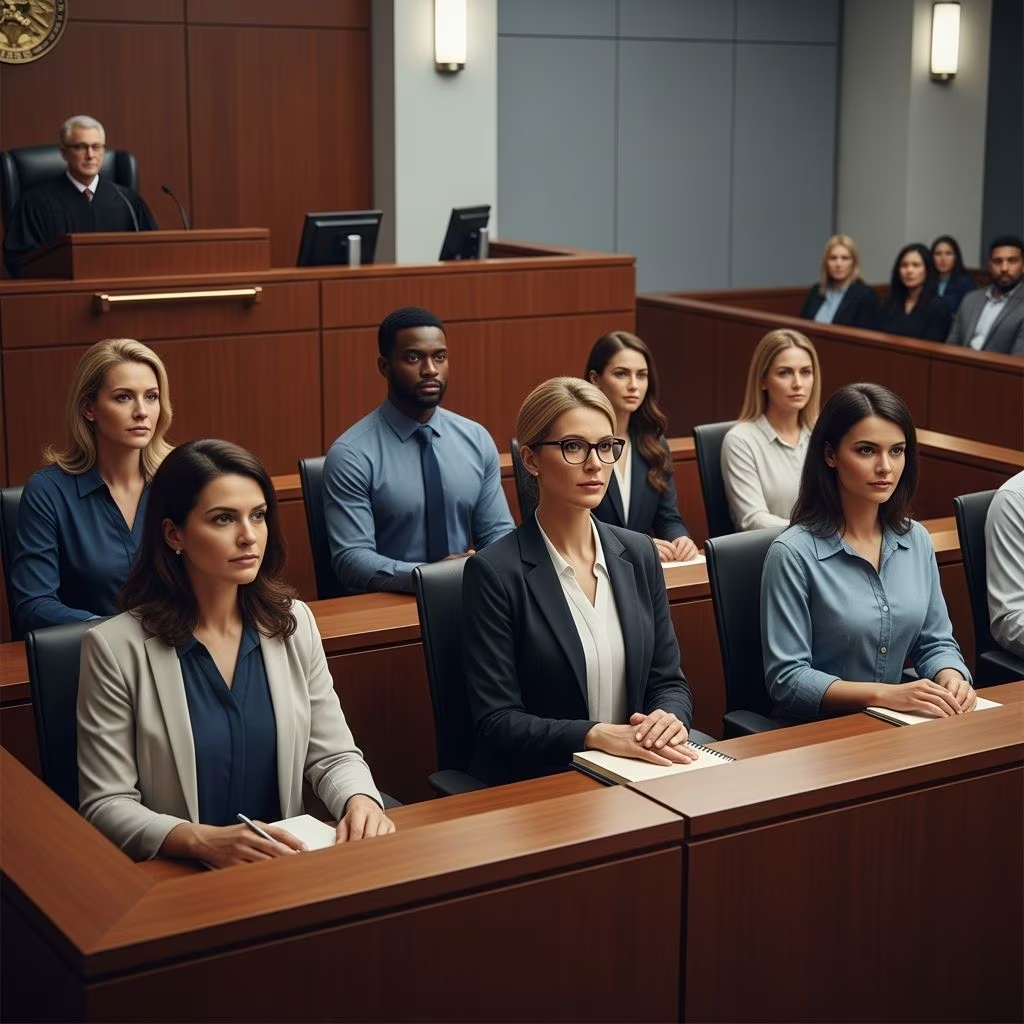
Once sworn in, jurors become central participants in the trial. It helps to know who else is in the room and what the expectations are.
Key Participants in a Trial
| Participant | Primary Role |
|---|---|
| Judge | Presides over the case, rules on legal issues, and instructs the jury on the law. |
| Jurors | Listen to evidence, decide what facts are proven, and reach a verdict based on the law. |
| Attorneys | Present evidence, question witnesses, and argue how the law should apply to the facts. |
| Parties | The people or organizations bringing and defending the case. |
| Court clerk | Manages exhibits, swears in witnesses, and handles records and scheduling. |
| Bailiff | Maintains order, assists the judge, and helps manage the jury. |
Proper Juror Conduct
Court rules are strict about how jurors must behave to protect the fairness of the trial.
- Do not investigate the case on your own—no online searches, news reading, or site visits.
- Do not discuss the case with anyone, including other jurors, until deliberations begin.
- Avoid social media posts or messages about your service or the trial while it is ongoing.
- Pay close attention to all testimony and evidence; take notes if the judge permits it.
- Follow the judge’s instructions even if they differ from your expectations about the law.
How a Trial Typically Unfolds
Although each case is unique, many trials follow a predictable sequence once the jury is sworn in.
1. Opening Statements
Each side may give an opening statement to outline what they believe the evidence will show.
- The party with the burden of proof (prosecution in a criminal case, plaintiff in a civil case) usually goes first.
- Opening statements are not evidence; they are roadmaps of the case.
2. Presentation of Evidence
This phase makes up most of the trial. Evidence may include:
- Witness testimony from people who observed events or have relevant knowledge
- Expert testimony from professionals qualified in specific fields
- Exhibits such as documents, photographs, recordings, or physical objects
The judge decides what evidence the jury is allowed to see or hear by applying the rules of evidence. Jurors must base decisions only on admitted evidence and not on speculation or information from outside the courtroom.
3. Closing Arguments
After all evidence has been presented, the attorneys deliver closing arguments.
- Each side summarizes key points of the evidence and explains how it supports their position.
- As with openings, arguments are not evidence; they are interpretations of what you have heard and seen.
4. Jury Instructions
The judge then gives detailed instructions about the law that applies to the case and your duties as jurors.
- In a criminal case, you may be told about the presumption of innocence and the burden of proof “beyond a reasonable doubt.”
- In a civil case, you might hear about liability standards and the “preponderance of the evidence” standard.
These instructions guide how you must evaluate the facts. For example, the judge may define legal terms and explain what elements must be proven before you can find someone liable or guilty.
Deliberations and Reaching a Verdict
Once instructions are complete, the jury retires to a private room to deliberate. This is the only time jurors may openly discuss the case with each other.
The Deliberation Process
- The jury selects a foreperson to help organize discussion and communicate with the court.
- Jurors review evidence and, if allowed, their notes, discussing disputed points and different interpretations.
- Each juror must decide the case individually but should keep an open mind and listen to others.
Judges stress that jurors must reach their decisions solely on evidence and law, not on sympathy, prejudice, or outside influence.
Verdict Requirements
The number of jurors and how many must agree on a verdict vary by jurisdiction and case type.
- Many criminal cases require a unanimous verdict by all jurors.
- Some civil cases may allow a verdict with agreement by fewer than all jurors, depending on local rules.
If the jury cannot agree after significant deliberation, the judge may declare a mistrial. The case could then be retried with a new jury.
Announcing the Verdict
After the jury has reached its decision:
- The jurors return to the courtroom and the foreperson delivers the verdict form to the judge or clerk.
- The verdict is read aloud in open court.
- In some courts, lawyers may request to “poll” the jury, asking each juror to confirm the verdict individually.
Once your duties are complete, the judge will formally excuse you, often with thanks for your service.
Practical Tips for Jurors
To make your experience smoother and more comfortable, consider the following:
- Arrive early to allow time for parking, security, and check-in.
- Dress comfortably but respectfully—many courts suggest business casual attire.
- Bring reading material for waiting periods, but avoid anything related to law or the specific case.
- Plan for time away from work, caregiving, or school; ask your employer in advance about jury duty policies.
- Keep your summons and any proof-of-service documents for your records or employer.
Frequently Asked Questions About Jury Duty
Do I have to serve if I am summoned?
In most cases, yes. A jury summons is a court order requiring you to appear unless the court excuses you for legal reasons such as disqualification, hardship, or prior service. Ignoring a summons can result in penalties.
Will I definitely serve on a trial?
No. Many people report as required but are never seated on a jury. You might be excused based on questionnaire responses, not be chosen during voir dire, or be released if there are more prospective jurors than needed.
How long does jury service last?
Length of service varies by court. Some courts use a “one day or one trial” system, where your obligation ends after one day if you are not selected, or when the trial you’re on concludes if you are chosen. Other courts may require a longer service window but may not need you every day within that period.
Can I talk about the case after it is over?
After the judge dismisses you, restrictions on discussing the case usually end. However, some jurors prefer not to talk about their experience, and in rare situations the court may give additional instructions. Always follow any final directions from the judge.
Do I need legal knowledge to be a good juror?
No. Courts emphasize that jurors are not expected to know the law beforehand. Your role is to decide what facts the evidence proves, while the judge explains the law and how you must apply it.
References
- Jury Service — United States Courts. 2023-04-01. https://www.uscourts.gov/court-programs/jury-service
- Juror Selection Process — United States Courts. 2023-04-01. https://www.uscourts.gov/court-programs/jury-service/juror-selection-process
- Role of Jurors & Jury Trial Process — Jefferson County Superior Court, WA. 2022-05-10. https://www.co.jefferson.wa.us/198/Role-of-Jurors-Jury-Trial-Process
- How a Jury is Chosen — Seattle Municipal Court. 2022-03-15. https://www.seattle.gov/courts/jury/reporting-for-jury-duty/how-a-jury-is-chosen
- A Juror’s Guide — Washington Courts. 2021-09-01. https://www.courts.wa.gov/newsinfo/resources/?fa=newsinfo_jury.jury_guide
- Answering the Call for Jury Service: Jury Duty Explained — Superior Court of California, County of Los Angeles (via YouTube). 2020-06-18. https://www.youtube.com/watch?v=eoITNwwyCac