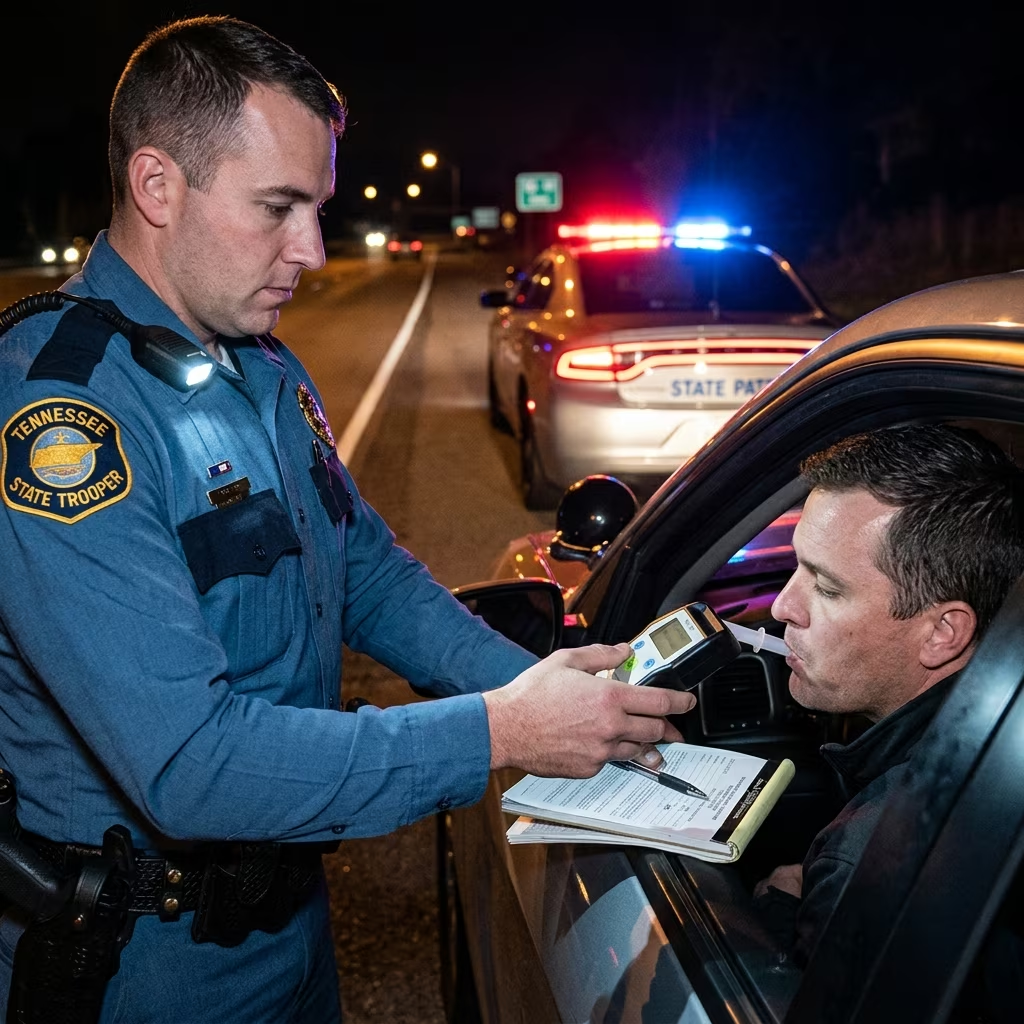
In Tennessee, a driving under the influence (DUI) charge does not automatically lead to a conviction. To secure a guilty verdict, police and prosecutors must establish several specific facts, often called elements of the offense, beyond a reasonable doubt. Understanding these elements is crucial for anyone facing a DUI allegation or wanting to better understand how Tennessee’s impairment laws work.
Under Tennessee law, it is illegal to drive or be in physical control of a motor vehicle in certain locations while impaired by alcohol, drugs, or a combination of substances, or while at or above the legal blood alcohol concentration (BAC) limit. Each part of that statement represents something the state must prove with evidence in court, not just suspicion.
Overview of Tennessee DUI Law
Tennessee’s primary DUI statute is Tennessee Code Annotated § 55-10-401. It makes it unlawful for any person to drive or be in physical control of a motor vehicle in specified areas while:
- Under the influence of an intoxicant, controlled substance, marijuana, or any substance that impairs the person’s ability to safely operate a motor vehicle; or
- Having a BAC of 0.08% or more (0.04% for commercial drivers);
- Or, for commercial vehicles, having a BAC of 0.04% or more while driving a qualifying commercial motor vehicle.
Because of this structure, the prosecution can proceed on either an “impairment” theory (showing that substances affected the driver’s abilities) or a “per se” theory (showing the BAC exceeded the legal limit), or both.
| Type of DUI Theory | What Must Be Shown | Key Evidence |
|---|---|---|
| Impairment DUI | Driver was under the influence of alcohol/drugs such that safe driving was impaired. | Driving behavior, officer observations, field sobriety tests, statements. |
| Per Se DUI | Driver’s BAC was at or above 0.08% (0.04% for commercial vehicles), regardless of visible impairment. | Breath, blood, or urine chemical test results; testing and calibration records. |
The Four Core Elements Police Must Establish
Although phrased differently in various legal discussions, Tennessee DUI prosecutions typically revolve around four core elements that must be proven beyond a reasonable doubt:
- Driving or physical control of a motor vehicle;
- In a location covered by the statute (public road or similar area);
- While impaired by alcohol, drugs, or having an unlawful BAC;
- Based on a lawful investigation and admissible evidence (including chemical tests, if used).
Each element can be contested. If the defense successfully creates reasonable doubt about any one of them, the jury should not convict on the DUI charge.
Element 1: Driving or Being in Physical Control
The first hurdle for the state is to show that the accused was either driving or in physical control of a motor vehicle. Tennessee law does not require the car to be moving at the moment the officer arrives. “Physical control” can be broader than actual driving and may include situations such as a person sitting in the driver’s seat with the keys readily available.
How Prosecutors Attempt to Prove Control
Evidence commonly used to show driving or control includes:
- Officer testimony about seeing the vehicle in motion or observing traffic violations;
- Location of the accused (for example, in the driver’s seat versus a passenger seat);
- Key position (in the ignition, on the floorboard, or in the person’s hand);
- Statements by the accused admitting they were driving or about where they were coming from;
- Witness accounts or video showing the person behind the wheel.
In some cases, a person may be found in a parked vehicle on the side of the road. Whether that counts as “physical control” depends on detailed facts, such as whether the engine is running, how close the vehicle is to travel lanes, and where the keys are located. These facts can become important defense issues.
Common Defense Arguments on Control
- Another person was actually driving, and the accused took over the driver’s seat after the vehicle stopped.
- The car was inoperable (for example, mechanically disabled) and not realistically capable of being driven.
- No clear evidence links the accused to the vehicle’s movement prior to police arrival.
Because the burden is on the prosecution, any significant uncertainty about who was driving can undermine this first element.
Element 2: Covered Roadway or Location
The statute does not apply everywhere. Tennessee law focuses on public roads, highways, streets, alleys, and premises generally open to the public, such as shopping center parking lots or apartment complexes. To convict, the state must show the vehicle was on a location that falls within these defined areas at the time of the alleged DUI.
Examples of Covered Locations
- Interstate highways and state routes;
- City streets, rural roads, and public alleys;
- Parking lots at shopping centers or grocery stores;
- Apartment complex or trailer park roads that are used by residents and visitors.
Private property that is not generally open to the public may fall outside the statute’s reach, but the analysis can be complex. For instance, a locked private driveway might be treated differently than an open commercial parking lot.
How Location Is Proven
Prosecutors commonly rely on:
- Officer testimony describing where the stop occurred;
- Photographs or dash-camera video showing the roadway or parking area;
- Maps, diagrams, or GPS data.
If the location is ambiguous or truly private, the defense may argue that the statute does not apply, potentially defeating this element.
Element 3: Impairment or Unlawful BAC
The third, and often most contested, element is whether the accused was either under the influence or had a prohibited BAC level. Tennessee law recognizes several pathways to proving this element, each with slightly different requirements.
Impairment-Based DUI
To prove an impairment DUI without relying solely on a numeric BAC, the prosecution must show that substances affected the driver’s ability to operate a vehicle safely, depriving them of the clearness of mind and control they would otherwise have. Evidence may include:
- Erratic driving, speeding, drifting between lanes, or failing to maintain a lane;
- Difficulty producing documents, fumbling with keys, or delayed responses;
- Odor of alcohol, slurred speech, bloodshot or watery eyes;
- Performance on standardized field sobriety tests (SFSTs), such as the walk-and-turn or one-leg stand;
- Admissions of drinking or drug use.
Impairment can stem from alcohol, illegal drugs, prescription medications, or a combination of substances that affect the central nervous system.
Per Se DUI Based on BAC
In addition to traditional impairment evidence, Tennessee recognizes per se DUI, where a valid chemical test shows a BAC at or above the legal limit. In most cases, this limit is:
- 0.08% BAC for typical non-commercial drivers;
- 0.04% BAC for drivers of commercial motor vehicles.
For drivers under 21, a separate “underage DUI” or related offense can apply at 0.02% BAC with specific penalties, even if traditional adult DUI standards are not met.
In a per se case, the focus is less on whether the driver appeared drunk and more on whether the test was lawfully obtained and accurate. A single reliable test showing BAC at or above the legal limit can be enough for this element.
Drug-Related and Combination DUIs
Not all DUIs involve alcohol. Tennessee law specifically covers impairment caused by:
- Illegal drugs or controlled substances;
- Marijuana or THC-containing products;
- Prescription medications used in ways that impair driving;
- Any combination of alcohol and drugs that reduces safe driving ability.
In drug DUI cases, prosecutors often rely on blood tests, officer observations, and, in some situations, testimony from trained drug recognition experts.
Element 4: Lawful Investigation and Admissible Evidence
Even if police suspect impairment, the evidence they collect must be obtained and preserved lawfully to be used in court. This element is not always listed explicitly in statutes but is critical because evidence gathered in violation of constitutional or statutory rules may be suppressed.
Reasonable Suspicion for the Stop
Officers typically need at least reasonable suspicion that a traffic or criminal violation has occurred before stopping a vehicle. Common reasons include:
- Speeding, failing to signal, or running a red light;
- Weaving, straddling lanes, or driving significantly below the speed limit;
- Equipment violations like broken headlights;
- Responding to a specific report or 911 call about erratic driving.
If the initial stop is unlawful, any evidence obtained afterward, including field sobriety tests or BAC results, may be challenged as the “fruit” of that unlawful stop.
Probable Cause for Arrest
Before making an arrest for DUI, the officer must generally have probable cause—a higher standard than reasonable suspicion. This is often based on:
- Driving behavior observed by the officer;
- Physical signs of intoxication;
- Performance on SFSTs;
- Admissions of drinking or using substances.
If probable cause is lacking, the defense may seek to suppress the arrest and any subsequent chemical tests.
Chemical Testing and Implied Consent
Tennessee has an implied consent framework, under which drivers implicitly agree to chemical testing for BAC or drugs when lawfully arrested for DUI. Refusing a requested test can lead to license revocation even if the person is not ultimately convicted of DUI.
However, for BAC or drug test results to be admitted as evidence, the state typically must show:
- The test was requested after a lawful arrest or otherwise legally authorized;
- The driver was properly informed of the consequences of refusal, where required;
- The test instrument (for example, a breathalyzer) was properly maintained and calibrated;
- Samples were collected, stored, and analyzed according to accepted protocols.
Recent and proposed changes to Tennessee DUI law have addressed issues like mandatory blood draws in serious DUI cases and expanded consequences for first-time offenders. Any new procedures must still comply with constitutional protections against unreasonable searches and seizures.
Penalties Once the Elements Are Proven
If the prosecution successfully proves all elements and secures a conviction, Tennessee imposes a series of mandatory penalties that increase with each subsequent offense. While exact details can change over time, the following table provides a snapshot of typical statutory ranges for adult offenders:
| Offense Level | Classification | Jail Time (Approximate) | Fine Range (Approximate) | License Revocation |
|---|---|---|---|---|
| First DUI | Misdemeanor | Minimum 48 hours up to 11 months, 29 days (longer minimum if higher BAC). | About $350 to $1,500. | About 1 year. |
| Second DUI | Misdemeanor | At least 45 days up to 11 months, 29 days. | About $600 to $3,500. | About 2 years. |
| Third DUI | Misdemeanor | At least 120 days up to 11 months, 29 days. | About $1,100 to $10,000. | Up to 6 years. |
| Fourth or more DUI | Felony | At least 150 days, with potential for significantly longer confinement under felony sentencing ranges. | About $3,000 to $15,000. | Up to 8 years or more, depending on circumstances. |
In addition to jail, fines, and license loss, courts can order community service, alcohol and drug treatment, participation in DUI education programs, and installation of ignition interlock devices once driving privileges are restored.
Why These Elements Matter for Defense Strategy
Because every DUI case must be built on the elements described above, effective defense strategies typically focus on creating reasonable doubt at one or more of these points. Common approaches include:
- Challenging whether the accused was driving or in control at all;
- Questioning whether the location falls under Tennessee’s DUI statute;
- Attacking the reliability of field sobriety tests or officer observations;
- Contesting the legality of the traffic stop or arrest;
- Scrutinizing chemical testing procedures, chain of custody, and instrument calibration.
Because Tennessee law imposes mandatory minimum penalties and escalating consequences for repeat offenses, the outcome of even a first DUI case can have long-term effects on driving privileges, employment, and insurance costs.
Frequently Asked Questions About Tennessee DUI Proof
1. Can I be convicted of DUI in Tennessee if I felt sober?
Yes. If your BAC is at or above 0.08%, prosecutors can pursue a per se DUI even if you did not feel drunk and were not driving erratically. Feeling sober is not a legal defense when the chemical test is reliable and lawfully obtained.
2. Do I have to be driving for police to charge me with DUI?
No. Tennessee law covers being in physical control of a motor vehicle, which can include situations where the vehicle is stationary but the person is in the driver’s seat with the ability to operate it. However, whether the state can prove physical control in a particular case depends on the specific facts.
3. What happens if I refuse a breath or blood test?
Refusal can lead to a separate administrative license revocation under Tennessee’s implied consent rules, even if you are not convicted of DUI. It may also affect how prosecutors build their case, often leading them to rely more heavily on officer observations and field sobriety tests.
4. Are underage drivers held to the same BAC standard?
No. Drivers under 21 can face consequences at a much lower BAC level—around 0.02%—under underage drinking and driving laws, even though traditional DUI standards use 0.08% for adults.
5. Can a prescription medication lead to a DUI charge?
Yes. Even if a medication is legally prescribed, driving while impaired by that medication can still form the basis for a DUI charge if it affects your ability to operate a vehicle safely.
References
- Tennessee Code § 55-10-401 (Driving under the influence) — Tennessee General Assembly. 2024. https://law.justia.com/codes/tennessee/title-55/chapter-10/part-4/section-55-10-401/
- Tennessee DUI Laws — FindLaw. 2023-05-23. https://www.findlaw.com/state/tennessee-law/what-are-the-tennessee-dui-laws.html
- DUI Offenses — Steve Oberman, tndui.com. 2023. https://www.tndui.com/areas-of-practice/dui-offenses/
- DUI Laws — Knox County General Sessions Judges. 2022. https://www.knoxcounty.org/gsjudges/dui_laws.php
- First DUI Offense Tennessee: What to Expect — Smart Start. 2023. https://www.smartstartinc.com/blog/first-dui-in-tn/
- DUI Offenses – Bill Tracking — Tennessee General Assembly. 2025. https://wapp.capitol.tn.gov/apps/subjectindex/BillsBySubject.aspx?PrimarySubject=1473
- New Tennessee DUI laws: Police can use “reasonable force” to get blood sample first time offenders can lose their license longer term — WSMV. 2025-12-31. https://www.wsmv.com/2025/12/31/new-tennessee-dui-laws-police-can-use-reasonable-force-get-blood-sample-first-time-offenders-can-lose-their-license-longer-term/