
Legal Marriage: How A Wedding Becomes Legally Valid Explained
Understanding how ceremonies, licenses, and state laws turn a relationship into a legally recognized marriage in the United States.
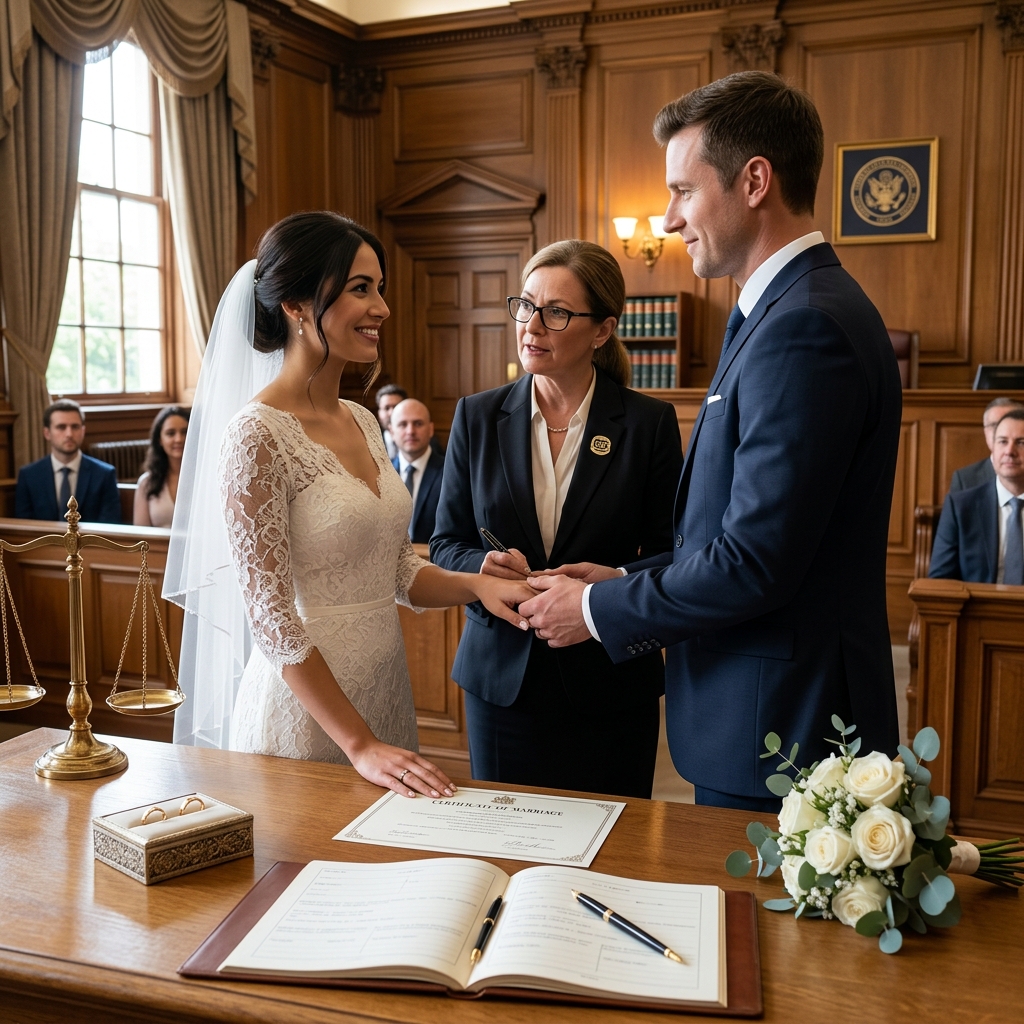
Television weddings, destination ceremonies, and reality shows often make marriage look like a purely romantic event. In law, however, marriage is a legal status that exists only when specific requirements are met and recorded by government authorities. This article explains what turns a relationship or ceremony into a legally valid marriage in the United States, and when a wedding that looks real on screen might not count in the eyes of the law.
Marriage as a Legal Union, Not Just a Ceremony
In U.S. law, marriage is defined as the legal union of individuals that creates rights and obligations between spouses. It is treated much like a contract: both parties must have the legal ability to marry, must give mutual consent, and must follow any formal requirements set by state law. Without those elements, a ceremony alone does not create a valid marriage.
- Legal union: The government recognizes the relationship and grants a specific legal status.
- Contract-like nature: Both parties must be capable of entering into a binding agreement.
- Formalities required: Licenses, officiants, and registrations are usually mandatory.
This distinction matters because couples who assume they are married based only on a ceremony may discover later that they lack rights related to taxes, inheritance, immigration, or medical decision-making.
Who Controls Marriage Rules? The Role of State Law
Marriage in the United States is primarily governed by state law, not federal law. Each state determines its own rules about age, necessary documents, waiting periods, and who may perform the ceremony. There is only one key federal principle: if a marriage is valid under the law of the state where it was performed, it is generally valid in every other state.
In practice, this means:
- Requirements to marry can vary substantially between states.
- A wedding conducted according to State A’s rules is usually recognized in State B.
- Couples should verify the rules of the state or country where they plan to marry, especially for destination weddings.
Core Elements of a Legally Valid Marriage
Despite variations among states, several core elements typically determine whether a marriage is legally valid:
- Legal capacity to marry
- Free and informed consent
- Compliance with age and relationship restrictions
- Issuance of a marriage license
- Performance of a ceremony by an authorized officiant
- Proper completion and registration of the marriage certificate
When these components are in place, the marriage is ordinarily treated as valid in the state of celebration and, under standard principles, in other states and for federal purposes such as immigration.
Legal Capacity and Age Requirements
To marry, both individuals must have the legal capacity to enter into the relationship. This includes meeting age requirements and being mentally able to give consent. Most states set the standard minimum age at 18 years, with limited exceptions in some jurisdictions.
Typical Age Rules
Across the United States, the general rule is:
- Most states: minimum marriage age of 18.
- Some states allow younger individuals to marry with parental or judicial consent.
- A few states have specific higher minimum ages or detailed conditions for exceptions.
Research has shown that marriage below age 18 is associated with negative outcomes, including higher rates of poverty, intimate partner violence, and lower educational attainment. These risks explain why many states have tightened or are reconsidering underage marriage rules.
Other Capacity Requirements
In addition to age, legal capacity involves:
- Being mentally competent to understand the nature of marriage and its consequences.
- Not being currently married to someone else, as bigamy is prohibited in all states.
- Complying with any state restrictions on close family relationships.
Consent: Voluntary and Free Agreement
A valid marriage requires that both parties give free, informed, and voluntary consent. Agreements obtained through coercion, fraud, or force can make a marriage void or voidable. This is particularly relevant in cases involving forced marriages or situations where an individual is pressured by family or others.
U.S. authorities treat forced marriage as a serious abuse. For citizens abroad, the State Department advises contacting a U.S. embassy or consulate if they are being forced into a marriage or prevented from leaving to avoid it.
The Marriage License: Gateway to a Legal Wedding
In most states, a marriage license is a central requirement. It is the document issued by a local government office—often the county or city clerk—that authorizes the couple to marry.
Common License Requirements
While details vary by state, couples can expect some or all of the following:
- Proof of identity, such as a driver’s license, passport, or other government ID.
- Birth certificates or proof of age.
- Social Security numbers for U.S. citizens, where required.
- Proof that prior marriages have legally ended, such as divorce decrees or death certificates.
- Payment of a license fee.
The license is typically valid for a limited time, and some states impose a waiting period between issuance and the ceremony. Failure to obtain or use the license correctly can raise questions about whether a marriage is valid.
The Ceremony and the Officiant
Once a license is issued, the couple must have the marriage solemnized—usually through a ceremony—by an authorized officiant. State law determines who can perform this role, ranging from judges and clerks to religious leaders and, in some jurisdictions, civil celebrants.
The ceremony does not have to be elaborate, and in many states it can be simple and brief. What matters legally is that:
- The officiant is authorized under applicable law.
- The couple exchanges some form of vows or statements of intent to marry.
- The officiant signs the marriage certificate after the ceremony.
Registration: Turning Paperwork into Legal Status
After the ceremony, the officiant is typically responsible for returning the signed marriage license or certificate to the appropriate government office for registration. Registration creates the official record of the marriage, and the issued certificate serves as proof of legal status.
Why Registration Matters
Proper registration is important because:
- A certified marriage certificate is often needed to prove a legal marriage in court, for taxes, or for benefits.
- Immigration authorities rely on official civil records to verify the validity of marriages used as a basis for naturalization and other benefits.
- Unregistered or improperly registered ceremonies can lead to disputes about whether a marriage exists.
For U.S. immigration purposes, the federal government generally applies a place-of-celebration rule: if the marriage is valid under the law of the jurisdiction where it was performed, it is recognized for immigration benefits, assuming no other disqualifying factors.
Common Law Marriage: When There Is No Ceremony
Not all legally recognized marriages arise from a formal ceremony with a license. A small number of U.S. states recognize common law marriages, which can form through conduct rather than explicit formalities.
Typical Requirements for Common Law Marriage
Among states that recognize it, common law marriage usually requires:
- Both parties meeting the state’s age of consent.
- Neither party already being married to someone else.
- Living together in a relationship akin to marriage (cohabitation).
- Representing themselves to others as married—for example, using the same last name or describing each other as spouses.
Even without a license or ceremony, a couple that satisfies these conditions in a state that recognizes common law marriage may be treated as legally married. However, requirements and recognition vary, and proving such a marriage can be more complicated than demonstrating a traditional civil marriage.
Civil Marriage vs. Religious or Symbolic Ceremonies
Many couples have religious or symbolic ceremonies that matter deeply to them but do not follow the civil procedures required by the state. It is important to distinguish between civil marriage and purely ceremonial unions:
- Civil marriage: Meets state requirements, including license and registration, creating legal status and rights.
- Religious-only or symbolic ceremonies: May carry spiritual or personal significance but may not create a legal marriage if civil rules are not followed.
This distinction is crucial in situations involving reality shows, staged weddings, or entertainment events that may look like real marriages but do not satisfy legal requirements. Without the underlying civil process, the televised or symbolic event alone usually does not create legal marital rights or obligations.
International Weddings and U.S. Recognition
Couples who marry outside the United States often want to know whether their marriage is recognized when they return home. U.S. authorities generally require that the marriage comply with the law of the country where it took place. That country’s rules can include:
- Residency requirements before marriage.
- Blood tests or medical checks.
- Age and parental consent rules.
- Proof of termination of prior marriages.
Once a marriage abroad is valid under local law, states typically recognize it, and it can be used for immigration or other legal purposes, subject to general U.S. public policy limits.
Legal Rights That Depend on a Valid Marriage
Establishing a legally valid marriage is important because it unlocks numerous rights and responsibilities. These can include:
- Access to favored tax filing statuses for married couples.
- Property rights, including inheritance expectations and rules for dividing marital property.
- Eligibility for spousal benefits under certain employer plans or government programs.
- Authority to make medical decisions for a spouse who is incapacitated.
- Immigration benefits, including certain naturalization options for spouses of U.S. citizens.
Because these rights hinge on proving a valid marriage, accurate documentation and compliance with legal formalities are essential.
FAQ: Common Questions About Legal Marriage
Does a televised or reality show wedding automatically create a legal marriage?
No. A wedding broadcast on television or staged for entertainment is legally effective only if the parties obtain a valid marriage license, use an authorized officiant, and register the marriage according to state law. Without these elements, the event is typically symbolic rather than legally binding.
Can a couple be considered married without a ceremony?
Yes, but only in jurisdictions that recognize common law marriage and only when specific conditions are met, such as cohabitation and holding themselves out as married. In most states, a formal civil process is required.
Is a religious ceremony alone enough to create a legal marriage?
Not usually. A religious ceremony can create a legal marriage only if it is combined with a marriage license and performed by an officiant whose role is recognized by state law, followed by proper registration.
Do U.S. states recognize marriages performed abroad?
Generally yes, if the marriage is valid under the law of the place where it was celebrated. Couples should ensure they meet local requirements and retain certified documentation.
How can I prove that my marriage is legally valid?
The most common proof is a certified copy of the marriage certificate issued by the government office where the marriage was registered. For common law marriages, evidence may include documents and testimony showing cohabitation and public representation as spouses.
Quick Reference Table: Ceremony vs. Legal Requirements
| Aspect | Symbolic/Entertainment Wedding | Legally Valid Marriage |
|---|---|---|
| Marriage license | May be absent; not always obtained | Required in most states before the ceremony |
| Authorized officiant | Could be a host, actor, or friend with no legal authority | Must be permitted under state law (judge, clergy, etc.) |
| Registration | Often not filed with the government | License and certificate filed and recorded by civil authorities |
| Legal status | Usually no legal marriage created | Spouses gain legal rights and obligations |
| Recognition in other states | Not applicable if marriage is not legally formed | Generally recognized under place-of-celebration rule |
References
- State Laws on Marriage — FindLaw. 2023-05-01. https://www.findlaw.com/family/marriage/state-laws-on-marriage.html
- Marriage Law — LawInfo. 2022-08-10. https://www.lawinfo.com/resources/family-law/marriage-law.html
- Marriage and Marital Union for Naturalization — U.S. Citizenship and Immigration Services (USCIS). 2023-03-15. https://www.uscis.gov/policy-manual/volume-12-part-g-chapter-2
- Marriage — Legal Information Institute, Cornell Law School. 2021-11-30. https://www.law.cornell.edu/wex/marriage
- Legal Marriage Age — MOST Policy Initiative. 2022-09-20. https://mostpolicyinitiative.org/science-note/legal-marriage-age/
- Marriage Abroad — U.S. Department of State, Travel.gov. 2023-01-05. https://travel.state.gov/en/international-travel/living-abroad/marriage.html
- Marriage Laws in the US: Key Facts and Legal Implications — YouTube (educational video). 2023-04-10. https://www.youtube.com/watch?v=COsJyfjs-0c
Similar Articles








Read full bio of medha deb


