
What iPhones Can Reveal in a Police Investigation
Learn how iPhones can preserve digital traces that may matter in criminal investigations.
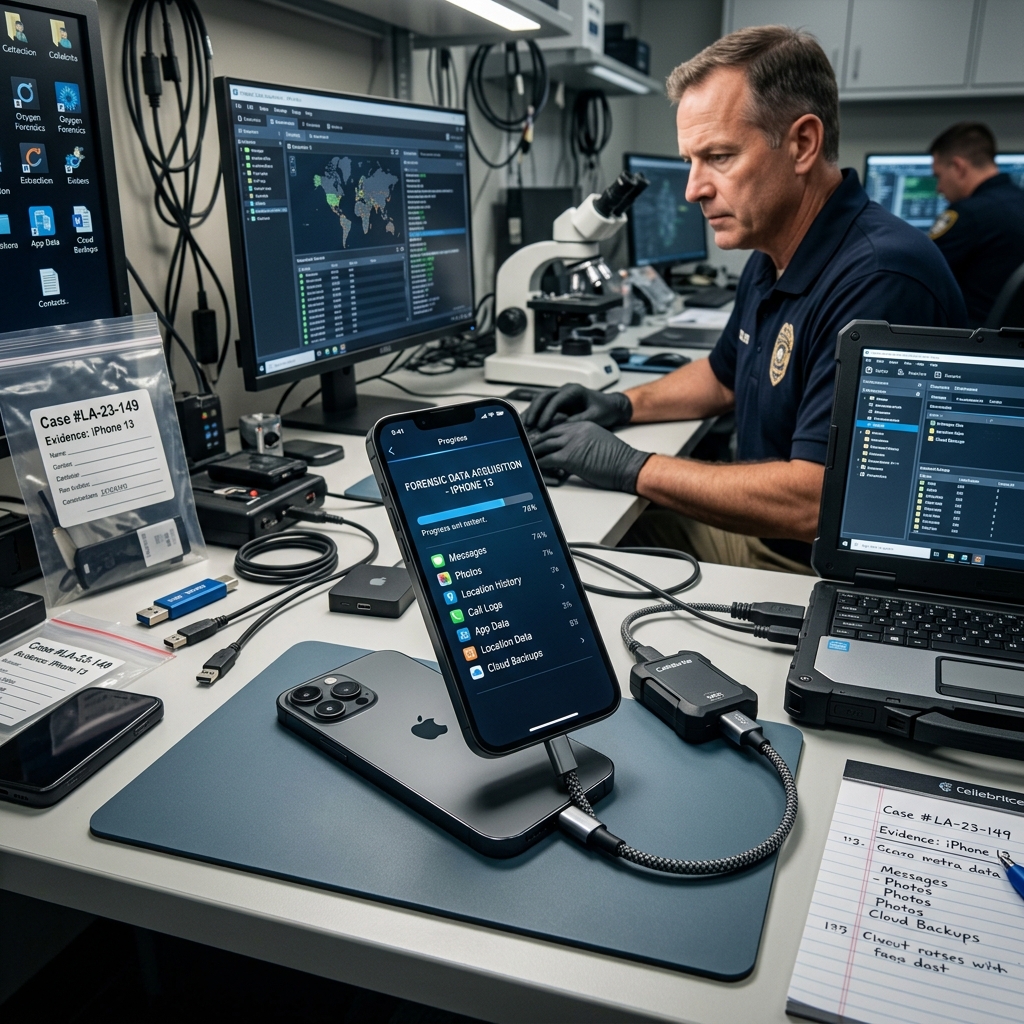
Smartphones often hold a detailed record of everyday life, and iPhones are no exception. In a criminal investigation, law enforcement may look for location clues, message content, app activity, browser history, and other digital traces that can help build a timeline of events.
What police can actually see depends on several factors: whether they have a warrant, whether the phone is locked, what version of iOS is installed, and whether the information exists on the device itself or in a cloud account.
Why an iPhone can matter in a criminal case
An iPhone is more than a communication device. It can function as a diary, a map, a search history, a photo archive, and a record of app use. That is why investigators often treat a phone as a source of corroboration, contradiction, or chronology.
In practice, a phone may help prosecutors place a person at a location, connect them to another person, or show what they searched before or after an event.
- Location history can help reconstruct movement over time.
- Photos and videos may show where a person was or what they possessed.
- Messages can show planning, contact, or reaction.
- Search and browsing activity may help establish intent or knowledge.
Types of data investigators may seek
Police do not search a phone for one single kind of evidence. They may look for several categories of digital information, depending on the allegations and the scope of the warrant.
| Data type | Possible evidentiary value |
|---|---|
| Messages and call logs | Can show communication, timing, or relationships. |
| Photos and videos | May reveal places, people, items, or actions. |
| Maps and location services | Can help place a user near a scene or chart a route. |
| Browser and search history | May show planning, curiosity, or research before an event. |
| App records | Can include ride requests, payments, notes, or social media activity. |
How location information can become evidence
Location data is often among the most useful information on a phone. Even when a person does not manually record their whereabouts, iPhones may retain digital traces from maps, photos, apps, and system services.
For example, map use may leave behind evidence of places searched or routes viewed. Photos may also contain metadata that links an image to a time and place. Together, these records can help investigators build a timeline, even if no single record tells the whole story.
That said, location evidence is not always exact. Investigators and defense lawyers often need to examine whether the data is complete, whether it was extracted correctly, and whether alternative explanations exist.
What police can do with a warrant
In the United States, the Supreme Court’s decision in Riley v. California established that police generally need a warrant to search the contents of a cell phone seized during an arrest. In other words, taking the phone and searching it are not the same thing.
A warrant may authorize a search, but the device still has to be technically accessible. Even with legal authority, officers may face encryption, passcode protection, or security settings that slow or prevent extraction.
- A warrant may allow a search of stored content.
- The scope of the warrant matters because it should define what officers may examine.
- Technical barriers may still limit access to the data.
Why phone security can change the outcome
Modern iPhones are designed with strong security features. Those protections can make it harder for law enforcement to pull data directly from the device, even when officers have lawful authority to search it.
Recent reporting has described how Apple security features can interfere with common forensic workflows, especially when a device reboots or requires biometric authentication before it can be connected to an extraction tool. In practical terms, that means a phone may contain evidence that cannot be accessed immediately or at all without additional steps.
Security, however, does not eliminate evidentiary value. It simply changes how data is pursued, preserved, and interpreted.
Device data is not the same as cloud data
Another important distinction is between information stored on the phone and information stored elsewhere. Some records may remain on the handset itself, while others may live in cloud backups or service-provider accounts.
That distinction matters because law enforcement may seek data from a third party rather than from the phone directly. If a provider stores backups, account logs, or synced content, investigators may request that information through legal process directed at the company.
This means a locked phone does not necessarily end the inquiry. It may simply shift the investigation toward connected accounts, backups, or other devices.
Common misconceptions about what police can see
People often assume that if a phone is locked, it is completely inaccessible. Others assume that a warrant automatically gives police everything on the device. Neither view is fully accurate.
- A locked phone may still contain recoverable information through backups or synced services.
- A warrant does not guarantee immediate access to every file.
- Some data may be readable, while other data remains protected by encryption or operating-system safeguards.
The real answer depends on the phone model, the operating system, the forensic tools available, and the legal authority supporting the search.
How defense counsel can use a forensic review
When a phone is central to a case, defense lawyers often benefit from an independent review. A defense expert can help determine what data exists, what data is missing, and whether the government’s interpretation is sound.
That review can be especially useful when the prosecution relies heavily on location traces, partial message threads, or app-based records. A careful examination may reveal that the record is narrower than it first appears.
- Confirming the presence or absence of relevant artifacts.
- Testing whether extraction results were reliable.
- Identifying gaps or limitations in the government’s evidence.
- Helping counsel decide how to challenge the search or the interpretation of the data.
Questions judges and lawyers often ask
In a phone-based investigation, the legal and technical questions are often intertwined. Courts may need to consider whether the search was supported by a valid warrant, whether the search stayed within its authorized scope, and whether the extraction process altered or omitted important information.
Lawyers may also ask whether the device was powered on, whether it rebooted, whether biometrics were involved, and whether a cloud account contains the same material in a different form.
Frequently asked questions
Can police search an iPhone without a warrant?
Generally, police need a warrant to search the contents of a cell phone seized during an arrest, subject to narrow exceptions.
Can police use photos or maps as evidence?
Yes. Photos, map activity, and related metadata can help show where someone was, what they saw, or what they did at a particular time.
Does a locked phone mean police cannot get any data?
No. Data may still exist in backups, cloud accounts, or synced services, and some forensic methods may still recover information from the device.
Why do defense attorneys care about phone forensics?
Because phone data can be powerful, but it can also be incomplete, misread, or overinterpreted. An independent review helps test the government’s claims.
Practical takeaways for defendants and counsel
When an iPhone is involved in an investigation, the key issue is not just whether the phone contains evidence, but what kind of evidence exists, where it is stored, and how law enforcement obtained it.
For defense teams, that means the important questions are often legal and technical at the same time: Was there a warrant? Was the search properly limited? Did the extraction capture the full picture? Could the same information have come from another source?
For individuals, the broader lesson is simple. Phones preserve a great deal of digital history, and that history can matter in court even when the phone itself appears ordinary.
References
- What Can Law Enforcement Find On Your iPhone — Lucid Truth Technologies. 2025-01-01. https://lucidtruthtechnologies.com/what-can-law-enforcement-find-on-your-iphone/
- Riley v. California — Supreme Court of the United States. 2014-06-25. https://supreme.justia.com/cases/federal/us/573/373/
- Apple is making it harder for police to collect evidence from iPhones — The Washington Post. 2018-06-13. https://www.washingtonpost.com/news/the-switch/wp/2018/06/13/apple-is-making-it-harder-for-police-to-collect-evidence-from-iphones-of-suspected-criminals/
- What Data Can Police Retrieve from Your Cell Phone? — The Law Man. 2024-01-01. https://thelawman.net/blog/what-data-police-can-retrieve-from-cellphone/
- Police: iPhones Store Incriminating Evidence — FindLaw. 2024-01-01. https://archive.findlaw.com/legalblogs/criminal-defense/police-iphones-store-incriminating-evidence/
- Can Police Unlock Your iPhone? What iOS 26.4 Changed — Texas DWI Site. 2025-01-01. https://www.texasdwisite.com/police-iphone-unlock-stolen-device-protection/
Similar Articles








Read full bio of medha deb


