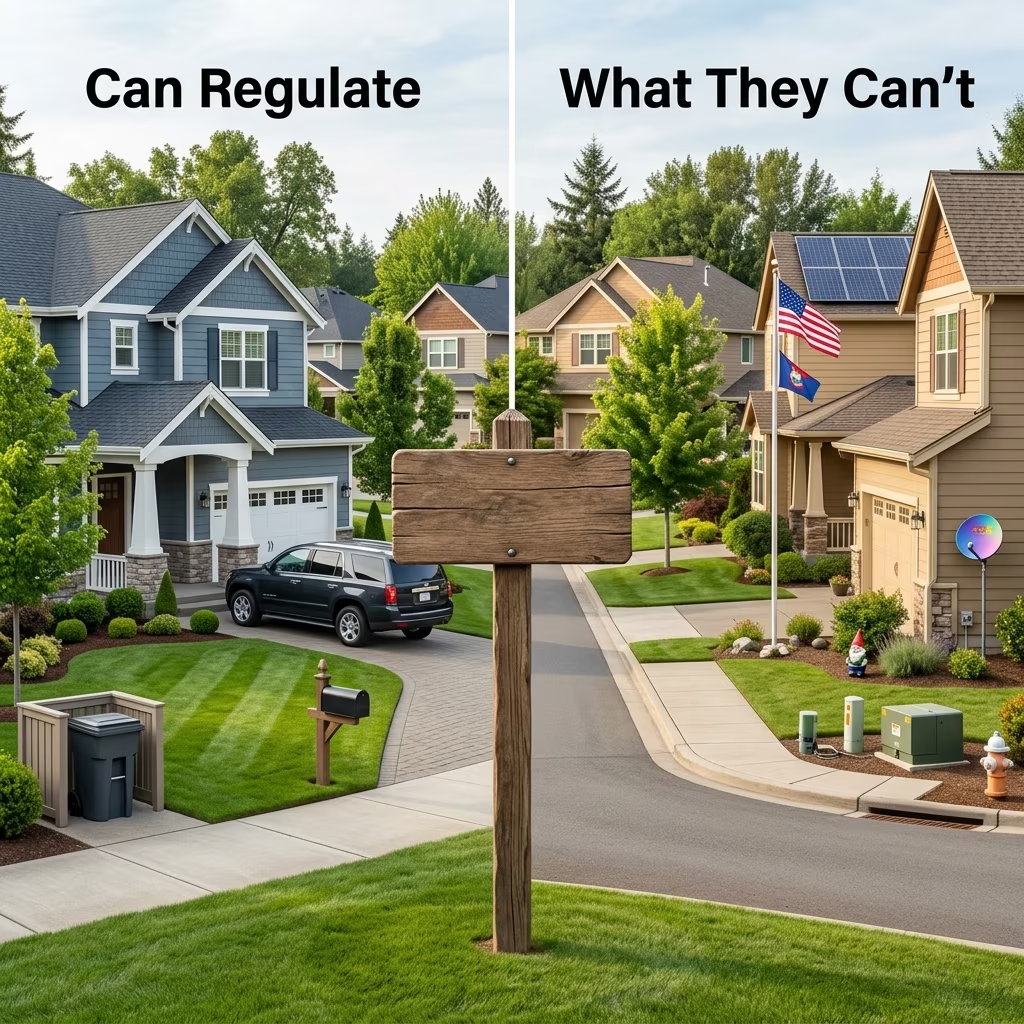
Buying into a community with a homeowners association (HOA) means agreeing to a unique mix of benefits, costs, and legal responsibilities. HOAs can shape everything from your home’s exterior color to whether you rent your property, but their power is not unlimited. Federal and state laws, as well as the association’s own governing documents, place real boundaries on what an HOA may regulate.
This guide explains the typical areas HOAs regulate, common legal limits on those rules, and practical steps homeowners can take to avoid or resolve conflicts.
How HOA Authority Works
To understand what an HOA can regulate, you first need to know where its authority comes from. Legally, HOAs are usually created through a recorded declaration or similar document that runs with the land and binds each owner in the community.
Core governing documents
Most HOAs rely on several key documents that define what they can and cannot do:
- Declaration / CC&Rs (Covenants, Conditions & Restrictions) – Creates the HOA, imposes deed restrictions, and outlines owners’ obligations and property use limits.
- Bylaws – Describe how the association is run: board structure, elections, meetings, and voting procedures.
- Rules and regulations or policies – Day‑to‑day rules adopted by the board to interpret and enforce the CC&Rs (for example, detailed parking or pool rules).
These documents are legally binding on owners from the moment they purchase a property in the community, but they must also comply with state statutes, federal laws, and constitutional protections.
Key legal limits on HOA power
Even a broadly written declaration does not give an HOA unlimited authority. Important limits include:
- Federal law supremacy – Federal protections for fair housing, disability rights, and free speech in certain contexts override conflicting HOA rules.[10]
- State statutes – Many states have HOA‑specific laws that define what associations may regulate, how they enforce rules, and what rights homeowners retain.
- Procedural requirements – New rules often must be adopted following notice, open meetings, and sometimes owner approval.
- Reasonableness and clarity – Courts are more likely to strike down rules that are vague, arbitrary, discriminatory, or unrelated to a legitimate community interest.
| Source | Role | Typical Effect |
|---|---|---|
| Declaration / CC&Rs | Primary contract between owners and HOA | Defines use restrictions, assessments, maintenance duties |
| Bylaws | Internal governance rules | Controls board powers, meetings, elections |
| Rules & regulations | Detailed behavioral and property rules | Implements policies on parking, noise, amenities |
| State & federal law | Legal framework and safeguards | Overrides inconsistent HOA rules and protects owner rights |
Common Areas HOAs Regulate
HOAs exist largely to manage shared property and maintain community standards, so rules tend to focus on appearance, use of common areas, and neighbor‑to‑neighbor impacts.
Exterior appearance and property modifications
Appearance rules are among the most visible and sometimes controversial HOA regulations. Typical requirements include:
- Pre‑approval by an architectural review committee for additions, exterior color changes, new decks, or fences.
- Approved materials and color palettes for roofs, siding, doors, and windows.
- Restrictions on exterior clutter, storage of equipment, and appearance of driveways or carports.
While HOAs can generally regulate aesthetics, many states limit their ability to prohibit certain eco‑friendly features like solar panels outright, allowing only reasonable time, place, and manner restrictions.
Landscaping and yard maintenance
To keep communities looking consistent, HOAs often regulate:
- Grass height, weed control, and lawn maintenance standards.
- Permitted tree removal or planting, especially for shared or protected species.
- Placement and type of fences, hedges, and garden structures.
- Use of xeriscaping or native plants (sometimes encouraged, sometimes limited depending on local law).
In many jurisdictions, state or local laws increasingly support water‑conserving landscaping, which can limit how restrictive an HOA may be in that area.
Parking and vehicle rules
Parking is a frequent source of friction in HOA communities. Associations commonly regulate:
- Where residents and guests may park (driveways vs. streets vs. common lots).
- Overnight street parking or long‑term guest parking limits.
- Storage of boats, RVs, trailers, and commercial vehicles.
- Abandoned or inoperable vehicles, including towing policies.
These rules must still comply with disability accommodations, local parking regulations, and any public road authority, especially where streets are not privately owned.
Pets and household animals
Pet rules aim to balance animal ownership with neighbors’ comfort and safety. Many HOAs regulate:
- Number and type of pets, and sometimes maximum weight limits.
- Leash requirements and designated relief areas.
- Noise and nuisance standards (such as restrictions on persistent barking).
- Clean‑up requirements and penalties for violations.
However, federal disability laws may require reasonable accommodations for service animals and emotional support animals, meaning an HOA often cannot enforce standard pet bans against such animals.
Noise, conduct, and use of common areas
HOAs commonly adopt behavioral rules to preserve residents’ quiet enjoyment and safety:
- Quiet hours and limits on amplified music or construction noise.
- Pool, gym, and clubhouse rules, including hours, guest limits, and dress codes.
- Prohibitions on dangerous activities or misuse of playgrounds and sports facilities.
- Smoking restrictions in common spaces and sometimes on balconies or patios.
These rules usually mirror or supplement local nuisance and health laws and can be enforced through fines or suspension of amenity access when allowed by governing documents.
Leasing, rentals, and home‑based businesses
Many communities want to manage the balance between owner‑occupants and renters. HOAs often regulate:
- Minimum lease terms (for example, 6 or 12 months) or restrictions on short‑term rentals.
- Tenant screening requirements, registration with the HOA, or copies of leases.
- Limits on the percentage of units that may be rented at any given time.
Several states explicitly regulate how far an HOA can go in restricting home‑based businesses. Some laws allow HOAs to impose reasonable time, place, and manner restrictions but forbid outright bans on many low‑impact home offices.
Signs, flags, and exterior displays
Political signs, seasonal decorations, and flags are frequent flashpoints. HOAs may:
- Set size, duration, and location limits for political or event signs.
- Regulate holiday lights and decorations to particular dates and brightness levels.
- Restrict non‑governmental flags or banners attached to homes or in yards.
At the same time, several states and federal law protect the right to display certain flags (such as the U.S. flag) and impose limits on how associations may restrict political expression.
What HOAs Cannot Do: Legal Boundaries
Despite the broad scope of many HOA rules, there are clear legal lines they cannot cross.
Override state and federal law
The most important principle is that state law always overrides HOA rules that conflict with it, just as federal law overrides both.
- An HOA cannot adopt or enforce a rule that violates fair housing protections based on race, religion, national origin, disability, or other protected traits.
- Where state law grants specific rights (for example, to install solar energy devices or operate certain home‑based businesses), associations may only impose reasonable restrictions, not complete bans.
- Procedural protections—such as notice, hearing rights, or limits on fines—cannot be waived by HOA rules that are more restrictive than the law allows.
Act beyond the scope of governing documents
Boards must stay within the authority granted by the declaration and bylaws. Overreach may occur when:
- The board tries to regulate conduct that the declaration clearly leaves to individual owners.
- Rules are adopted without following required processes for notice, meetings, or member votes.
- The association attempts to impose new, substantial obligations not reasonably related to existing covenants.
Rules passed outside proper authority may be unenforceable and can sometimes be challenged in court or through state dispute procedures.
Enforce rules arbitrarily or discriminatorily
Even lawful rules can become legally risky if enforcement is inconsistent or unfair.
- Selective enforcement against certain owners (for example, based on personal conflicts or protected characteristics) can expose the HOA to discrimination claims.
- Vague standards like “unattractive” or “offensive” that lack clear criteria increase the risk of arbitrary decisions.
- Courts are more likely to uphold rules that are objective, consistently enforced, and tied to a legitimate community purpose.
How HOAs Enforce Rules
Enforcement procedures vary by state and by community, but most HOAs follow a progressive approach to violations.
Typical violation process
- Initial notice or courtesy warning – A written notice describes the violation and gives time to correct it.
- Formal violation letter and hearing – If the issue continues, the owner may receive a formal notice and an opportunity for a hearing before the board or a committee.
- Fines and penalties – The association may levy fines, suspend amenity use, or place other sanctions as allowed by its documents and state law.
- Legal action and liens – For serious or repeated violations or unpaid assessments, HOAs may file lawsuits, seek injunctions, or record liens on the property, subject to statutory requirements.
Many states require HOAs to offer internal dispute resolution or alternative dispute mechanisms for certain conflicts before either party goes to court.
Homeowner rights in the enforcement process
Owners are not powerless in the face of enforcement. Typical rights include:
- Access to governing documents and association records related to rules, finances, and board decisions.
- Reasonable notice of alleged violations and an opportunity to respond or cure the problem.
- The right to attend and participate in member meetings, vote for board members, and sometimes vote on major policy changes.
- Ability to contest fines or enforcement actions through hearings, mediation, arbitration, or court, depending on state law.
Protecting Yourself: Before and After You Buy
Because HOA rules are contractual and often strict, a smart homeowner treats them as seriously as the purchase contract.
Due diligence before purchase
Before buying a home in an HOA‑governed community, consider the following steps:
- Request and read the governing documents – Declarations, bylaws, rules, and recent amendments should be reviewed for restrictions that affect your lifestyle or plans.
- Check for recent or pending rule changes – Meeting minutes and newsletters may reveal upcoming policy shifts (such as new rental caps or parking rules).
- Review financials and budgets – Strong reserves and realistic budgets can reduce the risk of special assessments or drastic rule changes aimed at cutting costs.
- Investigate dispute history – Frequent lawsuits or heavy‑handed enforcement may signal governance problems.
Some states require sellers to disclose the existence of an HOA and related obligations in writing, making it easier for buyers to identify communities with mandatory membership and assessments.
Working constructively with your HOA
If you already live in an HOA, you can reduce conflict and influence community rules by:
- Attending annual and board meetings to stay informed.
- Serving on committees or the board to give input on new policies.
- Communicating early and in writing when you need approvals or exceptions.
- Organizing with neighbors when you seek rule changes, since many amendments require a supermajority of owner votes.
Involving yourself in governance can help ensure rules stay reasonable, legally compliant, and reflective of the community’s evolving needs.
FAQs About HOA Regulation and Homeowner Rights
Can an HOA change the rules after I buy?
Yes. Most declarations and bylaws give the board and sometimes the membership the power to adopt or amend rules over time. However, they must follow the procedures set out in the governing documents and applicable state law, such as providing notice and holding required votes.
Are HOA rules legally enforceable?
Generally yes. When you purchase property in an HOA community, you accept the recorded covenants and subsequent properly adopted rules. Violations can lead to fines, liens, or lawsuits, as long as the rules are valid, properly adopted, and enforced consistently within the limits of state and federal law.
What can I do if I think a rule is illegal or unfair?
Start by reviewing the rule, the governing documents, and any relevant state statutes. You can raise your concerns with the board, request an internal hearing, or seek mediation if your state offers HOA dispute programs. For serious issues—especially those involving discrimination, due process, or large financial stakes—consulting a real estate or community association attorney is often advisable.
Can an HOA stop me from installing solar panels?
In some states, HOAs may not impose a total ban on solar energy devices but can enforce reasonable limits on placement, size, and appearance. For example, Virginia law allows associations to regulate the size and location of solar devices but restricts outright prohibitions unless the recorded declaration expressly permits them.
Do HOAs control what I do inside my home?
HOA authority is strongest over exterior appearance, common areas, and uses that affect neighbors or the community. Most associations have little say over purely internal activities that do not create noise, safety, or nuisance issues, but they may still regulate matters such as short‑term rentals or high‑traffic home businesses depending on the governing documents and applicable state law.
References
- HOA Rules and Regulations Guide — ManageCasa. 2026-01-10. https://managecasa.com/articles/hoa-rules-and-regulations-guide
- Property Owners’ Association Act — Code of Virginia. Accessed 2026-07-09. https://law.lis.virginia.gov/vacodepopularnames/property-owners-association-act/
- The 2025 Florida Statutes, Chapter 720 Homeowners’ Associations — Florida Legislature. 2025-07-01. https://www.leg.state.fl.us/Statutes/index.cfm?App_mode=Display_Statute&URL=0700-0799/0720/0720.html
- Virginia HOA Regulations: A 2025 Guide — FirstService Residential. 2025-03-15. https://www.fsresidential.com/virginia/news-events/articles/virginia-hoa-regulations/
- Property Owners’ Associations: General Information — Texas State Law Library. Updated 2024-06-20. https://guides.sll.texas.gov/property-owners-associations
- Homeowners Associations (HOAs) — National Association of REALTORS®. 2024-04-05. https://www.nar.realtor/homeowners-associations-hoas
- Understanding Homeowners Associations (HOAs) — Investopedia. 2023-08-23. https://www.investopedia.com/terms/h/hoa.asp