
What Really Happens If You Violate Probation?
Understand how probation violations are handled, what penalties you may face, and how to protect your rights if you’re accused.
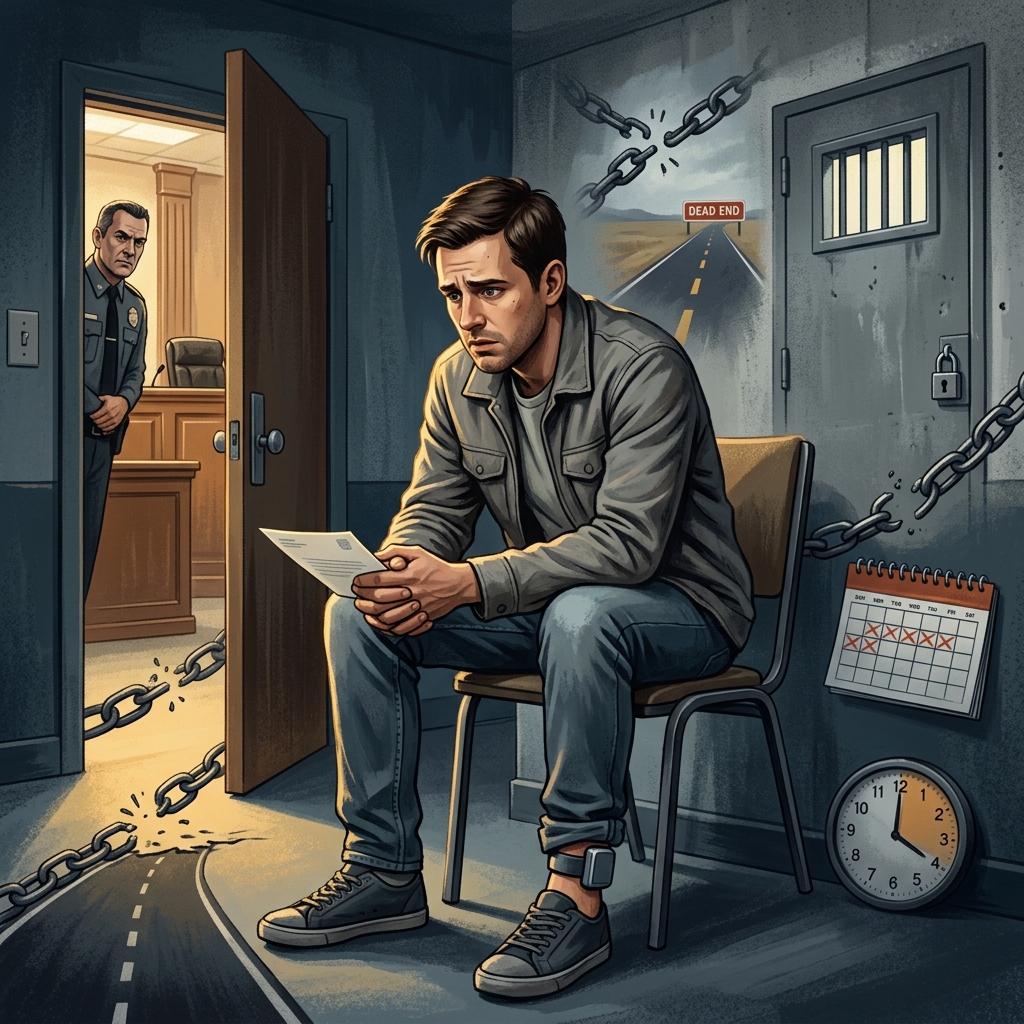
Probation is often described as a second chance: instead of serving your full sentence behind bars, you serve part or all of it under court supervision in the community. When you violate probation, that second chance is at risk. The response can be as minor as a warning or as serious as sending you to jail or prison to serve the original sentence.
This guide explains, in plain language, what happens when a probation violation is alleged, what penalties are possible, and how you can protect yourself during the process.
Understanding Probation: Why Violations Are Taken So Seriously
Probation is a sentence imposed by a judge that allows a person convicted of a crime to remain in the community instead of being incarcerated, usually under strict conditions such as reporting to a probation officer, staying crime‑free, and complying with treatment or program requirements.
Courts take violations seriously because probation is already a more lenient alternative to jail or prison. When a person fails to follow the rules, judges may decide that community supervision is not working and consider harsher penalties.
Common Types of Probation Conditions
- Regular check‑ins with a probation officer
- Obeying all laws and avoiding new criminal charges
- Submitting to drug or alcohol testing
- Attending treatment, counseling, or education programs
- Maintaining employment or actively seeking work
- Paying fines, restitution, or court costs
- Staying away from certain people, places, or areas
- Complying with curfews or electronic monitoring
Breaking any of these rules can be considered a probation violation if the court finds that you were required to follow the condition and did not comply.
What Counts as Violating Probation?
Not all violations are the same. Courts and probation officers usually distinguish between technical violations and substantive violations.
| Type of violation | What it means | Examples |
|---|---|---|
| Technical violation | Breaking a rule of supervision without committing a new crime. | Missing a check‑in, failing a drug test, unpaid fees, breaking curfew. |
| Substantive violation | Committing a new criminal offense while on probation. | New DUI, theft, assault, drug possession, or any other charge. |
Technical violations may be more likely to result in warnings, added conditions, or extended probation, especially if it is your first violation. Substantive violations, especially serious or violent crimes, are more likely to lead to probation being revoked and incarceration.
How a Probation Violation Case Usually Starts
The process generally begins when your probation officer or another authority believes you failed to follow one or more conditions.
Initial Steps After a Suspected Violation
- Internal review by the probation officer: The officer looks at what happened and decides whether the issue can be handled informally or must be reported to the court.
- Written report or “statement of violations”: In many jurisdictions, the officer prepares a sworn statement listing each alleged violation and sends it to the judge.
- Summons or warrant: The court may issue a notice ordering you to appear in court or a warrant for your arrest. In some cases, officers can arrest you directly for the alleged violation.
From there, you will typically have one or more court hearings where a judge decides whether a violation occurred and what should happen next.
Possible Immediate Responses: Warning, Hearings, or Arrest
Not every violation allegation leads to jail. Probation officers and judges have significant discretion, particularly for first‑time or minor violations.
1. Informal Warning or Increased Supervision
For a first‑time, minor, or clearly accidental violation, your probation officer might:
- Give a verbal or written warning
- Increase reporting frequency
- Remind you of the consequences of further violations
In these situations, your case may not even be sent to the judge, and no formal violation hearing is held.
2. Formal Court Hearing Without Immediate Jail
For more serious or repeated violations, the officer may refer the matter to the court but allow you to remain in the community until your hearing. You receive:
- A notice of the alleged violations
- A date to appear in court for a violation hearing
At the hearing, the judge decides whether you violated probation and what sanctions, if any, to impose.
3. Arrest and Detention Pending Hearing
In more severe cases—such as a new serious crime or repeated violations—the court or probation officer may seek your arrest. After arrest:
- You may be held in jail until the violation hearings are completed
- Bond or release conditions may be more limited than in a normal criminal case
Some jurisdictions restrict or eliminate the right to bond while a probation violation is pending, depending on the underlying offense and the alleged violations.
Probation Violation Hearings: How They Work
A probation violation is not a new criminal trial, but you still have important rights. Courts typically use a two‑step process: deciding whether there is enough evidence to proceed, and then deciding whether a violation occurred and what penalty to impose.
Key Features of Violation Hearings
- Notice of the allegations: You must receive written notice describing which terms of probation you allegedly violated.
- Right to a hearing: You have the right to appear before a judge to contest the allegations.
- Right to an attorney: In many cases you have the right to legal counsel; if you cannot afford one, you may request a court‑appointed lawyer.
- Opportunity to present evidence: You can testify, call witnesses, and present documents or other evidence, and you may be able to cross‑examine witnesses who testify against you.
- Lower burden of proof: The judge usually decides based on a “preponderance of the evidence,” meaning it is more likely than not that a violation occurred, which is a lower standard than “beyond a reasonable doubt.”
After the judge decides whether a violation happened, the court moves on to the question of what to do about it.
What Penalties Can Follow a Probation Violation?
If the court finds that you violated probation, the judge has a range of options. The choice often depends on factors such as the seriousness of the violation, whether you have violated before, and the nature of the original offense.
Common Consequences of a Probation Violation
- No change or a formal warning: The judge may warn you but leave your existing conditions in place.
- Additional conditions: The court may add requirements such as more community service, stricter reporting, curfews, or treatment programs.
- Extended probation term: Judges may lengthen the time you remain on probation, sometimes up to the legal maximum for the offense.
- Short jail stays or sanctions: Some systems use brief jail terms or local sanctions to respond to violations while keeping you on probation.
- Revocation of probation: In serious cases, the judge can revoke probation entirely and order you to serve part or all of the original sentence in jail or prison.
If your violation involves a new crime, you can also be prosecuted separately for that offense, which means you may face penalties both for the probation violation and for the new criminal charge.
First‑Time vs. Repeat Violations
Judges and probation officers often treat a first‑time violation differently from repeated violations:
- First‑time, minor violations may result in a warning, modified conditions, or extended probation rather than immediate revocation.
- Repeated or escalating violations make it more likely the court will revoke probation and impose incarceration or stricter sanctions.
Will You Automatically Go to Jail for a Violation?
There is no automatic one‑size‑fits‑all answer. Whether you go to jail depends on the specific circumstances and your judge’s discretion.
Factors that commonly affect the outcome include:
- The seriousness of the violation (missed meeting vs. new felony)
- Whether anyone was harmed or put at risk
- Your prior criminal record and past performance on probation
- Your efforts to comply (e.g., attending treatment, finding work)
- Recommendations from your probation officer
- State laws limiting or guiding sentencing for violations
In many cases, especially for technical violations, judges opt for increased supervision, additional programs, or extended probation rather than full revocation, particularly when rehabilitation and community safety can be maintained without incarceration.
Your Rights and How to Protect Yourself
Being accused of a probation violation is serious, but you are not powerless. How you respond can significantly affect the outcome.
Key Rights in a Probation Violation Case
- Right to notice: You have the right to know exactly which probation conditions you allegedly violated.
- Right to a hearing: You generally have the right to appear before a judge before probation is revoked, except in rare circumstances such as absconding.
- Right to counsel: In many jurisdictions, you have the right to an attorney at the violation hearing and may request a court‑appointed lawyer if you cannot afford one.
- Right to present evidence: You can present documents, testimony, and other evidence to show you complied or had a good‑faith reason for any non‑compliance.
Practical Steps If You’re Accused of Violating Probation
- Do not ignore notices or warrants: Failing to appear will almost always make things worse and can lead to additional charges.
- Contact an attorney quickly: A lawyer can help you understand the allegations, gather evidence, and argue for a less severe outcome.
- Gather proof of compliance: Collect pay stubs, treatment attendance records, emails, or texts that show your efforts to follow the rules.
- Address underlying problems: If substance use, mental health, or housing instability contributed to the violation, seek help and bring documentation to court.
- Be honest with your probation officer: While you should not incriminate yourself regarding new crimes without legal advice, open communication about technical issues can sometimes prevent formal violations.
Frequently Asked Questions About Probation Violations
Do I get a jury trial for a probation violation?
No. Probation violation hearings are held before a judge, not a jury. The judge decides whether you violated probation and what the consequences will be, usually under a lower burden of proof than in a criminal trial.
Can I be punished twice if my violation is a new crime?
Yes. If you commit a new crime while on probation, you can be punished for the new offense and also for violating probation by committing that offense. The sentence for the violation may be separate from or added to the sentence for the new charge.
Is there a time limit for filing a probation violation?
In many jurisdictions, there is no separate statute of limitations for probation violations. As long as the probation term has not expired or certain legal steps have been taken before it expires, a violation can be filed and heard even if the alleged conduct happened earlier.
What if my violation was an honest mistake?
Court responses often depend on whether the violation was willful and how serious it was. If you missed an appointment due to an emergency or miscommunication, and you can provide proof, the judge may treat that more leniently than a deliberate failure to follow the rules.
Should I talk to my probation officer if I think I broke a rule?
Open communication can sometimes prevent a minor issue from becoming a formal violation, but you should be cautious about admitting to conduct that could be a new crime. In situations involving potential criminal charges, speaking with an attorney before making detailed statements is often wise.
References
- Violating Probation & Potential Legal Consequences — Justia. 2023-05-01. https://www.justia.com/criminal/parole-and-probation/probation-violations/
- Consequences of Probation Violation — Law Offices of Alison M. Lopes. 2022-09-15. https://lopeslawoffices.com/consequences-of-probation-violation/
- Understanding Ohio Probation Violation Laws — The Meade Law Group. 2023-08-10. https://themeadelawgroup.com/blog/understanding-ohio-probation-violation-laws/
- What Happens if I Violate Probation? — Law Office of Catherine Turner. 2021-11-30. https://feddefense.com/violate-probation/
- First-Time Probation Violation Penalties in Pennsylvania — David McKenzie Law Firm. 2023-04-05. https://www.davidmckenzielawfirm.com/faqs/what-are-the-penalties-for-first-time-probation-violations-in-pennsylvania
Similar Articles








Read full bio of Sneha Tete




