
What a Strong Home Improvement Contract Needs
Learn the contract terms that help homeowners and contractors avoid confusion, delays, and payment disputes.
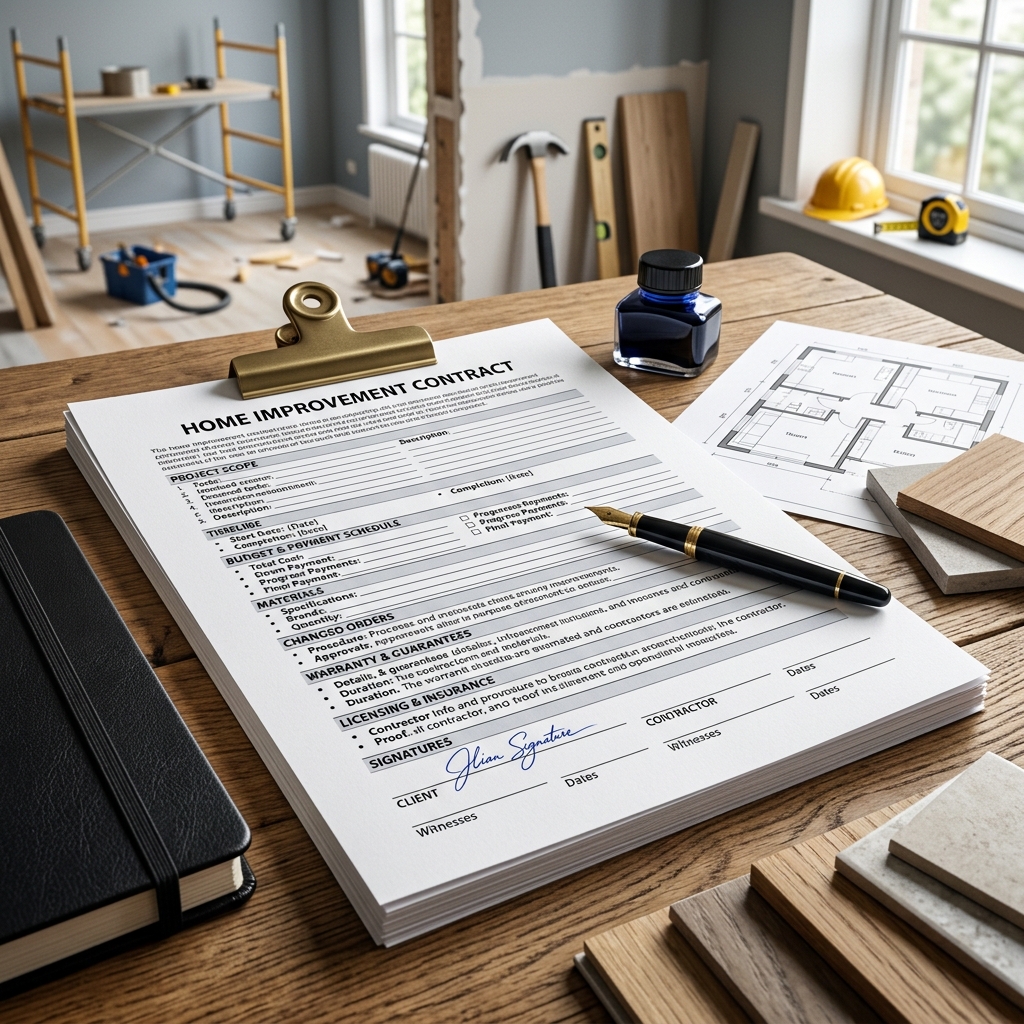
A home improvement project can go smoothly when expectations are clear from the start. A written contract is the tool that turns a general idea—such as a kitchen remodel, roof replacement, or room addition—into specific obligations that both sides can follow. Without that document, even a simple project can lead to disagreements about cost, timing, materials, or quality.
The most useful contracts do more than identify the parties involved. They describe the work in detail, explain how and when payment will happen, set out the project schedule, and identify who is responsible for permits, insurance, and cleanup. They also create a plan for change orders, warranties, and dispute resolution so that surprises do not become full-blown conflicts.
For homeowners, the goal is to protect the budget and the property. For contractors, the goal is to reduce confusion and make duties enforceable. A well-drafted agreement gives both sides a shared roadmap before work begins.
Start with a precise description of the work
The most important part of any home improvement contract is the scope of work. This is where the agreement should explain exactly what the contractor will do and what the finished result should look like. Vague language such as “remodel the bathroom” is not enough because it leaves room for disagreement over details.
A stronger scope section identifies the tasks included in the project and the work excluded from it. It can also describe demolition, installation, repairs, finishing, disposal, and any specialty work. If the project depends on drawings, plans, design specifications, or product selections, those materials should be listed as part of the agreement or attached to it.
- Type of work to be performed
- Materials, brands, or product standards
- Drawings, plans, or design documents
- Subcontracted work, if any
- Any exclusions or limits on the work
Clarity in this section reduces the chance that one side will later claim the project was supposed to include more than the other side expected.
Identify the people and property involved
Every contract should name the homeowner and the contractor clearly. It should include current contact information and the address of the property where the work will happen. If the contractor works through a business entity, the business name should match the legal entity responsible for the project.
This information matters because the contract must show who is legally bound by its terms. It also helps prevent confusion if multiple people are involved in approving the job, handling payments, or communicating about changes. Where a project involves a salesperson, project manager, or another representative, it can be wise to list that person too.
Accurate identification is especially useful if there is ever a dispute over responsibility, signatures, warranties, or collection of payment.
Set a timeline that includes milestones and deadlines
Time is often one of the first issues to cause frustration in a renovation project. A solid contract should spell out when work begins, when it is expected to finish, and whether there are milestone dates along the way. Those milestones are especially helpful on larger jobs such as additions, major remodels, or projects with multiple phases.
A schedule can also identify outside deadlines that affect the project, such as permit approvals, inspections, or delivery dates for special-order materials. If delays are possible, the contract should explain what happens when the timeline changes because of weather, supply problems, design revisions, or client decisions.
- Project start date
- Expected completion date
- Milestone dates for major phases
- Deadlines for permits and inspections
- What counts as a delay beyond the contractor’s control
The more specific the schedule, the easier it is to measure progress and identify when a project is falling behind.
Make payment terms detailed and easy to follow
Money disputes often begin when a contract leaves payment terms too broad. A home improvement contract should state the total price, the deposit amount, the timing of progress payments, and the final payment conditions. It should also explain the accepted payment methods and whether payments are tied to completed stages of work.
Many good contracts also address change orders and cost overruns. If the homeowner requests extra work or if an unexpected issue raises the price, the agreement should require written approval before the contractor proceeds. That helps prevent surprise bills and disputes about whether extra work was authorized.
| Payment Topic | What the Contract Should Clarify |
|---|---|
| Total price | The full agreed cost of the project |
| Deposit | How much is due at signing and when it is collected |
| Progress payments | Whether payments are tied to milestones or completed phases |
| Final payment | When it is due and whether completion is required first |
| Change orders | How changes are approved and priced |
Payment terms are strongest when they protect both sides: the contractor knows when money will be available, and the homeowner knows what work must be completed before paying more.
Address permits, inspections, and job-site responsibilities
Many projects require permits, inspections, or compliance with local building rules. The contract should say who is responsible for obtaining permits and who will schedule or coordinate inspections. That point matters because a project can stall if nobody knows who is supposed to handle the paperwork.
Job-site responsibilities should also be spelled out. For example, the agreement can explain who will provide access to the property, who is responsible for utility shutoffs if needed, and who will secure the work area. If the contractor must protect the site from damage or keep materials stored safely, those duties should be included as well.
When the project involves an occupied home, the contract may also need to address daily access, work hours, noise restrictions, and cleanup requirements. Those practical terms help keep the project manageable for everyone involved.
Clarify insurance, liability, and risk allocation
Homeowners should know what happens if something goes wrong during construction. A useful contract states what insurance coverage the contractor carries and what risks each party assumes. Depending on the project and local law, this may include general liability insurance, workers’ compensation coverage, or other protections.
The contract can also explain who is responsible for damage to the home, theft of materials, injury on the property, or other unexpected losses. If the project involves demolition or major structural changes, that section becomes even more important because the risk profile is higher.
- Type of insurance required
- Proof of coverage before work starts
- Responsibility for accidental damage
- Handling of theft, loss, or vandalism
- Responsibilities for injuries on the property
Clear risk allocation does not eliminate accidents, but it does reduce confusion about who is financially responsible if a problem occurs.
Explain how changes to the project will be handled
Few renovation jobs stay exactly the same from beginning to end. Hidden damage may appear after demolition, product selections may change, or the homeowner may decide to upgrade a fixture or finish. For that reason, the contract should contain a change-order process.
A good change-order clause says that no change becomes part of the project unless it is approved in writing. It should also require the extra price, any time extension, and the revised scope to be documented before the new work begins. That protects the homeowner from unexpected charges and protects the contractor from being asked to do additional work for free.
If the project is likely to involve evolving design choices, the change-order system should be easy to use. The simpler the process, the more likely both sides will follow it.
Include warranties and post-completion promises
Warranties are one of the most overlooked parts of a home improvement agreement. The contract should explain what workmanship is guaranteed, how long the warranty lasts, and whether product warranties come from the manufacturer or the contractor. It should also say what steps the homeowner must take to make a warranty claim.
This section can be especially useful for systems or features that may need follow-up service, such as roofing, plumbing, electrical work, or custom carpentry. If the contractor offers a service call period or a limited guarantee, the terms should appear in the contract rather than in a casual conversation.
When warranties are written clearly, both sides understand where responsibility ends and what kind of support remains after the project is complete.
Build in ways to end the contract and resolve disputes
Even well-planned projects can go sideways. A contract should explain when either party may terminate the agreement and what happens if one side fails to perform. Common triggers include repeated delays, nonpayment, refusal to follow the scope, or serious quality concerns.
The agreement should also describe how disputes will be handled. Some contracts require direct negotiation first, followed by mediation or arbitration if the problem is not resolved. Others allow litigation in court. The key is not which method is chosen, but whether the contract makes the process predictable.
- Grounds for termination
- Notice required before ending the contract
- How disputes will be raised
- Whether mediation or arbitration is required
- Which state’s law governs the agreement
When a contract anticipates disagreements, it gives both parties a path forward instead of forcing them to improvise after a problem starts.
Check the signature block before work begins
Even the best contract is incomplete if it is not properly signed. The document should include signature lines for all necessary parties, along with dates showing when the agreement was accepted. If the homeowner or contractor uses multiple pages or attachments, those documents should be part of the final signed package.
Before anyone signs, each side should review the entire agreement, including any exhibits, plans, specifications, and payment schedules. A contract is most effective when it reflects the actual deal and not just a general estimate.
Keeping a complete copy of the signed contract is also important. It provides a record to consult if there is a dispute about what was promised or when a task was supposed to be completed.
Why a detailed contract saves time later
At the beginning of a project, a detailed contract may feel like an extra step. In practice, it is one of the most efficient ways to reduce problems. It helps homeowners understand what they are buying and helps contractors define their responsibilities with precision.
That clarity is valuable because home improvement work often involves moving parts: material delays, design changes, inspections, weather, and payment timing. When those issues are addressed in writing, the project has a much better chance of staying organized and less stressful.
A strong contract is not just paperwork. It is the framework that supports the job from the first day on site to the final walkthrough.
Frequently asked questions
What is the most important part of a home improvement contract? The scope of work is usually the most important section because it defines exactly what the contractor will do and what the homeowner should expect.
Should payment terms be tied to progress? Often, yes. Progress-based payment terms can help align payment with completed work and reduce conflict over unfinished items.
Who should handle permits? The contract should clearly assign that responsibility. In many cases, the contractor handles permits, but the agreement should say so explicitly.
Why are change orders necessary? Change orders document extra work, price changes, and schedule adjustments so that both sides agree before the project changes.
Do verbal promises count? They can be difficult to prove. Important promises should be written into the contract or attached documents.
References
- What to include in your home improvement contract — Better Business Bureau. 2025. https://www.bbb.org/all/home-improvement/your-home-improvement-contract
- Home Improvement Contract Sample Language — Commonwealth of Massachusetts. 2025. https://www.mass.gov/info-details/home-improvement-contract-sample-language
- Sample Home Improvement Contract — California Contractors State License Board. 2025. https://www.cslb.ca.gov/Resources/GuidesAndPublications/2025/SAMPLE%20HOME%20IMPROVEMENT%20CONTRACT.pdf
- Navigating Residential Home Improvement Contracts in Alabama — The Cromeens Law Firm. 2026. https://thecromeenslawfirm.com/residential-home-improvement-contracts-in-alabama/
- Home Improvement Contracts — Texas Bankers Association. 2025. https://member.texasbankers.com/App_Themes/PB192/Documents/homeimprovementcontracts.htm
Similar Articles








Read full bio of Sneha Tete


