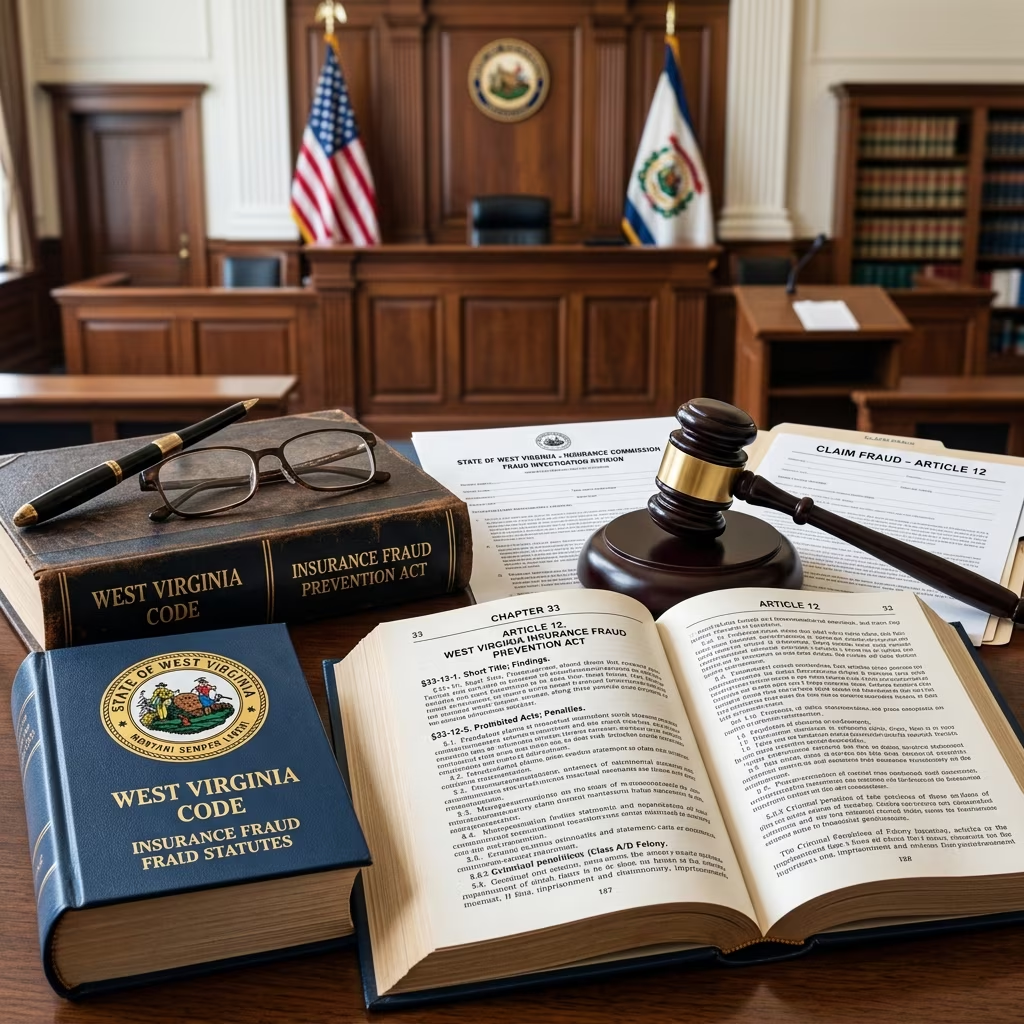
Insurance fraud in West Virginia is treated as a serious legal issue that can lead to criminal charges, civil penalties, and professional discipline. The state’s fraud laws are designed to protect insurers, policyholders, and the public from false claims, misleading statements, and other conduct that distorts the insurance process. West Virginia also gives regulators specific tools to investigate suspected fraud and to require reporting by those who discover suspicious activity.
What counts as insurance fraud in West Virginia?
At its core, insurance fraud involves knowingly making a false or misleading statement, or using deceptive conduct, in connection with an insurance application, policy, claim, payment, or related matter. The key element is intent: the person must act knowingly and willfully with the purpose of obtaining an improper benefit or causing another party to rely on false information.
West Virginia law reaches a broad range of conduct. Fraud can involve a false statement on an application, misleading information about a claim, inflated losses, altered documents, or an attempt to influence how an insurer handles a policy or payment. Because the law focuses on material misstatements and deceptive conduct, even a single dishonest act can trigger liability if it is significant enough to affect the insurance transaction.
Examples of conduct that may violate the law
Insurance fraud is not limited to staged accidents or exaggerated property losses. The statute also covers false statements made during the application process, claims handling, premium-related issues, and other insurance matters. Common examples include:
- Submitting a claim for damage that did not occur.
- Inflating the value of lost or damaged property.
- Providing false information about the condition of a vehicle, home, or other insured property.
- Using altered or fabricated documents to support a claim.
- Misrepresenting facts on an insurance application to obtain coverage or lower premiums.
- Concealing relevant information that would affect underwriting, coverage, or payment decisions.
These categories reflect the state’s broader goal of stopping fraudulent conduct wherever it appears in the insurance lifecycle. The law is not limited to policyholders alone; it can also apply to agents, brokers, company representatives, and others involved in the transaction.
Criminal penalties for fraudulent insurance acts
West Virginia classifies insurance fraud as a crime and uses the value of the benefit sought to determine the level of punishment. If the benefit sought is less than $1,000, the offense is a misdemeanor punishable by up to one year in jail and a fine of up to $2,500. If the benefit sought is $1,000 or more, the offense becomes a felony and can result in a prison term of up to 10 years and a fine of up to $10,000.
The felony provisions give courts substantial sentencing discretion. Depending on the facts, a person convicted under the statute may face incarceration, fines, or both. That structure reflects the legislature’s judgment that larger fraud schemes and higher-dollar claims deserve more severe punishment.
| Benefit sought | Classification | Possible punishment |
|---|---|---|
| Less than $1,000 | Misdemeanor | Up to 1 year in jail and up to $2,500 in fines |
| $1,000 or more | Felony | Up to 10 years in prison and up to $10,000 in fines |
Civil consequences and regulatory enforcement
Criminal charges are only one part of the risk. West Virginia law also authorizes administrative and civil enforcement against people or entities that violate the fraud provisions. Depending on the situation, the commissioner may impose a civil penalty of up to $10,000 per violation, suspend or revoke a license or certificate of authority, require restitution to injured persons, and assess the cost of the investigation.
The statute also allows the commissioner to seek a temporary or permanent injunction to stop continued violations. That means regulators are not limited to post-violation punishment; they can also act to prevent further harm when fraud is suspected. These powers are especially important in the insurance context, where repeated misconduct can affect many claims or many customers at once.
How West Virginia investigates suspected fraud
The state maintains a dedicated Insurance Fraud Unit within the Office of the Insurance Commissioner. This unit is responsible for investigating suspected violations of the insurance laws related to fraud and related criminal activity. The presence of a specialized unit signals that fraud matters are handled as a distinct enforcement priority rather than as routine insurance disputes.
Citizens and industry participants can report suspected fraud to the Special Investigations Division, which is headquartered in Charleston and supported by investigators around the state. The division encourages reporting through formal channels, including fraud report forms for individuals, insurance companies, and insurance agencies.
Who has to report suspected fraudulent activity?
West Virginia rules require certain persons identified by statute to report suspected fraudulent insurance acts in writing to the Insurance Fraud Unit. The report must be made on a form prescribed by the commissioner and signed and dated by the reporting party or authorized representative.
The reporting obligations are detailed and require more than a brief notice. When the facts are known, the report should include information such as the identity of the insurer or reporting person, policy and claim numbers, the date and location of the loss, the estimated claim value, the parties involved, and a narrative describing why fraud is suspected. Supporting documents such as police reports, photographs, or altered records may also be listed.
What information should a fraud report contain?
A proper report is meant to give investigators enough detail to evaluate the claim quickly and accurately. The reporting person may need to provide:
- The date the report was prepared.
- The name and contact information of the insurer or other reporter.
- The policy number or claim number.
- The type of insurance involved.
- The date and location of the loss or occurrence.
- The estimated value of the claim.
- The names and roles of the people involved.
- A detailed explanation of the suspected fraud.
- A list of documents or other evidence supporting the concern.
- Any other agency that has already been notified.
This reporting framework is designed to standardize submissions and improve the quality of investigations. In practice, the more complete the report, the easier it is for the state to determine whether the matter involves fraud, an ordinary claim dispute, or a misunderstanding that needs further review.
Possible defenses and common misunderstandings
Not every inaccurate statement is insurance fraud. The state law focuses on conduct that is knowingly and willfully false, which means an honest mistake, sloppy paperwork, or a good-faith disagreement over value does not automatically equal a crime. The difference between an inflated claim and a disputed estimate often turns on intent and materiality.
Materiality also matters. A statement generally must be significant enough to affect the insurance decision, the handling of a claim, or the payment outcome. Small clerical errors, immaterial omissions, or trivial inconsistencies may not meet that standard even if they create confusion during a claim review.
Why the law matters to policyholders and insurers
For policyholders, the main lesson is that honesty and consistency matter at every stage of the insurance process. Information provided on an application, during a claim investigation, or in support of reimbursement should be accurate and complete. Misstatements can transform an ordinary claim into a criminal or civil problem.
For insurers, the statute provides a pathway to investigate suspicious claims, coordinate with regulators, and seek penalties when fraud is confirmed. The legal framework is meant to protect honest claimants by reducing the losses caused by false claims, which can increase costs across the insurance market.
How suspected fraud is handled in practice
When a suspicious claim arises, an insurer may gather documents, interview witnesses, compare records, and report the matter to the state. Regulators may then review the submission, request additional information, and decide whether the facts support administrative action, referral for criminal prosecution, or closure without further action.
In many cases, fraud concerns are resolved through documentation and fact-checking. In others, especially where there is evidence of deliberate deception, the matter can lead to formal charges or license consequences. Because the law covers both individual applicants and business participants, the likely response depends on the role of the person involved and the seriousness of the alleged conduct.
Frequently asked questions
Is insurance fraud a felony in West Virginia?
It can be. If the benefit sought is $1,000 or more, the offense is generally treated as a felony. Smaller amounts may be prosecuted as misdemeanors.
Can someone be punished even if the insurer did not pay the claim?
Yes. The focus is on the fraudulent act and the benefit sought, not only on whether payment was actually made.
Who investigates insurance fraud in West Virginia?
The Office of the Insurance Commissioner, through its Special Investigations Division and Insurance Fraud Unit, handles investigations and reporting.
Can professionals in the insurance industry face discipline?
Yes. The law allows civil penalties, licensing consequences, restitution orders, and other enforcement measures against persons or entities engaged in the business of insurance.
What should a person do if they suspect fraud?
They should gather available documents and report the matter through the state’s fraud reporting process, providing as much factual detail as possible.
References
- Disputing Fraudulent Claims Under WV Insurance Fraud Prevention … — PFBWV. 2024-01-01. https://www.pffwv.com/blog/disputing-fraudulent-policyholder-claims-under-the-wv-insurance-fraud-prevention-act/
- W. Va. Code R. § 114-71-3 – Reporting of Insurance Fraud or … — Cornell Law School, Legal Information Institute. 2025-01-01. https://www.law.cornell.edu/regulations/west-virginia/W-Va-C-S-R-SS-114-71-3
- West Virginia Code | §33-41-11 – WV Legislature — West Virginia Legislature. 2026-01-01. https://code.wvlegislature.gov/33-41-11/
- West Virginia Code Chapter 33. Insurance § 33-41-8 | FindLaw — FindLaw. 2026-01-01. https://codes.findlaw.com/wv/chapter-33-insurance/wv-code-sect-33-41-8/
- Special Investigations Division — West Virginia Offices of the Insurance Commissioner. 2026-01-01. https://www.wvinsurance.gov/Divisions_Special-Investigations-Division
- West Virginia Code | §33-41-12 — West Virginia Legislature. 2026-01-01. https://code.wvlegislature.gov/33-41-12/