
Washington Wage and Hour Rules Explained
A practical guide to Washington’s minimum wage, overtime, breaks, and pay protections for workers and employers.
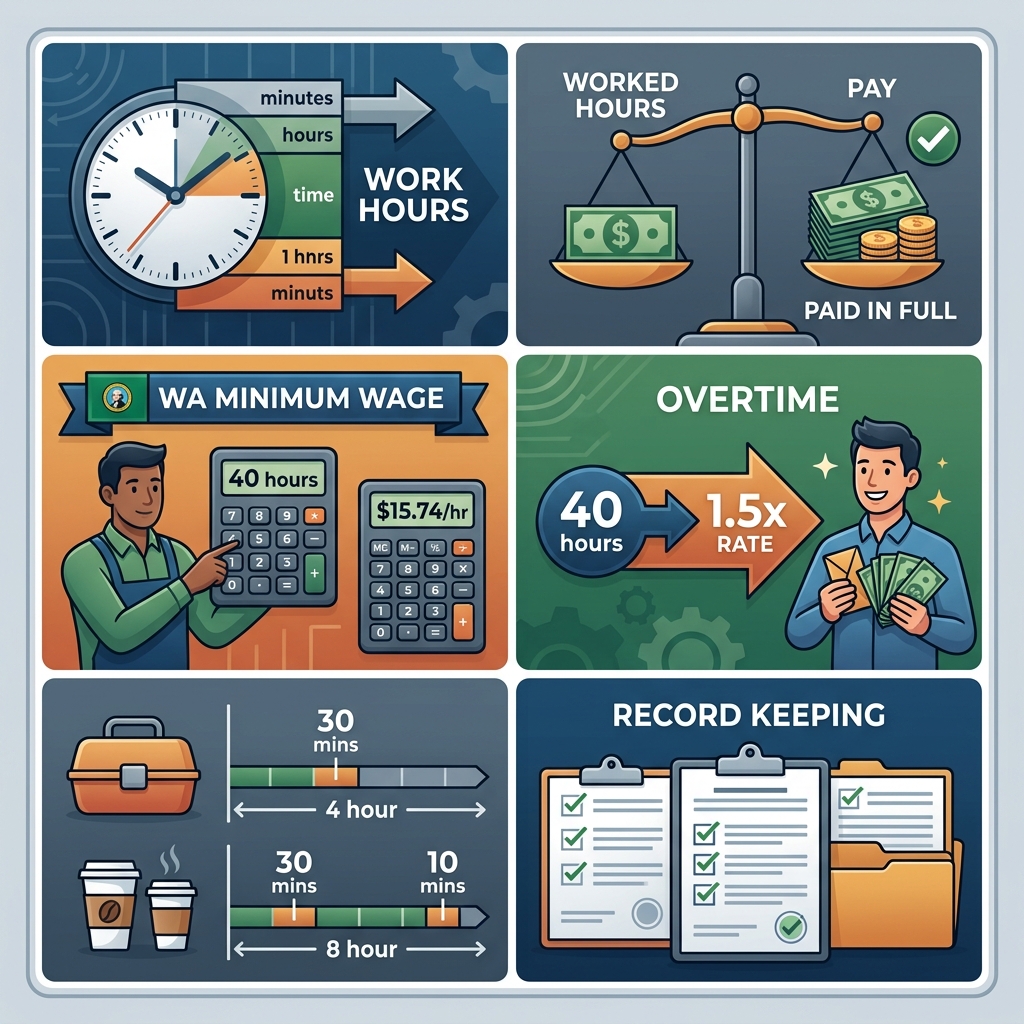
Washington state has some of the most protective wage and hour laws in the country. These rules govern how workers must be paid, when overtime kicks in, what breaks are required, and how often paychecks must be issued. Understanding these requirements is essential for both employees and employers to avoid violations and ensure fair compensation.
Overview of Wage and Hour Protections in Washington
Washington’s system is built on a combination of state statutes, regulations, and agency guidance that go beyond federal standards in many areas. While federal law (the Fair Labor Standards Act) sets a national floor, Washington often requires higher minimum wages, stricter overtime rules, and more generous break and leave provisions.
- Higher minimum wage than federal law.
- No tip credit allowed — tips cannot reduce the minimum wage obligation.
- Strong rules on overtime pay after 40 hours in a workweek.
- Mandatory meal and rest breaks for most non-exempt workers.
- Defined payday and final pay obligations.
Most wage and hour issues in Washington are enforced by the Washington State Department of Labor & Industries (L&I), which handles complaints, investigations, and recovery of unpaid wages.
Minimum Wage Requirements
Washington sets its own statewide minimum wage at a level higher than the federal minimum, and adjusts that amount annually based on inflation. As of early 2025, the statewide minimum was $16.66 per hour for most workers, with an announced increase to $17.13 per hour for 2026 based on L&I’s inflation adjustment.
Key features of Washington’s minimum wage system include:
- Annual adjustment based on the Consumer Price Index.
- Coverage for most hourly workers, with limited exemptions under state and federal law.
- The ability of cities and counties to adopt higher local minimum wages, such as the city of Seattle.
Some workers may be subject to special rules—for example, younger minors may be paid a percentage of the full minimum wage under certain conditions, and agricultural or commissioned workers can have different structures—but the default rule is that most non-exempt employees must be paid at least the statewide or local minimum wage, whichever is higher.
No Tip Credit or Dual Wage System
Unlike many states, Washington does not allow employers to use a tip credit that reduces the cash wage for tipped employees. Employers must pay tipped workers at least the full minimum wage in cash, and any tips are in addition to that wage, not a substitute.
- Tips cannot be counted toward the employer’s minimum wage obligation.
- Employers may not retain any portion of employee tips for company use.
- Tip pooling may be allowed under certain rules, but total pay must still meet minimum wage requirements.
Overtime Pay and Workweek Rules
Overtime protections in Washington closely track, but often strengthen, federal standards. In general, non-exempt employees must receive overtime pay at 1.5 times their regular rate of pay for all hours worked over 40 in a seven-day workweek.
Important aspects of Washington overtime law include:
- A fixed 7-day workweek for overtime calculations; employers cannot average hours across multiple weeks to avoid overtime.
- The requirement that overtime be based on the employee’s regular rate of pay, which may include certain nondiscretionary bonuses.
- Special rules for some occupations, such as certain public safety workers and commissioned salespeople, depending on the statute or regulation.
Exempt vs. Non-Exempt Employees
Some employees are legally exempt from overtime requirements, typically in executive, administrative, or professional roles that meet both a duties test and a salary threshold. Washington’s salary threshold for exempt status is tied to the state minimum wage and is often higher than the threshold under federal law.
To lawfully treat an employee as exempt from overtime, an employer generally must ensure:
- The employee’s job duties fit within a recognized exempt category (such as executive management, certain professionals, or outside sales).
- The salary is at or above the Washington-specific overtime exemption threshold, which is a multiple of the minimum wage.
- The employee is paid on a salary basis rather than hourly, subject to limited deductions allowed by law.
Misclassifying workers as exempt can result in substantial liability for unpaid overtime, interest, and penalties, making accurate classification a critical compliance issue.
Meal and Rest Break Rights
Washington mandates both meal breaks and rest breaks for most non-exempt employees to ensure reasonable time away from work duties. These requirements are more protective than in many other states.
Rest Breaks
Employees are generally entitled to paid, duty-free rest breaks of at least 10 minutes for every 4 hours worked, or major fraction thereof.
- Breaks should be scheduled as close as possible to the middle of each work period.
- No worker should be required to work more than three consecutive hours without a rest break.
- Rest breaks are typically counted as paid time, and employees must be relieved of duties during the break.
Meal Periods
For shifts longer than five consecutive hours, Washington law generally requires a meal period of at least 30 minutes.
- The meal period must start between the second and fifth hours of the shift.
- Meal periods are usually unpaid if the employee is fully relieved of duties, but may be paid if the worker must remain on duty or on call.
- Certain healthcare workers have flexibility to waive meal breaks for shorter shifts under recent amendments, subject to specific conditions.
In addition, employers must provide reasonable access to restroom facilities and may not impose unreasonable restrictions on bathroom breaks.
Breaks for Minors and Special Groups
Younger workers face additional protections. Minor employees must receive meal and rest breaks that meet or exceed the general requirements, and their work hours are strictly limited depending on age and whether school is in session.
- Limits on daily and weekly hours for minors aged 14–17.
- Restrictions on start and end times, especially on school days.
- Required meal and 10-minute rest periods during longer shifts.
Washington also recognizes extra break needs for certain workers, such as nursing mothers who may request additional breaks to express breast milk.
Pay Frequency, Paydays, and Final Wages
Washington law regulates how often employees must be paid and how quickly they must receive their final paycheck after separation from employment.
Regular Paydays
Employers generally must establish regular, predictable paydays and pay non-exempt employees at least once a month.
- Paydays must be designated in advance and followed consistently.
- Employers must pay for all hours worked, including overtime, on or before the established payday.
- Employees should receive enough detail on their pay statements to understand how wages were calculated, including hours, rates, and deductions.
Final Paychecks
When employment ends, Washington requires employers to pay all earned wages on the next regularly scheduled payday following the employee’s last day of work.
Final pay must generally include:
- All regular wages earned through the last day worked.
- Overtime owed for hours over 40 in the final workweek.
- Any accrued, usable paid leave required to be paid out under written policies or collective bargaining agreements, where applicable.
Wage Deductions and Pay Transparency
Washington limits when an employer may deduct money from an employee’s paycheck and encourages transparency around wages to reduce discrimination and confusion.
Permissible Wage Deductions
Certain deductions are allowed by law, while others require employee consent or are prohibited. Common lawful deductions include:
- Required withholding such as federal and state taxes, Social Security, and court-ordered garnishments.
- Employee-authorized deductions for benefits, retirement contributions, or other agreed items.
- Limited deductions for overpayments or equipment losses, subject to strict notice and consent rules.
Employers may not use deductions to drive take-home pay below the required minimum wage for non-exempt workers, and may face penalties for unauthorized or deceptive deductions.
Pay Equity and Transparency
Washington’s Equal Pay and Opportunities Act prohibits wage discrimination based on sex and strengthens workers’ rights to discuss compensation.
- Employers cannot require employees to keep their wages secret or penalize them for discussing pay.
- Employers with a certain number of employees must include wage or salary ranges and benefit information in job postings.
- Pre-employment questions about an applicant’s prior salary or wage history are restricted, to avoid perpetuating pay disparities.
Paid Sick Leave and Other Time-Off Protections
Washington law includes robust leave protections that interact closely with wage and hour rules, especially for paid time off.
Paid Sick Leave
Under Washington’s paid sick leave requirements, eligible workers accrue at least one hour of paid, protected sick leave for every 40 hours worked.
- Accrual begins on the first day of employment, but employees may be required to wait up to 90 days before using leave.
- Sick leave can be used for the worker’s own illness, injury, or health condition, or to care for a family member.
- Employers must allow leave to be used without retaliation and must restore employees to the same or an equivalent position after approved leave.
Family, Medical, and Protective Leave
Separate from paid sick leave, Washington’s Paid Family and Medical Leave (PFML) program and other statutes allow time off for serious health conditions, bonding with a new child, domestic violence situations, and certain military-related reasons.
While PFML benefits are funded through insurance-style contributions and administered by the state, employers must coordinate scheduling, wage replacement, and job protection to comply with both PFML and federal laws such as the Family and Medical Leave Act (FMLA) when applicable.
Sample Wage and Hour Comparison Table
| Topic | Washington Requirement | Federal Baseline |
|---|---|---|
| Minimum Wage | Statewide rate (e.g., $16.66–$17.13), adjusted annually; local ordinances may be higher. | $7.25 per hour (no automatic inflation adjustment). |
| Overtime | 1.5× regular rate after 40 hours in a 7-day workweek; strict ban on averaging weeks. | Generally similar standard under FLSA, but with lower exemption thresholds. |
| Rest Breaks | Paid 10-minute break for each 4 hours worked or major fraction thereof. | No nationwide federal requirement for short rest breaks; if provided, typically treated as paid. |
| Meal Periods | 30-minute meal for shifts over 5 hours, scheduled between 2nd and 5th hour. | No general federal requirement for meal periods; rules vary by state. |
| Paid Sick Leave | At least 1 hour per 40 hours worked; broad usage protections. | No federal paid sick leave mandate for most private employers. |
Enforcement, Complaints, and Worker Remedies
Workers who believe their wage and hour rights have been violated can seek help from Washington L&I, which offers online and phone complaint processes.
- Employees may file wage complaints for unpaid minimum wage, overtime, final pay, or unlawful deductions.
- L&I can investigate, order payment of back wages, and impose penalties for violations.
- In some situations, workers may also bring private lawsuits to recover unpaid wages and additional damages.
Employers can reduce enforcement risk by maintaining accurate records, promptly correcting payroll errors, training supervisors on break and overtime rules, and consulting official guidance on borderline issues.
Frequently Asked Questions (FAQs)
1. Who is covered by Washington’s minimum wage law?
Most hourly, non-exempt workers in Washington are covered, including part-time and temporary employees. Certain categories such as independent contractors, some agricultural workers, and properly classified exempt employees may be excluded, but misclassification can lead to serious liability.
2. Can my employer require me to work through my breaks?
Generally, no. Employers must provide both rest and meal breaks according to state rules. If you are required to remain on duty or perform work during a meal period, that time typically must be paid and may not count as a lawful unpaid meal break.
3. How is overtime calculated if I receive bonuses?
Nondiscretionary bonuses and certain incentive payments may need to be included when calculating your regular rate of pay for overtime purposes. This can increase the overtime rate above 1.5 times your base hourly wage.
4. What should I do if I think I was underpaid?
You can start by reviewing your pay stubs, time records, and employer policies, then raise the issue internally if comfortable. If the problem is not resolved, you may file a wage complaint with L&I or consult an employment attorney to explore further options.
5. Are employers allowed to cut my pay without telling me?
While employers can change pay rates prospectively in many situations, they must comply with notice requirements and cannot reduce pay below the applicable minimum wage. Retroactive changes that undercut wages already earned can be unlawful.
References
- Washington Wage and Hour Laws — FindLaw. 2025-01-01. https://www.findlaw.com/state/washington-law/washington-wage-and-hour-laws.html
- Workers’ Rights — Washington State Department of Labor & Industries (L&I). 2025-10-01. https://www.lni.wa.gov/workers-rights/
- Washington State Payroll Laws 2026 — PayNW. 2025-12-15. https://www.paynw.com/blog/washington-state-payroll-laws-and-processing
- Washington Employment and Labor Laws — Paylocity. 2024-11-10. https://www.paylocity.com/resources/tax-compliance/state-laws/washington/
- Washington Employment & Labor Law Overview — Deputy. 2025-01-01. https://www.deputy.com/compliance-hub/states/washington
- Understanding Labor Laws and Your Workplace Rights in Washington State — OSHA Education Center. 2024-06-01. https://www.oshaeducationcenter.com/understanding-labor-laws-and-your-workplace-rights-in-washington-state/
- State Labor Laws: Minimum Paid Rest Periods, Minimum Meal Periods, Prevailing Wages, Payday Requirements — U.S. Department of Labor, Wage and Hour Division. 2023-09-01. https://www.dol.gov/agencies/whd/state
Similar Articles








Read full bio of Sneha Tete




