
How Divorce Works In Washington: Key Steps To Finalize Today
A clear, practical guide to the steps, deadlines, and decisions that shape a Washington divorce.
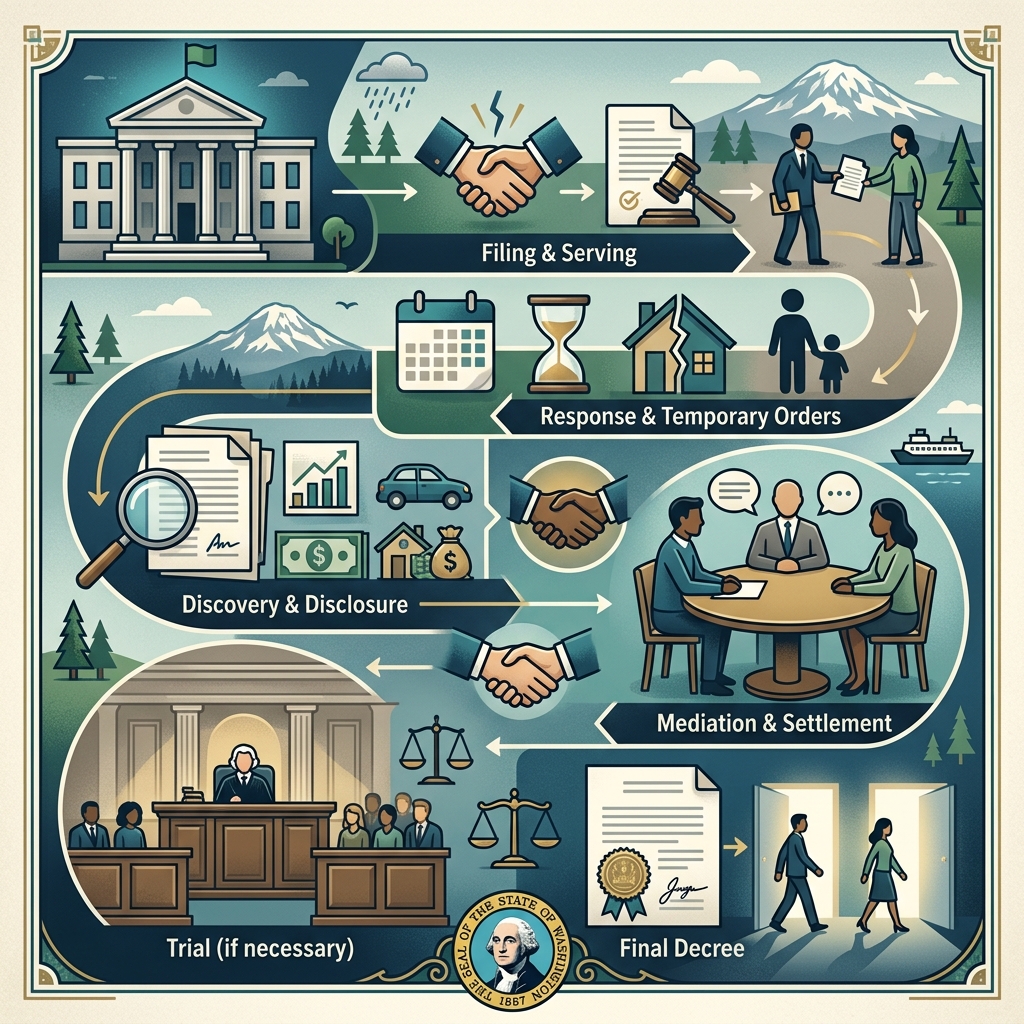
How Divorce Works in Washington
Divorce in Washington is legally called a dissolution of marriage, and it is based on a no-fault approach. That means the court does not need to decide who caused the breakup; one spouse only needs to state that the marriage is irretrievably broken. Washington also requires a mandatory waiting period before a divorce can be finalized, even when both spouses agree on every issue.
The process is often straightforward in concept but detailed in practice. A person must start the case with the correct paperwork, notify the other spouse, wait through the required time period, and resolve any disputed issues about children, support, property, or debt. If the spouses reach full agreement, the case may end through final orders without a trial. If they do not, the court may need to decide the remaining issues.
Before Filing: Basic Eligibility and Case Setup
In Washington, at least one spouse must have a sufficient connection to the state to file for divorce here. Washington law and court guidance describe residency or military presence in the state as the key starting point. The case is typically filed in the county where one spouse lives, not the county where the marriage took place.
Because divorce is a court case, the filing spouse must prepare forms carefully and choose the proper superior court. The initial paperwork usually includes a petition for dissolution, a summons, and other required forms such as confidential information and vital statistics documents. Court resources note that the forms and instructions are available through the Washington courts system.
The First Formal Step: Filing the Case
The divorce begins when one spouse files the petition with the superior court clerk. This filing starts the lawsuit and gives the court jurisdiction over the case. Once filed, the court assigns a case number and the case becomes active.
Filing is more than a paperwork task; it marks the point from which deadlines begin to run. The most important of those deadlines is the mandatory 90-day waiting period. Washington courts explain that a divorce cannot be finalized until at least 90 days have passed after the petition is filed and served.
Serving the Other Spouse
After filing, the next major step is service of process. The non-filing spouse must receive copies of the divorce papers so they have formal notice of the case. Washington sources describe this as service of the petition and summons, and they emphasize that the papers must be delivered in a legally recognized way.
In many cases, another adult who is not a party to the case hand-delivers the papers. A process server, friend, or other eligible adult can usually perform this task. If the other spouse accepts service and signs the appropriate acknowledgment, the case may move forward more smoothly. If not, the filing spouse must still prove that service was completed correctly.
Why the 90-Day Waiting Period Matters
Washington’s waiting period is one of the most important features of the divorce process. The court cannot enter final divorce orders until at least 90 days have passed from the date the petition was filed and served. This period is sometimes described as a cooling-off period because it gives the parties time to reconsider, negotiate, and resolve issues before the marriage is legally ended.
The waiting period does not mean the case sits idle. Instead, the spouses may exchange information, request temporary orders, attend mediation, and work toward settlement. In many cases, the waiting period is when most of the real negotiation happens. If the spouses are unable to agree, the case may continue well beyond the 90 days.
Temporary Orders During the Case
Divorce cases often involve immediate needs that cannot wait until the final hearing. A spouse may ask the court for temporary orders to address issues such as parenting arrangements, child support, use of the family home, payment of bills, or division of responsibilities while the case is pending. These orders are meant to stabilize the situation, not to resolve the case permanently.
Temporary relief can be especially important when children are involved or when the couple shares debts and expenses that must be managed during the divorce. A temporary order may help reduce conflict by setting short-term rules until the court enters final orders or the spouses reach an agreement.
Information Gathering and Discovery
Once the case is underway, each spouse may need information about income, assets, debts, parenting schedules, retirement accounts, and other financial or family matters. This exchange of information is commonly called discovery. Washington divorce guidance notes that discovery is a typical stage in which the parties collect facts needed for negotiation or trial.
Discovery matters because fair settlement depends on accurate information. A spouse cannot make informed decisions about property division or support without knowing what exists and what each person earns or owes. In contested cases, discovery can also reveal whether the parties truly disagree about facts or simply about the best outcome.
Mediation and Settlement Negotiations
Many Washington divorces are resolved without a trial. Mediation and settlement talks give the spouses a chance to work out parenting plans, child support, property division, and debt allocation with or without professional help. Washington sources describe mediation as a common step after information has been exchanged and before final court hearings take place.
A full settlement can save time, reduce cost, and give the spouses more control over the outcome. Instead of asking a judge to decide, the parties can craft a parenting plan and financial agreement that fits their family’s needs. If the agreement is complete, final orders can often be prepared for the court to approve.
When a Divorce Becomes Contested
A divorce is contested when the spouses cannot agree on one or more issues. The disagreement may involve child custody, support, the division of property, or the handling of debt. In that situation, the court process becomes more active, and the spouses may need motions, hearings, and eventually a trial.
Contested cases usually take longer than uncontested cases because each disputed issue must be resolved through negotiation or judicial decision. Even so, many contested divorces settle before trial once both sides understand the strengths and weaknesses of their positions.
Finalizing the Divorce
A Washington divorce is not complete when the petition is filed, and it is not complete merely because the spouses separate. The court enters final orders only after the waiting period has passed and the necessary legal steps have been satisfied. Washington court guidance explains that the judge signs final divorce orders, and the case becomes final when those orders are filed with the clerk.
If the spouses agree, they may sign final papers and ask the court to approve them. If they do not agree, unresolved issues may be decided at a hearing or trial before the court enters final orders. In either situation, the divorce becomes legally effective only when the final paperwork is entered.
Common Timeline for a Washington Divorce
| Stage | What Happens |
|---|---|
| Initial filing | One spouse files the petition and related forms with the superior court. |
| Service | The other spouse is formally served with the divorce papers. |
| Waiting period | At least 90 days must pass before final orders can be entered. |
| Case development | The spouses exchange information, seek temporary orders, and negotiate. |
| Resolution | The case ends by agreement, or remaining issues are decided by the court. |
Although the 90-day period is the minimum, many divorces take longer. Cases with children, disagreements about finances, or disputes over custody and property can extend the timeline well beyond the minimum waiting period.
Issues That Often Need Special Attention
- Parenting plans: If children are involved, the court may need to address residential time, decision-making, and exchange schedules.
- Child support: Support obligations may be included in temporary or final orders.
- Property division: Real estate, retirement assets, bank accounts, and personal property may need to be divided.
- Debt allocation: Credit cards, loans, and household obligations may need to be assigned between spouses.
- Spousal support: In some cases, one spouse may ask for maintenance during or after the divorce.
Practical Ways to Stay Organized
Even a fairly simple divorce moves faster when the parties stay organized. Keeping copies of every filed document, tracking service dates, and maintaining records of income, expenses, and parenting schedules can reduce confusion later. Accurate records also help if the court needs to review temporary orders or settle a disputed issue.
It is also helpful to distinguish between legal deadlines and personal expectations. The legal process may be emotionally difficult, but the court focuses on service, timing, disclosure, negotiation, and final orders. Understanding that structure can make the process feel more manageable.
Frequently Asked Questions
How long does a divorce take in Washington?
The shortest possible timeline is generally 90 days from filing and service, but many divorces take longer if the spouses disagree about children, property, or support.
Does Washington require fault to get divorced?
No. Washington is a no-fault state, so the court does not need proof that either spouse did something wrong to cause the marriage to end.
Can one spouse stop the divorce?
Not permanently. A spouse can contest issues in the case, but if the marriage is irretrievably broken and the legal requirements are met, the court may still grant the dissolution.
What happens if my spouse does not respond?
If the other spouse does not respond after proper service, the case may still proceed through the court system, often on an uncontested track if all other requirements are satisfied.
Do I have to go to trial?
Not always. Many Washington divorces end through settlement and final orders without trial. Trial is usually needed only when important issues remain unresolved.
What to Remember About the Washington Divorce Process
The Washington divorce process is built around a few core steps: filing the petition, serving the other spouse, waiting at least 90 days, resolving temporary and permanent issues, and entering final orders. The process is designed to give both spouses notice and time to negotiate while still allowing the court to step in when agreement is not possible.
For people who understand the sequence early, divorce becomes less confusing. The paperwork matters, the deadlines matter, and the opportunity to settle matters just as much as the courtroom itself.
References
- WA State Divorce Process | How to Get a Divorce in Washington — Shanathompsonlaw.com. 2026-07-09. https://www.shanathompsonlaw.com/divorce/stages/
- What to Expect in Washington Divorce Court: A Complete Timeline — Sean John Law. 2025-11-01. https://www.seanjohnlaw.com/2025/11/what-to-expect-in-washington-divorce-court-a-complete-timeline/
- Basics of Divorce in Washington State – Part 1 of 3: Filing for Divorce — Fairchild Air Force Base. 2016-06-03. https://www.fairchild.af.mil/News/Commentaries/Display/Article/763001/basics-of-divorce-in-washington-state-part-1-of-3-filing-for-divorce/
- Divorcing in Washington State. The Basics — Beresford Booth. 2024-01-01. https://beresfordlaw.com/divorcing-in-washington-state-the-basics/
- Filing for divorce in Washington State — Washington Courts. 2026-01-01. https://info.courts.wa.gov/support/solutions/articles/72000577384-filing-for-divorce-in-washington-state
- Washington Divorce — WomensLaw.org. 2025-01-01. https://www.womenslaw.org/laws/wa/divorce
- Divorce guide — Washington Law Help. 2026-01-01. https://www.washingtonlawhelp.org/en/divorce-guide
- Divorce basics — Washington Law Help. 2026-01-01. https://www.washingtonlawhelp.org/en/divorce-basics
- Court Forms: Divorce (Dissolution) – Washington Courts — Washington Courts. 2026-01-01. https://www.courts.wa.gov/forms/?fa=forms.contribute&formID=13
Similar Articles








Read full bio of medha deb


