
Warrantless Cell Phone Searches and Your Fourth Amendment Rights
Understand when police can access your cell phone without a warrant, the limits on those searches, and how key Supreme Court cases shape your privacy rights.
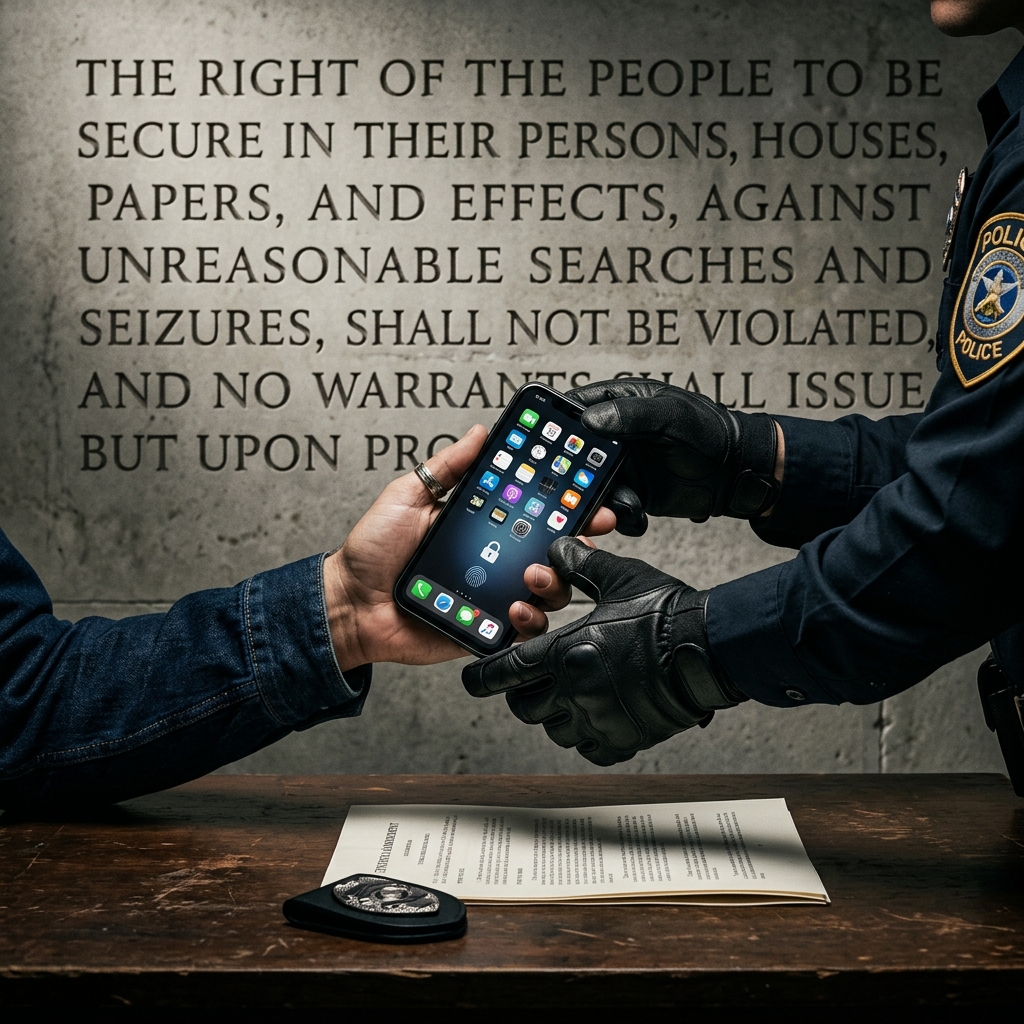
Modern smartphones hold a detailed record of our lives, from private messages and photos to financial and health information. As a result, the question of when police may conduct a warrantless cell phone search has become one of the most important issues in digital privacy and criminal law. This article explains the legal framework, key court decisions, and practical implications for anyone concerned about law enforcement access to their mobile devices.
Why Cell Phones Raise Unique Fourth Amendment Concerns
The Fourth Amendment protects people against unreasonable searches and seizures by the government. It generally requires that police obtain a warrant supported by probable cause before searching areas where a person has a reasonable expectation of privacy. While this principle is well established for homes, cars, and personal effects, cell phones pose special problems:
- Vast quantity of data: Smartphones store years of communications, locations, photos, and documents, far beyond what officers could traditionally find in a wallet or briefcase.
- Highly sensitive information: Phones often contain banking apps, health records, two-factor authentication codes, and private conversations that reveal intimate details about a person’s life.
- Access to cloud data: A single device can reach remote servers, making it a gateway to data stored far outside the physical space in which an arrest occurs.
- Continuous tracking: Location history and app usage logs can reconstruct where a person has been over time, creating a detailed behavioral profile.
Courts have recognized that the scale and sensitivity of digital information make cell phone searches far more intrusive than traditional searches, even when the device is physically small.
The General Rule: Police Usually Need a Warrant
Under current U.S. constitutional law, the general rule is straightforward: police must obtain a warrant to search the contents of a cell phone. This rule applies even when officers lawfully seize the phone during an arrest. The Supreme Court has emphasized that digital devices are not merely containers like cigarette packs or wallets, because they provide access to extensive personal information.
In practice, this means officers typically must:
- Develop probable cause that the phone contains evidence of a crime.
- Apply to a neutral judge or magistrate for a warrant describing the device and the type of data to be searched.
- Execute the search within the scope and time frame authorized by the warrant.
Without a warrant, any search of the phone’s contents is assumed to be unconstitutional unless it falls within a recognized exception to the warrant requirement.
Key Supreme Court Guidance: Riley v. California
The leading case on warrantless cell phone searches is Riley v. California, in which the U.S. Supreme Court addressed whether police may search an arrestee’s phone incident to arrest without a warrant. Historically, officers were allowed to search items on a suspect’s person at the time of arrest to protect safety and preserve evidence. That doctrine was developed in earlier cases involving physical objects such as pockets and briefcases.
In Riley, the Court unanimously held that this traditional justification did not extend to the full contents of a cell phone. The Court explained that:
- Information stored on a phone does not itself pose a physical threat to officer safety.
- Concerns about remote wiping or encryption are not prevalent enough to justify routine warrantless searches, and officers have tools to mitigate those risks.
- The volume and sensitivity of data on phones make such searches qualitatively different from examining a physical container.
As a result, the Court concluded that, in most circumstances, officers must secure a warrant before accessing the content of a seized phone. They may physically take the device, but they generally cannot browse apps, messages, or stored files without judicial authorization.
Recognized Exceptions to the Warrant Requirement
Even though warrants are usually required, the Fourth Amendment allows some limited circumstances where police can conduct a warrantless cell phone search. These exceptions are narrow and carefully scrutinized by courts.
Consent
One of the most common exceptions is consent. If a person voluntarily allows officers to look through their phone, the search may be lawful without a warrant. For consent to be valid, it must be freely given, not forced or obtained through coercion. If consent is withdrawn, officers are generally expected to stop the search unless another exception applies.
- Officers do not have to inform you that you may refuse consent.
- You may limit consent to specific apps or time periods.
- Any data accessed beyond the scope of consent can be challenged later in court.
Exigent Circumstances
The Supreme Court has also acknowledged a small window for exigent circumstances that may justify a warrantless cell phone search. Exigent circumstances exist when there is an immediate, urgent need to act and there is no time to obtain a warrant. Courts examine these claims closely and require a clear factual basis for the emergency.
Illustrative scenarios discussed in official guidance and case law include:
- Preventing a remote wipe or imminent encryption of data that would destroy critical evidence.
- Pursuing a fleeing suspect where live location information from the phone might prevent serious harm.
- Assisting individuals who are seriously injured or in danger, where information on the phone could be quickly lifesaving.
- Disrupting communications between conspirators in a suspected terrorist plot.
- Locating a missing child in a child abduction case where time is critical and data on the abductor’s phone may reveal the child’s whereabouts.
Even in these situations, courts later evaluate whether the claimed emergency genuinely justified bypassing a warrant or whether officers could have secured the device and sought judicial approval instead.
Plain View of Limited Information
Another limited exception is the plain view doctrine. If officers lawfully possess the phone and incriminating information is visible without further intrusion—such as a text message preview on a lock screen—some courts allow seizure of that specific information. However, accessing material beyond what is immediately visible usually requires a warrant.
Comparing Pre-Riley and Post-Riley Approaches
Before Riley, some courts treated cell phones as simple containers that could be searched incident to arrest, similar to pockets or bags. Others recognized higher privacy interests in digital devices. The Supreme Court’s decision largely resolved this split in favor of stronger privacy protection.
| Feature | Pre-Riley View | Post-Riley Rule |
|---|---|---|
| Phone classification | Often treated as a physical container; contents accessible incident to arrest. | Recognized as qualitatively different due to volume and sensitivity of data. |
| Default requirement | More frequent allowance for warrantless searches after arrest. | Warrant generally required to access contents of the phone. |
| Justification | Officer safety and evidence preservation broadly applied. | Officer safety concerns limited; evidence preservation handled through securing device and seeking a warrant. |
| Cloud data | Less clearly distinguished from on-device data. | Search incident to arrest does not extend to files stored in the cloud; warrant needed. |
Cloud Computing and Remote Data
An important aspect of modern phone searches is cloud computing. Many apps and services store information remotely on servers rather than directly on the device. The Supreme Court has recognized that accessing cloud-based data raises additional privacy concerns and cannot be justified merely by the fact that officers physically hold the phone.
In practice:
- Officers generally need a separate warrant to access data stored in the cloud, such as email accounts, social media profiles, or remote backups.
- Law enforcement must describe the specific accounts or categories of cloud data sought.
- Policies often distinguish between copying device data and issuing legal process (like subpoenas or warrants) to cloud service providers.
This distinction reflects the understanding that pressing an app icon could expose far more than what is physically present on the device, including communications and files stored around the world.
Practical Implications for Individuals
Understanding when warrantless cell phone searches are permitted can help individuals make informed decisions if they encounter law enforcement. While legal advice must come from a qualified attorney, several general points emerge from current case law and constitutional principles:
- You are not required to consent to a phone search. Refusing consent does not provide grounds for arrest by itself.
- Officers may lawfully seize your phone incident to arrest but usually cannot explore its contents without a warrant or a valid exception.
- Any exigent circumstances claim will later be reviewed by a court, so officers must be prepared to articulate specific facts that justified immediate access.
- Data visible on the lock screen may be more vulnerable to plain-view seizure; using privacy features such as reduced notification previews can limit exposure.
- Strong device encryption and screen locks can prevent unauthorized access, but they do not change what the law allows officers to attempt.
Because digital privacy law is complex and fact-specific, anyone facing a criminal investigation involving their phone should seek legal counsel promptly to understand their rights and potential defenses.
Frequently Asked Questions (FAQ)
Do police always need a warrant to search my phone?
In most situations, police need a warrant supported by probable cause to search the contents of your phone. Limited exceptions exist, such as consent and exigent circumstances, but routine searches incident to arrest must now proceed with judicial approval.
Can officers take my phone when I am arrested?
Yes. Police may generally seize your phone as part of the arrest process and hold it as evidence or property. However, possession of the device does not automatically authorize a full search of its digital contents without a warrant.
What counts as an exigent circumstance for phone searches?
Exigent circumstances are urgent situations where delaying a search to obtain a warrant could result in serious harm or loss of critical evidence. Examples discussed in judicial and training materials include preventing remote wiping of data, locating a kidnapped child, or interrupting imminent violent crimes.
Is cloud data treated differently from data stored on my phone?
Yes. Courts and official guidance distinguish between data physically stored on the device and information kept in the cloud. The search incident to arrest doctrine does not automatically allow officers to access cloud-based files via your phone; they typically must obtain a warrant specifically authorizing access to those remote accounts.
What should I do if I believe my phone was searched unlawfully?
If you suspect an unlawful search, it is important to speak with a lawyer. Courts can suppress evidence obtained in violation of the Fourth Amendment, meaning that improperly acquired phone data may be excluded from your case. A legal professional can review the facts, evaluate whether any exception applied, and help you pursue appropriate remedies.
References
- Fourth Amendment — Electronic Privacy Information Center (EPIC). 2024-03-15. https://epic.org/issues/privacy-laws/fourth-amendment/
- Getting Back to the Fourth Amendment: Warrantless Cell Phone Searches and the Case for a Constitutional Framework — New York Law School Law Review. 2012-01-01. https://digitalcommons.nyls.edu/cgi/viewcontent.cgi?article=1674&context=nyls_law_review
- US Supreme Court Rules on Warrantless Cellphone Searches — Joel Sogol, Attorney at Law. 2014-07-01. https://joelsogol.com/articles/us-supreme-court-rules-on-warrantless-cellphone-searches/
- Limits of Warrantless Cell Phone Searches: What Law Enforcement Needs to Know — SEARCH, The National Consortium for Justice Information and Statistics. 2014-09-01. https://www.search.org/limits-of-warrantless-cell-phone-searches-what-law-enforcement-needs-to-know/
- Can Police Search Your Phone Without a Warrant in Indiana? — Indy Justice. 2023-05-10. https://www.indyjustice.com/blog/search-phone-without-warrant-indiana/
Similar Articles








Read full bio of Sneha Tete




