
Walmart Wage and Hour Settlements: What Employers Can Learn
How Walmart’s multi-million dollar wage and hour settlements offer a cautionary roadmap for employers on labor compliance and risk management.
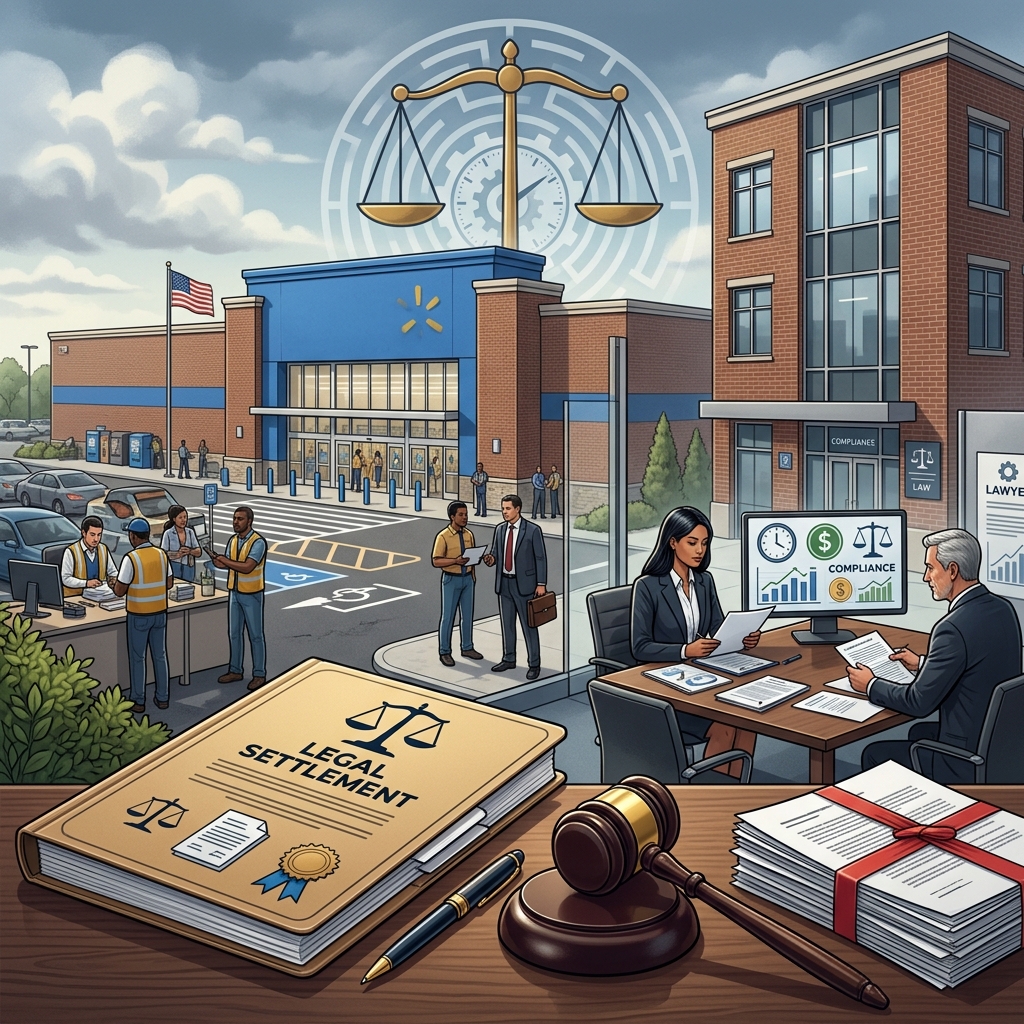
Wage and hour lawsuits have become one of the most persistent legal challenges facing large employers in the United States, and few companies illustrate this reality more clearly than Walmart. Over the past two decades, the retail giant has agreed to pay hundreds of millions of dollars to resolve dozens of cases involving allegations of unpaid work, inaccurate wage statements, and other labor practice issues. These settlements, while costly, offer valuable lessons to any organization that relies on large hourly workforces and complex scheduling systems.
This article uses Walmart’s wage and hour litigation history as inspiration to explain what these cases typically involve, why they arise, and how employers can reduce their exposure. The focus is on practical, compliance-focused guidance rather than individual personalities or isolated anecdotes.
Understanding Wage and Hour Law in Plain Terms
Most wage and hour disputes are rooted in a simple legal principle: employers must pay workers correctly and on time for all hours worked. In the United States, the core federal rules are set out in the Fair Labor Standards Act (FLSA), which governs minimum wage, overtime, recordkeeping, and child labor for most employees. States often add their own requirements, which may be stricter than federal rules.
Key Components of Wage and Hour Compliance
- Minimum wage: Paying at least the federal or applicable state minimum wage for every hour worked.
- Overtime pay: Compensating non-exempt employees at one and a half times their regular rate of pay for hours worked over 40 in a workweek, unless a state sets a different threshold.
- Hours worked: Including all time that is integral and indispensable to the job, such as certain pre-shift activities and mandatory screenings.
- Recordkeeping: Maintaining accurate records of hours worked, wages paid, and other required details.
- Wage statements: In many states, providing employees with clear written pay stubs that show how their pay was calculated.
When employers fall short in any of these areas, affected workers may bring individual lawsuits or, more commonly, class or collective actions that aggregate claims by thousands of employees. For large companies, the financial and reputational stakes can be significant.
Walmart’s Wage and Hour Litigation Landscape
Walmart’s sheer size—millions of employees, thousands of stores, and global operations—makes it particularly vulnerable to wage and hour disputes. Over time, these disputes have covered a wide range of issues, from allegedly unpaid time spent on job-related tasks to the form and content of wage statements given to employees.
One widely discussed set of cases involved 63 separate wage and hour lawsuits filed in multiple jurisdictions, which Walmart agreed to resolve in a consolidated settlement reportedly exceeding $640 million
Common Allegations in Large Retail Wage Cases
- Off-the-clock work: Claims that employees were required or pressured to perform tasks before clocking in or after clocking out, such as preparing workstations, completing closing duties, or submitting to mandatory health screenings.
- Unpaid pre-shift screening: During the COVID-19 pandemic, some Walmart workers alleged that time spent undergoing required pre-shift temperature checks or health questionnaires was not fully compensated.
- Inaccurate wage statements: In California, plaintiffs claimed that wage statements failed to meet state statutory requirements, leading to a separate multi-million dollar settlement.
- Break and meal period violations: Allegations that scheduled meal or rest breaks were shortened, interrupted, or not provided in accordance with state law.
- Classification issues: Disputes about whether certain employees were wrongly treated as exempt from overtime protections.
Although Walmart has often denied wrongdoing, it has repeatedly chosen to settle rather than litigate these cases to final judgment. For employers, the key question is not whether Walmart was correct on the law in any single case, but what patterns of risk these disputes reveal.
Representative Examples of Settlement-Driven Risk
To better understand how wage and hour issues translate into real-world liability, it helps to look at specific settlement scenarios involving Walmart and other large employers.
Pre-Shift COVID-19 Screening Time
In the wake of the COVID-19 pandemic, many employers introduced mandatory health screening procedures. In one case involving Walmart’s Arizona stores, hourly workers claimed that they were not paid for time spent undergoing required pre-shift temperature checks and symptom questionnaires. The company agreed to pay $2.5 million to resolve the claims under state wage law.
The U.S. Department of Labor (DOL) has clarified that under the FLSA, an employer generally must pay employees for all hours worked, including time before or after a scheduled shift if the tasks are necessary for the employee’s work and are “integral and indispensable” to their job. When health screenings are mandatory and closely tied to the performance of the job, the screening time can be compensable.
Unpaid Screening Time in California
Similar claims emerged in California, where a federal court reviewed a proposed settlement involving workers who alleged they were not paid for COVID-related screening time. Under the proposed agreement, Walmart would pay roughly $5.2 million to resolve those wage and hour claims, in addition to applicable payroll taxes.
These cases demonstrate how quickly a seemingly small practice—such as five or ten minutes of unpaid pre-shift activity—can escalate into multimillion-dollar class actions when multiplied across tens of thousands of employees and hundreds of workdays.
Wage Statement Accuracy Issues
Not all wage and hour litigation concerns unpaid work; some disputes focus on the way pay information is presented. In California, where wage statement requirements are particularly detailed, Walmart faced a class action alleging that pay stubs did not meet statutory standards. The case ultimately led to an agreement to pay approximately $35 million to resolve the claims of more than 260,000 current and former employees, without an admission of wrongdoing.
For employers, the lesson is clear: wage statements are not merely administrative paperwork. They are legally significant documents that can form the basis of large-scale liability if they are inaccurate, incomplete, or confusing.
Patterns and Lessons from Walmart’s Experience
Across these and many other cases, several recurring themes emerge. These themes can serve as a roadmap for other employers seeking to strengthen compliance and reduce risk.
1. Small Time Increments Can Have Big Consequences
Five minutes of unpaid pre-shift work may not seem important in isolation, but when thousands of employees perform those tasks daily, the total unpaid time can become very substantial. When aggregated in a class action, those minutes translate into significant back pay, penalties, and attorneys’ fees.
Employers should:
- Identify any regular pre- or post-shift activities required of employees.
- Determine whether those activities are integral and indispensable to the job under federal guidance.
- Ensure that time-keeping systems capture and compensate that time.
2. Complexity in Scheduling and Timekeeping Adds Risk
Large retailers often use sophisticated scheduling software, flexible shifts, and multi-tasking roles. While these systems can optimize labor costs, they also make it easier for time entry errors, missed breaks, or unrecorded tasks to slip through unnoticed.
Effective risk management requires:
- Regular audits of time records and payroll data to identify anomalies.
- Clear policies that prohibit off-the-clock work and require employees to report all time worked.
- Training for supervisors so they understand that encouraging unpaid work—even informally—is prohibited.
3. State Law Matters as Much as Federal Law
While the FLSA sets the federal baseline, states like California impose additional requirements for minimum wage, overtime, meal and rest breaks, and wage statements. Employers operating across multiple states must adapt their practices to local rules rather than assuming that one-size-fits-all policies will suffice.
| Issue | Federal Baseline (FLSA) | State Example (California) |
|---|---|---|
| Overtime threshold | Over 40 hours in a workweek. | Daily overtime rules and additional premiums for certain schedules. |
| Wage statements | Basic recordkeeping requirements. | Detailed pay stub content mandated by statute, with penalties for noncompliance. |
| Breaks | Not comprehensively regulated at federal level. | Mandatory meal and rest periods with specific timing and penalties. |
Companies with national footprints should work closely with legal counsel to ensure that their systems accommodate state-level variations and that store-level leadership understands the differences.
4. Class Actions Amplify Operational Weaknesses
Wage and hour class actions often expose systemic problems rather than isolated missteps. For Walmart, repeated lawsuits about similar issues—such as unpaid screening time or wage statement formats—suggest that operational practices were not sufficiently aligned with evolving legal expectations.
Proactive strategies include:
- Conducting periodic, independent compliance reviews.
- Monitoring enforcement trends and guidance from agencies like the DOL.
- Responding quickly to internal complaints about pay, breaks, or scheduling.
Practical Compliance Steps for Employers
Employers do not need Walmart’s scale to learn from its experience. Even mid-sized organizations can face significant exposure if wage and hour issues are left unchecked. The following steps can help reduce risk and demonstrate good-faith compliance efforts.
Audit and Modernize Timekeeping Systems
- Ensure that time clocks or digital systems allow employees to accurately record all time worked, including pre- and post-shift tasks.
- Prevent managers from altering time records without documented justification and appropriate review.
- Integrate payroll and scheduling systems to flag inconsistencies between scheduled and recorded hours.
Review Pre-Shift and Post-Shift Activities
- List all activities employees perform before and after shifts, such as security checks, equipment preparation, health screenings, or closing procedures.
- Determine which activities are required and job-related under DOL guidance.
- Update policies to clarify that employees must be on the clock while performing these duties.
Strengthen Wage Statement Accuracy
- Verify that wage statements comply with all applicable state laws, especially in jurisdictions with detailed requirements like California.
- Include clear information about hours worked, rates of pay, overtime, deductions, and pay periods.
- Establish a process for employees to promptly report and correct wage statement errors.
Educate Supervisors and HR Personnel
- Train supervisors on the prohibition against off-the-clock work and the importance of honoring break rules.
- Provide HR teams with regular updates on changes in federal and state wage and hour law.
- Encourage a culture where employees are not penalized for accurately reporting their hours.
Wage and Hour Settlements: Strategic Considerations
Despite strong compliance efforts, disputes may still arise. When they do, companies must decide whether to litigate aggressively or pursue settlement. Walmart’s repeated decisions to settle large wage and hour cases suggest a pragmatic calculation: the combined uncertainty, cost, and reputational risk of prolonged litigation can outweigh the price of settlement, even when the company believes it has valid defenses.
Factors that often drive settlement decisions include:
- The number of employees involved and potential exposure if plaintiffs prevail.
- The strength of documentary evidence, including time records and internal communications.
- The impact of media coverage on public perception and brand reputation.
- The likelihood of similar claims emerging in other jurisdictions.
For employers, the best strategy is to approach wage and hour compliance as an ongoing risk management function rather than a reactive response to litigation. Settlement should be the exception, not the everyday tool.
FAQs About Wage and Hour Settlements
What is a wage and hour class action?
A wage and hour class action is a lawsuit in which a group of employees jointly claim that an employer violated labor laws, typically by failing to pay minimum wage, overtime, or required premiums, or by mishandling wage statements and breaks. Class actions allow courts to address systemic issues affecting many workers at once.
Why do large employers like Walmart face so many wage and hour cases?
Large employers with thousands of hourly workers and complex staffing models are more likely to encounter inconsistencies in pay and timekeeping. Even small errors can affect many employees, making them attractive targets for class action litigation.
Are pre-shift activities always compensable?
No, not every pre-shift activity must be paid. Under the FLSA, employers must compensate for time spent on tasks that are integral and indispensable to the employee’s principal work, such as mandatory health screenings or safety checks, but not for purely personal or incidental activities.
What is the significance of wage statements in wage and hour law?
Wage statements provide employees with essential information about how their pay was calculated. In some states, laws specify exactly what must be shown on these statements, and violations can lead to statutory penalties or class actions, even if the underlying pay amounts were technically correct.
How can employers reduce the risk of wage and hour litigation?
Employers can reduce risk by maintaining accurate time records, paying for all hours worked, complying with state-specific rules, auditing their systems, and training managers and HR staff on wage and hour obligations. Proactive compliance is far less costly than defending a large class action.
References
- Walmart Settles Wage Statement Lawsuit for $35M — Feldman Shepherd Wohlgelernter Tanner Weinstock & Dodig. 2021-09-15. https://www.fslawfirm.com/blog/2021/09/walmart-settles-wage-statement-lawsuit-for-35m/
- The Walmart Wage and Hour Settlement — EOS Global Expansion. 2023-06-01. https://eosglobalexpansion.com/walmart-wage-and-hour-settlement/
- Walmart will pay $2.5M to settle class-action wage claims for pre-shift COVID-19 screening — HR Dive. 2023-08-02. https://www.hrdive.com/news/walmart-settle-class-action-wage-claims-pre-shift-covid-checks/721939/
- WAGE-HOUR—SETTLEMENTS—E.D. Cal.: California Walmart workers get final approval of $5.2M settlement over claims of unpaid COVID-19 screening time — VitalLaw (Wolters Kluwer). 2023-07-20. https://www.vitallaw.com/news/wage-hour-settlements-e-d-cal-california-walmart-workers-get-final-approval-of-5-2m-settlement-over-claims-of-unpaid-covid-19-screening-time/eld019b9511dd59fe4064b57a8d661978ba8e
- Fact Sheet #22: Hours Worked Under the Fair Labor Standards Act (FLSA) — U.S. Department of Labor, Wage and Hour Division. 2016-07-01. https://www.dol.gov/agencies/whd/fact-sheets/22-flsa-hours-worked
Similar Articles








Read full bio of Sneha Tete




