
Voting Rights Act in Peril: History, Threats, and the Future
Exploring the systematic dismantling of the Voting Rights Act.
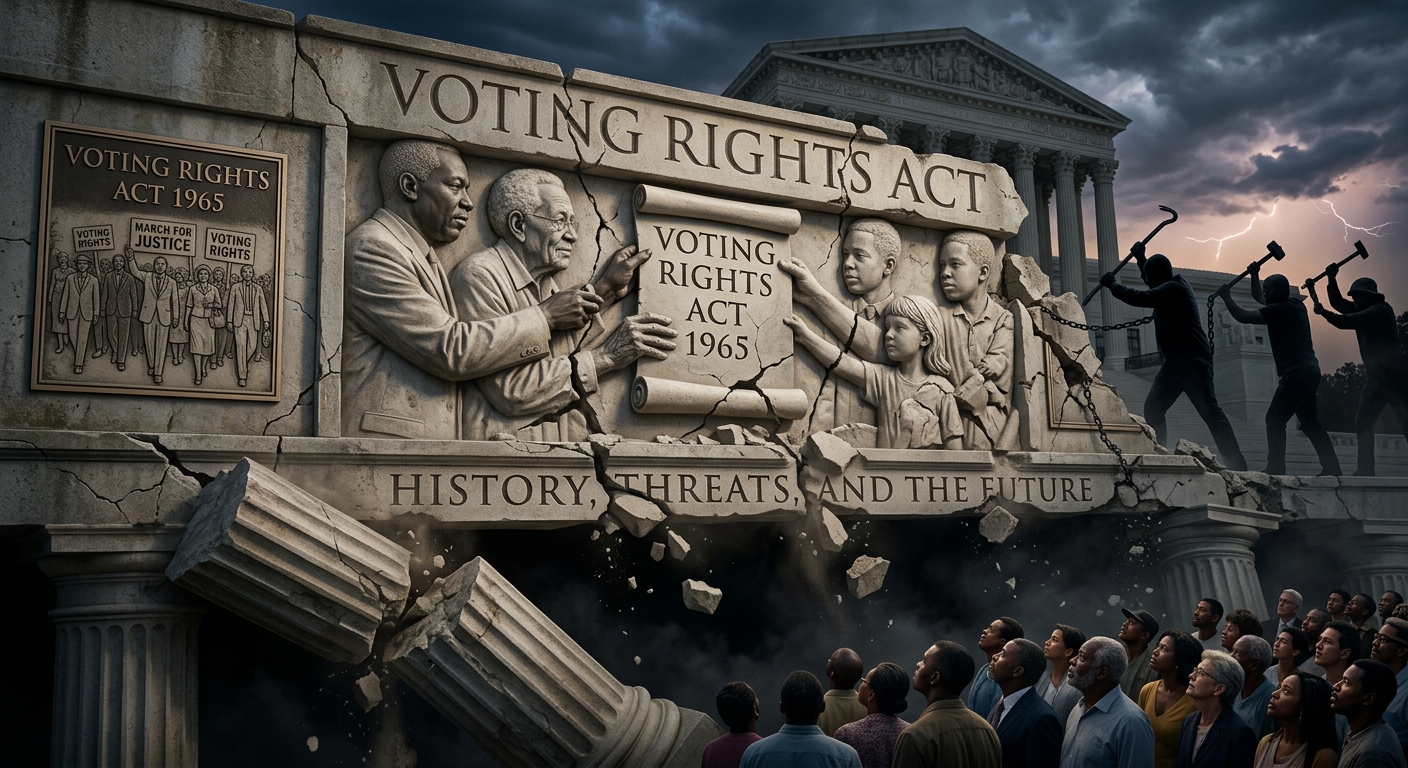
Democracy in the United States relies upon the fundamental premise that every eligible citizen possesses the right to cast a ballot and have their voice heard in the halls of power. For more than half a century, the Voting Rights Act of 1965 stood as the ultimate safeguard of this democratic principle, systematically dismantling discriminatory barriers that had intentionally disenfranchised voters of color for generations. However, this monumental piece of civil rights legislation is currently facing an unprecedented and existential crisis. Driven by a series of transformative judicial decisions from the nation’s highest courts and an onslaught of restrictive state-level legislation, the robust protections that once guaranteed equitable access to the ballot box are being methodically dismantled. Understanding the current peril facing the Voting Rights Act requires a comprehensive historical examination of its original efficacy, the legal precedents that have incrementally stripped its enforcement power, and the modern legislative battles being waged across the nation to either restrict or expand democratic participation. The outcome of these battles will inevitably shape the landscape of American elections for decades to come, determining whether the promise of equal representation remains a reality or fades into a historical footnote.
The Historical Context of the Voting Rights Act
The passage of the Voting Rights Act (VRA) in 1965 was the culmination of decades of advocacy, profound human sacrifice, and intense political pressure during the height of the American Civil Rights Movement. Despite the ratification of the 15th Amendment in 1870, which explicitly prohibited the denial of the right to vote based on race, color, or previous condition of servitude, many states—particularly in the Jim Crow South—implemented insidious, systemic measures to bypass federal law. Poll taxes, impossible literacy tests, grandfather clauses, and campaigns of violent intimidation were institutionalized by local governments to ensure that Black Americans and other minority groups remained systematically excluded from the electoral process.
The brutal attacks on peaceful voting rights marchers attempting to cross the Edmund Pettus Bridge in Selma, Alabama, in a confrontation known as “Bloody Sunday,” catalyzed a national outcry. Prompted by this televised brutality and the relentless pressure from civil rights leaders, President Lyndon B. Johnson championed the VRA, which Congress rapidly enacted. The legislation was remarkably and immediately effective. By federalizing the oversight of election procedures, the VRA summarily outlawed discriminatory testing devices and instituted mechanisms that led to millions of newly registered minority voters. For decades, the Act remained a bipartisan triumph, overwhelmingly reauthorized by multiple presidents from both major political parties who recognized its indispensable role in preserving the integrity of the American republic.
The Turning Point: Shelby County v. Holder
The modern erosion of the Voting Rights Act can be definitively traced back to the landmark 2013 United States Supreme Court decision in Shelby County v. Holder. At the very heart of this highly contentious case were Sections 4(b) and 5 of the VRA. Section 5 established a vital “preclearance” requirement, mandating that states, counties, and local jurisdictions with a documented, historical record of voting discrimination obtain federal approval from the Department of Justice or a federal court before altering any of their election laws or procedures. Section 4(b) contained the specific coverage formula used to mathematically determine which jurisdictions were subject to this stringent oversight.
In a deeply divided 5-4 decision, the Supreme Court ruled that the coverage formula situated in Section 4(b) was unconstitutional. The majority opinion argued that the formula was based on obsolete, decades-old data that no longer accurately reflected the current racial dynamics and electoral realities of the nation. While the Court technically left Section 5 intact, rendering the coverage formula void effectively neutered the preclearance requirement. The immediate aftermath of the Shelby County decision was profound and swift. Within mere hours of the ruling, several states previously operating under federal oversight announced the implementation of strict voter identification laws, the closure of numerous polling places in predominantly minority neighborhoods, and sweeping changes to electoral maps that had previously been blocked by the Justice Department. This pivotal decision opened the floodgates for a massive wave of second-generation voter suppression tactics. Crucially, it fundamentally shifted the legal burden of proof from the states—who formerly had to prove their proposed laws were not discriminatory before implementation—to citizens and civil rights organizations, who now must endure lengthy, expensive litigation to strike down discriminatory laws after they have already taken effect.
Recent Judicial Blows to Section 2 Protections
Following the catastrophic neutralization of Section 5 preclearance, civil rights advocates and voting rights attorneys heavily relied on Section 2 of the VRA to combat voter suppression. Section 2 applies nationwide and strictly prohibits any voting practice or procedure that results in the denial or abridgment of the right to vote on account of race or color. However, subsequent rulings from the Supreme Court have severely weakened this critical provision as well, significantly narrowing the avenues for legal recourse.
In the pivotal 2021 case Brnovich v. Democratic National Committee, the Court issued a ruling that made it substantially more difficult for plaintiffs to successfully challenge voting restrictions under Section 2. The decision established new guideposts that heavily favored state interests in preventing theoretical voter fraud over the demonstrable disparate impact these laws impose on minority voters. The Court essentially ruled that minor inconveniences in voting, even if they disproportionately affect specific racial groups, do not automatically constitute a violation of the VRA.
More recently, the judicial landscape shifted even further with the highly controversial 2026 decision in Louisiana v. Callais. This sweeping ruling effectively gutted the utility of Section 2 regarding racial gerrymandering, making it almost impossible to challenge congressional maps that dilute the political power of minority communities, provided state legislatures cloak their actions under the guise of partisan objectives. These sequential legal decisions have systematically dismantled the VRA’s core enforcement mechanisms, leaving voters of color with significantly diminished federal protection against discriminatory electoral practices.
The Modern Wave of Restrictive State Voting Laws
Empowered by the Supreme Court’s steady retreat from federal oversight and enforcement, state legislatures across the country have introduced and enacted a historic volume of restrictive voting legislation. According to data tracked by the Brennan Center for Justice, the period following the 2020 election saw an unprecedented spike in state laws designed to curtail ballot access, a trend continuing aggressively into 2025 and 2026. Between January 1 and May 1, 2026 alone, at least 9 states enacted 12 restrictive voting laws. These legislative efforts frequently and surgically target the precise methods of voting most utilized by marginalized communities, working-class citizens, and young voters.
Prominent examples of these modern restrictive measures include:
- Strict Voter Identification Requirements: Mandating specific, narrow forms of government-issued photo identification that can be costly, time-consuming, or logistically difficult for low-income, rural, and elderly voters to obtain.
- Severe Restrictions on Mail-in Voting: Drastically shortening the legal window to request absentee ballots, eliminating or strictly limiting the use of secure 24-hour ballot drop boxes, and imposing harsh signature matching requirements that frequently lead to arbitrary ballot rejections.
- Aggressive Voter Roll Purges: Enacting list-maintenance legislation that forces local election officials to remove registered voters from the rolls with limited prior notice, often trapping eligible citizens in bureaucratic errors and preventing them from voting on Election Day.
- Documentary Proof of Citizenship: As seen in contentious proposed federal legislation like the SAVE Act and implemented in certain states, requiring voters to physically produce birth certificates or passports to register. This poses a severe, immediate barrier to millions of eligible, native-born Americans who do not have immediate access to these specific documents.
To clearly illustrate the evolving landscape of state-level election legislation, the following table summarizes the contrasting legislative trends over recent election cycles.
| Election Cycle / Year | Restrictive Laws Enacted | Expansive Laws Enacted | Primary Focus of Legislation |
|---|---|---|---|
| 2021-2022 | Over 40 across multiple states | Minimal outside of deeply blue states | Limiting mail-in voting access, establishing strict photo ID requirements. |
| 2024-2025 | 32 laws in 17 states | 30 laws in 25 states | Voter roll purges, documentary proof of citizenship vs. automatic voter registration. |
| Early 2026 | 12 laws in 9 states | 16 laws in 6 states | Bans on out-of-state IDs for students, severe criminalization of voter assistance. |
The Impact on Marginalized Communities
The cumulative, real-world effect of this judicial rollback combined with targeted legislative restrictions is most acutely and painfully felt by historically marginalized communities. Data demonstrates a growing racial turnout gap across the nation. This critical metric, which measures the difference in voting participation rates between white voters and voters of color, had steadily and encouragingly narrowed during the decades of robust VRA enforcement. However, it has widened significantly in the post-Shelby County era, reversing decades of hard-fought democratic progress.
Minority voters often face disproportionately longer wait times at polling locations, a direct consequence of the targeted closure and consolidation of polling sites in densely populated urban neighborhoods. Furthermore, restrictions on early voting days and the elimination of same-day registration disproportionately impact hourly wage workers, single parents, and college students who lack the flexibility to navigate rigid, narrow voting windows. Language minority voters often find themselves without necessary translated materials or bilingual poll workers. Native American communities, who frequently reside on remote rural reservations without standard residential street addresses, face immense logistical hurdles due to new, strict address and identification requirements. Similarly, voters with physical disabilities often find themselves effectively disenfranchised by punitive laws that criminalize or severely restrict the ability of advocacy groups, neighbors, and even family members to assist them in completing or returning absentee ballots.
Federal and State Legislative Countermeasures
In direct response to the rapidly deteriorating state of voting rights and the erosion of the VRA, pro-democracy advocates, civil rights organizations, and federal lawmakers have continuously pushed for comprehensive legislative countermeasures to protect the ballot. Two primary, sweeping bills have dominated the federal discourse in recent years:
- The John Lewis Voting Rights Advancement Act: Named in solemn honor of the late civil rights icon and congressman, this vital legislation seeks to restore, repair, and modernize the original VRA. Its primary objective is to establish a new, constitutionally sound, and data-driven coverage formula for preclearance. This would ensure that states and localities with recent, documented histories of systemic voting discrimination are once again subject to mandatory federal oversight before they can implement any new, potentially harmful election laws.
- The Freedom to Vote Act: This sweeping legislative package aims to set comprehensive national baseline standards for election access, overriding restrictive state laws. It includes robust provisions for automatic and same-day voter registration, guarantees a national minimum of 15 consecutive days of early voting, establishes standardized rules for mail-in voting, and includes strict measures to permanently combat partisan gerrymandering and the corrosive influence of dark money in campaign finance.
While these essential federal legislative efforts have repeatedly stalled due to procedural hurdles, proactive action at the state level has provided a blueprint for democratic resilience. Several states, including New York, California, Michigan, and Connecticut, have successfully enacted their own comprehensive State Voting Rights Acts. These powerful state-level laws codify strict protections against minority vote dilution, require localized preclearance procedures for municipal jurisdictions with specific histories of discrimination, and provide individual voters with significantly enhanced legal standing to rapidly challenge suppressive laws in state courts.
Frequently Asked Questions (FAQs)
What was the original purpose of the Voting Rights Act of 1965?
The Voting Rights Act was intentionally designed to enforce the 15th Amendment of the U.S. Constitution, which explicitly guarantees that the right to vote cannot be denied on account of race. It aimed to permanently eliminate systemic, discriminatory practices like literacy tests, poll taxes, and intimidation tactics that had historically disenfranchised Black Americans for decades.
What is the concept of preclearance?
Preclearance was a powerful legal mechanism established by Section 5 of the VRA. It explicitly required specific states and local jurisdictions with a documented history of discriminatory voting practices to receive formal approval from the federal government (either the DOJ or a federal court) before implementing any changes to their election laws or maps.
How did the Shelby County v. Holder decision change voting rights?
The 2013 Supreme Court ruling invalidated the specific formula used to determine which states were subject to preclearance. Without this formula, the preclearance requirement became practically unenforceable. This monumental shift allowed states with histories of discrimination to pass restrictive voting laws without any prior federal review or intervention.
What is the John Lewis Voting Rights Advancement Act?
It is a proposed federal civil rights bill designed to forcefully restore the gutted protections of the original VRA. It aims to achieve this by creating a new, updated, and legally sound formula to determine which jurisdictions require federal oversight (preclearance) based on recent, verifiable instances of voting rights violations.
Conclusion
The Voting Rights Act of 1965 was once widely considered the undisputed crown jewel of the American civil rights movement, serving as an indispensable and fiercely effective tool for realizing the profound promise of a truly representative and egalitarian democracy. However, decades after its historic enactment, the legislation faces systematic, calculated dismantlement from both the judiciary and partisan state legislatures. As the critical legal safeguards that protect minority and marginalized voters continue to precipitously erode, the responsibility falls squarely upon legislative bodies and the American electorate to forge new, robust frameworks. The ongoing, high-stakes struggle over ballot access serves as a stark reminder that the right to vote is not a permanent acquisition securely locked away in history, but rather a continuous battle that requires vigilant, unyielding defense to ensure that every single citizen retains their fundamental voice in the democratic process.
References
- History Of Federal Voting Rights Laws — Department of Justice. 2017-07-28. https://www.justice.gov/crt/history-federal-voting-rights-laws
- Section 2 Of The Voting Rights Act — Department of Justice. 2023-04-05. https://www.justice.gov/crt/section-2-voting-rights-act
- State Voting Laws Roundup: May 2026 — Brennan Center for Justice. 2026-05-19. https://www.brennancenter.org/our-work/research-reports/state-voting-laws-roundup-may-2026
- Strengthening the Voting Rights Act — Brennan Center for Justice. 2026-04-30. https://www.brennancenter.org/our-work/research-reports/strengthening-voting-rights-act
Similar Articles








Read full bio of medha deb


