
Virginia Open Container Rules for Drivers and Passengers
Understand how Virginia treats open containers of alcohol in vehicles, when drivers are presumed to be drinking, and how to stay safely within the law.
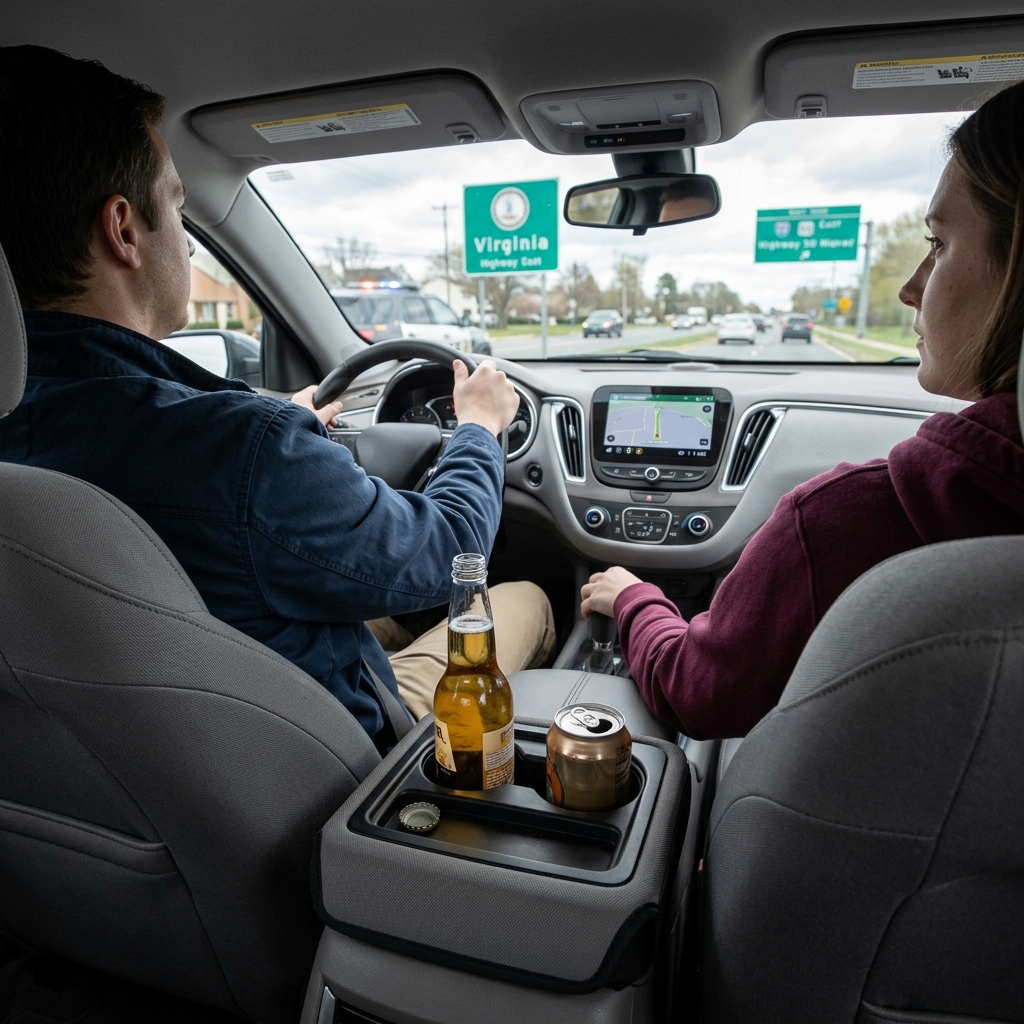
Virginia handles open containers of alcohol in vehicles differently from many other states. Instead of a broad statewide ban on any open alcoholic beverage in a car, Virginia focuses on whether the driver is consuming alcohol while operating on a public highway and uses open containers as evidence to create a legal presumption of drinking.
This guide explains how the law works, what counts as an open container, where alcohol may be stored in a vehicle, how passengers are treated, and the potential penalties and practical risks drivers face.
1. Big Picture: How Virginia Regulates Alcohol in Vehicles
Under Virginia law, the key statewide rule is simple: a driver may not consume alcohol while operating a motor vehicle on a public highway. There is no separate statewide statute that forbids every open container in the car, but an open container can trigger a presumption that the driver has been drinking, which may support a charge.
- No broad statewide ban on passengers having open containers of alcohol in all circumstances.
- Clear prohibition on the driver drinking while driving on a public highway.
- Open container + driver’s condition can create a rebuttable presumption that the driver violated the drinking-while-driving law.
- Local ordinances in some cities and counties may impose stricter rules on passengers and open containers on public roads.
Because of this structure, the legal risk in Virginia is not only about what is in the car, but also about the driver’s apparent condition and where the vehicle is being operated.
2. Core Statute: Drinking While Operating a Motor Vehicle
The main provision governing alcohol in vehicles is Virginia Code § 18.2-323.1, titled “Drinking while operating a motor vehicle; possession of open container while operating a motor vehicle and presumption; penalty.”
2.1 What the statute prohibits
Subsection A of § 18.2-323.1 establishes the basic rule:
- It is unlawful for any person to consume an alcoholic beverage while driving a motor vehicle upon a public highway of the Commonwealth.
This applies to the driver only. It does not, by itself, ban passengers from drinking, although other laws and local rules may apply.
2.2 The rebuttable presumption based on an open container
Virginia law uses open containers as evidence that the driver may have been drinking. Subsection B of § 18.2-323.1 creates a rebuttable presumption of a violation when all these conditions are met:
- An open container is located within the passenger area of the vehicle.
- The alcoholic beverage in that container has been at least partially removed (in other words, some of it has been consumed).
- The driver’s appearance, conduct, odor of alcohol, speech, or other physical characteristics may reasonably be associated with the consumption of alcohol.
When these elements are present, the law allows a court to presume the driver has consumed alcohol while operating the vehicle. The presumption is rebuttable, meaning the driver is permitted to present evidence to challenge it.
3. What Counts as an Open Container?
Virginia provides a clear definition of an open container for purposes of this statute.
3.1 Legal definition
Under § 18.2-323.1(C):
- “Open container” means any vessel containing an alcoholic beverage, except the originally sealed manufacturer’s container.
This definition focuses on whether the factory seal is intact. Once the original seal has been broken, the container is considered “open,” regardless of whether a cap or lid has been put back on.
3.2 Common examples
Typical items that may be treated as open containers include:
- Beer bottles or cans with the manufacturer’s seal removed.
- Wine bottles that have been opened and re-corked.
- Liquor bottles with a broken seal, even if re-closed.
- Cups, flasks, or other vessels holding poured alcohol.
If any of these are found in the passenger area while you are driving on a public highway, they may contribute to a presumption that you have been drinking.
4. Understanding the “Passenger Area”
Where an open container is located in the vehicle is crucial. The law treats the passenger area differently from areas that are considered separated from the driver’s reach.
4.1 Passenger area defined
Section 18.2-323.1 defines the passenger area as:
- The area designed to seat the driver.
- Any area within reach of the driver, including an unlocked glove compartment.
- The area designed to seat passengers.
As a practical matter, this includes most of the cabin: front seats, back seats, and any reachable storage like a center console or glove box that is not locked.
4.2 Areas that are not passenger areas
The statute specifically excludes certain locations from the definition of passenger area:
- The trunk of a passenger vehicle.
- The area behind the last upright seat in a passenger van, station wagon, hatchback, sport utility vehicle, or similar vehicle.
- The living quarters of a motor home or comparable recreational vehicle.
- The passenger area of a vehicle primarily used to transport persons for compensation (such as a bus, taxi, or limousine) while engaged in transporting those persons.
Open containers stored solely in these locations are not considered to be in the passenger area, and therefore do not contribute to the statutory presumption of drinking while driving.
5. Penalties for Violating the Statute
A person found guilty of violating § 18.2-323.1 faces a specific class of criminal offense and possible fines.
5.1 Classification of the offense
Drinking while operating a motor vehicle on a public highway, as defined in the statute, is punishable as a Class 4 misdemeanor.
5.2 Possible punishment
- For a Class 4 misdemeanor, Virginia law allows the court to impose a fine of up to $250.
- Jail time is not authorized for a Class 4 misdemeanor; the penalty is financial rather than custodial.
- A separate DUI charge may be filed if there is sufficient evidence of impairment or unlawful blood alcohol concentration.
Although this offense is less severe than many DUI charges, a conviction can still carry consequences, including a criminal record and potential impact on driving privileges if combined with other offenses.
6. Drivers vs. Passengers: Different Legal Treatment
One distinctive feature of Virginia law is how it separates legal responsibilities for the driver and passengers when alcohol is in the vehicle.
6.1 Obligations and risks for drivers
For drivers, the key concerns are:
- It is illegal to consume alcohol while driving on a public highway.
- An open container in the passenger area, combined with signs of alcohol use, may create the presumption that the driver is drinking.
- The driver could face both an open-container-related charge under § 18.2-323.1 and a DUI charge if impairment or a prohibited blood alcohol concentration is established.
- Permitting passengers to drink or hold open containers may increase the risk that officers infer driver involvement, especially if alcohol odor or other signs are present.
6.2 Treatment of passengers under state law
Unlike many states, Virginia does not contain a broad statewide rule that categorically forbids passengers from possessing open containers of alcohol in every situation. However, this does not mean passengers always have a free hand.
- State law focuses on the driver’s conduct, not a blanket prohibition on passengers.
- Passengers are still subject to other laws, such as prohibitions on drinking in public places in certain circumstances.
- Local governments may adopt ordinances that expressly forbid passengers from consuming alcohol or possessing open containers on public streets and highways.
6.3 Comparison: Virginia vs. a typical open-container state
| Aspect | Virginia | Example of typical open-container state |
|---|---|---|
| Driver drinking while driving | Explicitly prohibited on public highways. | Usually prohibited. |
| Passenger drinking in vehicle | Not broadly banned by statewide statute; subject to local rules. | Frequently prohibited in the passenger area. |
| Open container in passenger area | Creates rebuttable presumption driver has been drinking if other conditions met. | Often directly unlawful for driver and passengers. |
| Penalty level | Class 4 misdemeanor; fine up to $250 for drinking while driving. | Varies; may include fines and in some cases higher penalties. |
7. Public Drinking and How It Interacts with Vehicle Laws
Even when no one is driving, Virginia law addresses consuming alcohol in public places, which can intersect with situations involving parked vehicles.
7.1 Drinking in public places
Under Virginia Code § 4.1-308:
- Any person who takes a drink of alcoholic beverages, or offers a drink to another person, at or in any public place is guilty of a Class 4 misdemeanor.
A conviction under this provision can carry a fine of up to $250, similar to the penalty for drinking while driving.
7.2 Overlap with vehicle situations
The definition of “public place” does not automatically treat every vehicle as public, but circumstances matter. For example:
- Drinking in a vehicle parked in a publicly accessible location might be treated as public drinking in some enforcement contexts.
- Local ordinances may treat consumption of alcohol in vehicles on public roads as a form of public drinking or open-container violation.
Because these rules can be fact-specific and vary by locality, individuals often benefit from legal advice when facing charges that combine vehicle and public drinking laws.
8. Practical Guidance: Safely Transporting Alcohol in Virginia
Even though Virginia does not have a sweeping statewide ban on every open container in a vehicle, best practices can significantly reduce the risk of citations or misunderstandings.
8.1 Recommended ways to store alcohol
- Place any open containers (such as partially consumed bottles) in the trunk of the vehicle.
- In vehicles without a traditional trunk, store open containers behind the last upright seat in the cargo area, beyond the driver’s reach.
- Avoid keeping open containers in the cabin, including the glove compartment, center console, or passenger seats.
- Keep factory-sealed containers in packaging that makes their status obvious, reducing the chance of confusion about whether they are open.
8.2 Why drivers should be cautious with passenger drinking
Even when local law may not expressly forbid passengers from drinking, allowing it can create risks for the driver:
- Alcohol odor, visible containers, or passenger behavior may lead officers to suspect driver involvement.
- If the driver appears to have consumed alcohol, an open container in the passenger area can establish the presumption of a violation.
- Proving that only the passenger, and not the driver, was drinking can be difficult in some roadside encounters.
For these reasons, many legal practitioners advise avoiding open containers in the passenger area entirely, regardless of who is drinking.
9. Frequently Asked Questions
9.1 Is it always illegal to have an open container of alcohol in a car in Virginia?
No. Virginia does not have a statewide law that absolutely forbids any open container in every vehicle situation. The law focuses on drinking while driving on a public highway and uses open containers to create evidence of that conduct. However, local ordinances and public drinking laws can create additional restrictions.
9.2 Can a passenger legally drink alcohol in a moving car in Virginia?
Under statewide law, passengers are not categorically prohibited from drinking alcohol in every circumstance. Virginia is one of the few states that does not expressly bar all passengers from having open containers, but some localities impose stricter rules on public roads. Passengers must also consider public drinking restrictions.
9.3 If a half-empty beer bottle is in the front seat, can the driver be charged?
If the bottle is an open container in the passenger area, the statute’s presumption applies when the beverage is partially consumed and the driver shows signs associated with drinking. The driver can be charged with drinking while driving and may also face DUI charges if impairment or prohibited blood alcohol concentration is alleged.
9.4 How can a driver rebut the presumption of drinking?
The presumption is rebuttable, meaning the driver can offer evidence that they did not consume alcohol—for example, showing that the alcohol belonged exclusively to a passenger, that the driver had not been drinking, or providing other credible explanations. The effectiveness of rebuttal will depend on the facts and any supporting testimony or documentation.
9.5 Where is the safest place to keep open alcohol containers in a vehicle?
The safest option under Virginia law is to store any open container in the trunk or, in vehicles without a traditional trunk, behind the last upright seat in the cargo area. Keeping open containers out of the passenger area reduces the chance of triggering the statutory presumption and minimizes legal risk.
9.6 Can someone be cited for public drinking if they consume alcohol in a parked car?
Virginia law punishes taking a drink of alcohol in public places as a Class 4 misdemeanor. Whether drinking inside a parked car counts as drinking in a public place can depend on the location of the vehicle and the circumstances, and is often interpreted case by case. Local ordinances may also play a role.
References
- § 18.2-323.1. Drinking while operating a motor vehicle; possession of open container while operating a motor vehicle and presumption; penalty. — Commonwealth of Virginia, Legislative Information System. 2023-01-01. https://law.lis.virginia.gov/vacode/title18.2/chapter7/section18.2-323.1/
- Does Virginia Have an Open Container Law? — Greenspun Shapiro PC. 2022-06-15. https://www.greenspunlaw.com/faqs/open-container-offense-and-penalties-in-virginia.cfm
- Virginia’s Open Container Laws | Driving with Alcohol in VA — The Law Offices of Daniel J. Miller. 2020-01-10. https://www.legaldefense.com/legal-blogs/2020/january/examining-virginia-s-open-container-laws/
- Virginia’s Open Container Laws and Your DUI Defense — The Wilson Law Firm. 2021-09-20. https://www.tkevinwilsonlawyer.com/blog/virginia-s-open-container-laws-and-your-dui-defense.cfm
- § 4.1-308. Drinking alcoholic beverages, or offering to another in public place. — Commonwealth of Virginia, Legislative Information System. 2023-01-01. https://law.lis.virginia.gov/vacode/title4.1/chapter3/section4.1-308/
Similar Articles








Read full bio of medha deb




