
Virginia Marriage Laws: Licensing, Ceremonies, and Legal Effects
A practical, plain-language guide to marriage requirements, restrictions, and legal consequences under Virginia law.
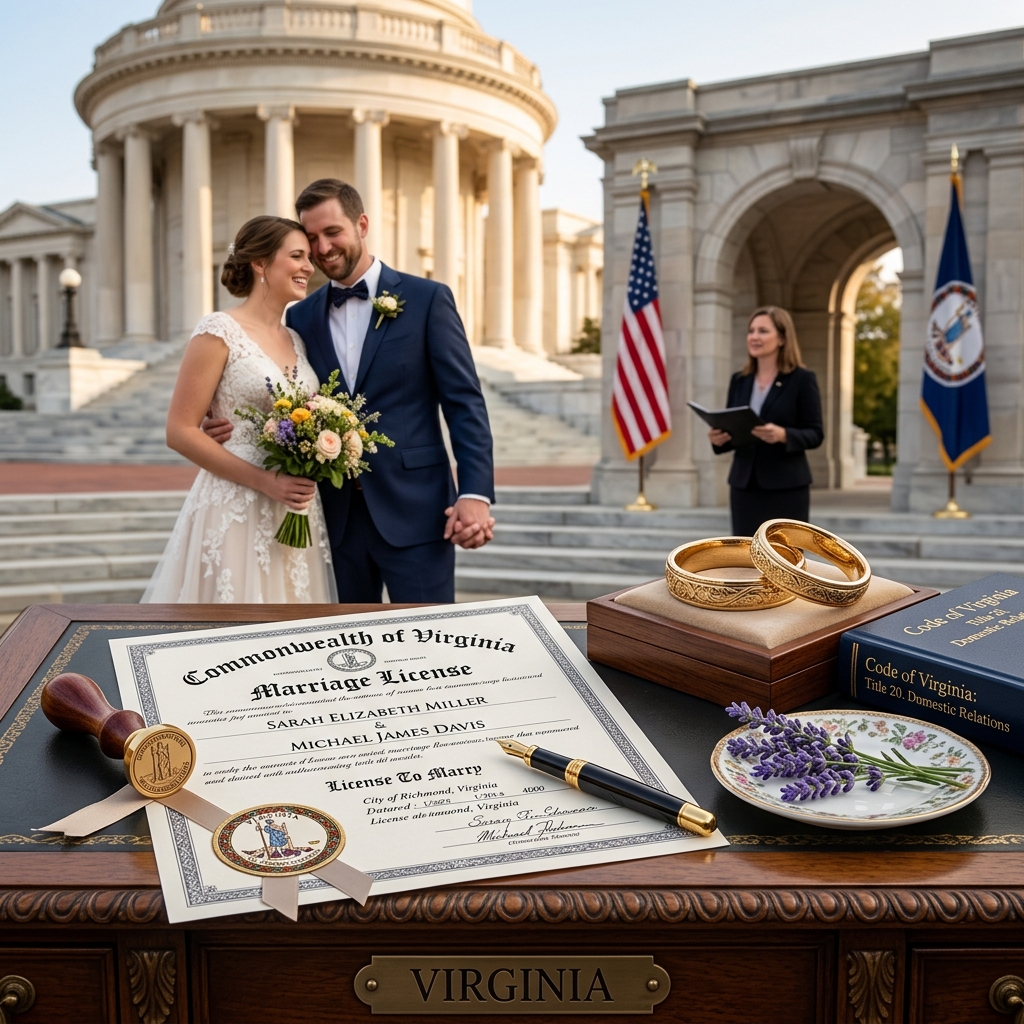
Marriage in Virginia is not just a personal commitment; it is also a legal status created and regulated by state law. A couple must follow specific rules to form a valid marriage, and that marriage carries important consequences for property, support, inheritance, and more.
This guide explains the major legal requirements for getting married in Virginia, the limits on who can marry, how ceremonies must be conducted, and what changes once a marriage is legally recognized. It is designed for general information and does not replace personalized legal advice.
Core Legal Requirements for a Valid Virginia Marriage
Virginia law sets out two basic pillars for a valid marriage: a marriage license and a lawful ceremony (solemnization) within the Commonwealth.
- License requirement: Every marriage in Virginia must be based on a marriage license issued by a circuit court clerk in any Virginia county or city.
- Solemnization requirement: The marriage must be solemnized in a ceremony, in the manner provided by law, by a person authorized to perform marriages.
- Location: For the marriage to be considered valid under Virginia law, the ceremony must take place within the Commonwealth.
- Deadline: A marriage license is only valid for 60 days from issuance, and the ceremony must be performed within that period.
Without both a valid license and a ceremony conducted according to Virginia law, no legal marriage is created, even if the couple believes they are married.
Obtaining a Marriage License in Virginia
The first formal step for couples is applying for a marriage license with a circuit court clerk. Virginia provides a uniform process statewide, with modest fees and no residency requirement.
Where and How to Apply
- Issuing office: Licenses are issued by the clerk or deputy clerk of the circuit court of any Virginia county or city.
- Residency: Couples do not need to be Virginia residents to obtain a license or marry in the state.
- In‑person appearance: Both parties typically must appear together in person to apply for the license.
- Fee: Virginia law provides for a nominal fee (commonly around $30) for issuance of the license.
The clerk will ask for identifying information about each applicant, such as names, ages, and prior marital history, to ensure compliance with age limits, divorce requirements, and restrictions on prohibited relationships.
Time Limit on Use of the License
Once issued, a marriage license is not valid indefinitely. Virginia law restricts its use to a fixed window:
- The license authorizes a marriage ceremony for 60 days from the date of issuance.
- If the ceremony does not occur within 60 days, the license expires and the couple must apply again.
This time limit ensures that records remain current and that the marriage is promptly completed and recorded with the clerk after the ceremony.
Age Limits, Emancipation, and Consent
Virginia has modernized its rules regarding underage marriage to emphasize protection of minors and judicial oversight. The critical issues are the minimum age to marry and the circumstances under which minors may marry.
Minimum Age and Emancipation
| Age | May Marry? | Conditions |
|---|---|---|
| Under 16 | No | Too young to marry; instead, the law uses emancipation and judicial safeguards. |
| 16–17 | Only if emancipated | Must be judicially emancipated and provide a certified emancipation order when applying. |
| 18 and older | Yes | May marry without parental consent, assuming other requirements are met. |
Virginia requires a minor who wishes to marry to be at least 16 years old and to have been emancipated by court order. Upon applying for a marriage license, an emancipated minor must present a certified copy of the order of emancipation.
Parental Consent and Special Cases
Historically, Virginia permitted parental consent as a pathway to marriage for minors, but reforms now focus on court‑ordered emancipation rather than simple parental permission. As a result:
- Emancipated minors do not need parental consent to marry.
- Unemancipated minors generally cannot marry, even if parents consent.
Anyone who has been married before must obtain a valid divorce or annulment before entering a new marriage; marrying again without dissolving the prior marriage can be illegal and may render the new marriage void.
Prohibited Marriages and Family Relationships
Virginia, like all states, bars certain close relatives from marrying to prevent incestuous relationships and protect family integrity.
Relationships That Cannot Marry
Virginia law prohibits marriage between a person and specified close relatives, whether the relationship is by full blood or half‑blood.
- Ancestor or descendant (for example, parent–child or grandparent–grandchild).
- Siblings.
- Aunt or uncle.
- Niece or nephew.
These prohibitions apply even when the parties are related by half‑blood. The goal is to avoid genetic and social complications that arise from marrying close family members.
Relationships That May Marry
Not all relatives are prohibited from marrying under Virginia law. For example:
- Cousins are allowed to marry.
- Step‑siblings are not barred by statute from marrying.
This distinction reflects a policy judgment about which family relationships present unacceptable risks or conflicts and which do not.
Common Law Marriage: Not Recognized in Virginia
A key area of confusion is “common law” marriage. Some states recognize a marriage that arises when a couple lives together, holds themselves out as married, and satisfies certain requirements, even if there is no formal license or ceremony. Virginia does not create marriages this way.
No Common Law Marriage Formed Within Virginia
- Simply living together, even for many years, does not create a legal marriage in Virginia.
- Calling each other husband and wife or filing joint paperwork without a license and ceremony does not establish marital rights.
- No duties or obligations arise merely from cohabitation unless the couple signs express agreements (such as contracts or powers of attorney).
Because there is no common law marriage in Virginia, couples who live together without formal marriage do not automatically get property division rights, spousal support protections, or inheritance rights that spouses receive.
Recognition of Common Law Marriages from Other Jurisdictions
While Virginia does not create common law marriages, it may recognize a common law marriage that was validly formed in another state or foreign country that recognizes such unions.
- If a couple establishes a lawful common law marriage in another jurisdiction and later moves to Virginia, Virginia will generally treat them as legally married.
- Ending such a recognized marriage usually requires formal legal action, such as a divorce, just like any other valid marriage.
This approach prevents families from losing marital status simply because they relocate to Virginia, while still preserving Virginia’s choice not to create common law marriages within its borders.
Marriage Ceremonies and Authorized Officiants
Once a license has been obtained, the couple must complete a marriage ceremony. Virginia law outlines who may perform ceremonies and how they may be conducted.
Authorized Celebrants
- Religious celebrants: Ministers or other religious officials who have been authorized by the Commonwealth and by their religious body may perform marriages.
- Civil celebrants: Certain public officials, or persons appointed as civil marriage celebrants, may solemnize marriages.
- Religious societies without ordained ministers: Members of such societies may solemnize marriages in the manner prescribed by their traditions.
After the ceremony, the celebrant completes the license and returns it to the circuit court clerk so the marriage can be officially recorded.
Presumption of Validity and Defective Ceremonies
Virginia law strongly favors upholding marriages as valid and contains protections against minor defects in licensing or officiant authorization.
- There is a rebuttable presumption that marriages are valid; courts treat this presumption as very strong.
- If a couple complies with the license and ceremony requirements in good faith, defects in the officiant’s authority or in the license paperwork generally do not invalidate the marriage.
- If the validity of a marriage is questioned, a spouse may file a suit to affirm the marriage, and a court decree upholding the marriage will be binding on all concerned.
These rules aim to protect couples who reasonably believed they were lawfully married, while still allowing courts to reject marriages that clearly violate statutory requirements or involve prohibited relationships.
Legal Consequences of Marriage in Virginia
Once a marriage is validly created, it carries major legal consequences in areas such as property ownership, debt responsibility, support, and inheritance. Couples should understand these effects when deciding to marry or when facing separation or divorce.
Property and Debts
- Marital property: Property acquired during marriage is generally presumed to be marital property in divorce proceedings, subject to equitable distribution by the court.
- Separate property: Property owned before marriage or acquired by gift or inheritance may be treated as separate, depending on how it is managed and whether it is commingled.
- Debts: A spouse is not automatically liable for the other spouse’s pre‑existing debts unless they co‑sign or otherwise assume responsibility.
- Debts during marriage: Creditors may sometimes pursue either spouse for debts incurred during the marriage, particularly if the debt relates to household needs or joint obligations.
Understanding how property and debts are classified helps couples plan their finances, manage risk, and anticipate how a court might divide assets and liabilities in the event of divorce.
Spousal Support and Mutual Obligations
Marriage creates mutual obligations of support between spouses. These obligations often become central issues when the marriage ends.
- Spouses are generally expected to support one another, especially where one spouse is economically dependent on the other.
- In a divorce or separation case, Virginia courts consider factors such as each spouse’s income, needs, the length of the marriage, and the standard of living established during the marriage when deciding whether to award spousal support and in what amount.
- Serious marital misconduct, such as adultery, can affect spousal support; in some cases, a spouse who committed adultery may be denied alimony.
Because support obligations can be significant and long‑lasting, they are a critical part of the legal landscape of marriage in Virginia.
Inheritance Rights and Estate Planning
Marriage also changes how property passes at death. Virginia law gives surviving spouses important inheritance rights, especially when a deceased spouse dies without a will.
- If a person dies without descendants (children or further lineal descendants) and without a will, the surviving spouse typically receives the entire estate.
- If a person dies with descendants and without a will, the estate is divided between the surviving spouse and the descendants; in many situations, the spouse receives a specified fraction (such as one‑third), with the remainder going to descendants.
- Spouses often gain rights in pension plans, insurance benefits, and Social Security survivor benefits, which generally require a valid marriage.
Even with these default rules, it is wise for married couples to create wills and estate plans to reflect their wishes and avoid disputes among relatives.
Name Change and Other Practical Effects
Marriage can make it easier to change one’s surname, although Virginia does not require spouses to change names.
- A spouse may choose to adopt the other spouse’s surname or to use a hyphenated or combined name.
- Once married, spouses should update identification documents, bank accounts, and insurance policies as needed to reflect any name changes.
Marriage can also affect health insurance coverage, tax filing status, and eligibility for certain employer benefits, making it important to review these areas after the wedding.
Criminal and Moral Aspects: Adultery
Although many people view adultery purely as a private matter, Virginia law treats adulterous sexual intercourse by a married person as a criminal offense and a significant factor in divorce cases.
- Voluntary sexual intercourse with someone other than a spouse while married is considered adultery under Virginia law.
- Adultery is grounds for divorce and may influence whether a court awards spousal support to the adulterous spouse.
- Even if authorities rarely prosecute adultery as a crime, its presence in the statutes underscores the seriousness with which Virginia views marital fidelity.
Couples considering divorce should discuss the implications of adultery with a qualified attorney, as it can affect both financial outcomes and the pace of the proceedings.
Frequently Asked Questions About Virginia Marriage Laws
Do we have to be Virginia residents to get married there?
No. Virginia does not impose a residency requirement. Any couple who meets the legal criteria can obtain a license from a Virginia circuit court clerk and marry within the Commonwealth.
How long is a Virginia marriage license valid?
A Virginia marriage license is valid for 60 days from the date of issuance. The ceremony must occur within that period or the license will expire and the couple must apply again.
Can we become married just by living together in Virginia?
No. Virginia does not allow common law marriage. Living together, even for many years, does not create a legal marriage without a proper license and ceremony.
Is a marriage still valid if the officiant was not properly authorized?
Often yes. If the couple obtained a valid license, held a ceremony, and believed in good faith they were lawfully married, Virginia courts generally treat the marriage as valid despite certain defects in the officiant’s authority.
Can cousins or step‑siblings marry in Virginia?
Yes. Virginia law does not prohibit marriage between cousins or step‑siblings, although it does ban marriages between closer relatives such as siblings, parents and children, and aunts or uncles with nieces or nephews.
References
- Code of Virginia, Title 20, Chapter 2: Marriage Generally — Commonwealth of Virginia. Accessed 2024-06-01. https://law.lis.virginia.gov/vacode/title20/chapter2/
- Virginia State Bar Informational Brochure: Marriage in Virginia — Virginia State Bar. 2017-01-01. https://vsb.org/common/Uploaded%20files/docs/pub-fa-marriage.pdf
- Common Law Marriage in Virginia — VaDivorceOnline. Accessed 2024-06-01. https://www.vadivorceonline.com/vapages/Alimony/commonlawmarriage.asp
- Understanding Marriage Rights and Legal Considerations in Virginia — Kales Law. Accessed 2024-06-01. https://www.kaleslaw.com/resources/marriages-in-virginia/
- Wedding Fails: Two Requirements for Valid Marriage in Virginia — Smith Strong, PLC. Accessed 2024-06-01. https://www.smithstrong.com/library/two-requirements-for-virginia-marriage.cfm
- Are You Really Married? — Hanger Law. Accessed 2024-06-01. https://hangerlaw.com/are-you-really-married/
- Marriage in Virginia — Hunter Law Firm. Accessed 2024-06-01. https://www.hunterlawfirm.com/articles/marriage-in-virginia/
Similar Articles








Read full bio of Sneha Tete


