
Virginia Historic Rehabilitation Tax Credits Guide
Learn how Virginia property owners and investors can combine state and federal historic rehabilitation tax credits to reduce project costs.
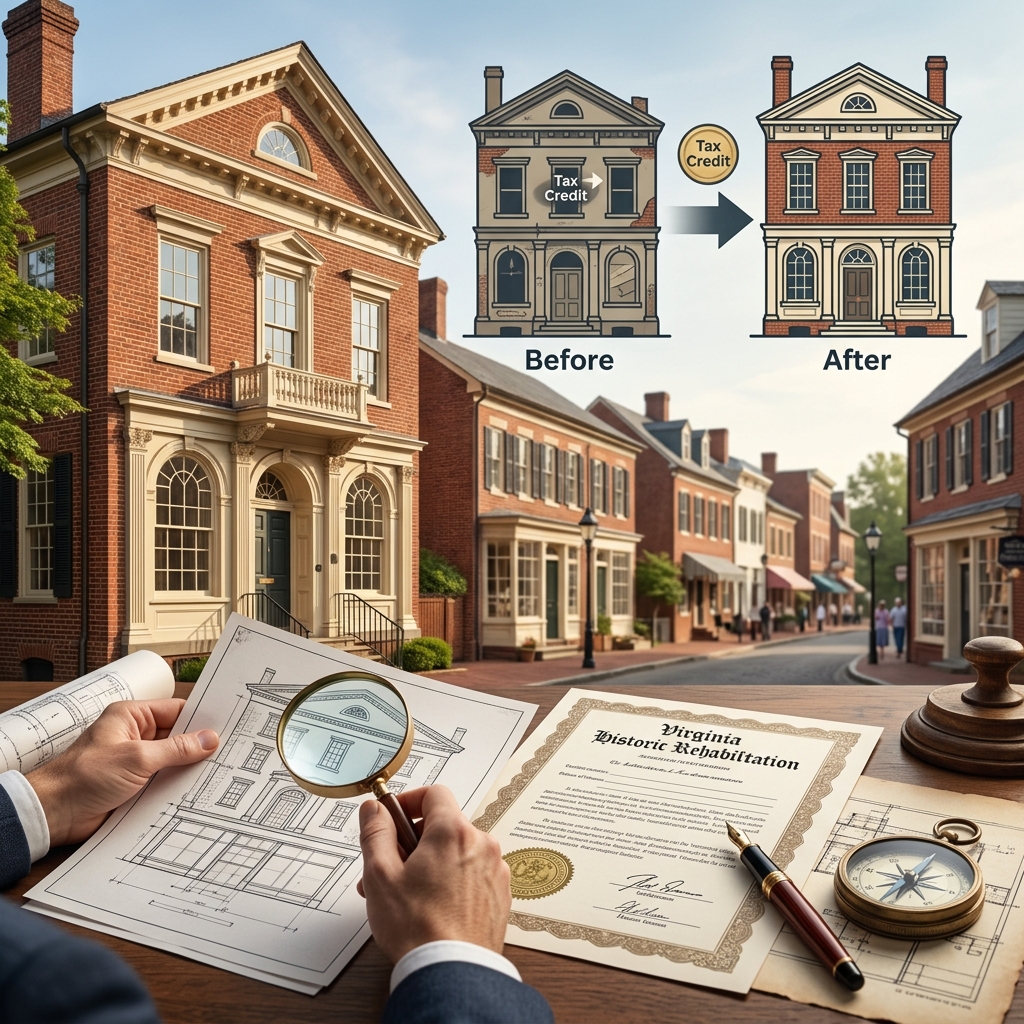
Virginia offers one of the most robust historic rehabilitation tax credit programs in the United States, allowing property owners and investors to significantly reduce the after-tax cost of restoring historic buildings. When combined with federal incentives, qualified projects may secure tax credits equal to roughly 45% of eligible rehabilitation expenses, making preservation financially attractive while supporting economic development and community revitalization.
Understanding Historic Rehabilitation Tax Credits
Historic rehabilitation tax credits are tax incentives that reduce income tax liability based on a percentage of qualified rehabilitation expenditures incurred on eligible historic properties. These programs are designed to offset the higher costs associated with working on older buildings, encouraging owners to preserve historic character rather than demolish and rebuild.
In Virginia, historic rehabilitation incentives exist at two levels:
- Federal historic rehabilitation tax credit of 20% for income-producing properties that are certified historic structures.
- Virginia state historic rehabilitation tax credit of 25% for eligible expenses incurred on certified historic structures, including certain owner-occupied residences.
These credits are claimed separately but can be used together, allowing a qualifying project to benefit from both programs simultaneously.
Key Features of Virginia’s Historic Rehabilitation Tax Credit
Virginia’s program is established by statute and administered by the Virginia Department of Historic Resources (DHR) in coordination with the state tax authorities. Below are the core structural features of the credit:
Credit Percentage and Eligible Taxpayers
Virginia law provides a 25% income tax credit based on eligible rehabilitation expenses incurred on a certified historic structure for taxable years 2000 and thereafter. Any of the following may claim the credit:
- Individuals
- Trusts and estates
- Corporations
- Partnerships and S corporations (with credits passing through to partners or shareholders)
Annual Credit Caps and Carryforward Rules
Virginia imposes an annual cap per taxpayer on the amount of historic rehabilitation credit that can be claimed, including carryforward amounts.
| Taxable Years | Maximum Credit Per Taxpayer |
|---|---|
| Beginning on or after 2017 and before 2025 | $5 million per year (including carryforward) |
| Beginning on or after 2025 | $7.5 million per year (including carryforward) |
If the credit amount exceeds the taxpayer’s liability for a particular year, unused credits may be carried forward for up to 10 years, or until fully utilized.
Federal vs. State Credits: How They Work Together
The federal and Virginia programs are separate but complementary. Understanding how they differ helps taxpayers design projects that maximize total benefits.
| Feature | Federal Historic Rehabilitation Credit | Virginia Historic Rehabilitation Credit |
|---|---|---|
| Credit Percentage | 20% of qualified rehabilitation expenses (QREs) | 25% of eligible rehabilitation expenses |
| Eligible Use | Income-producing properties only (commercial, rental, etc.) | Owner-occupied and income-producing certified historic structures |
| Historic Status Requirement | Must be a certified historic structure listed on or contributing to a district on the National Register of Historic Places | Must be listed on the Virginia Landmarks Register or National Register, contribute to a listed historic district, or be certified as eligible for listing |
| Claiming Process | Claimed on IRS Form 3468; involves a federal three-part certification process | Requires certification from Virginia DHR and attachment of DHR certificate to the Virginia tax return |
| Recapture/Ownership Rules | Subject to federal recapture rules and continuing ownership requirements | No state-level recapture; no continuing ownership requirement after rehabilitation is complete |
By meeting both sets of requirements, a qualifying project may access combined credits of up to 45% of rehabilitation costs (20% federal + 25% Virginia), dramatically improving project feasibility.
What Counts as a Certified Historic Structure?
The concept of a certified historic structure is central to both tax credit programs. Although definitions vary slightly between federal and state levels, they share common elements.
Federal Certification
For the federal credit, a building qualifies as a certified historic structure if it is either:
- Individually listed on the National Register of Historic Places, or
- Located in and contributing to a historic district listed on the National Register.
The building must be used for income-producing purposes and be subject to depreciation for federal tax purposes.
Virginia Certification
For the state credit, Virginia recognizes a broader set of eligible buildings. A property may qualify if it is:
- Listed on the Virginia Landmarks Register,
- Listed on the National Register of Historic Places,
- Classified as a contributing structure within a designated historic district, or
- Certified as eligible for listing (even if not yet formally listed).
This flexibility allows more properties to participate in the state program, including some buildings that are in the process of being formally recognized.
Qualified Rehabilitation Expenses: What Is Eligible?
Not all construction or acquisition costs qualify for historic rehabilitation tax credits. The programs emphasize expenditures that directly relate to rehabilitating the historic building in a manner consistent with preservation standards.
Typical Qualified Rehabilitation Expenses (QREs)
Qualified rehabilitation expenses commonly include:
- Structural repairs and replacements (foundations, roofs, walls)
- Restoration of historic interior and exterior finishes
- Installation or upgrading of HVAC, plumbing, and electrical systems
- Life-safety and code compliance improvements, such as fire suppression systems
- Work related to accessibility (e.g., ADA-compliant entrances and restrooms)
- Certain soft costs, including architectural and engineering fees, construction-period interest and taxes, construction management, and reasonable developer fees
Commonly Ineligible Costs
Several categories of expenditures are generally not eligible for credit.
- Purchase price of the property (acquisition costs)
- Additions or building enlargements that expand the overall footprint
- Personal property such as furniture, appliances, or equipment
- Most site work not directly tied to the historic building
Threshold Tests for Rehabilitation Projects
In addition to certification and eligibility rules, rehabilitation projects must meet certain minimum investment thresholds to qualify for tax credits.
State-Level Thresholds
Virginia’s program requires that eligible rehabilitation expenses exceed a percentage of the building’s pre-rehabilitation assessed value.
- For owner-occupied residential properties, eligible expenses must be at least 25% of the assessed value before rehabilitation.
- For commercial or other non-residential buildings, expenses must reach at least 50% of assessed value before rehabilitation.
Federal Substantial Rehabilitation Requirement
For the federal credit, the rehabilitation must be substantial. Typically, this means qualified rehabilitation expenditures over a 24-month measuring period must exceed the greater of a specified dollar threshold or the building’s adjusted basis, with special rules for phased projects allowing a 60-month period.
The Application and Certification Process
Both federal and state credits rely on structured, multi-part application processes designed to ensure that rehabilitations respect historic character and meet statutory requirements.
Federal Three-Part Process
The federal program uses a three-part certification framework administered by the National Park Service (NPS) in conjunction with state historic preservation offices.
- Part 1 – Evaluation of Historic Significance
Determines whether the building qualifies as a certified historic structure, based on its listing status or contribution to a historic district. - Part 2 – Review of Proposed Rehabilitation
Examines plans and specifications to confirm that the proposed work meets the Secretary of the Interior’s Standards for Rehabilitation. - Part 3 – Certification of Completed Work
Confirms that the finished project matches the approved plans and adheres to the standards, often supported by photographs and documentation.
Once certified, the federal tax credit is generally claimed on IRS Form 3468 for the relevant tax year.
Virginia DHR Certification
For the state credit, Virginia law requires applicants to obtain a certificate from the Department of Historic Resources verifying the amount of eligible rehabilitation expenses. The process typically includes:
- Submitting detailed information about the property’s historic status and ownership.
- Providing plans, descriptions, and photos of the proposed and completed work.
- Demonstrating compliance with applicable preservation standards and statutory thresholds.
After DHR determines the eligible rehabilitation expenses, it issues a certificate that must be attached to the taxpayer’s Virginia income tax return when the credit is claimed.
Strategic Considerations for Owners and Investors
Because historic rehabilitation credits can be substantial and complex, many owners treat them as a core component of project financing and tax planning.
Planning Ahead
Owners and investors should incorporate tax credit strategy early in the project life cycle. Key planning steps include:
- Confirming the property’s current or potential status as a certified historic structure.
- Evaluating whether projected rehabilitation costs will satisfy federal and state threshold tests.
- Designing project scope to maximize qualified rehabilitation expenses while minimizing ineligible costs.
- Coordinating with architects and engineers familiar with the Secretary of the Interior’s Standards for Rehabilitation.
Entity Choice and Credit Utilization
For partnerships and S corporations, credits generally pass through to partners or shareholders, who then claim them on their individual returns. Decisions regarding ownership structure may affect:
- Who ultimately receives the credits.
- How credits are allocated among investors.
- The ability to make use of credits within annual caps and carryforward periods.
Interaction With Other Financing Tools
Historic rehabilitation tax credits often work alongside other incentives, such as grants, local tax abatements, or low-income housing credits. While those programs are outside the scope of this guide, owners should consider:
- Whether additional incentives might affect the adjusted basis used in federal threshold calculations.
- Potential implications for project underwriting and lender requirements.
- Timing of credits relative to construction schedules and placed-in-service dates.
Frequently Asked Questions
1. Can I use both federal and Virginia historic rehabilitation tax credits on the same project?
Yes. A project that meets the requirements of both programs may claim the 20% federal credit and the 25% Virginia credit on the same qualified rehabilitation expenses, subject to applicable thresholds and limitations. Many projects are structured specifically to leverage this combined benefit, which can total up to 45% of qualified costs.
2. Does my building need to be formally listed on a historic register to qualify for Virginia’s credit?
Not necessarily. Virginia permits buildings that are certified as eligible for listing on the Virginia Landmarks Register or the National Register of Historic Places to qualify, even if they are not yet formally listed, provided other program requirements are satisfied.
3. Are owner-occupied residences eligible for historic rehabilitation credits?
Owner-occupied historic residences can qualify for Virginia’s 25% credit if they are certified historic structures and the rehabilitation expenses meet the required percentage of the property’s assessed value. For the federal 20% credit, however, the building must be used for income-producing purposes, although a portion of an otherwise residential building may qualify if part of it is used for business or rental income.
4. What happens if I cannot use all of my Virginia historic rehabilitation credit in one year?
If your credit exceeds your Virginia income tax liability for a given year, you may carry unused credits forward for up to 10 subsequent taxable years or until they are fully used, subject to the annual cap per taxpayer.
5. Is there a recapture risk if I sell the property after the rehabilitation is complete?
Federal historic credits are subject to recapture rules if the property is disposed of within a specified period after claiming the credit. Virginia’s program does not impose state-level recapture or continuing ownership requirements after completion of the rehabilitation. Owners should still review federal rules before transferring ownership.
References
- § 58.1-339.2. Historic rehabilitation tax credit — Commonwealth of Virginia, Virginia Law Portal. 2024-07-01. https://law.lis.virginia.gov/vacode/title58.1/chapter3/section58.1-339.2/
- Maximizing Virginia’s Historic Rehabilitation Tax Credit — PBMares, LLP. 2023-10-10. https://www.pbmares.com/maximizing-virginias-historic-rehabilitation-tax-credit/
- Virginia Historic Rehabilitation Tax Credits – Legislative Update — Williams Mullen. 2024-04-10. https://www.williamsmullen.com/insights/news/legal-news/virginia-historic-rehabilitation-tax-credits-legislative-update-0
- Historic Rehabilitation Tax Credits — Keiter CPA, Real Estate CPAs. 2022-06-15. https://keitercpa.com/blog/virginia-historic-preservation-certification-applications/
- Historic Tax Credits — Huber Architects. 2023-05-01. https://www.huberarch.com/historic-tax-credits
- Tax Credits for Rehabilitating Historic Properties — Historic Fredericksburg Foundation, Inc. 2022-09-20. https://hffi.org/facility-resources/tax-credits/
Similar Articles








Read full bio of Sneha Tete




