
Vehicle Searches and Your Rights Under the Fourth Amendment
Understand when police can search your vehicle, what the Fourth Amendment protects, and how common warrant exceptions work on the road.
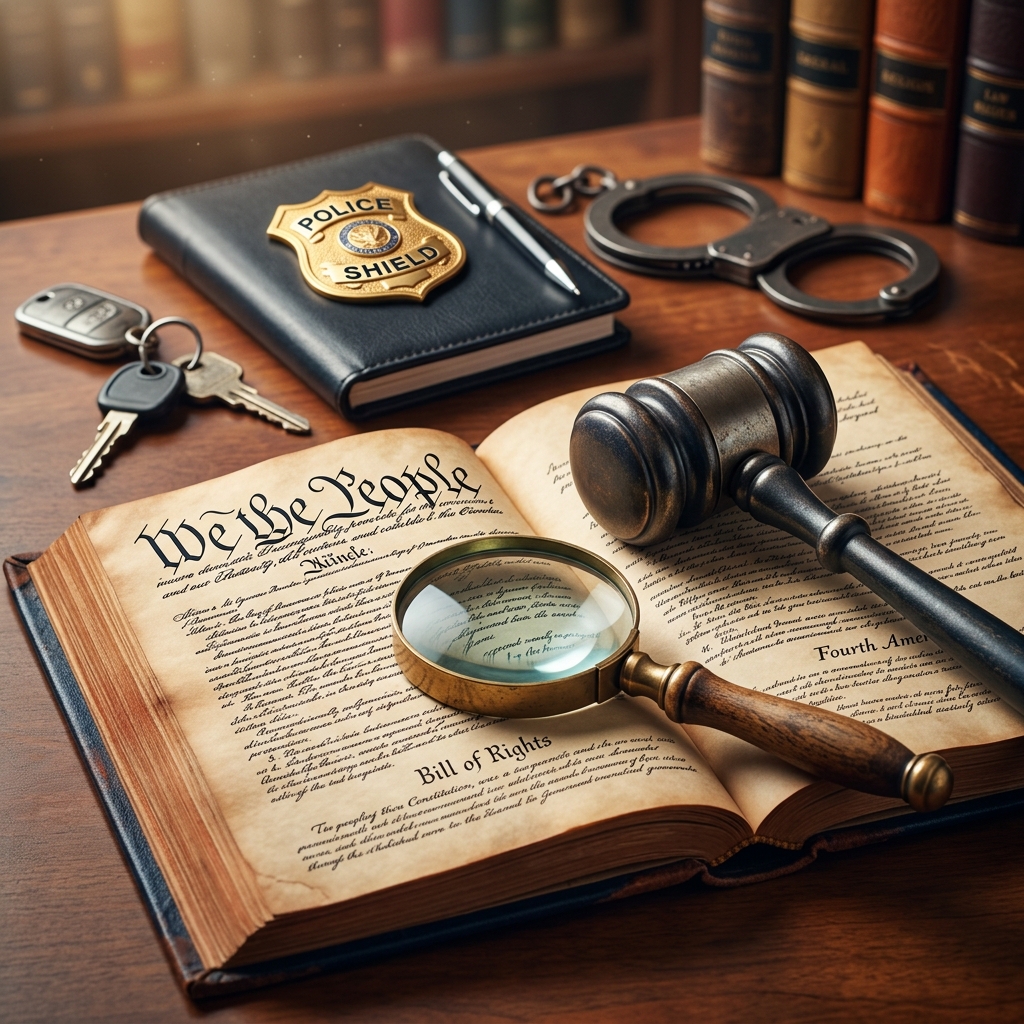
When you are stopped on the road, the question of whether an officer may search your vehicle without a warrant is governed by the Fourth Amendment and a series of specific legal rules. Understanding these rules helps you recognize what police may lawfully do and what protections you retain as a driver.
Fourth Amendment Basics for Drivers
The Fourth Amendment to the U.S. Constitution protects people against unreasonable searches and seizures and generally requires a warrant issued on probable cause for a search to be valid. However, over time, courts have recognized several exceptions to the warrant requirement, especially in the context of automobiles, because vehicles are mobile and drivers have a reduced expectation of privacy compared to homes.
For drivers, this means that police do not always need a warrant to look inside your car, but they still must act within the limits set by the Constitution and case law.
- Searches must be reasonable under the Fourth Amendment.
- Warrants are not required in certain clearly defined situations, such as the automobile exception and consent searches.
- Officers usually need probable cause or a recognized exception to search beyond simple observation.
Key Concepts: Probable Cause, Reasonable Suspicion, and Consent
Several legal standards determine whether a vehicle search is lawful. They differ in how much evidence an officer must have and what kind of intrusion is allowed.
Probable Cause
Probable cause is a higher standard than mere suspicion. Courts describe it as a reasonable belief, based on facts and circumstances, that evidence of a crime or contraband is present in a specific place. It requires more than a hunch and must be supported by objective observations or credible information.
- There must be probable cause to believe an item is connected to criminal activity or will assist in an arrest or conviction.
- There must be probable cause to believe that item is located in the area to be searched, such as your car or a container inside it.
Reasonable Suspicion
Reasonable suspicion is a lower threshold than probable cause. It allows officers to briefly stop a vehicle or conduct limited protective checks when specific and articulable facts suggest criminal activity or danger. For example, an officer who reasonably believes a driver may be armed and dangerous can perform a limited search of the passenger compartment for weapons.
Consent
Consent is one of the most common reasons officers search vehicles without a warrant and without probable cause. If a person with apparent authority over the vehicle voluntarily agrees to a search, officers may proceed even if they do not have probable cause.
- Consent must be voluntary; officers cannot force or coerce it.
- Valid consent eliminates the need for both a warrant and probable cause.
- You have the right to refuse consent, although declining may affect the interaction.
The Automobile Exception to the Warrant Requirement
The automobile exception is a central rule allowing warrantless vehicle searches when certain conditions are met. Under this doctrine, officers may search a vehicle without first obtaining a warrant if they have probable cause to believe it contains evidence of a crime or contraband and the vehicle is readily mobile.
| Requirement | What It Means |
|---|---|
| Probable cause | Specific facts support a reasonable belief that evidence or contraband is in the vehicle. |
| Readily mobile vehicle | The vehicle need not be moving but must be capable of quick movement when encountered. |
| No warrant needed | Officers may search at the scene or later, such as after impound, without a warrant. |
Once probable cause exists, officers may search the entire vehicle and any containers that could hold the object of the search, including luggage and closed compartments. Courts have held that the search may be done immediately or after the vehicle is moved to a station house, without losing its validity under the automobile exception.
Common Situations Where Vehicles Are Searched
Several recurring scenarios arise during traffic stops and criminal investigations. Each is governed by specific rules and limitations recognized by courts and law enforcement training materials.
Search Incident to a Lawful Arrest
When an officer makes a lawful custodial arrest, they may conduct a search related to that arrest. For vehicles, this can include the passenger compartment under defined circumstances.
- The arrest must be lawful and custodial, not merely a citation.
- The search must be substantially contemporaneous with the arrest, meaning not too remote in time or place.
- Officers may search if the arrestee is unsecured and within reach of the vehicle during the search, or if they reasonably believe the vehicle contains evidence relevant to the crime of arrest.
These restrictions are designed to balance officer safety and evidence preservation against the driver’s privacy rights.
Protective Searches for Weapons
Officers may conduct a limited protective search of a vehicle when they have a reasonable, articulable suspicion that a suspect is dangerous and may gain immediate control of weapons. This principle extends the protective pat-down concept from pedestrians to drivers and passengers.
- The search is limited to areas where a weapon could be placed or hidden, such as under seats or inside reachable compartments.
- The officer’s belief must be based on specific facts, not generalized fear.
Inventory Searches
When a vehicle is lawfully taken into police custody, officers may conduct an inventory search pursuant to standardized procedures. This type of search does not require probable cause or reasonable suspicion.
- Inventory searches aim to protect the owner’s property, shield officers from claims of lost items, and identify potential dangers in the vehicle.
- They must follow reasonable, standardized policies to avoid abuse of the procedure.
Plain View Observations
If officers can see evidence of a crime or contraband in plain view from outside the vehicle, they may seize it without a warrant. However, simply seeing an item may not always justify a full search without additional legal grounds.
- Officers may look through windows, observe items on seats, and verify vehicle identification numbers (VIN) that are visible through the windshield in public places.
- Plain view can help establish probable cause for a broader search under the automobile exception.
Your Rights and Practical Tips During a Traffic Stop
Although officers have significant authority under various exceptions, drivers retain important rights. Knowing them can help you navigate the interaction calmly and lawfully.
- Right to be free from unreasonable searches: Officers must comply with the Fourth Amendment. They cannot arbitrarily search vehicles without legal justification.
- Right to refuse consent: You may decline an officer’s request to search your car if they lack a warrant and no exception applies. Consent is voluntary.
- Right to ask questions: You may politely ask the officer whether you are free to leave and whether the search is based on consent, probable cause, or another basis.
- Right to remain silent: You are not required to answer incriminating questions, though you may need to provide license, registration, and proof of insurance as required by law.
Remaining calm, avoiding sudden movements, and communicating respectfully often improves the outcome of a roadside encounter, regardless of whether a search occurs.
Frequently Used Exceptions to Warrant Requirements
Several recognized exceptions allow officers to search vehicles without obtaining a warrant first. They often overlap, but each serves a distinct purpose.
- Automobile exception: Probable cause plus a readily mobile vehicle permits a full search without a warrant.
- Consent: Voluntary consent allows a search without probable cause or reasonable suspicion.
- Search incident to arrest: Limited search following a lawful custodial arrest, subject to strict conditions.
- Protective search for weapons: Limited, targeted search for weapons based on reasonable suspicion that a suspect is dangerous.
- Inventory searches: Administrative search of a vehicle lawfully in police custody, following standard policies.
Illustrative Comparison: Home vs. Vehicle Searches
Many drivers assume their car is protected just like their home. In reality, courts treat vehicles differently, largely because they move and are heavily regulated.
| Aspect | Home | Vehicle |
|---|---|---|
| Warrant requirement | Generally required absent limited exceptions. | Not required under automobile exception and other vehicle-specific doctrines. |
| Expectation of privacy | High; strongest Fourth Amendment protections. | Reduced due to mobility and regulation of vehicles. |
| Inventory searches | Less common; more limited scenarios. | Routine when vehicles are impounded following standardized procedures. |
FAQs: Vehicle Search and Seizure
Can police search my car without a warrant?
Yes, in many circumstances. If officers have probable cause and the vehicle is readily mobile, they may search under the automobile exception. They can also search with your voluntary consent, incident to a lawful arrest, as part of a protective search for weapons, or during an inventory search when the vehicle is in custody.
Do officers always need probable cause to search a vehicle?
No. Probable cause is required for full evidentiary searches under the automobile exception and some other actions. However, valid consent and routine inventory searches do not require probable cause or reasonable suspicion.
Can I refuse a search of my car?
In many situations, you may refuse a consent search if officers do not already have another legal basis for the search, such as probable cause. Refusing consent does not guarantee that no search will occur, but it prevents officers from relying on your voluntary consent as their legal justification.
What happens if officers find evidence during an illegal search?
If a court later determines that a search violated the Fourth Amendment, evidence obtained may be suppressed, meaning it cannot be used in court. This is a complex issue typically litigated by attorneys in motions challenging the legality of the search.
Are passengers’ belongings treated differently from the driver’s?
When officers have probable cause to search a vehicle, they may generally search containers inside it, even if they belong to passengers. The key question is whether the container could reasonably hold the object of the search, not who owns it.
Practical Takeaways for Drivers
The intersection of traffic enforcement and constitutional law can be complicated, but several practical points help drivers understand their position on the road:
- Vehicle searches are governed by the Fourth Amendment, but cars are subject to special rules because they are mobile and drivers have a reduced expectation of privacy.
- Officers typically need probable cause or a recognized exception—such as consent, a lawful arrest, a protective weapons search, or inventory procedures—to go beyond simple viewing of the interior.
- You maintain rights during traffic stops, including the right to refuse consent and the right to be free from unreasonable searches.
- Legal disputes about vehicle searches are often resolved later in court, where judges review whether officers complied with constitutional requirements.
References
- Vehicular Searches :: Fourth Amendment — Justia Law. 2024-01-01. https://law.justia.com/constitution/us/amendment-04/16-vehicular-searches.html
- Warrantless Searches of Automobiles — Connecticut General Assembly, Office of Legislative Research. 1998-01-08. https://www.cga.ct.gov/PS98/rpt/olr/htm/98-R-0018.htm
- Searching Vehicles Without Warrants (Vehicle Search Visor Card) — Federal Law Enforcement Training Centers (FLETC). 2012-01-01. https://www.fletc.gov/sites/default/files/imported_files/training/programs/legal-division/downloads-articles-and-faqs/downloads/other/VehicleSearchVisorCard.pdf
- Searching a Vehicle Without a Warrant (Consent) — Federal Law Enforcement Training Centers (FLETC). 2015-01-01. https://www.fletc.gov/sites/default/files/imported_files/training/programs/legal-division/downloads-articles-and-faqs/research-by-subject/4th-amendment/searchingavehicle-consent.pdf
- Automobile Exception | Wex — Legal Information Institute, Cornell Law School. 2023-06-01. https://www.law.cornell.edu/wex/automobile_exception
Similar Articles








Read full bio of medha deb


