Vehicle Customizations That Trigger Law Enforcement Stops
Discover which popular car modifications attract police attention and legal consequences.
Understanding Vehicle Modifications and Police Enforcement
Customizing your vehicle represents a significant investment in personal expression and performance enhancement. However, many car owners discover too late that their favorite modifications violate state and local traffic regulations. Law enforcement officers are trained to identify aftermarket upgrades that compromise vehicle safety, obscure identification, or create public disturbances. Understanding which modifications attract police scrutiny helps vehicle owners make informed decisions about customization while avoiding costly citations, vehicle impoundment, or criminal charges.
Exhaust System Modifications and Noise Ordinances
One of the most commonly targeted modifications involves aftermarket exhaust systems that exceed noise limitations established by municipalities. Exhaust cutouts and valve control dumps allow drivers to toggle between quieter and extremely loud operational modes, creating attention-grabbing sound levels that violate noise ordinances across most jurisdictions. These systems often produce decibel levels significantly exceeding legal thresholds, making them obvious targets during traffic enforcement activities.
Police officers recognize loud exhaust systems as indicators of potential street racing or reckless driving behavior. When officers hear excessively loud vehicles at traffic signals or on residential streets, they frequently initiate traffic stops to investigate whether the driver is engaging in speed exhibitions or other dangerous driving practices. The combination of attention-getting sound and visual modifications often results in multiple violations being cited during a single enforcement encounter.
Vehicle owners seeking legitimate performance improvements should verify their exhaust system compliance with local noise ordinances before installation. Most jurisdictions establish specific decibel limits for passenger vehicles, typically ranging from 80-90 decibels. Choosing quality aftermarket systems designed to meet these standards allows for performance gains without inviting enforcement attention.
Window Tinting Beyond Legal Specifications
Automotive window tinting represents another modification category that frequently results in traffic stops and citations. While some jurisdictions permit light tinting on rear and side windows, limo-style dark tints that obscure interior visibility violate state regulations in most locations. These deep tints create safety concerns by preventing officers from observing seatbelt compliance, identifying occupants, or detecting contraband during traffic stops.
Modern law enforcement recognizes that illegal window tints serve purposes beyond aesthetic enhancement. Dark tints can facilitate criminal activities by concealing vehicle occupants and contents from public view. Officers viewing tinted vehicles often conduct stops specifically to verify compliance with visibility regulations, which frequently result in additional violations being discovered during the encounter.
Top-strip tints, inspired by professional racing vehicles and custom show builds, remain illegal on public roads in most states despite their visual appeal. These modifications are classified as unsafe operational changes rather than cosmetic upgrades, resulting in inspection failures and stacked citations, particularly when combined with other non-compliant modifications.
Legal window tinting options exist that provide some privacy benefits while maintaining compliance. Most states permit lighter tints on rear windows and back side windows while maintaining front side window transparency. Vehicle owners should verify specific state regulations before applying any window film to their vehicles.
Lighting System Alterations and Brightness Standards
Upgrading headlight systems to High-Intensity Discharge (HID) or Light-Emitting Diode (LED) technology appears attractive as a performance enhancement, but many aftermarket kits fail to comply with Department of Transportation standards. These non-compliant kits often produce scattered or misaligned light patterns that create hazards for oncoming traffic. Police officers recognize improperly aligned or excessively bright headlights as safety violations that warrant immediate traffic stops.
Colored headlights and taillights also attract enforcement attention in jurisdictions where they violate lighting regulations. Even legal colors can become illegal if they appear too bright, create distracting effects, or become visible at inappropriate angles. The installation of non-DOT-compliant lighting systems positions vehicles as targets for enforcement, with officers treating these modifications as dangerous driving violations rather than cosmetic customizations.
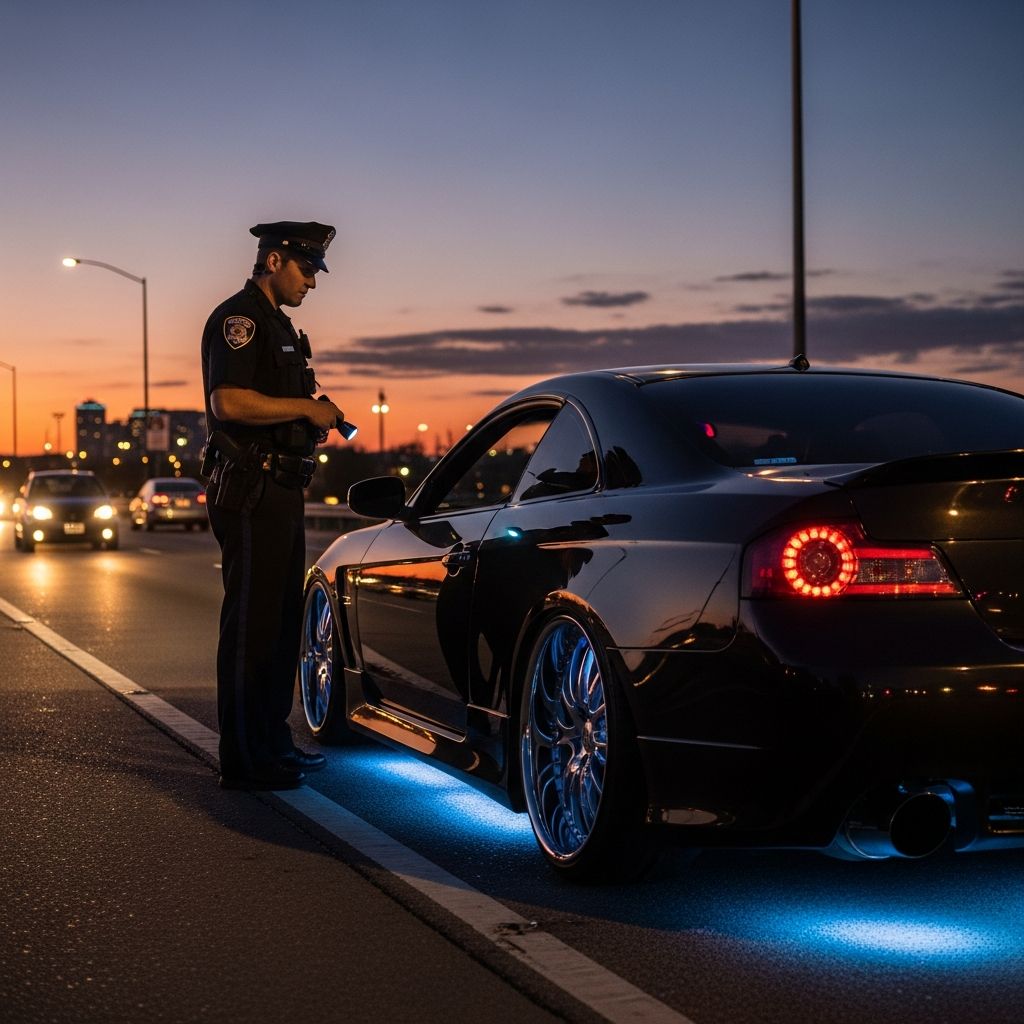
Underglow lighting and neon accent lights represent additional lighting modifications that trigger enforcement attention. Many states maintain strict prohibitions against these modifications, and even in jurisdictions where they are technically permitted, officers frequently conduct stops to verify compliance with specific regulations. These modifications provide minimal practical benefit while creating significant enforcement risk.
Flashing lights installed on vehicles create the most serious enforcement consequences. Police-style lighting systems can result in felony charges in many jurisdictions, as officers interpret these modifications as deliberate attempts to impersonate emergency vehicles or deceive the public. Unlike standard traffic citations, police-style lighting violations can result in immediate arrest, vehicle seizure, and criminal prosecution.
License Plate Visibility and Concealment Devices
License plate covers, sprays, or smart-glass systems that obscure vehicle registration numbers represent among the most serious modification-related offenses. These devices function specifically to defeat traffic enforcement technology, including red light cameras and automatic license plate readers. The deliberate intent to evade law enforcement detection makes these modifications subject to criminal rather than merely civil penalties.
Laser jammers, which disrupt speed measurement devices, occupy a complex legal position. While technically legal to purchase in the United States, several states have explicitly outlawed their use on public roads. These devices interfere with law enforcement’s ability to conduct speed enforcement, making them likely to result in serious legal consequences if discovered during traffic stops or vehicle inspections.
Vehicle registration numbers serve critical public safety functions, including identification during hit-and-run incidents, stolen vehicle recovery, and crime investigations. Any modification that obscures these numbers violates federal and state regulations, regardless of the driver’s stated purpose for the modification.
Suspension and Ride Height Modifications
Extremely lowered or lifted suspensions beyond manufacturer specifications create multiple enforcement concerns. These modifications alter vehicle handling characteristics, affect braking performance, and change headlight alignment—all factors that affect vehicle safety and road visibility. Law enforcement recognizes these modifications as indicators of vehicles operated for street racing or exhibition driving.
Vehicles that scrape bumpers on speed bumps, drag undercarriage components on road surfaces, or tuck tires into fenders risk not only traffic citations but also failed vehicle inspections and fix-it citations. These modifications frequently result in cumulative violations, with vehicles potentially facing impoundment for unsafe modifications that compromise fundamental safety systems.
Extreme stance modifications, popular in car enthusiast communities, create alignment problems that compromise vehicle control and stability. Police officers view these modifications as strong indicators of reckless driving tendencies, making them primary targets for traffic enforcement activities even when drivers operate vehicles at legal speeds.
Exterior Paint and Wrap Modifications
Over-the-top paint jobs featuring excessively bright colors or flashy wraps make vehicles highly visible to law enforcement, essentially creating mobile targets for traffic enforcement. From an enforcement perspective, vehicles with attention-grabbing paint schemes violate principles of inconspicuous operation, making them significantly more likely to be selected for traffic stops.
Law enforcement training often emphasizes that distinctive vehicles with unusual customizations warrant closer scrutiny for potential violations. A vehicle with bright, unconventional paint serves as a memorable identifier, meaning repeat contacts between the same officer and vehicle increase the likelihood of enforcement action.
While vehicle owners certainly possess the legal right to apply unique paint treatments, doing so effectively broadcasts the vehicle to law enforcement. Drivers choosing distinctive paint colors should understand that this modification increases visibility to police and creates greater scrutiny during traffic stops.
Legal Alternatives for Vehicle Enhancement
Vehicle owners seeking legitimate customization options can pursue modifications that enhance appearance and performance while maintaining legal compliance. Performance-focused upgrades such as compliant exhaust systems, proper-specification lighting components, and manufacturer-supported engine modifications provide benefits without triggering enforcement attention.
Suspension modifications that maintain manufacturer-recommended ride heights or remain within manufacturer-supported parameters avoid the safety concerns associated with extreme lowering or lifting. Wheel upgrades that maintain proper tire sizes and alignments enhance appearance without creating the enforcement risks associated with extreme stance modifications.
Quality tinting films applied within legal specifications for specific windows provide privacy benefits while maintaining compliance. Owners should verify state and local regulations before applying any window film and ensure application remains within specified transparency percentages.
Paint color choices emphasizing neutral tones such as black, gray, or white maintain vehicle inconspicuousness while remaining within legal parameters. Drivers choosing these conservative color schemes significantly reduce their visibility to law enforcement compared to those selecting bright or unusual colors.
Cumulative Violation Risk During Traffic Stops
Vehicle modifications frequently function cumulatively to increase enforcement risk. A vehicle featuring multiple non-compliant modifications—such as illegal tinting, loud exhaust, and underglow lighting—becomes exponentially more likely to trigger traffic stops. Once a stop occurs, officers frequently conduct thorough inspections that identify additional violations beyond the initial triggering modification.
One problematic modification can transform what might otherwise be a routine traffic stop into an encounter involving multiple citations. Vehicles with several visible violations often face more extensive officer scrutiny and increased likelihood of citations, fines, and potential vehicle impoundment.
State-by-State Variation in Modification Regulations
Modification legality varies significantly across jurisdictions, making national generalizations problematic. California, for example, maintains particularly strict regulations regarding exhaust noise, window tinting, and lighting modifications, resulting in frequent traffic stops initiated specifically to verify modification compliance. Other states maintain more permissive standards for certain modifications while prohibiting others.
Vehicle owners relocating to new states or purchasing vehicles in different jurisdictions should verify local modification regulations before retaining existing customizations. A modification that complies with regulations in one state may violate laws in another, creating enforcement risks during interstate travel.
Consequences Beyond Traffic Citations
Vehicle modifications that violate regulations can result in consequences far more serious than simple traffic tickets. Modifications involving police-style lighting or license plate obscurement devices create criminal liability, potentially resulting in arrest, criminal charges, vehicle seizure, and prosecution beyond standard traffic court procedures.
Failed vehicle inspections resulting from illegal modifications can prevent vehicle registration, effectively removing the vehicle from legal operation. Fix-it citations requiring expensive modifications to restore compliance create financial burdens that accumulate with repeated violations.
Assessment of Modification Risks
| Modification Type | Legal Risk Level | Typical Consequences | Jurisdictional Variation |
|---|---|---|---|
| Loud Exhaust Systems | High | Citations, fines, fix-it tickets | Significant variation in noise limits |
| Dark Window Tinting | High | Citations, inspection failures | Most states prohibit dark front tints |
| Non-Compliant Lighting | High | Citations, vehicle inspection failures | DOT standards apply nationally |
| Police-Style Lighting | Severe | Criminal charges, arrest, vehicle seizure | Consistent prohibition nationally |
| License Plate Obscurement | Severe | Criminal charges, arrest, vehicle seizure | Consistent prohibition nationally |
| Extreme Suspension Lowering | Moderate-High | Citations, inspection failures, impoundment | Significant variation by state |
| Underglow Lighting | Moderate-High | Citations, vehicle impoundment | Prohibited in most states |
Frequently Asked Questions
Q: Are all window tints illegal?
A: No, but dark tints on front windows and windshields are illegal in most jurisdictions. Lighter tints on rear windows and back side windows generally comply with state regulations. Vehicle owners should verify specific state requirements before applying window film.
Q: Can I modify my exhaust system legally?
A: Yes, aftermarket exhaust systems designed to meet local noise ordinances remain legal. Most compliant systems produce decibel levels within 80-90 decibel ranges established by municipalities. Verify local noise standards before purchasing and installing exhaust modifications.
Q: What vehicle modifications attract the most police attention?
A: Loud exhaust systems, dark window tints, non-compliant lighting, and extreme suspension modifications most frequently trigger traffic stops. Vehicles combining multiple non-compliant modifications face exponentially higher enforcement risk.
Q: Are LED or HID headlight upgrades legal?
A: Only if the specific kit is DOT-compliant and properly installed in your vehicle’s housing. Many aftermarket kits fail compliance standards and create misaligned light patterns that violate safety regulations.
Q: What are the consequences of police-style lighting?
A: Police-style lighting violations result in criminal charges rather than simple traffic citations. Consequences include potential arrest, vehicle seizure, criminal prosecution, and felony charges in many jurisdictions.
Q: Can license plate covers help avoid traffic cameras?
A: No, and attempting to obscure license plates through covers, sprays, or smart-glass systems violates federal and state laws. These modifications result in criminal charges, vehicle seizure, and arrest.
Q: How does suspension lowering affect legal compliance?
A: Extreme lowering that causes vehicles to scrape bumpers or drag undercarriage components violates safety regulations. These modifications fail vehicle inspections and result in citations, fines, and potential impoundment.
References
- These 10 Car Modifications Can Get You Arrested (While Driving in the U.S.) — American Autos. 2024. https://www.youtube.com/watch?v=eP-tBFCgIM4
- 4 Car Mods That Police Look For (and 1 That Prevents Traffic Stops) — Motor Biscuit. 2024. https://www.motorbiscuit.com/car-mods-police-look-for-traffic-stops/
- Avoid These 10 Car Mods That Instantly Attract Police Attention — Car Care. 2024. https://www.youtube.com/watch?v=ABRIEplU0yA
- How Your Choice of Vehicle Can Impact Traffic Stops — Drive Safe Online. 2024. https://www.drivesafeonline.org/traffic-school/vehicle-types-traffic-stops/
- 10 Mods of Questionable Legality — Supercars.net. 2024. https://www.supercars.net/blog/10-mods-of-questionable-legality/
- 5 Car Mods That Can Get You Pulled Over — YouTube Shorts. 2024. https://www.youtube.com/shorts/unxwZYeses4
Similar Articles







Read full bio of Sneha Tete