Utah Power of Attorney Guide
Comprehensive guide to creating, executing, and managing powers of attorney under Utah's Uniform Power of Attorney Act.
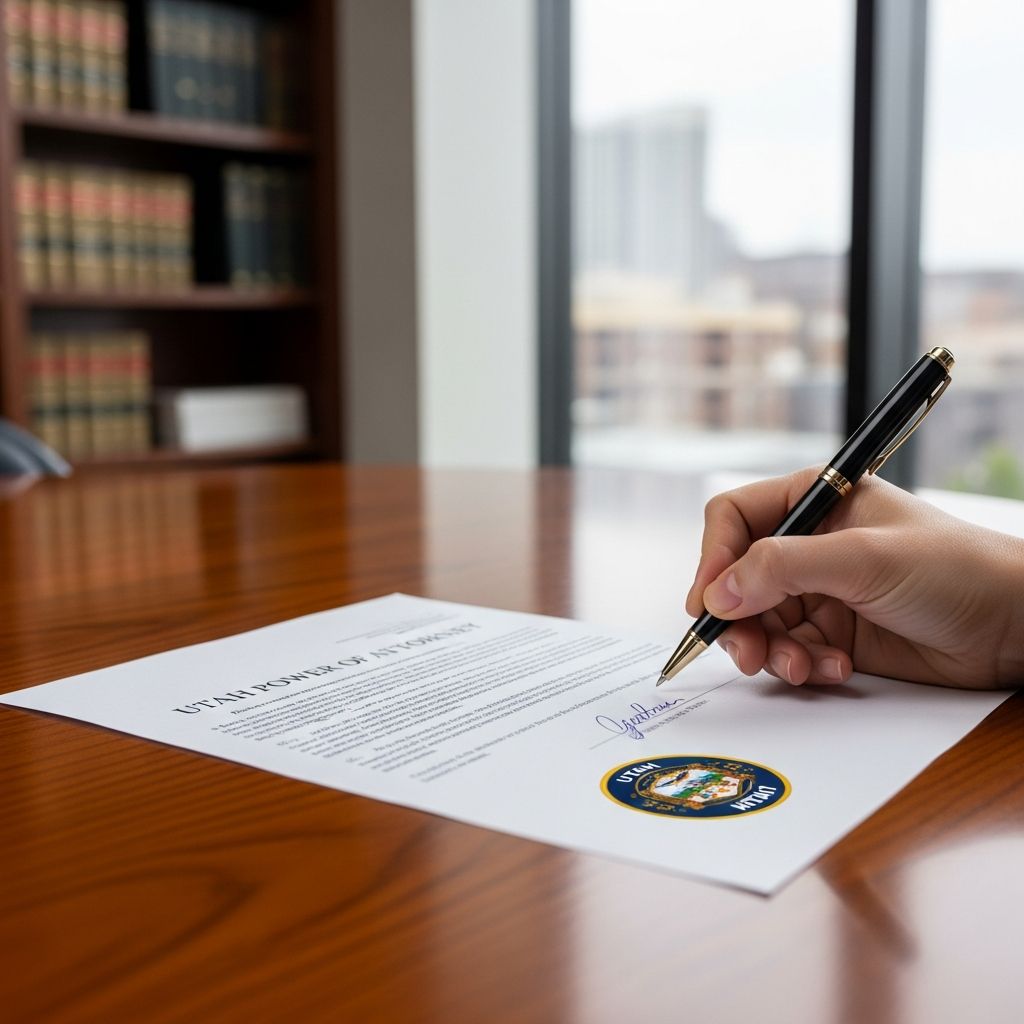
Utah’s legal framework for powers of attorney (POAs) is governed by the Uniform Power of Attorney Act, providing clear rules for delegating decision-making authority over property and finances. This guide explains key concepts, requirements, and best practices for principals and agents.
Understanding Powers of Attorney in Utah
A power of attorney is a legal instrument where a principal authorizes an agent to act on their behalf regarding financial matters, property management, or other specified affairs. Under Utah law, POAs are versatile tools for planning ahead, especially during incapacity or travel. The Act, effective since May 10, 2016, applies retroactively to existing documents and judicial proceedings.
Principals must possess mental capacity at signing, meaning they understand the delegation’s implications without needing to predict exact agent actions. POAs cannot be imposed; they must be voluntarily granted by a capable adult.
Types of Powers of Attorney Available
- General POA: Grants broad authority over finances, real estate, banking, and investments, ideal for comprehensive management.
- Limited POA: Restricts authority to specific tasks, like selling a property or handling a single transaction.
- Durable POA: Remains effective post-incapacity unless stated otherwise; the default under Utah law.
- Springing POA: Activates upon a triggering event, such as physician-certified incapacity, though not always recommended due to verification challenges.
Utah emphasizes durability to ensure continuity during vulnerability, protecting assets without court intervention.
Statutory Form: A Ready-to-Use Template
Utah provides an official statutory form under Utah Code § 75-9-301, simplifying POA creation with predefined powers. This form includes:
- Designation of primary agent, co-agents, and successors.
- Initialed subjects for authority, such as real property transactions, banking, or beneficiary changes.
- Optional special instructions for custom limitations or compensation.
- Nomination of conservator or guardian for future court needs.
To use it, initial desired powers or select “All Preceding Subjects” for full authority. Agents may not self-benefit unless explicitly allowed. The form clarifies that authority covers property decisions regardless of the principal’s capacity.
| Common Authority Categories | Description |
|---|---|
| Real Property | Buy, sell, mortgage homes or land. |
| Banking | Manage accounts, deposits, withdrawals. |
| Taxes | File returns, pay obligations. |
| Beneficiaries | Change designations on accounts or plans. |
| Fiduciary Powers | Delegate or exercise delegated duties. |
This table highlights frequently initialed areas; full definitions are in Utah Code Title 75, Chapter 9.
Execution Requirements for Validity
For enforceability, the principal must sign before a notary public. If physically unable, another can sign in their conscious presence and at their direction. No witnesses are required beyond notarization, streamlining the process.
Capacity is assessed at signing: the principal need only comprehend the appointment, not intricate details. Electronic signatures may apply under Utah’s uniform laws, but physical notarization ensures acceptance by banks and institutions.
Agent Selection and Responsibilities
Choose trustworthy agents—family, friends, or professionals—who prioritize your interests. Multiple co-agents can act independently unless specified otherwise; successors activate if primaries cannot serve.
Agents owe fiduciary duties per Utah Code § 75-9-114 (now under 75A-2-114):
- Act in the principal’s best interest or known expectations.
- Avoid conflicts, disclosing material ones.
- Maintain records of all transactions.
- Cooperate with health/estate fiduciaries.
- Attempt revocation notification if aware.
Compensation is reasonable unless waived; violations invite liability for damages.
When Does a POA Become Effective?
By default, immediately upon execution. Customize via special instructions for future dates or events, like incapacity certification. Springing POAs require clear triggers to avoid disputes, but immediate durability is preferred for reliability.
Keeping the POA Document Active
Distribute copies to agents, banks, and advisors. Third parties accepting in good faith are protected, even if later revoked, unless they have actual knowledge. Record real property POAs with county recorders for public notice.
Ending or Revoking Authority
POAs terminate on:
- Principal’s death.
- Revocation (written notice to agent and third parties).
- Termination event in the document.
- Purpose fulfillment.
- Principal-agent divorce, unless preserved.
Revocation demands prompt notification to prevent misuse.
Practical Applications and Planning Tips
POAs facilitate real estate deals, bill payments, and investment management without court conservatorships, saving time and costs. Nominate guardians in the form to influence future appointments.
Best Practices:
- Discuss expectations with agents beforehand.
- Review periodically, especially post-life changes.
- Pair with wills, trusts for holistic planning.
- Consult attorneys for complex needs.
For medical decisions, separate healthcare directives are advised, as financial POAs exclude health matters.
Frequently Asked Questions
Can I appoint multiple agents in a Utah POA?
Yes, name co-agents or successors; co-agents act separately unless joint action is required.
Is notarization mandatory for Utah POAs?
Yes, signing before a notary is required; proxies can sign in the principal’s presence if needed.
What if my agent misuses the POA?
Agents are liable for breaches; report to authorities, seek court remedies, or revoke promptly.
Does a POA survive incapacity?
Yes, durable by default unless non-durability is specified.
Can banks refuse my POA?
They may request “adequate notice,” but good-faith acceptance protects them; use statutory form to ease acceptance.
Recent Legislative Context
Utah’s framework saw updates via HB 181 in 2026, refining estate planning integration with durable POAs. Always verify current statutes, as laws evolve.
References
- Utah Code § 75-9-301 (2023) – Statutory form power of attorney — Utah State Legislature. 2023-05-10. https://law.justia.com/codes/utah/2023/title-75/chapter-9/part-3/section-301/
- Power of Attorney – Utah Courts — Utah Courts. Accessed 2026. https://www.utcourts.gov/en/self-help/categories/probate/power-of-attorney-general.html
- Power of Attorney – Utah Parent Center — Utah Parent Center. Accessed 2026. https://utahparentcenter.org/power-of-attorney/
- What Are Utah’s Power of Attorney Laws? – Nolo — Nolo. 2025. https://www.nolo.com/legal-encyclopedia/utah-power-of-attorney-laws.html
- HB 181 Uniform Estate Planning Amendments — Utah Legislature. 2026. https://le.utah.gov/~2026/bills/static/HB0181.html
Similar Articles








Read full bio of Sneha Tete