
Using Car Accident Police Reports in Court
How hearsay rules, evidence exceptions, and practical strategy shape the way car accident police reports can be used in civil and small claims courts.
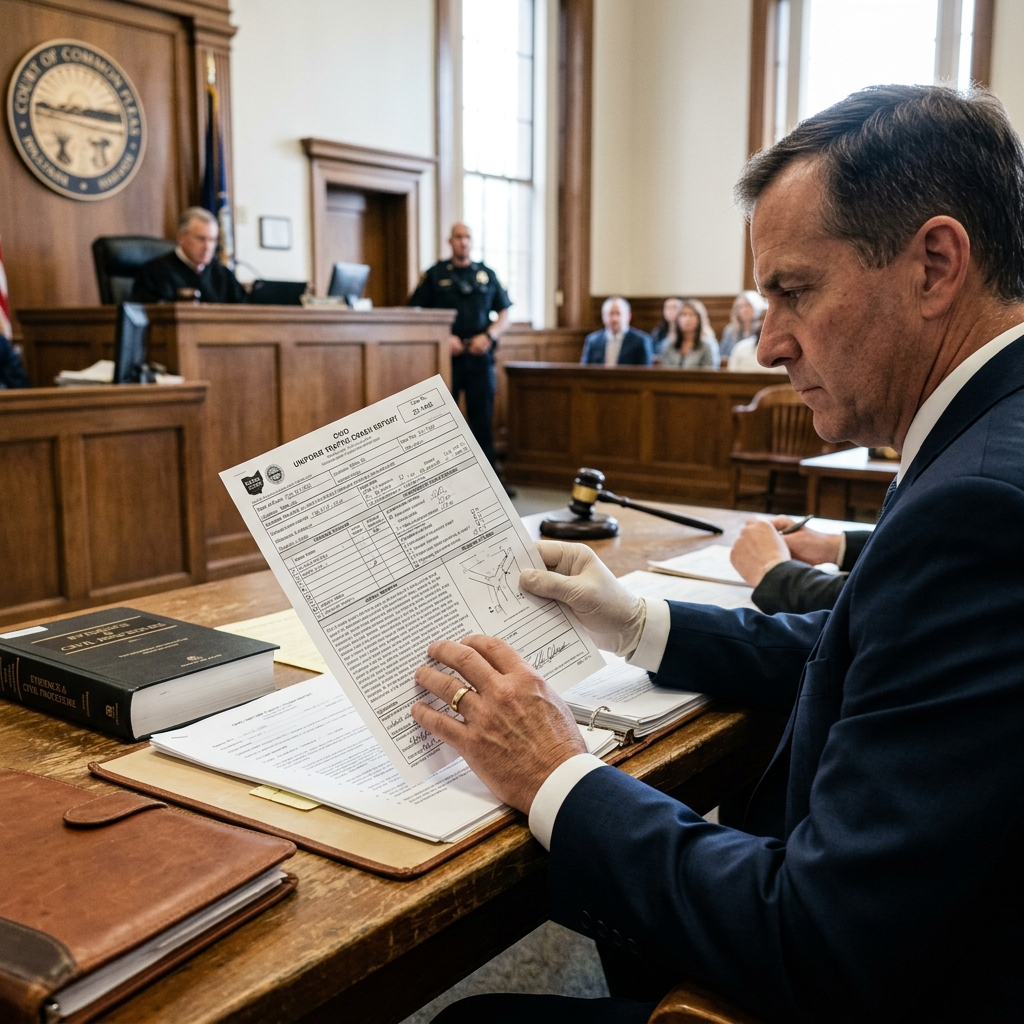
Car accident police reports often provide the most detailed, neutral account of a crash. Yet, many drivers are surprised to learn that these reports are not automatically usable as evidence in court. Whether a report can be admitted depends heavily on the rules of evidence, hearsay exclusions, and specific exceptions that vary by jurisdiction.
This article explains how courts treat car accident police reports, why hearsay is such a central issue, and what strategies lawyers use to make these reports work for or against a claim. It is for general information only and does not replace advice from a licensed attorney in your state.
Why Police Reports Matter After a Car Crash
When officers respond to a collision, they usually prepare a written report that may include:
- Names and contact details of all drivers, passengers, and witnesses
- Insurance information and vehicle descriptions
- Diagrams and notes about road layout, traffic controls, and impact points
- Weather and lighting conditions at the time of the crash
- Statements from involved parties and third-party witnesses
- Citations or charges issued, such as speeding or DUI
- The officer’s preliminary opinion on fault or contributing causes
These reports are crucial during settlement negotiations with insurers because they help adjusters reconstruct what happened and assess liability, even when the report itself might later be excluded at trial.
Understanding Hearsay and Its Impact on Police Reports
To understand why police reports can be difficult to admit in court, you need to understand hearsay. Under modern rules of evidence, hearsay generally means a statement made outside the courtroom that is offered in court to prove the truth of what it asserts.
Police reports usually contain multiple layers of hearsay, for example:
- The officer’s written report is itself an out-of-court statement.
- Statements inside the report (drivers, passengers, bystanders) are additional out-of-court statements recorded by the officer.
- Opinions or conclusions (e.g., “Driver A was at fault”) often rely on information the officer did not personally witness.
Because of these layers, courts tend to treat police reports with caution and only admit them when they fit narrowly defined exceptions.
Key Evidence Rules Affecting Admissibility
In the United States, most civil courts follow rules similar to the Federal Rules of Evidence, which heavily influence how police reports are analyzed.
Business Records and Public Records Exceptions
Police reports may be admitted under two main hearsay exceptions, often mirrored in state rules:
- Records of a regularly conducted activity (“business records” exception):
Reports created as part of an agency’s routine practice, at or near the time of the event, by someone with a duty to record the information, can sometimes be admitted under this exception. - Public records exception:
Records of public offices or agencies that document actions taken, duties performed, or factual observations may qualify as public records.
Even when a police report fits one of these exceptions, courts often separate what portions can be admitted (objective observations) from what must be excluded (opinions, secondhand statements, unknown sources).
Firsthand Observation vs. Investigation
Many jurisdictions distinguish between information the officer personally observed and information gathered during an investigation after the fact:
- Firsthand observations (e.g., position of vehicles, skid marks, weather) are more likely to be admitted as part of a business or public record.
- Statements from drivers and witnesses are typically treated as separate hearsay and must independently qualify under a hearsay exception to be admitted for their truth.
- Opinions on fault or causation may be excluded or admitted only for limited purposes, such as impeachment.
Civil Trials vs. Small Claims: Different Rules, Different Outcomes
How strictly courts handle hearsay depends in part on the type of case. Civil trials in higher courts usually apply evidence rules rigorously, while small claims courts are often more flexible.
Use in Standard Civil Personal Injury Trials
In many personal injury trials, police reports are generally inadmissible as full exhibits because they are hearsay and contain multiple layers of hearsay.
Common patterns include:
- Courts exclude the report entirely unless a proper foundation is laid and a hearsay exception clearly applies.
- Only portions based on the officer’s own observations may be admitted, often after certification or testimony establishing reliability.
- Statements from unnamed or nonparty witnesses are frequently excluded when they cannot be tied to a recognized hearsay exception.
Use in Small Claims Court
Small claims courts are designed for speed and simplicity, and many do not strictly follow the formal rules of evidence.
As a result:
- A car accident police report is often admitted in small claims without extensive argument over hearsay.
- Judges frequently allow reports to help understand the case, then decide what weight to give the information.
- Parties can rely on the report to support their version of events, even if a higher court might later treat the document differently.
Because practice varies by state, it is important to consult local small claims procedures.
Certified vs. Uncertified Reports: Why Certification Matters
Courts often distinguish between certified and uncertified police reports, especially in jurisdictions that treat reports as business records.
| Type of Report | Typical Requirements | Likely Treatment in Court |
|---|---|---|
| Certified police accident report | Official certification that the report was created in the regular course of police duties, at or near the time of the accident. | More likely to be admitted for factual observations, provided hearsay rules and exceptions are satisfied. |
| Uncertified police accident report | No certification or formal proof of regular business record practice. | Often treated as inadmissible hearsay unless another foundation is established. |
In some appellate decisions, courts have emphasized that a party cannot “bootstrap” statements inside an uncertified report into evidence without first satisfying the foundational requirements for the report itself.
Common Parts of a Police Report and How Courts See Them
Because police reports contain different types of information, courts often evaluate each part separately.
Objective Facts and Measurements
Information such as:
- Vehicle positions and damage descriptions
- Road markings, traffic signs, and signals
- Time of day, visibility, and road surface conditions
- Presence of skid marks or debris fields
These items are more likely to be admitted as part of a business or public record because they reflect observable facts gathered by the officer while performing official duties.
Statements from Drivers and Witnesses
Statements recorded in the report may be treated as separate hearsay and must independently fit an exception to be admitted for their truth.
Examples of possible exceptions include:
- Party admissions: A driver’s own statement, recorded by the officer, may be admissible as an admission against interest if the rules recognize it.
- Excited utterances: A statement made under stress or immediately following the crash could qualify as an exception in some cases.
- Present sense impressions: Descriptions made during or immediately after the event may fit certain hearsay exceptions.
Opinions on Fault or Violation of Law
Officers frequently note who they believe caused the crash or whether traffic laws were violated. Courts may:
- Exclude these opinions as inadmissible hearsay or speculation.
- Allow them only for limited purposes, such as assessing credibility rather than proving fault.
- Prefer live testimony from the officer, where the report is used only to refresh memory or support their account.
Strategic Ways Lawyers Use Police Reports
Even when the report itself cannot be admitted as an exhibit, it still plays an important strategic role in car accident litigation.
Building the Investigation and Case Theory
Attorneys and insurers use police reports to:
- Identify witnesses and follow up with interviews or depositions.
- Locate physical evidence or surveillance footage mentioned in the report.
- Understand initial statements and compare them with later testimony.
- Decide whether to hire accident reconstruction experts and what questions to ask.
Guiding Settlement Negotiations
Because police reports appear neutral and official, they often carry weight in negotiations. Insurers may adjust offers based on:
- Whether the report attributes fault to one driver.
- Whether citations were issued or sobriety concerns are documented.
- Whether any party admitted distraction, speeding, or other risky behavior.
In many cases, the case settles using information from the report without the court ever needing to decide its admissibility.
Using the Officer as a Witness
When the report itself is inadmissible or partially excluded, attorneys may call the officer to testify directly:
- The officer can describe their personal observations of the scene.
- The report can sometimes be used to refresh the officer’s memory.
- The officer may explain why they issued citations or formed certain conclusions.
This approach bypasses some hearsay issues because the officer is giving in-court testimony subject to cross-examination.
Practical Tips for Crash Victims and Litigants
If you are involved in a car accident and worried about how the police report will affect your case, consider these practical steps.
- Obtain a copy promptly: Request the report from the agency as soon as it is available and review it for accuracy.
- Check for errors: Mistakes in names, vehicle information, or descriptions of the crash can often be clarified or supplemented through testimony.
- Consult local rules: Evidence rules differ by state, and some jurisdictions treat police reports more favorably than others.
- Talk to an attorney early: A lawyer can explain whether and how your report may be admissible and what alternative evidence is needed.
- Do not rely on the report alone: Photographs, medical records, expert opinions, and witness testimony often carry more weight than the report itself.
Frequently Asked Questions (FAQ)
Are car accident police reports always inadmissible?
No. While many courts treat police reports as hearsay and exclude them as full exhibits, portions may be admitted under business records or public records exceptions, especially when based on the officer’s own observations and properly certified.
Can I use a police report in small claims court?
In many small claims courts, judges allow police reports to be used more freely and do not strictly enforce formal evidence rules. The report may be accepted and considered, although the judge decides how much weight to give it.
What should I do if the report contains incorrect information?
You can gather other evidence such as photographs, witness statements, and medical records to counter errors, and an attorney may call the officer or other witnesses to explain discrepancies. In some cases, agencies may issue supplemental reports to clarify major mistakes.
Is a certified police report stronger evidence than an uncertified one?
Generally, yes. Courts are more likely to admit properly certified reports as business records or public records. Uncertified reports often remain inadmissible hearsay unless another foundation is carefully laid.
Do I still need a lawyer if I have a favorable police report?
Yes. A favorable report can help but does not guarantee success. A lawyer can explain whether the report will be admissible, identify other crucial evidence, and prepare a strategy that does not depend solely on the report.
References
- Federal Rules of Evidence — Legal Information Institute, Cornell Law School. 2023-01-01. https://www.law.cornell.edu/rules/fre
- Are Car Accident Police Reports Admissible in Court? — FindLaw. 2023-09-12. https://www.findlaw.com/legalblogs/personal-injury/are-car-accident-police-reports-admissible-in-court/
- The Police Report in New York Personal Injury Litigation — Pospisil Law Firm. 2024-08-04. https://pospislaw.com/blog/2024/08/04/the-police-report-in-new-york-personal-injury-litigation/
- Yassin v. Blackman — New York Appellate Division, Second Department. 2020-02-19. https://law.justia.com/cases/new-york/appellate-division-second-department/2020/2019-04138.html
- Are Police Reports Admissible in Injury Cases in Philadelphia? — The Reiff Law Firm. 2022-04-15. https://www.reifflawfirm.com/are-police-reports-admissible-in-injury-cases-in-philadelphia/
- Accident Reports and the Business Records Hearsay Exception — Albany Law School (Hutter). 2002-01-01. https://www.albanylaw.edu/sites/default/files/media/user/faculty/hutter/hutter-on-evidence-accident-reports-2002.pdf
- Using Police Reports to Win Your Car Accident Settlement — Adam S. Kutner, Injury Attorneys. 2021-06-10. https://www.askadamskutner.com/auto-accident/using-a-police-report-to-win-your-car-accident-settlement/
Similar Articles








Read full bio of medha deb


