
U.S. vs. Canada: Due Process in National Security
How the U.S. and Canada balance due process with national security demands.
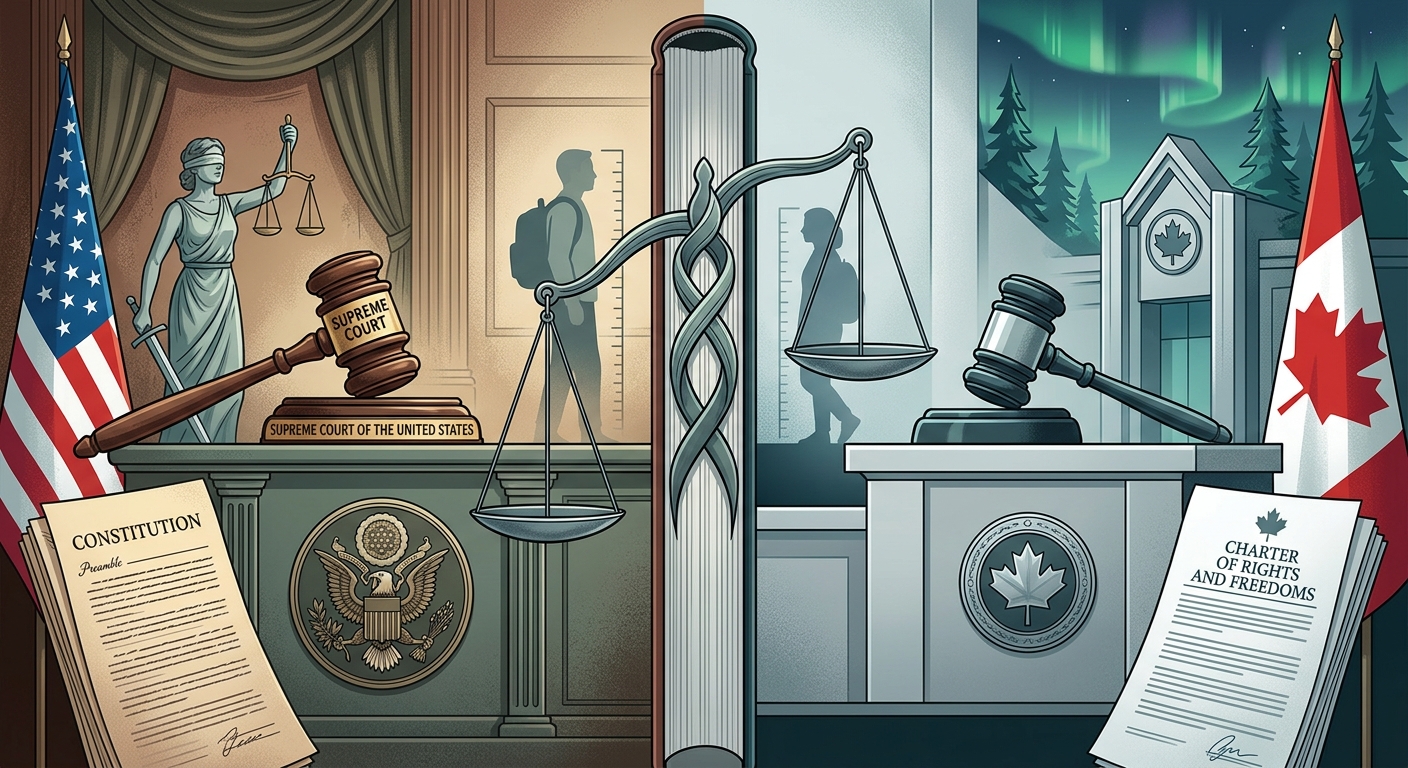
In the landscape of modern democratic governance, the inherent tension between safeguarding national security and preserving fundamental civil liberties remains one of the most defining legal challenges of our era. Following the unprecedented global security shifts of the early 21st century, governments worldwide faced immense pressure to expand executive powers, authorize sweeping surveillance programs, and detain individuals suspected of terrorism. Yet, how neighboring nations with shared historical roots respond to these profound pressures reveals stark and fascinating contrasts in their constitutional architectures. The United States and Canada—two steadfast allied nations boasting robust democratic traditions—have charted notably different courses when confronting the limits of due process, executive power, and the rights of the accused.
At the very heart of this divergence is a fundamental philosophical disagreement regarding the nature of constitutional rights during a period of crisis. In the United States, the governmental response to severe national security threats has frequently involved the executive branch attempting to carve out geographical and jurisdictional exceptions to the established constitutional framework. By creating specialized categories for detainees, the U.S. government has historically sought to bypass civilian court oversight. Conversely, Canada’s legal framework generally insists that fundamental justice must follow the state’s actions wherever they occur, vehemently rejecting the premise that a national security crisis permits the total abandonment of constitutional oversight.
To understand how these two North American allies handle the delicate equilibrium between liberty and security, we must dive deep into their foundational legal documents, their highest court rulings, and their respective approaches to government transparency and preventative detention.
The Architectural Differences in Constitutional Rights
The foundation of how each country addresses the rights of the accused lies within their primary constitutional texts. While both nations share a common law heritage inherited from the British legal system, their modern constitutional frameworks operate on distinctly different mechanical principles when tested by the extraordinary circumstances of national security.
The United States relies heavily on the Bill of Rights, which was designed to provide absolute negative liberties—meaning it strictly defines what the government cannot do to an individual. The Fifth Amendment explicitly guarantees that no person shall be deprived of “life, liberty, or property, without due process of law.” However, because these rights are framed in absolute terms, the U.S. legal system has often relied on creating stark exceptions rather than nuanced balances. During wartime or perceived national emergencies, the U.S. executive branch has historically argued that constitutional constraints either do not apply to specific classes of individuals—such as foreign nationals captured abroad—or that extraordinary circumstances trigger inherent executive powers that supersede standard civilian legal processes.
In contrast, Canada’s approach is governed by the Constitution Act of 1982, which introduced the Canadian Charter of Rights and Freedoms. The Charter takes a profoundly different structural approach to civil liberties:
- Section 7 Guarantees: Section 7 of the Charter ensures the “right to life, liberty and security of the person and the right not to be deprived thereof except in accordance with the principles of fundamental justice.” This creates a powerful baseline for due process that applies broadly to individuals interacting with the Canadian state.
- Section 1 Proportionality: Unlike the U.S. Constitution, the Canadian Charter includes a built-in limitation mechanism via Section 1. This clause states that Charter rights are subject “only to such reasonable limits prescribed by law as can be demonstrably justified in a free and democratic society.”
Counterintuitively, the inclusion of a clause that explicitly allows the government to limit rights has often led to more rigorous, structured judicial review in Canada. When the Canadian government attempts to infringe on a liberty for national security reasons, it cannot simply declare an executive exception. It must formally prove in court that the limitation is proportional, minimally impairing, and absolutely necessary. This forces the state to justify its actions transparently, rather than allowing it to operate in a legal void.
The Crucible of Crisis: Indefinite Detention and Habeas Corpus
The most visible manifestation of this legal divergence occurred in the aftermath of the September 11 attacks, specifically concerning the detention of suspected terrorists. The strategy adopted by the United States involving the Guantánamo Bay Naval Base was explicitly engineered to place detainees outside the territorial jurisdiction of U.S. federal courts. The objective was to intentionally suspend the ancient writ of habeas corpus—the fundamental legal right that allows an individual to challenge the lawfulness of their detention before an impartial judge.
To codify this strategy, the U.S. government passed the Military Commissions Act of 2006. This sweeping legislation formally sought to strip non-citizens classified as enemy combatants of their habeas corpus rights, establishing a parallel system of military commissions. These commissions operated with significantly lower evidentiary standards than civilian courts, controversially permitting the introduction of hearsay and heavily relying on classified intelligence that the accused could not fully review.
The U.S. Supreme Court eventually intervened in this legally murky territory. In the landmark 2008 decision of Boumediene v. Bush, the Court ruled that the constitutional privilege of habeas corpus extended to detainees held at Guantánamo Bay, declaring a crucial section of the Military Commissions Act unconstitutional. The Court recognized that the executive branch could not simply draw a line on a map and declare it a constitution-free zone. Nevertheless, despite this judicial pushback, the underlying architecture of indefinite preventative detention without formal civilian trial remains largely intact, representing a continuing departure from traditional constitutional due process.
Canada’s Judicial Check on Executive Action
While the United States was establishing military commissions, Canada faced its own intense legal reckoning regarding citizens caught in the global security dragnet. The approach taken by the Supreme Court of Canada (SCC) demonstrated a distinct unwillingness to allow the government to operate outside the boundaries of fundamental justice, even when operating cooperatively with foreign intelligence agencies.
The most prominent example involves the extended litigation surrounding Omar Khadr, a Canadian citizen who was detained at Guantánamo Bay as a teenager. When Canadian intelligence officials traveled to the facility to interrogate Khadr and subsequently shared the fruits of those interrogations with U.S. authorities, it triggered a massive constitutional battle in Canadian courts. The SCC was tasked with determining whether the Canadian government’s participation in a foreign detention regime that lacked standard due process violated the Charter.
In a unanimous and defining ruling in Canada (Prime Minister) v. Khadr (2010), the Supreme Court of Canada determined that the regime at Guantánamo constituted a clear denial of due process and violated core international human rights obligations. Crucially, the Court ruled that Canadian officials had breached Section 7 of the Charter by actively participating in a process that ignored the principles of fundamental justice. Furthermore, the Canadian judicial system consistently compelled the federal government to disclose secret documents to the accused so that he could adequately mount a legal defense, firmly establishing that the invocation of national security cannot entirely extinguish the right to a fair and transparent hearing.
Transparency, Secrecy, and the Right to a Defense
One of the most consequential battlegrounds in the intersection of national security and civil liberties is the courtroom handling of classified intelligence. A cornerstone of traditional due process is the right of the accused to know exactly what they are being charged with and to have full access to the evidence being used against them.
In the United States, the national security apparatus frequently relies on the State Secrets Privilege and the Classified Information Procedures Act (CIPA) to shield sensitive intelligence from public and defense scrutiny. In military commissions, prosecutors have successfully withheld critical details surrounding the capture and interrogation of detainees—including credible allegations of coercion and torture. This systemic reliance on secrecy effectively blindfolds the defense team, deeply compromising the adversarial nature of the justice system.
The Canadian legal system navigates this treacherous territory through a significantly different procedural mechanism. Under the Canada Evidence Act, when the state attempts to withhold information on national security grounds, the matter is referred to a specialized federal judge. This judge is mandated to meticulously weigh the broader public interest in protecting the intelligence against the specific individual’s constitutional right to make a “full answer and defence.” If the judge determines that the non-disclosure of the intelligence fundamentally impairs the accused’s ability to receive a fair trial, the prosecution may be forced into an impossible choice: either disclose the sensitive information or stay the criminal charges entirely. The Canadian system explicitly refuses to allow a conviction based on evidence the accused cannot challenge.
Comparing Due Process in National Security Contexts
To fully grasp the magnitude of these differing approaches, it is helpful to look at a direct comparison of how these two allied nations manage the mechanics of justice under the umbrella of national security.
| Legal Element | United States Approach | Canadian Approach |
|---|---|---|
| Constitutional Oversight | Attempts to carve out geographical exceptions (e.g., offshore detention) to limit Bill of Rights applicability. | Charter of Rights generally applies to state actions, enforcing “fundamental justice” even in complex security environments. |
| Evidentiary Standards | Military commissions allow heavily classified evidence and, historically, hearsay; strict state secrets privilege. | Judges rigorously balance state secrecy against the absolute right to make a “full answer and defence.” |
| Indefinite Detention | Preventative detention of “enemy combatants” without civilian trial utilized as a primary security tool. | Highly restricted. Security certificates exist for deportation, but are subject to intense, ongoing judicial scrutiny. |
The Long-Term Implications for Civil Liberties
What do these divergent legal strategies mean for the long-term health of democratic governance? The U.S. approach of isolating national security issues from the traditional civilian justice system risks normalizing a dangerous two-tiered system of justice. When a government views its foundational Bill of Rights as a procedural obstacle to be bypassed during emergencies rather than a sacred standard to be universally upheld, the moral and legal authority of the state slowly degrades. The lingering existence of indefinite detention facilities serves as a permanent reminder of the fragility of absolute rights when confronted with executive power.
Conversely, Canada’s legal architecture, while certainly not immune to controversy or criticism, forcefully maintains that the Constitution must govern the state’s actions in all weather. The Canadian insistence on strictly adhering to the principles of fundamental justice forces the intelligence and executive branches to justify their security measures openly within the bounds of the law. By refusing to compromise the core tenets of a fair trial, Canada demonstrates a profound belief that respecting civil liberties does not weaken a nation’s security posture; rather, it reinforces the very democratic values that the state is attempting to protect in the first place.
Frequently Asked Questions (FAQs)
What is the primary difference between the U.S. Bill of Rights and the Canadian Charter regarding national security?
The U.S. Bill of Rights outlines absolute negative liberties, which the executive branch has historically tried to bypass during crises by claiming special jurisdictions or wartime exceptions. The Canadian Charter includes Section 1, which allows for rights to be reasonably limited, but forces the government to legally prove that such limitations are proportional, justified, and fundamentally fair, resulting in stronger judicial oversight.
What does the writ of habeas corpus mean in the context of detention?
Habeas corpus is an ancient legal doctrine that requires the government to bring a detained individual before an impartial court to justify the legal basis for their imprisonment. In national security contexts, suspending this right allows governments to hold suspects indefinitely without formally charging them with a crime or providing a trial.
Why did the U.S. government create military commissions?
Following the events of 9/11, the U.S. government established military commissions under the argument that traditional civilian courts were unequipped to handle the complexities of international terrorism, sensitive intelligence, and battlefield captures. Critics argue this was primarily a mechanism to lower evidentiary standards and avoid the strict due process requirements of the U.S. federal court system.
How does Section 7 of the Canadian Charter protect the accused?
Section 7 guarantees the right to life, liberty, and security of the person, ensuring these cannot be taken away except in accordance with the “principles of fundamental justice.” In practice, this means the government cannot use arbitrary, secret, or grossly disproportionate measures against an individual, even if they are suspected of national security offenses.
References
- The Canadian Charter of Rights and Freedoms — Department of Justice Canada. 2026-04-13. https://www.justice.gc.ca/eng/csj-sjc/rfc-dhc/
- Boumediene v. Bush, 553 U.S. 723 — U.S. Supreme Court. 2008-06-12. https://www.law.cornell.edu/supct/html/06-1195.ZS.html
- Canada (Prime Minister) v. Khadr, 2010 SCC 3 — Supreme Court of Canada. 2010-01-29. https://scc-csc.lexum.com/scc-csc/scc-csc/en/item/7842/index.do
- Military Commissions Act of 2006 — U.S. Congress. 2006-10-17. https://www.congress.gov/bill/109th-congress/senate-bill/3930
Similar Articles








Read full bio of Sneha Tete


