
US Green Card via Marriage to German Citizen
Comprehensive guide to securing a US green card for spouses of German citizens through marriage-based immigration processes.
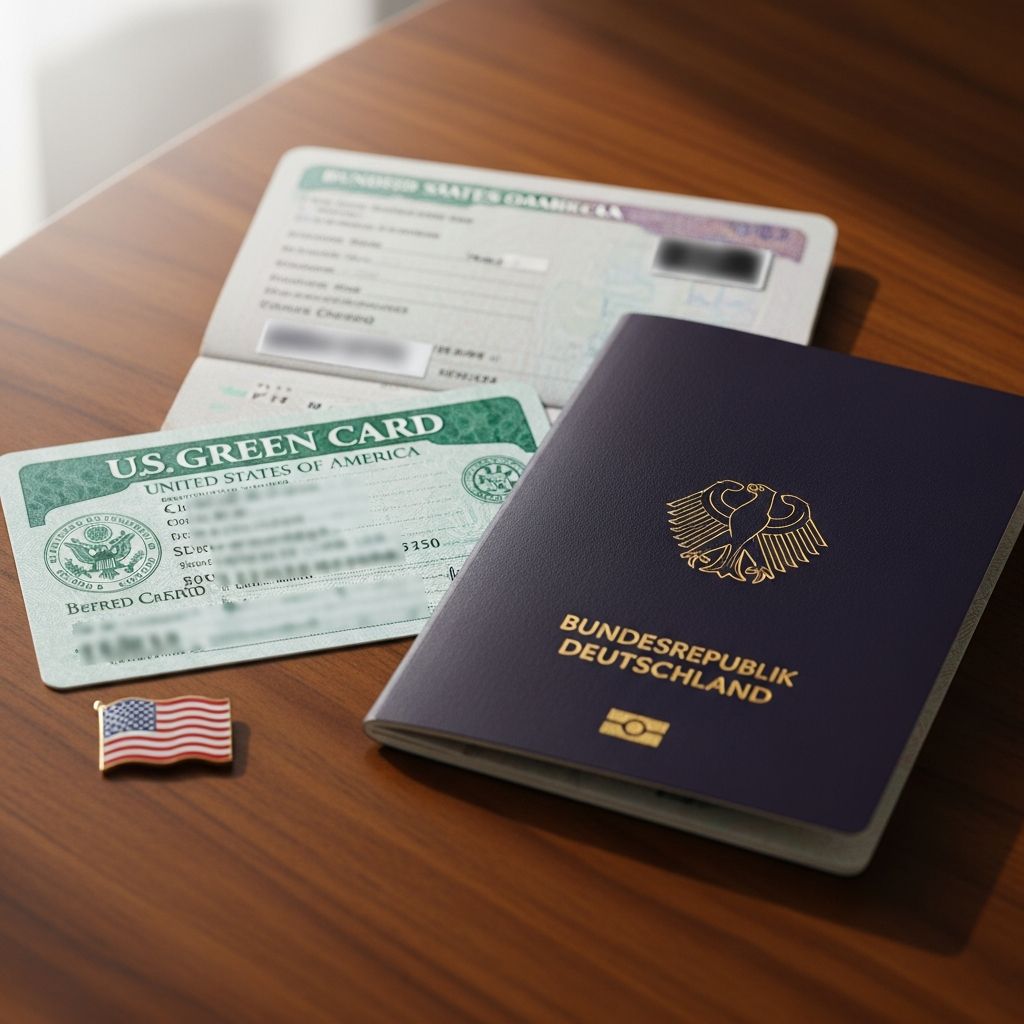
Marrying a German citizen opens pathways to US permanent residency, known as a green card, primarily through family-sponsored immigration channels administered by US Citizenship and Immigration Services (USCIS). This process allows the foreign spouse to live and work indefinitely in the United States, with options varying based on the couple’s location at the time of application.
Understanding Eligibility for Marriage-Based Green Cards
To qualify for a green card through marriage to a German citizen, the union must be legally recognized and bona fide, meaning it is entered for genuine companionship rather than solely for immigration benefits. German marriages are generally valid in the US if properly documented with an apostille under the Hague Convention, ensuring authenticity for USCIS review.
Key eligibility factors include:
- The US citizen spouse must be at least 21 years old.
- The marriage must be legally performed and registered, with certificates translated into English if necessary.
- Both parties must prove the relationship’s legitimacy through joint financial records, photos, travel itineraries, and affidavits from friends or family.
- No prior immigration violations or criminal bars that render the foreign spouse inadmissible.
German citizens, as non-EU nationals for US purposes, follow standard immediate relative procedures without visa number wait times, unlike spouses of green card holders.
Primary Pathways: Inside vs. Outside the US
Couples have two main routes depending on the foreign spouse’s location. If the German spouse is already in the US on a valid nonimmigrant visa, they can pursue Adjustment of Status (AOS) domestically. Otherwise, Consular Processing (CP) applies abroad.
| Pathway | Location | Key Steps | Processing Time |
|---|---|---|---|
| Adjustment of Status | In the US | File I-130 and I-485 concurrently; biometrics; interview | 12-24 months |
| Consular Processing | Outside US | I-130 approval; NVC; US embassy interview in Germany | 10-18 months |
AOS is simpler if eligible, avoiding travel risks, but requires maintaining lawful status. CP involves the National Visa Center (NVC) and an interview at the US Consulate in Frankfurt.
Step-by-Step Guide for Adjustment of Status
For German spouses present in the US, the process begins with filing Form I-130 (Petition for Alien Relative) alongside Form I-485 (Application to Register Permanent Residence). Include supporting evidence of the marriage’s validity.
- Prepare and Submit Forms: Gather marriage certificate (apostilled), birth certificates, passports, and proof of bona fides. Pay fees: $675 for I-130, $1,440 for I-485 (as of 2026).
- Biometrics Appointment: USCIS schedules fingerprinting within weeks.
- Work and Travel Authorizations: Optional Forms I-765 and I-131 for interim benefits.
- Interview: Joint appearance at a USCIS office to verify relationship authenticity.
- Approval and Green Card Issuance: Conditional 2-year card if marriage under 2 years; removable via I-751 after.
Consular Processing for Spouses Abroad
German citizens outside the US start with the I-130 petition filed by their US spouse. Upon approval, the case transfers to NVC for document submission and fee payments.
- Submit DS-260 online immigrant visa application.
- Provide Affidavit of Support (I-864) proving financial sponsorship at 125% of poverty guidelines.
- Attend medical exam at an approved panel physician in Germany.
- Visa interview at US Consulate General Frankfurt, answering questions on relationship history.
Post-approval, enter the US with immigrant visa, activating green card status upon arrival.
Required Documentation Checklist
Comprehensive paperwork is crucial to avoid delays or Requests for Evidence (RFEs).
- Identity Documents: Passports, birth certificates, apostilled marriage certificate.
- Relationship Evidence: Joint leases, bank statements, insurance policies, wedding photos, chat logs.
- Financial Proof: I-864 with tax returns, W-2s, employment letters.
- Medical and Police: Sealed exam results, German police certificates (Führungszeugnis).
- Photos: Two US visa-style images.
Financial Sponsorship Obligations
The US petitioner must demonstrate capacity to support the spouse, preventing public charge reliance. Income from the German spouse can count if legally working in the US. Public benefits like Medicaid are limited post-green card.
Potential Challenges and Pitfalls
Common hurdles include proving a bona fide marriage amid scrutiny for fraud. Prior overstays or unlawful presence may trigger 3/10-year bars, resolvable via waivers. Same-sex marriages are equally valid post-Obergefell.
COVID-era backlogs persist into 2026, with Frankfurt consulate processing immigrant visas efficiently but interviews booked months ahead.
From Green Card to Citizenship
Green card holders can naturalize after 3 years of marriage-based residency (vs. 5 years standard), filing N-400 with B1 English and civics tests. German citizens retain dual nationality options under US-German treaties.
Frequently Asked Questions
Can I work while my green card application is pending?
Yes, apply for Employment Authorization Document (EAD) via I-765 concurrently with AOS for work permission in 3-5 months.
What if our marriage is less than 2 years old at approval?
Receive a conditional green card; file I-751 joint petition 90 days before expiry to remove conditions.
Is a prenuptial agreement required?
No, but it may support I-864 if addressing support obligations.
How long can processing take at Frankfurt Consulate?
Typically 3-6 months post-NVC document acceptance, subject to scheduling.
Can children be included?
Stepchildren under 21 qualify as derivatives if relationship predates marriage.
Professional Assistance Recommendations
Immigration attorneys specializing in marriage cases can review documents and represent at interviews. Free consultations via AILA members; avoid notarios for US filings.
This process demands meticulous preparation, but successful reunification builds lasting US family foundations.
References
- Family Reunification for Spouses — U.S. Citizenship and Immigration Services (USCIS). 2025-10-01. https://www.uscis.gov/family/family-of-us-citizens/bringing-spouses-to-live-in-the-united-states-as-permanent-residents
- Immigrant Visa for a Spouse of a U.S. Citizen (IR1 and CR1) — U.S. Department of State. 2026-01-10. https://travel.state.gov/content/travel/en/us-visas/immigrate/family-immigration/immigrant-visa-for-spouse.html
- Adjustment of Status for Immediate Relatives — U.S. Citizenship and Immigration Services (USCIS). 2025-11-15. https://www.uscis.gov/green-card/green-card-processes-and-procedures/adjustment-of-status
- Public Charge Resources — U.S. Citizenship and Immigration Services (USCIS). 2025-09-20. https://www.uscis.gov/policy-manual/volume-8-part-g
- US Consulate General Frankfurt – Immigrant Visas — U.S. Department of State. 2026-01-05. https://de.usembassy.gov/visas/immigrant-visas/
Similar Articles








Read full bio of Sneha Tete


