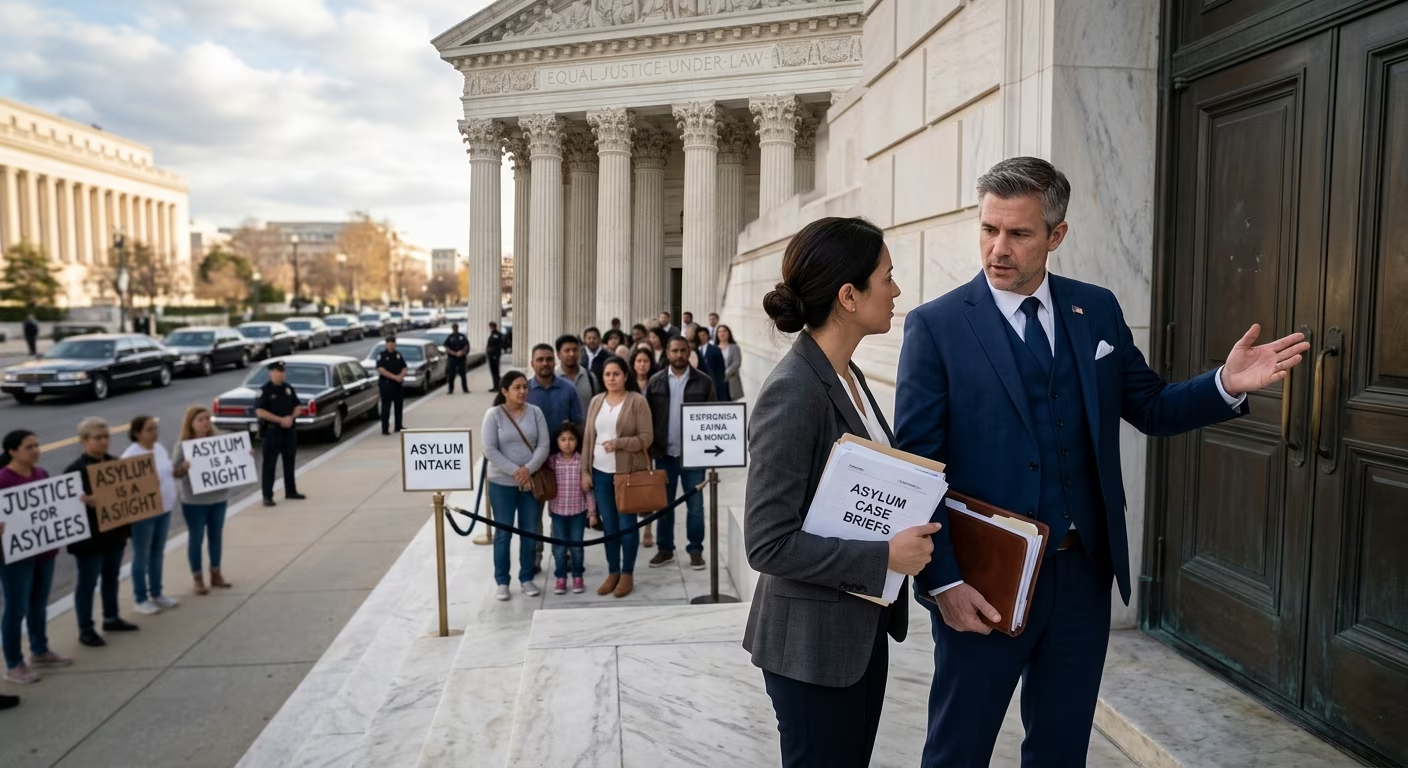
Introduction to the U.S. Asylum Framework
Since its formal inception, the United States immigration system has navigated a contentious balance between executive branch directives, legislative mandates drafted by Congress, and judicial oversight from federal courts. Among the most litigated arenas within this system is asylum law, a framework designed to offer safe haven to individuals fleeing persecution. Unlike many areas of federal law where independent courts establish legal precedent, U.S. immigration courts operate as an administrative arm of the executive branch. This structural reality means that national asylum policies are highly susceptible to swift shifts dictated by the sitting administration.
Over recent years, the interpretation of who qualifies for asylum—particularly among those fleeing non-state actor violence, such as domestic abuse and gang violence—has undergone dramatic volatility. From sweeping executive mandates attempting to categorically deny claims based on private violence to fierce judicial pushback ensuring individualized assessments, the legal landscape remains in constant flux. This article explores the internal mechanics of these abrupt policy shifts, the high-stakes legal battles they have sparked, and the enduring tension between domestic executive authority and international humanitarian obligations.
The Statutory Foundations of Asylum Eligibility
To properly understand the modern conflicts over asylum eligibility, one must look closely at the foundational statutes governing the immigration process. The Refugee Act of 1980 aligned U.S. domestic law with international treaties, codifying the global definition of a refugee. Under the framework established by the Immigration and Nationality Act (INA), an asylum seeker arriving at the border must demonstrate a well-founded fear of persecution in their home country. This persecution must be inflicted on account of one of five statutorily protected grounds: race, religion, nationality, political opinion, or membership in a “particular social group.”
While the first four categories are relatively straightforward, the “particular social group” (PSG) category has been the subject of intense litigation. The PSG classification was intentionally left vague by lawmakers to accommodate evolving forms of human rights abuses. Historically, the Board of Immigration Appeals (BIA) defined a PSG as a group sharing a common, immutable characteristic. Over time, immigration advocates successfully argued that individuals fleeing severe, systemic domestic abuse or targeted gang violence could constitute a valid PSG. They posited that in countries where governments are unwilling or unable to protect their citizens, the victims share an immutable characteristic defined by their vulnerability.
The Unique Architecture of Immigration Courts
Unlike federal criminal or civil courts operating under Article III of the Constitution, U.S. immigration courts are housed within the Department of Justice (DOJ). They are administered by the Executive Office for Immigration Review (EOIR). This structural positioning gives the executive branch—specifically the United States Attorney General—extraordinary power over national immigration policy and the daily interpretation of asylum law.
One of the most potent tools at the Attorney General’s disposal is the “self-referral” authority. This procedural mechanism allows the Attorney General to intervene directly in the administrative appellate process by lifting cases out of the BIA, reviewing them personally, and issuing binding, precedent-setting decisions. By utilizing this power, an Attorney General can effectively rewrite immigration policies from the top down without navigating the legislative hurdles of Congress. This unique architecture means that the adjudication of asylum claims is inextricably linked to the policy goals of the current administration. When the executive branch seeks to restrict immigration, the Attorney General can issue binding decisions that drastically narrow avenues for legal relief, forcing immigration judges nationwide to conform to a newly established standard virtually overnight.
The 2018 Paradigm Shift: Categorical Denials of Private Violence Claims
The innate volatility of this system was placed on full display in 2018 with a landmark executive decision known legally as Matter of A-B-. Utilizing the self-referral power, the Attorney General directly intervened in the case of a Central American asylum seeker fleeing systemic domestic abuse. The ruling overturned a crucial 2014 legal precedent, Matter of A-R-C-G-, which had formally recognized that certain survivors of domestic violence could qualify for asylum under the PSG category.
The Matter of A-B- decision instituted a sweeping policy shift, declaring that claims pertaining to domestic or gang violence perpetrated by non-governmental actors would generally no longer qualify for asylum. The legal rationale rested on the assertion that private violence is fundamentally a local criminal matter, not a form of persecution meant to be addressed by international protection. Furthermore, the decision heightened the burden of proof required to show that a foreign government was “unwilling or unable” to protect the victim. This restrictive directive had an immediate, chilling effect. Asylum officers conducting initial “credible fear” interviews were instructed to uniformly apply this new standard, leading to a dramatic spike in the rapid deportation of vulnerable individuals fleeing severe violence.
The Clash with Federal Courts: Striking Down Blanket Bans
The executive branch’s aggressive attempt to issue blanket denials for certain categories of asylum claims quickly triggered a massive legal counter-offensive. Civil rights organizations and immigration advocacy groups filed multiple lawsuits arguing that the new administrative directives explicitly violated the core provisions of the Immigration and Nationality Act. The most notable judicial pushback occurred in the federal courts, specifically in the landmark case of Grace v. Whitaker.
In late 2018, a federal district judge thoroughly examined the policy and struck down key components of the operational guidelines stemming from Matter of A-B-. The federal court firmly ruled that it is fundamentally unlawful for the executive branch to apply a categorical ban to asylum claims based on gang or domestic violence. U.S. asylum law, the court emphasized, inherently requires an individualized, case-by-case assessment of a migrant’s specific fear of persecution. By formally instructing frontline asylum officers to universally reject credible fear claims tied to private violence, the executive branch had unlawfully bypassed the statutory requirements laid out by Congress. The pivotal ruling successfully reinstated the legal right for these populations to have their claims evaluated on their individual merits.
International Law and the Principle of Non-Refoulement
Beyond domestic federal statutes, the rapidly shifting U.S. asylum policies raised profound questions regarding the nation’s adherence to established international human rights standards. The United Nations High Commissioner for Refugees (UNHCR) established the 1951 Refugee Convention and its subsequent 1967 Protocol, which the United States has formally ratified. These texts enshrine the fundamental principle of non-refoulement. This universally recognized principle dictates that no sovereign state shall expel or return a refugee to a territory where their life or basic freedom would be threatened.
International legal scholars strongly argued that implementing categorical bans on asylum for victims of private violence came dangerously close to violating non-refoulement. When sovereign states fail to acknowledge the severe nature of gender-based violence or unchecked gang warfare, they risk deporting innocent individuals back to situations of almost certain torture. The UNHCR has consistently maintained that persecution orchestrated by non-state actors, in scenarios where the state apparatus is unable to offer effective protection, squarely falls within the ambit of the 1951 Convention. The domestic executive attempt to restrictively redefine persecution contradicted decades of established international legal consensus.
Comparing Asylum Criteria Through Recent Administrations
Visualizing how criteria for evaluating private violence claims have fluctuated highlights the instability of executive discretion.
| Time Period | Controlling Precedent | Stance on Private Violence (Domestic/Gang) | Impact on Asylum Seekers |
|---|---|---|---|
| Pre-2018 | Matter of A-R-C-G- | Recognized as a valid basis for asylum if the state is unwilling or unable to protect the victim. | Allowed individualized assessments; provided a viable pathway for victims of severe private abuse. |
| 2018 – 2021 | Matter of A-B- (I) | Generally categorically denied. High burden placed on proving government complicity or total failure. | Led to rapid deportations and high rates of negative credible fear determinations at the border. |
| Post-2021 | Matter of A-B- (III) | Vacated previous restrictions; returned to individualized, case-by-case legal analysis. | Restored due process for domestic and gang violence victims, allowing claims to be fully litigated. |
The 2021 Reversal and the Current Legal Landscape
The deeply cyclical nature of U.S. immigration policy was vividly demonstrated once again in the summer of 2021. Following a transition of power in the executive branch, the incoming Attorney General utilized the exact same self-referral authority to issue a new ruling, Matter of A-B- III. This decision formally vacated the highly restrictive precedents set by the previous administration in 2018.
The new directive explicitly instructed all immigration judges and the Board of Immigration Appeals to return to the pre-2018 legal standards. This meant that asylum claims involving severe private violence must once again be meticulously evaluated based on the specific, individualized facts of the case, rather than being immediately subjected to a categorical presumption of legal invalidity. While this crucial reversal offered immediate, life-saving relief to thousands of asylum seekers navigating the backlogged court system, it also laid bare the precarious nature of administrative protections. As long as the exact interpretation of a “particular social group” is left largely to the sole discretion of the executive branch, asylum law remains incredibly vulnerable to the shifting political winds of Washington.
Broader Implications and the Call for Legislative Reform
The human toll of this regulatory whiplash is immense. For thousands of asylum seekers, the utter lack of statutory permanence means that their survival often depends entirely on the arbitrary timing of their arrival and the prevailing political climate of the moment. These constantly shifting legal directives force legal practitioners into a grueling state of constant adaptation, complicating the thorough preparation of life-or-death legal defenses for their vulnerable clients.
The broader implication for the United States legal system is a pressing, undeniable need for comprehensive legislative reform. Legal scholars and human rights advocates increasingly argue that Congress must proactively intervene to explicitly define the specific parameters of a “particular social group” and permanently codify robust protections for survivors of domestic and gang violence within the INA. Only through binding statutory clarification can the United States truly establish a reliable, humane, and consistent asylum system that fully honors both its domestic democratic laws and its international human rights obligations. Until such legislative action is taken, the battle over asylum eligibility will continue to be waged back and forth in administrative tribunals.
Frequently Asked Questions (FAQs)
- What qualifies as a “particular social group” in U.S. asylum law?
A “particular social group” (PSG) is one of the five protected grounds for asylum. While not explicitly defined in the original statute, courts generally interpret it as a group of people sharing a common, immutable characteristic that they cannot or should not be forced to change. Examples often include tribal affiliations, sexual orientation, and, historically, victims of severe, systemic domestic violence. - How does the U.S. Attorney General influence immigration policy?
Immigration courts are part of the Department of Justice, which is an executive agency. The Attorney General possesses a unique “self-referral” authority, allowing them to independently review decisions made by the Board of Immigration Appeals and issue new, binding precedents that all immigration judges must follow, effectively changing policy without new legislation. - Why was the Grace v. Whitaker ruling legally significant?
The federal court ruling in Grace v. Whitaker was significant because it struck down executive attempts to apply a categorical ban on asylum claims rooted in domestic and gang violence. The court reinforced that U.S. law requires a case-by-case, individualized assessment of an applicant’s credible fear of persecution, preventing the government from summarily dismissing these claims at the border.
References
- Matter of A-B-, 27 I&N Dec. 316 (A.G. 2018) — U.S. Department of Justice. 2018-06-11. https://www.justice.gov/eoir/ag-bia-decisions
- Matter of A-B-, 28 I&N Dec. 307 (A.G. 2021) — U.S. Department of Justice. 2021-06-16. https://www.justice.gov/eoir/ag-bia-decisions
- The 1951 Refugee Convention — United Nations High Commissioner for Refugees (UNHCR). 1951-07-28. https://www.unhcr.org/about-unhcr/who-we-are/1951-refugee-convention
- Grace v. Whitaker, 344 F. Supp. 3d 96 — U.S. District Court for the District of Columbia. 2018-12-19. https://cgrs.uclawsf.edu/our-work/grace-v-whitaker