
The Void at the Table: US Absence at UN Human Rights Review
The US skipped a crucial UN human rights review, but dedicated advocates ensured critical domestic issues were not ignored.
Introduction
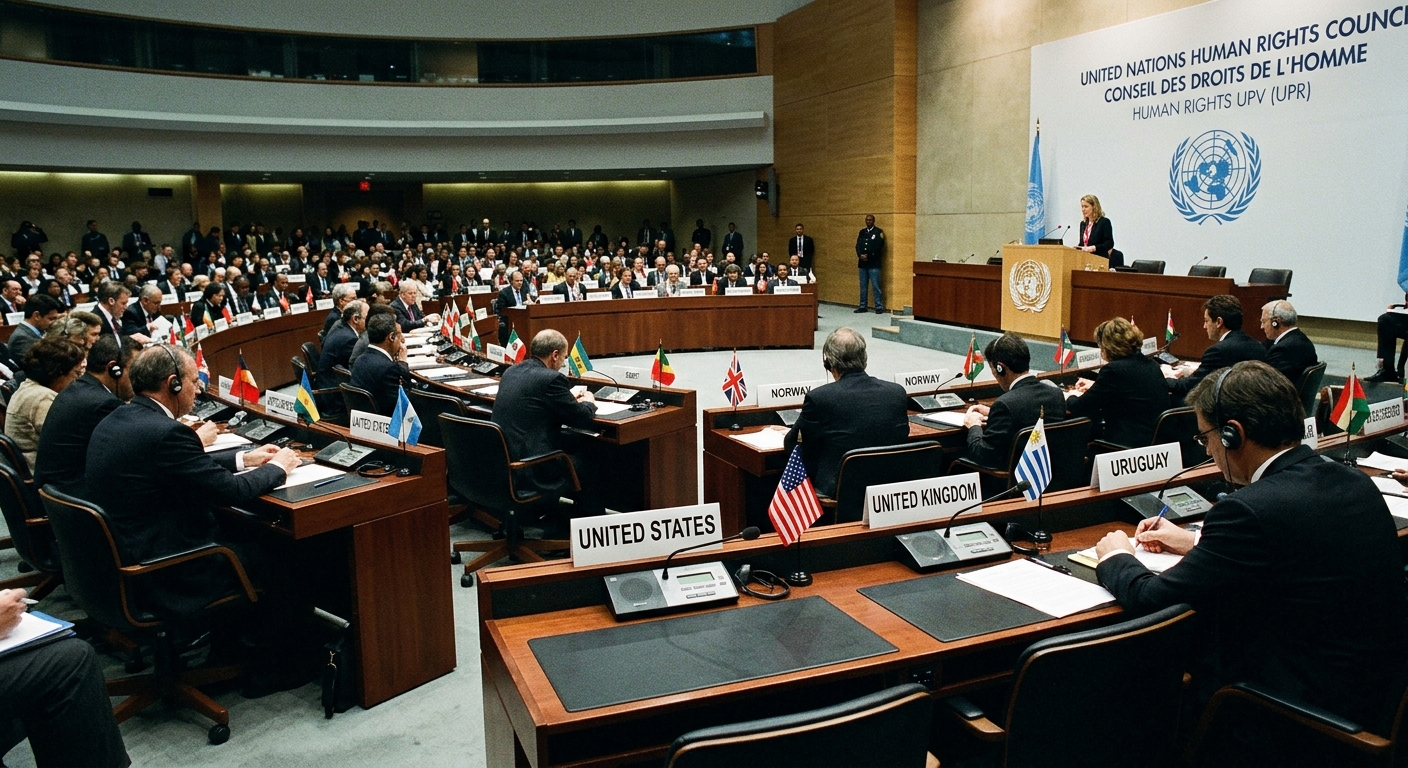
The United States has long positioned itself as a global beacon of democracy and a steadfast defender of civil liberties. However, a recent and unprecedented diplomatic withdrawal has cast a long, concerning shadow over that cultivated reputation. In early November 2025, the U.S. government made headlines not for its declarations, but for its absence, failing to appear for its scheduled peer review on its human rights record before the United Nations in Geneva, Switzerland. This diplomatic forum, known as the Universal Periodic Review (UPR), is a foundational element of international accountability, designed to hold every nation to the same standard of scrutiny. Yet, where the federal government stepped away, leaving empty chairs in the UN assembly hall, a robust coalition of civil rights advocates, legal experts, and non-governmental organizations aggressively stepped forward. These dedicated human rights defenders ensured that the world heard the unvarnished truth about the pressing, systemic issues within U.S. borders—particularly the silent crises affecting vulnerable children, marginalized families, and incarcerated youth.
Understanding the Universal Periodic Review: A Global Accountability Mechanism
To grasp the magnitude of the U.S. absence, one must first understand what the Universal Periodic Review entails. Established in 2006 by the United Nations General Assembly, the UPR is a unique, state-driven process managed by the Human Rights Council. Unlike treaties that only apply to the countries that ratify them, the UPR requires all 193 UN Member States to undergo a comprehensive peer review of their human rights records every four and a half years. The core philosophy of the UPR is universality and equal treatment; no nation, regardless of its economic power or military might, is exempt from the gaze of the international community.
The review process relies on a triad of crucial documents. First, the state under review submits a national report detailing its human rights advancements and challenges. Second, the Office of the UN High Commissioner for Human Rights (OHCHR) compiles information from independent UN experts and treaty bodies. Finally, a summary is created from reports submitted by “other stakeholders,” which crucially includes civil society organizations, national human rights institutions, and grassroots advocates. During a three-and-a-half-hour interactive dialogue in Geneva, other nations ask questions, highlight deficiencies, and issue formal recommendations for policy improvements. The objective is not merely to criticize, but to foster constructive dialogue and secure voluntary commitments to elevate human rights standards globally.
The Unprecedented Boycott and Its Diplomatic Fallout
When November 7, 2025, arrived, the scheduled UPR session for the United States became a stark symbol of diplomatic disengagement. The government’s refusal to participate marked an extraordinary departure from standard international cooperation. In response to the glaring absence, the UN Human Rights Council was forced to hold an organizational meeting to formally postpone the review, publicly expressing “regret” over the state’s non-cooperation.
The fallout from skipping the UPR extends far beyond a procedural hiccup in Geneva; it strikes at the core of the U.S.’s moral authority on the global stage. Historically, the U.S. has leveraged international platforms to condemn human rights abuses, authoritarian crackdowns, and unjust imprisonments in other nations. However, diplomatic experts argue that it becomes exceedingly difficult to demand accountability abroad when a nation refuses to subject its own domestic record to the same multilateral scrutiny. Furthermore, human rights defenders worry that this high-profile withdrawal provides a dangerous political cover for authoritarian regimes. If a leading democratic superpower actively ignores a UN oversight mechanism, it inadvertently signals to nations with egregious human rights records that they, too, can flout international norms without severe consequence.
Civil Society Steps In: The Shadow Review
In the vacuum left by federal representatives, American civil society refused to let the moment pass in silence. Advocates recognized that true accountability does not evaporate simply because official representatives refuse to participate. Coalitions of domestic activists, legal scholars, and child welfare advocates traveled to Geneva to host parallel events, widely referred to as “shadow reviews.”
Through panel discussions, detailed reports, and direct lobbying with international delegates, these organizations presented a sobering counter-narrative to the image of American exceptionalism. They specifically pivoted the conversation away from abstract foreign policy debates, focusing instead on the lived experiences of the most disenfranchised populations within the United States. Their central message was unequivocal: a society’s commitment to human rights is best measured by how it treats its most vulnerable citizens—its children.
Spotlight on Youth Justice: Warehousing the Future
One of the most alarming issues brought to the forefront by advocates in Geneva was the deeply flawed American juvenile justice system. Activists presented compelling, data-backed evidence highlighting the systemic inequities and harsh realities faced by incarcerated minors.
Recent statistics underscore a troubling trajectory in youth detention. According to data from the Office of Juvenile Justice and Delinquency Prevention (OJJDP), the number of youth held in residential placement facilities has seen a concerning resurgence, climbing from approximately 24,900 in 2021 to over 29,300 in 2023. Advocates argued passionately that these facilities frequently function as punitive warehouses rather than centers for rehabilitation and growth.
The conditions within many of these detention centers violate the spirit, if not the letter, of international human rights conventions. Advocates highlighted three major areas of concern:
- Mental Health Neglect: Many detained youths suffer from pre-existing trauma, which is severely exacerbated by a lack of access to adequate psychological care and therapeutic interventions.
- Racial Inequities: The U.S. juvenile justice system remains deeply skewed along racial lines. Black, Latino, and Indigenous youth are disproportionately arrested, detained, and subjected to harsher sentencing—including transfers to the adult criminal system—compared to their white counterparts.
- The Use of Isolation: The continued reliance on solitary confinement for minors remains a glaring human rights violation. International bodies frequently classify the prolonged isolation of adolescents as a form of psychological torture, yet the practice persists in numerous U.S. jurisdictions.
The “Family Policing” Crisis: When Welfare Becomes Surveillance
Equally prominent in the advocates’ presentations was a scathing critique of the U.S. child welfare system, a sprawling apparatus that civil rights lawyers increasingly refer to as the “family policing system.” The fundamental argument presented to the international community was that the U.S. too often conflates systemic poverty with child neglect, leading to the traumatic and unnecessary separation of families.
Rather than providing struggling households with the tangible resources they need to thrive—such as subsidized housing, food security, affordable childcare, or mental health support—the state’s default response is frequently punitive child removal. Research from the Department of Health and Human Services (HHS) consistently demonstrates that removing a child from their home and placing them in nonparental care is an Adverse Childhood Experience (ACE) that can severely disrupt cognitive development, emotional well-being, and long-term life outcomes.
Advocates used their platform in Geneva to highlight the systemic biases embedded in mandatory reporting laws, which disproportionately target low-income, minority families for state surveillance and intervention. The call to action was a demand for a radical paradigm shift: divesting funds from the mechanisms of family separation and reinvesting those resources directly into community-based support systems that preserve family unity and respect the fundamental human right to family life.
Beyond Children’s Rights: The Broader Landscape of Neglect
While child welfare and youth justice were central themes, the advocates’ shadow review also encompassed a broader spectrum of human rights deficiencies that the U.S. government evaded by boycotting the UPR. Representatives from various civil rights sectors highlighted ongoing crises, including the inhumane conditions within immigration detention centers and the devastating, long-term impacts of border policies that have historically separated migrant children from their parents.
Furthermore, activists raised alarms regarding the erosion of reproductive rights, the lack of federal mechanisms to ensure accountability for systemic police violence, and the continued marginalization of Indigenous communities. By bringing these issues to the UN, civil society ensured that the international record reflected the complex, multifaceted realities of human rights in modern America, rather than a sanitized official narrative.
The Path Forward: Sustaining Grassroots Pressure
The resilience demonstrated by civil rights advocates in Geneva proves that the pursuit of human rights accountability is not entirely dependent on the cooperation of the state. Moving forward, the momentum generated by these alternative UN sessions will serve as vital fuel for domestic action.
Advocates are strategically utilizing the international recommendations and solidarity garnered in Geneva to bolster local litigation, lobby for state-level legislative reforms, and elevate public consciousness. They are demanding an end to the criminalization of youth, a comprehensive overhaul of the family policing system, and the restoration of fundamental civil liberties. The mobilization of these groups serves as a powerful reminder: while governments may occasionally retreat from the international table, dedicated civil society actors will relentlessly ensure that the fight for human dignity remains squarely in the spotlight.
Frequently Asked Questions (FAQ)
What is the Universal Periodic Review (UPR)?
The Universal Periodic Review is a unique human rights mechanism established by the UN Human Rights Council in 2006. It requires all 193 UN Member States to undergo a peer review of their human rights records every four and a half years to ensure accountability and promote global human rights standards.
Why did the UN postpone the U.S. human rights review in 2025?
The UN Human Rights Council officially postponed the review because the United States government failed to appear for its scheduled session on November 7, 2025. The Council cited a “non-cooperation” from the state under review.
What is meant by the “family policing” system?
Civil rights advocates use the term “family policing” to describe the current child welfare system. They argue the system functions more like a surveillance and punitive apparatus that targets low-income and minority families, often separating children from their parents due to issues stemming from poverty rather than actual abuse.
How does the U.S. juvenile justice system conflict with international human rights?
Advocates point to several practices that violate international norms, including extreme racial disparities in arrests, the lack of adequate mental health care in detention, the transfer of minors to adult courts, and the use of solitary confinement, which international bodies often categorize as psychological torture.
Why does it matter if civil society attends the UN without the government?
When civil society organizations attend international forums, they provide critical, independent data that might otherwise be omitted from official government reports. Their presence ensures that the experiences of marginalized and vulnerable populations are documented and recognized by the international community, maintaining pressure for domestic reform.
References
- Basic facts about the UPR — Office of the United Nations High Commissioner for Human Rights (OHCHR). https://www.ohchr.org/en/hr-bodies/upr/basic-facts
- UN Human Rights Council reschedules US human rights review; regrets non-cooperation with UPR process — Office of the United Nations High Commissioner for Human Rights (OHCHR). 2025-11-10. https://www.ohchr.org/en/press-releases/2025/11/human-rights-council-reschedules-human-rights-review-united-states-america
- Trends and Characteristics of Youth in Residential Placement, 2023 — Office of Juvenile Justice and Delinquency Prevention (OJJDP), U.S. Department of Justice. 2025-09-01. https://ojjdp.ojp.gov/publications/trends-and-characteristics-of-youth-in-residential-placement-2023.pdf
- Children Living Apart from Their Parents: Highlights from the National Survey of Children in Nonparental Care — Office of the Assistant Secretary for Planning and Evaluation (ASPE), U.S. Department of Health and Human Services. https://aspe.hhs.gov/reports/children-living-apart-their-parents-highlights-national-survey-children-nonparental-care-0
Similar Articles








Read full bio of medha deb


