
Updating, Revoking, and Contesting a Will
Learn how to legally update, revoke, and challenge a will so your estate plan reflects your true wishes and remains enforceable.
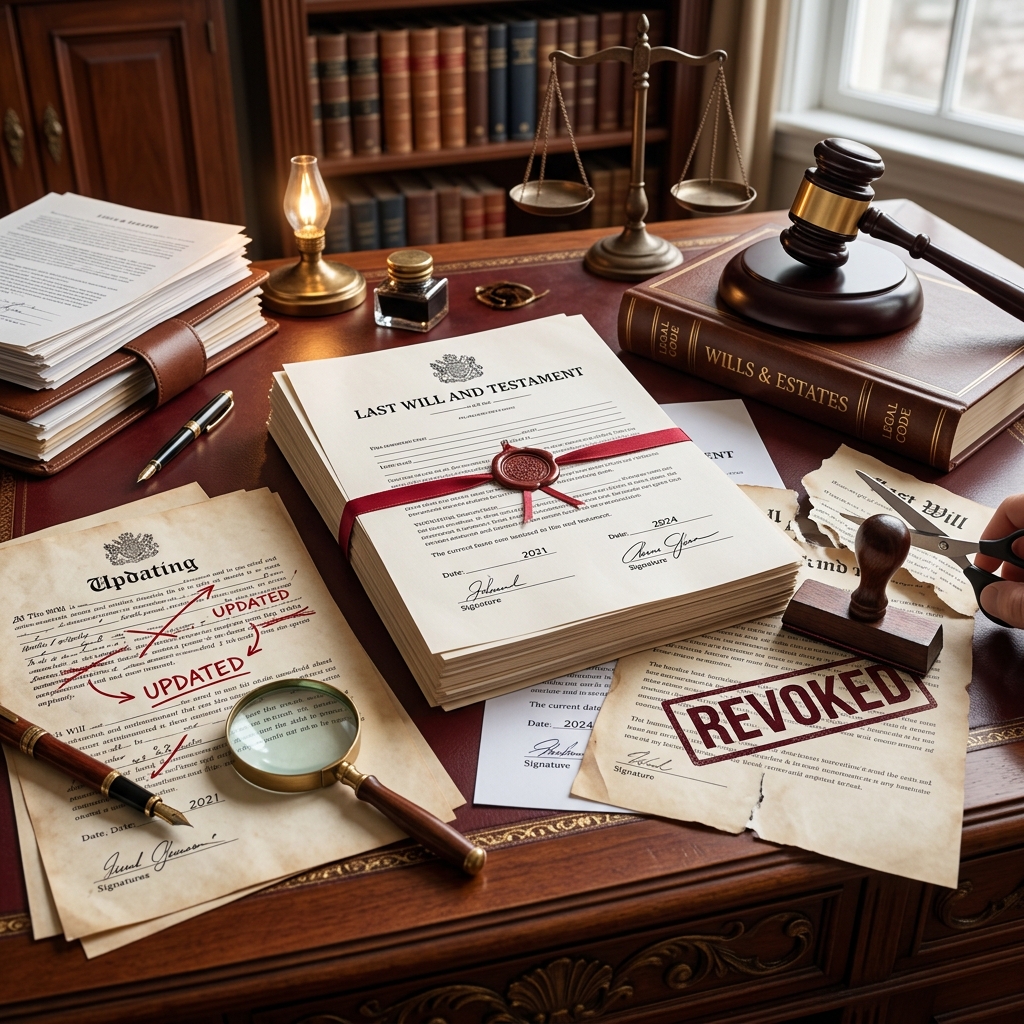
A will is not a static document. As your life changes, your estate plan should change with it. Understanding how to update, revoke, or even challenge a will is critical to making sure your property is distributed according to your real intentions and that your loved ones are not drawn into avoidable disputes.
This guide explains the main ways to change a will, when revocation is appropriate, how courts handle contested wills, and practical steps to keep your estate plan current and enforceable.
Why Wills Need Ongoing Attention
Many people sign a will and assume the job is done. In practice, major life events and law changes can make an old will misleading, unfair, or even partially invalid.
- Family changes: marriage, divorce, birth or adoption of children, or estrangement from relatives.
- Financial changes: selling a business, buying real estate, receiving an inheritance, or incurring significant debts.
- Legal changes: amendments to state probate law, recognition of electronic wills, or revisions to tax rules.
- Personal priorities: shifting charitable goals, new views on guardianship, or changing relationships with beneficiaries.
Failing to update a will after these events can leave gaps, create contradictory instructions, or unintentionally benefit people you no longer wish to include.
Key Ways to Change Your Estate Plan
There are three primary tools for adjusting an existing estate plan: creating a new will, adding a codicil, or using related estate planning documents such as trusts.
Creating a New Will
Drafting and signing a fresh will is often the most straightforward way to reflect your current wishes. In many jurisdictions, the most common method of revocation is simply signing a new will that clearly states it replaces all prior wills and codicils.
A carefully drafted new will should:
- Clearly identify you as the testator.
- Contain an explicit clause revoking “any and all prior wills and codicils”.
- Meet all formal execution requirements, such as signatures and witnesses, under your state’s law.
- Provide updated instructions for asset distribution, guardianship, and executor appointment.
Because a new will replaces the old plan entirely, it is an efficient option when you want broad changes or a fresh structure rather than small edits.
Using a Codicil for Targeted Changes
A codicil is a separate legal document used to amend rather than replace an existing will.
Codicils are useful when you wish to:
- Add or remove individual beneficiaries.
- Change specific bequests, such as a gift of a particular property.
- Update the person named as executor or guardian.
However, codicils must be executed with the same formalities as a will — typically requiring proper signatures and witnesses — and must clearly reference the original will they are changing.
Complex or repeated codicils can create confusion about which provisions control. Many practitioners therefore recommend drafting a comprehensive new will instead of layering multiple amendments.
Adjusting Your Plan Through Other Documents
Estate plans often include assets that pass outside of the will, such as:
- Beneficiary designations on life insurance or retirement accounts.
- Transfer-on-death or payable-on-death registrations for bank and brokerage accounts.
- Revocable living trusts controlling real estate or business interests.
Updating these documents can significantly reshape how your assets pass at death even if the text of your will remains unchanged. However, inconsistencies between non-probate transfers and will provisions can trigger disputes or challenges.
How Revocation of a Will Works
Revocation is the legal term for making a will no longer valid. It can occur intentionally through your actions or, in some situations, automatically under state law.
Intentional Revocation by a New Document
The safest and most common way to revoke a prior will is by signing a properly executed new will or formal written declaration that expressly revokes earlier documents.
Key points:
- Your new will should explicitly state that it revokes all earlier wills and codicils you have made.
- If the new will lacks an express revocation clause, prior wills may be revoked only to the extent they are inconsistent, which can create interpretive difficulties.
Revocation by Physical or Electronic Destruction
Most states recognize certain deliberate physical acts as valid revocation methods when performed by the testator (or by someone at the testator’s direction and in their presence) with the intent to revoke.
Common actions include:
- Burning, tearing, cutting, or mutilating the will.
- Canceling, obliterating, or defacing the document so it is clearly marked void.
- Destroying all original paper copies of the will.
For electronic wills, some states treat actions such as deleting, canceling, or rendering the electronic file unreadable as revocation, assuming it was done with the purpose of invalidating the will.
| Type of Will | Example Revocatory Acts | Key Condition |
|---|---|---|
| Paper will | Burning, tearing, or crossing out text; writing “void” across pages; destroying all originals. | Must be done with clear intent to revoke and typically by the testator. |
| Electronic will | Deleting the file, making it unreadable, or obliterating stored versions. | Act must be intentional and focused on invalidating the will. |
Importantly, accidental destruction — such as a house fire that burns the will — usually does not count as revocation unless other evidence shows it reflected your intent.
Revocation by Operation of Law
State statutes may automatically revoke a will or parts of it when specific events occur, even if you take no action.
- Divorce or annulment: In many states, provisions in favor of a former spouse or their family are revoked automatically.
- Marriage: Traditionally, marriage could revoke a will, though some jurisdictions are moving away from that rule to avoid unfair outcomes.
- Slayer statutes: If a beneficiary unlawfully kills the testator, statutes typically prevent them from inheriting.
- Inconsistent new documents: A new will or codicil with conflicting terms may revoke previous instructions to the extent of the inconsistency.
These automatic rules are designed to reflect typical expectations — for example, that people do not want ex-spouses to inherit — but they may not perfectly match your wishes. Confirming your plan through updated documents is still essential.
Practical Drafting Tips to Avoid Confusion
Because contested wills often arise from ambiguity or poor drafting rather than outright misconduct, clarity is a critical safeguard.
- Use explicit language in new wills or codicils to specify what is revoked, replaced, or added.
- Identify all related documents (prior wills, codicils, and trusts) that are being changed or superseded.
- Number and date pages of your will to help demonstrate that no pages are missing and to support authenticity if questions arise.
- Initial pages where appropriate to show your approval of the full document.
- Store copies wisely, ensuring that the most recent version is clearly labeled and accessible to your executor.
These steps do not replace legal formalities, but they significantly reduce the risk of conflicts among beneficiaries during probate.
When and How Wills Are Challenged
A will can be challenged in probate court by interested parties such as heirs, beneficiaries, or creditors. Challenges usually focus on whether the document is legally valid or accurately reflects the testator’s free and informed wishes.
Common Grounds for Contesting a Will
Although specific rules vary by jurisdiction, typical grounds for a will challenge include:
- Lack of testamentary capacity: The testator did not understand the nature of making a will, the extent of their property, or the identity of potential beneficiaries at the time of signing.
- Undue influence: Someone exerted pressure or manipulation that caused the testator to sign a will that does not reflect their independent judgment.
- Duress or coercion: The will was signed because of threats or wrongful acts, even if the testator understood the document.
- Fraud or forgery: The will or signature is fake, or the testator was misled about what they were signing.
- Failure to follow formalities: Missing signatures, improper witnessing, or other procedural defects required by state law.
- Conflicting wills: Multiple versions exist without clear revocation, leading to disputes about which one controls.
Role of Courts in Interpreting Conflicting Documents
When more than one will is presented, courts aim to enforce the testator’s final valid intentions. They will look at dates, explicit revocation clauses, and the degree of inconsistency between documents.
If a later will is partially consistent with an earlier one, courts may treat the older will as revoked only in areas where the two conflict. If the later will fully contradicts the earlier document, the older will may be considered entirely revoked.
Some law reform proposals suggest expanding courts’ powers to correct drafting errors or dispense with strict formalities in limited circumstances, especially where evidence of intent is strong and technical defects would otherwise defeat legitimate wishes.
Frequently Asked Questions
Does writing a new will automatically cancel my old one?
Often, but not always. To minimize uncertainty, your new will should contain a clear clause revoking all prior wills and codicils. Without that language, earlier documents may remain partially effective where not inconsistent.
Is tearing up my will enough to revoke it?
Physical destruction — such as tearing, burning, or obliterating the will — can revoke it if done intentionally by the testator or under their direct supervision. However, if other signed copies exist, courts in some states may still treat those copies as valid.
When should I use a codicil instead of a new will?
Codicils are suitable for limited, specific edits. If you are making multiple changes or revising the overall structure of your estate plan, a new will is generally clearer and less prone to misinterpretation.
Can my will be changed without my knowledge?
Valid changes to a will must comply with legal formalities and reflect the testator’s intent. Unauthorized alterations or forged documents can be challenged on grounds such as fraud, lack of capacity, or improper execution.
How often should I review my will?
A practical rule is to review your will after major life events and at least every few years. Regular reviews help ensure your plan remains accurate, consistent, and aligned with current law.
References
- Revoking, Challenging, or Changing a Will — FindLaw. 2023-06-01. https://www.findlaw.com/estate/wills/changes-revocation-challenges.html
- How to Legally Change or Revoke a Will — Justia. 2022-09-15. https://www.justia.com/estate-planning/wills/changing-or-revoking-a-will/
- Understanding Will Revocation: How Your Will Can Be Invalidated — Ball Morse Lowe. 2023-04-10. https://www.ballmorselowe.com/blog/understanding-will-revocation-how-your-will-can-be-invalidated
- Do New Wills Automatically Invalidate Your Previous One? — Diversified, LLC. 2023-05-22. https://diversifiedllc.com/how-to-retire/does-a-new-will-automatically-invalidate-your-previous-one/
- Six Ways to Challenge a Will’s Validity — Lord & Lindley. 2016-06-15. https://lordlindley.com/2016/06/15/six-ways-to-challenge-a-wills-validity/
- The Unique Challenge of Altering and Revoking Electronic Wills — Hull & Hull LLP. 2024-05-14. https://hullandhull.com/2024/05/the-unique-challenge-of-altering-and-revoking-electronic-wills/
- Reform of the Wills Act 1837: Proposed Changes, Possible Impact on Trusts, and Estates — WealthBriefing. 2017-07-19. https://www.wealthbriefing.com/html/article.php/-reform-of-the-wills-act-1837:-proposed-changes,-possible-impact-on-trusts,-and-estates
Similar Articles








Read full bio of Sneha Tete


