
Unpaid Internships: Employer Legal Guide And Compliance Tips
Understand when internships can be unpaid and what employers must do to stay compliant.
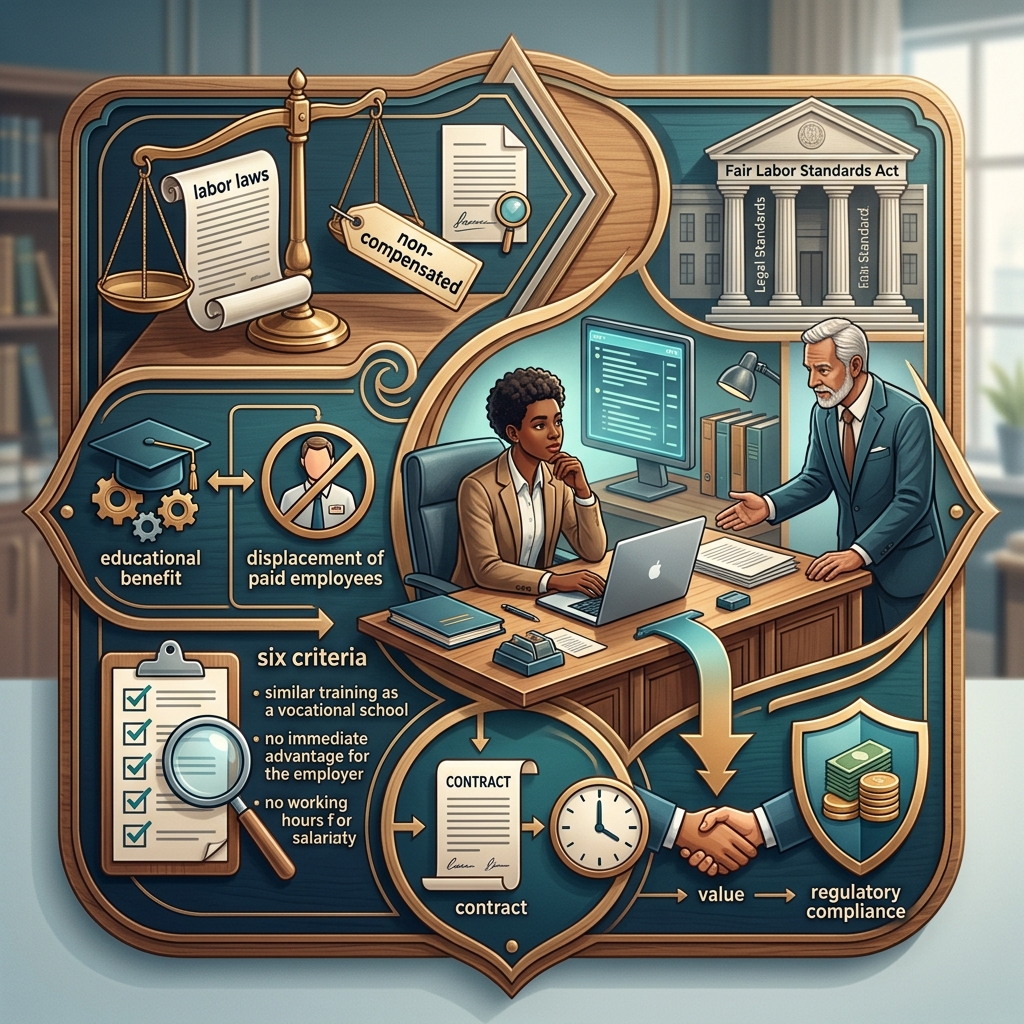
Unpaid internships can be lawful, but only in narrow circumstances. For private, for-profit employers, the central question is whether the intern is truly a trainee rather than an employee under the Fair Labor Standards Act (FLSA). If the arrangement looks like ordinary labor that mainly benefits the business, the intern is usually entitled to at least minimum wage and overtime pay.
This guide breaks down the core legal standards, explains how employers can evaluate an internship program, and highlights the practical risks of getting the classification wrong. It also covers the special treatment that may apply in the public sector and at nonprofit organizations.
When an internship can be unpaid
The basic rule is straightforward: a for-profit employer may not treat a worker as unpaid simply because the job is labeled an internship. The program must be structured so that the intern is the main beneficiary of the experience. Federal guidance focuses on whether the internship functions more like education and training than ordinary employment.
In practice, that means the employer should be able to show that the arrangement is designed to provide learning, supervision, and practical exposure rather than a substitute for paid labor. If the company receives the main operational benefit, the internship begins to look like a job.
- The internship must be educational in nature.
- The intern should gain the primary benefit from the arrangement.
- The employer should not use the intern to replace regular staff.
- The business should not depend on the intern to meet normal workload demands.
The legal test employers use
Federal wage-and-hour guidance uses a multi-factor analysis to determine whether an internship may be unpaid. No single factor controls the outcome. Instead, the full arrangement is examined to see who benefits most and whether the intern is effectively working as an employee.
Although courts and agencies have refined the analysis over time, the core ideas remain consistent. Employers should pay close attention to the educational structure, the lack of wage promises, the absence of job guarantees, and the extent to which the intern’s tasks are supervised and limited.
| Factor | What it means in practice |
|---|---|
| Training-like experience | The internship should resemble instruction, mentoring, or hands-on learning rather than routine labor. |
| Benefit to the intern | The intern should receive real educational value, skill development, or academic relevance. |
| No displacement of employees | The intern should not take the place of paid staff or fill staffing gaps. |
| No immediate employer advantage | The company should not rely on the intern to generate revenue or keep operations running normally. |
| No promise of a job | The intern should understand that the internship does not guarantee future employment. |
| No wage expectation | Both sides should clearly understand that the internship is unpaid. |
When most of these indicators point toward employment rather than education, the law typically treats the intern as a worker who must be paid.
Why supervision matters
Close supervision is one of the clearest signs that an internship is designed for learning. If interns work independently, manage core responsibilities, or operate with the same level of autonomy as employees, the program may not qualify as unpaid. Supervision demonstrates that the organization is investing time in instruction instead of simply extracting labor.
Good supervision also helps employers document what the intern is learning. Regular check-ins, assigned mentors, written learning objectives, and periodic feedback sessions can all support the educational purpose of the program.
- Assign a named supervisor or mentor.
- Use written training goals and task plans.
- Provide feedback on performance and learning progress.
- Limit the intern’s responsibility for mission-critical work.
Educational value versus business value
A lawful unpaid internship should be built around the intern’s educational experience, not the employer’s staffing needs. That does not mean the employer gains nothing at all. Some incidental benefit is unavoidable when an intern participates in real workplace activities. The key issue is whether the company is obtaining an immediate operational advantage that looks like paid labor.
For example, if an intern shadows staff, completes assigned training projects, or rotates through departments to learn how the business operates, the arrangement is more likely to be lawful. If the intern is scheduled to cover shifts, complete production quotas, or handle regular customer volume, the arrangement is more likely to be treated as employment.
Academic connection and timing
Many lawful unpaid internships are connected to a formal education program. That connection can include academic credit, coursework integration, or a structure that fits the student’s school schedule. While academic credit alone does not automatically make an internship lawful, it is often an important sign that the position is educational rather than purely commercial.
Employers should also consider whether the internship aligns with the student’s academic calendar and other educational commitments. A program that demands a standard employee schedule, ignores class obligations, or runs for an open-ended period can create compliance problems.
Written agreements and clear expectations
Clear documentation is one of the simplest ways to reduce risk. The intern and the employer should both understand, in writing, that there is no expectation of wages and no promise of a job at the end of the program. Written terms cannot override the law, but they can help show that the relationship was intended as a bona fide internship rather than hidden employment.
An effective internship agreement usually spells out the learning goals, duration, supervision structure, duties, and compensation status. It should also explain that the intern will not replace regular employees and that the company may adjust duties to preserve the educational purpose.
- State plainly that the internship is unpaid.
- Describe the learning objectives.
- Identify the supervisor and reporting structure.
- Confirm that no job offer is guaranteed.
Public sector and nonprofit internships
The rules can differ outside the for-profit private sector. Public agencies and qualifying nonprofit organizations may have more flexibility because interns may be treated as volunteers in certain settings. Even so, employers should not assume that a nonprofit label automatically removes wage obligations. The nature of the work, the expectations of the parties, and the applicable legal framework still matter.
Organizations in these sectors should review the duties carefully and avoid using volunteers or interns in ways that resemble normal paid employment. When in doubt, the safest approach is to treat the position as paid unless legal guidance confirms an unpaid structure is appropriate.
Common mistakes that create liability
Many employers run into trouble by using interns as low-cost staff. That mistake can trigger back pay, overtime liability, and penalties. Misclassification also creates reputational risk and can damage recruiting efforts if students or schools view the program as exploitative.
Typical errors include having interns cover routine administrative work, filling temporary staffing shortages with unpaid labor, letting interns work without meaningful training, or failing to explain the unpaid nature of the role up front. Another common problem is using interns as a long-term trial period for possible hires.
- Do not assign interns the same workload as entry-level employees.
- Do not use interns to handle tasks the company would otherwise pay staff to perform.
- Do not rely on interns to keep projects on schedule without supervision.
- Do not promise future employment as an incentive to accept unpaid work.
What happens if the internship does not qualify
If the arrangement fails the legal test, the intern is likely an employee under wage-and-hour law. That means the employer may owe minimum wage and overtime for hours worked over 40 in a workweek, along with any other required protections that apply to employees. The label used by the company does not control the outcome if the actual facts show employment.
This is why employers should review internship programs before launch, not after complaints arise. Retroactive wage claims can be expensive, especially if multiple interns were involved or if the program operated over several terms.
Best practices for a compliant internship program
Employers can reduce legal risk by designing internships around education, documentation, and limited responsibility. A compliant program should teach, observe, and guide rather than depend on unpaid workers for operational output.
Practical steps include setting a fixed duration, defining a curriculum-like learning plan, ensuring close supervision, and keeping the intern away from work that simply replaces staff. Employers should also review state wage laws, since some states impose stricter standards than federal law.
- Create a written internship plan before the start date.
- Train supervisors on what interns may and may not do.
- Audit duties regularly to make sure they remain educational.
- Keep records showing supervision, training, and feedback.
Frequently asked questions
Can an intern work for free if they want experience?
Not automatically. A person’s willingness to work without pay does not by itself make the arrangement legal. The internship still has to meet the legal standards that distinguish trainees from employees.
Does offering college credit make an internship lawful?
No. Academic credit can support the educational nature of the internship, but it does not replace the legal requirement that the arrangement primarily benefit the intern and not the employer.
Can an unpaid intern do productive work?
Some productive work may occur, but the employer should not receive the primary benefit. If the intern is filling a staffing role or producing work the company depends on, the position may need to be paid.
Is a written agreement enough to make an internship unpaid?
No. A written agreement helps document intent, but the actual day-to-day facts control. If the intern functions like an employee, wages may still be required.
Should employers always pay interns to be safe?
Paying interns is often the simplest risk-management strategy, especially for for-profit businesses. A paid structure avoids much of the uncertainty surrounding unpaid internship classification and can broaden access to talent.
Why the issue matters for employers and students
Internships are valuable when they provide real training and a path into a profession. They are problematic when they shift ordinary labor costs onto students or new entrants to the workforce. A well-designed program can support both workforce development and legal compliance, but only if the employer keeps the educational purpose at the center of the arrangement.
For businesses, the safest internship programs are the ones that look and function like structured learning experiences. For students, the most useful internships are those that offer genuine mentoring, relevant exposure, and fair treatment rather than unpaid labor dressed up as opportunity.
References
- Fact Sheet #71: Internship Programs Under the Fair Labor Standards Act — U.S. Department of Labor, Wage and Hour Division. 2018-01-01. https://www.dol.gov/agencies/whd/fact-sheets/71-flsa-internships
- Wage and Hour Division Fact Sheet on Internships — U.S. Department of Labor. 2018-01-01. https://www.dol.gov/agencies/whd/fact-sheets/71-flsa-internships
- Internship Programs Under the Fair Labor Standards Act — University of California, Davis. 2018-01-01. https://siss.ucdavis.edu/sites/g/files/dgvnsk631/files/inline-files/InternshipProgramsUndertheFairLaborStandardsAct_0.pdf
- Fair Labor Standards Act (FLSA) — Kean University. 2024-01-01. https://www.kean.edu/career-services/internships-and-experiential-learning/fair-labor-standards-act-flsa
- Unpaid Internships: What Employers Need to Know — SHRM. 2024-01-01. https://www.shrm.org/topics-tools/news/talent-acquisition/unpaid-internships-employers-need-to-know
Similar Articles








Read full bio of Sneha Tete




