
Understanding Workers’ Compensation Benefits and Claims
A practical, in-depth guide to workers’ compensation benefits, eligibility, and the claims process for injured employees.
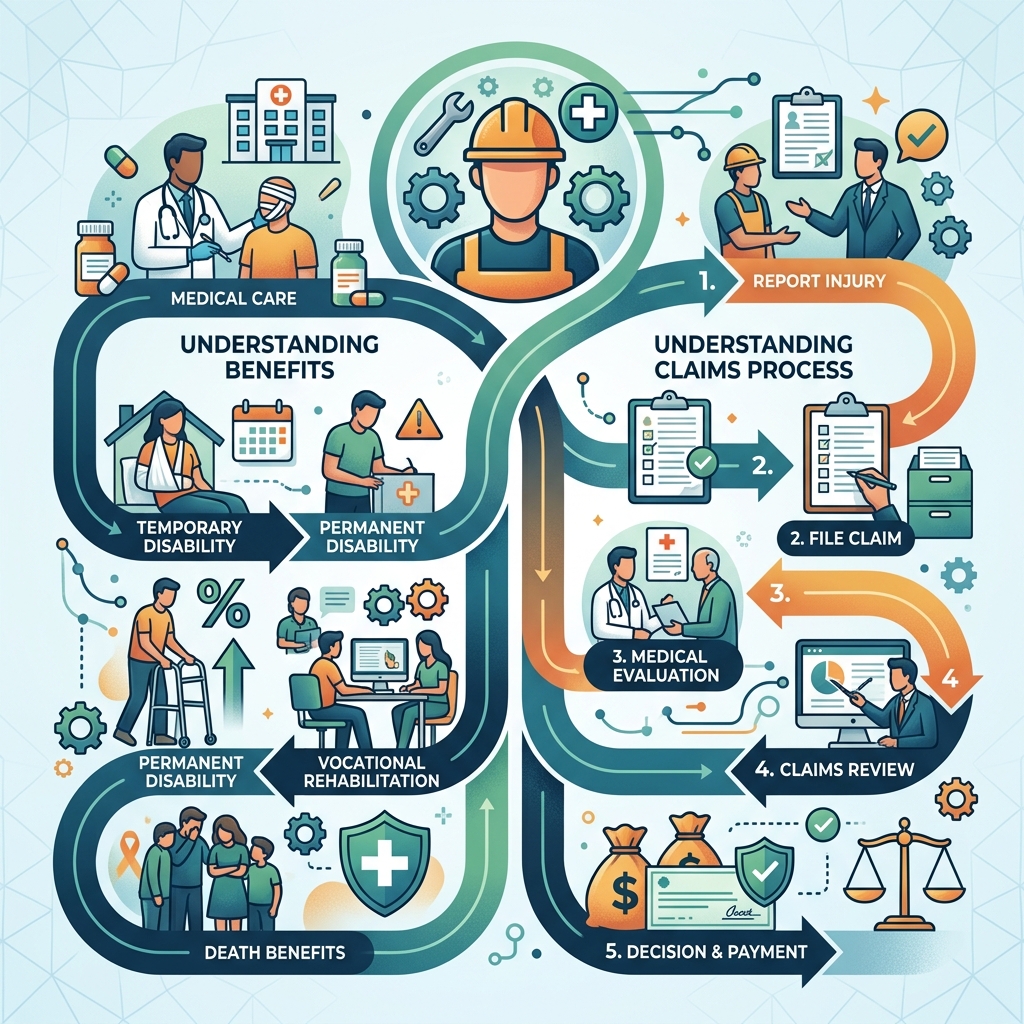
Workers’ compensation is a cornerstone of modern employment law, designed to support employees who suffer injuries or illnesses because of their job while limiting costly litigation between workers and employers. In the United States, this system is largely created and managed at the state level, with several specialized federal programs covering particular groups of workers. Although rules vary by jurisdiction, the core idea is the same: provide no-fault benefits such as medical care and wage replacement when a worker is hurt on the job.
What Workers’ Compensation Is and Why It Exists
Workers’ compensation is a legally mandated insurance-type system that offers financial and medical benefits to employees who are injured or become ill due to their work. Instead of requiring workers to prove their employer’s negligence in court, the system generally operates on a no-fault basis: if the injury is work-related and the worker is covered, benefits are paid regardless of who caused the incident.
This structure serves several important purposes:
- Protect injured workers by ensuring timely access to medical treatment and income support.
- Reduce litigation by replacing many personal injury lawsuits with a standardized benefit system.
- Provide predictability for employers and insurers through clear rules and fixed benefit formulas.
- Support dependents of workers who die from work-related causes, through death benefits and funeral cost coverage.
Historically, workers’ compensation laws were adopted in the United States in the early twentieth century, modeled on European systems, to address the growing number of industrial accidents in a fair and efficient manner.
Who Is Covered by Workers’ Compensation?
Most employees in the United States are covered by a workers’ compensation system, but the exact coverage rules depend on state law and the nature of the employment. In general, employers either purchase workers’ compensation insurance or qualify to self-insure, and this coverage applies to eligible workers.
Typical Categories of Covered Workers
- Private-sector employees in most industries, subject to state law requirements.
- State and local government employees, usually covered by state statutes.
- Federal workers and certain specialized occupations (e.g., maritime workers, coal miners, energy workers) covered by federal programs administered by the U.S. Department of Labor.
The U.S. Department of Labor’s Office of Workers’ Compensation Programs manages four major federal programs, including compensation for federal employees and longshore and harbor workers. Individuals employed by private companies or local governments typically fall under their state’s workers’ compensation system and must contact the relevant state board or agency for assistance.
Workers Who May Not Be Automatically Covered
Certain groups may have limited or different coverage, depending on state law:
- Some independent contractors, freelancers, or gig workers, if they are legally classified as non-employees.
- Very small employers in jurisdictions that exempt businesses below a certain size from compulsory coverage.
- Specific categories such as agricultural workers or domestic workers, depending on the state.
Because coverage rules vary widely, workers should confirm whether they are treated as employees and whether their employer carries workers’ compensation insurance under applicable state or federal law.
Key Types of Workers’ Compensation Benefits
Although the details differ by jurisdiction, most workers’ compensation systems provide a similar package of benefits addressing medical needs, income support, and long-term disability.
Common Benefit Categories
| Benefit Type | Purpose | Typical Features |
|---|---|---|
| Medical care | Cover treatment for work-related injuries and illnesses. | Includes doctor visits, hospital care, medication, surgery, and related costs. |
| Wage replacement | Replace lost income during periods of disability. | Often pays a percentage of average weekly wages, commonly around two-thirds, up to statutory limits. |
| Temporary disability benefits | Support workers who are temporarily unable to work. | Paid while the worker recovers and is unable to perform job duties. |
| Permanent disability benefits | Compensate for lasting impairments. | Lump-sum or ongoing payments based on the degree of permanent disability. |
| Vocational rehabilitation | Help injured workers return to suitable employment. | Job training, counseling, or assistance with job placement when returning to the same job is not possible. |
| Death benefits | Provide support to dependents of workers who die from work-related causes. | Includes survivor payments and funeral expenses. |
In addition, many systems distinguish between impairment (a medical assessment of loss of function) and disability (a legal determination of the worker’s reduced ability to work), which affects the amount and duration of benefits.
What Counts as a Work-Related Injury or Illness?
For a claim to be covered, the injury or illness generally must arise out of and occur during the course of employment. State statutes and case law define these terms, but some recurring examples illustrate the concept.
Examples of Covered Situations
- Injuries from accidents at the workplace, such as falls, equipment malfunctions, or collisions.
- Occupational illnesses linked to exposures on the job, such as respiratory diseases or certain cancers.
- Repetitive stress injuries related to job tasks, such as carpal tunnel syndrome.
- Aggravation of pre-existing conditions when work substantially contributes to the worsening.
Some categories of exposure, such as coal workers’ pneumoconiosis (“black lung”), are treated under specialized statutes and federal programs. The key question is usually whether the employment materially contributed to the injury or disease under the applicable legal standard.
Situations Where Coverage May Be Disputed
- Injuries occurring off-site or during commuting, unless the worker was on a special work assignment.
- Incidents involving serious misconduct, intoxication, or intentional self-harm.
- Conditions that cannot be reliably linked to workplace exposure.
Because the definitions and exceptions vary, disputes about whether an injury is work-related are common and may require evidence from medical professionals, employers, and witnesses.
How the Workers’ Compensation Claims Process Typically Works
Every jurisdiction has its own procedural rules, but most workers’ compensation claims follow a predictable sequence of steps from the moment of injury through benefit payments and possible appeals.
Core Steps After a Workplace Injury
- Seek immediate medical care. The injured worker should obtain prompt treatment and inform the health care provider that the injury is work-related.
- Notify the employer. Workers are usually required to report the injury to a supervisor or designated representative within a specified timeframe, often within days.
- File a claim with the appropriate agency. The worker (or their representative) typically submits a formal claim to the state workers’ compensation board or relevant federal program within statutory deadlines.
- Employer reporting. Employers generally must report the injury to their insurer and to the state or federal program according to statutory timelines.
- Insurer or program review. The insurance carrier or agency evaluates the claim, requests documentation, and determines eligibility and benefit levels.
- Benefit payments. If the claim is accepted, wage replacement and medical benefits are paid in accordance with program rules, often at regular intervals.
State boards and federal agencies exist to oversee the process, assist with disputes, and ensure compliance with legal requirements. In some jurisdictions, specialized administrative boards handle most claims, while in others cases go directly to courts with agency assistance.
Documentation That Strengthens a Claim
- Accurate incident reports detailing how, when, and where the injury occurred.
- Medical records describing diagnosis, treatment, and work limitations.
- Witness statements, if the injury was observed by co-workers or supervisors.
- Employment records showing job duties, work schedule, and wages.
Keeping organized records and meeting deadlines is critical, as late or incomplete filings can lead to delays or denials.
Employer Responsibilities and Legal Protections
Workers’ compensation is financed primarily by employers, either through insurance premiums or self-insurance mechanisms. In exchange for funding the system, employers typically receive important legal protections.
Employer Obligations
- Maintain required coverage: Many states mandate that employers carry workers’ compensation insurance once they have a certain number of employees.
- Report injuries promptly: Employers must notify their insurer and, in many cases, the state board when a worker is injured.
- Cooperate with claims investigations: Providing wage data, job descriptions, and incident information to the insurer or agency.
- Facilitate return-to-work: When feasible, offering modified duties or accommodations consistent with medical restrictions.
Failure to comply with coverage requirements can expose employers to fines, penalties, and potential civil liability outside the workers’ compensation system.
The Exclusive Remedy Principle
In many jurisdictions, workers’ compensation functions as the exclusive remedy for covered workplace injuries, meaning that workers generally cannot sue their employers in tort for these injuries. This trade-off balances interests:
- Workers receive predictable, quicker benefits without needing to prove negligence.
- Employers gain relief from many personal injury lawsuits related to workplace accidents.
However, workers may still pursue claims against third parties whose actions contributed to the injury, such as manufacturers of defective equipment, subject to reimbursement rules for benefits already paid.
When Claims Are Denied or Disputed
Not every workers’ compensation claim is accepted. Disputes commonly arise over whether an injury is work-related, the extent of disability, or the appropriate level of benefits. Each system provides procedures for resolving disagreements.
Frequent Reasons for Claim Denials
- Insufficient evidence that the injury occurred on the job.
- Failure to report the injury or file required forms within statutory deadlines.
- Disagreement over medical causation or the degree of impairment.
- Questions about whether the worker is covered under the law (e.g., independent contractor vs. employee).
Appeals and Hearings
Workers who disagree with a denial or partial award usually have the right to request a hearing before an administrative judge or board. The process can involve:
- Submission of additional medical reports or expert testimony.
- Presentation of witness evidence regarding the incident and job duties.
- Legal arguments concerning the interpretation of statutes and regulations.
In some states, decisions from administrative bodies can be appealed to higher courts for further review. Given the complexity of these disputes, workers and employers often seek legal assistance.
Practical Tips for Injured Workers
While the legal structure of workers’ compensation may appear complicated, injured workers can take practical steps to protect their rights and improve the outcome of their claim.
- Act quickly: Report the injury and seek medical treatment as soon as possible, following state-specific deadlines.
- Be honest and detailed: Provide accurate information about how the injury happened and all symptoms you experience.
- Follow medical advice: Comply with recommended treatment plans and attend scheduled appointments.
- Keep records: Maintain copies of all forms, correspondence, and medical documents related to the injury.
- Understand your benefits: Ask your insurer or agency to explain what benefits are available and how they are calculated.
- Seek help when needed: Contact your state workers’ compensation board, a legal aid organization, or a qualified attorney if you face a dispute or confusion.
Frequently Asked Questions (FAQs)
1. Do I have to prove my employer was at fault to get workers’ compensation?
Generally, no. Workers’ compensation systems are designed as no-fault schemes, meaning benefits can be paid without proving employer negligence, as long as the injury is work-related and covered by the law.
2. Can I sue my employer instead of filing a workers’ compensation claim?
In most cases, workers’ compensation is the exclusive remedy for job-related injuries, so you cannot sue your employer in tort for those injuries. However, you may be able to file a claim against third parties who contributed to the incident, such as manufacturers of defective equipment, subject to reimbursement rules for benefits paid.
3. What if I am an independent contractor?
Workers’ compensation generally covers employees, not independent contractors, though the exact classification rules vary by state. If you are uncertain about your status, you may need to review local law, your work arrangement, and possibly seek legal advice.
4. How much of my wages will workers’ compensation replace?
Benefit formulas differ by jurisdiction, but temporary disability payments often replace a portion of your average wage, commonly around two-thirds, subject to minimums and maximums set by statute.
5. What should I do if my claim is denied?
You typically have the right to contest the denial by requesting a hearing or filing an appeal with the appropriate board or court. Review the denial letter carefully, gather supporting medical and factual evidence, and consider obtaining professional assistance.
6. Are occupational diseases treated differently from accidents?
Many workers’ compensation laws explicitly cover occupational diseases and provide special rules for proving causation. Some conditions, such as black lung disease among coal miners, are addressed through dedicated federal programs.
References
- Workers’ Compensation (United States) — Various authors. Last updated 2024-02-10. https://en.wikipedia.org/wiki/Workers%27_compensation_(United_States)
- A Brief History of Workers’ Compensation — Burton JF. 2007-05-01. https://pmc.ncbi.nlm.nih.gov/articles/PMC1888620/
- Workers’ Compensation: What Is It & How Does It Work? — Tulane University Law School. 2022-09-15. https://online.law.tulane.edu/blog/what-is-workers-compensation
- Workers’ Compensation — U.S. Department of Labor, Office of Workers’ Compensation Programs. 2023-08-10. https://www.dol.gov/general/topic/workcomp
- Workers’ Compensation — Legal Information Institute, Cornell Law School. Last updated 2021-11-05. https://www.law.cornell.edu/wex/workers_compensation
- Workers’ Compensation: Overview and Issues — Congressional Research Service. 2016-08-25. https://www.congress.gov/crs-product/R44580
- History of Workers’ Compensation Insurance — The Hartford. 2020-06-01. https://www.thehartford.com/workers-compensation/history
Similar Articles








Read full bio of Sneha Tete




