
Understanding West Virginia Child Support Guidelines
A practical guide to how West Virginia calculates, orders, and enforces child support under its income‑shares model.
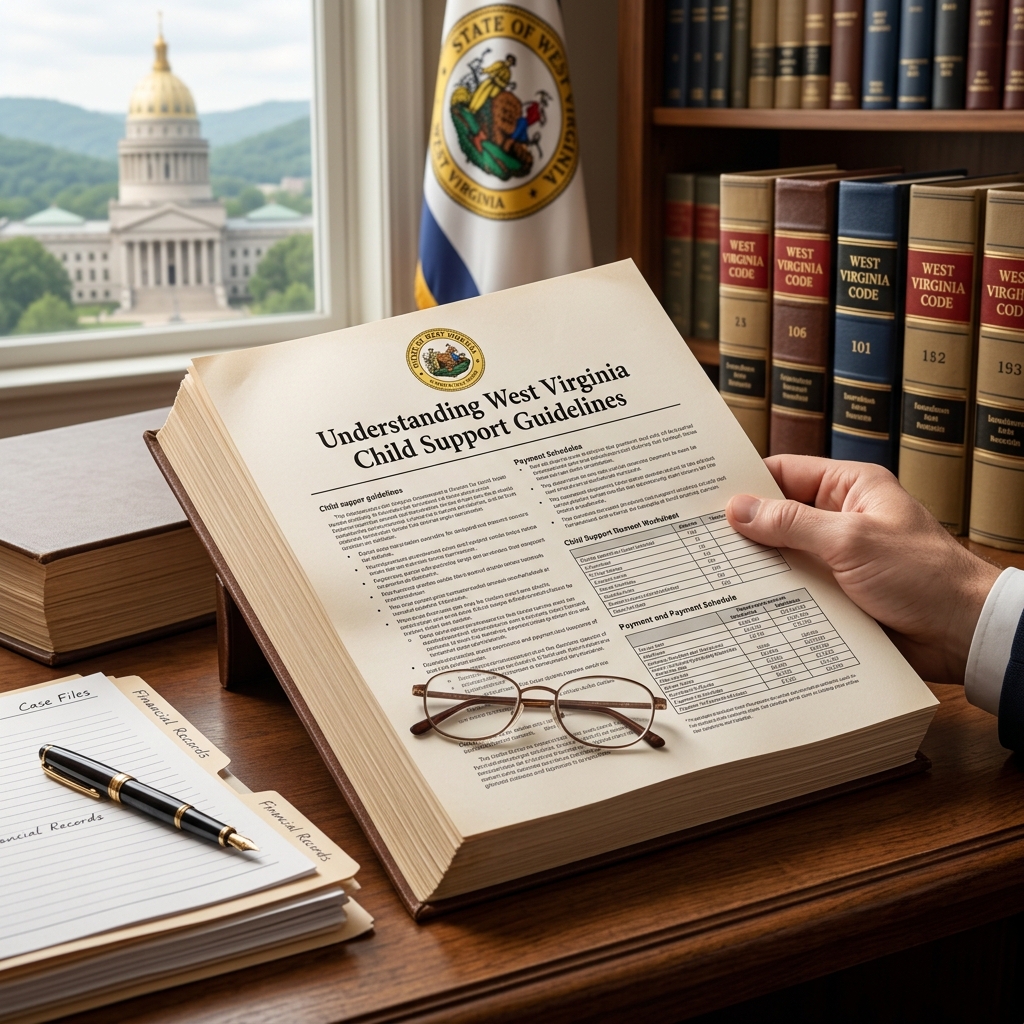
West Virginia law requires both parents to contribute financially to the support of their children, regardless of whether they are married, divorced, or were never in a formal relationship. The state uses a standardized set of child support guidelines so that similar families are treated consistently and children receive a predictable level of support.
This article explains how West Virginia calculates child support, how parenting time affects the amount, what role the Bureau for Child Support Enforcement (BCSE) plays, and the enforcement tools available when payments are not made. It is an informational overview, not legal advice.
Core Principles of Child Support in West Virginia
West Virginia’s child support rules are built on several core principles drawn from state statutes and administrative practice.
- Shared responsibility: Both parents have a legal duty to support their children, based on their ability to pay.
- Income-based support: Support is calculated primarily from the parents’ incomes and certain child-related expenses.
- Best interests of the child: Courts aim to protect the child’s financial well-being and maintain a reasonable standard of living.
- Uniformity and predictability: Statutory guidelines and schedules are designed to make outcomes more consistent statewide.
- Administrative enforcement: The BCSE has broad powers to collect and enforce child support obligations.
How Child Support Cases Begin
A child support order can be established in several ways, all of which ultimately rely on West Virginia’s statutory guidelines.
- As part of a divorce or separation case in family court, where support is decided alongside custody and property matters.
- Through a BCSE application, which allows parents or other caretakers to request administrative establishment and enforcement of support.
- By the state when a child receives certain public assistance; BCSE will typically pursue support from the noncustodial parent.
Under West Virginia law, any of the following may file or request support:
- Custodial parent
- Primary caretaker
- Guardian of the child’s property
- BCSE, acting on behalf of the state
The Income Shares Support Formula
West Virginia uses the Income Shares Support Formula to set the child support amount. This approach is intended to approximate what parents would have spent on their children if they lived together, then divide that cost according to their respective incomes.
Key Factors Used in the Formula
According to the BCSE and state statutes, the formula considers multiple factors related to the child and the parents.
- Gross income of both parents, before allowable deductions.
- Number of children in the case.
- Other children each parent supports or pays child support for.
- Parenting time and the percentage of overnights with each parent.
- Specific child-related expenses, such as child care and health insurance premiums.
- Extraordinary circumstances, like unusual medical or educational costs.
BCSE sends a financial form to both parents to collect this information; if a parent does not respond, BCSE may rely on employer data, tax records, or other sources to estimate income.
Basic vs. Extended Shared Parenting Plans
West Virginia guidelines distinguish between two broad parenting arrangements, because each affects how costs are split between households.
| Parenting Plan Type | Custody Threshold | General Effect on Support |
|---|---|---|
| Basic shared parenting | One parent has less than 35% of custodial time. | Noncustodial parent typically pays a higher share of cash support; custodial parent covers more day‑to‑day expenses. |
| Extended shared parenting | Each parent has at least 35% of custodial time. | Support is adjusted to reflect that both households incur substantial child‑related costs. |
The court uses the statutory guidelines and schedules to determine a presumptively correct support amount for each arrangement.
Understanding Income and Allowable Deductions
The starting point for any calculation is each parent’s gross income, which includes most types of earnings and unearned income. From this amount, certain deductions are permitted before the final support figure is calculated.
What Counts as Gross Income
Under West Virginia guidelines, gross income generally includes:
- Wages, salaries, tips, and commissions
- Self‑employment income and business profits
- Bonuses and overtime pay
- Interest, dividends, and investment income
- Some forms of public benefits or retirement income, subject to statutory rules
Courts can also consider potential earning capacity if a parent is underemployed or voluntarily unemployed, particularly where that affects the child’s support.
Common Deductions and Adjustments
Not all expenses are deductible, but West Virginia guidelines allow certain adjustments to reflect real financial obligations.
- Student loan payments that meet specified criteria, which may be deducted from income.
- Support paid for other children, where legally established.
- Health insurance premiums specifically attributable to the child.
- Work‑related child care costs necessary for a parent to maintain employment.
- Extraordinary medical or educational expenses approved by the court.
The court or BCSE will review documentation such as tax returns, pay stubs, and receipts to verify these figures.
Using the Child Support Schedule
Once adjusted incomes are determined, the court refers to a statutory schedule of basic child support obligations set out in the West Virginia Code.
- The schedule lists a baseline monthly support amount for different combined income levels and numbers of children.
- This basic amount represents typical child costs before adding health care, child care, or other specific expenses.
- Each parent’s share of the total is then allocated according to their percentage of combined income.
The resulting figure is presumed correct under state law, but judges may deviate when strict application of the guidelines would be unfair or not in the child’s best interests.
Additional Child‑Related Costs
In many cases, the basic amount from the schedule is only part of the overall support calculation. Courts and BCSE frequently add specific child‑related costs to the obligation.
Typical Add‑Ons
- Health insurance premiums for the child, whether paid by the custodial or noncustodial parent.
- Out‑of‑pocket medical expenses, especially recurring or extraordinary costs not covered by insurance.
- Work‑related child care such as daycare or after‑school programs that allow a parent to work or attend training.
- Educational expenses beyond normal school costs, if the parents or court agree to include them.
These amounts may be divided in proportion to each parent’s income or assigned in another way the court finds equitable.
The Role of the West Virginia BCSE
The West Virginia Bureau for Child Support Enforcement is the primary state agency responsible for establishing, monitoring, and enforcing child support orders.
- Collects financial information and applies the income shares formula.
- Helps establish paternity where necessary to create a support obligation.
- Issues and processes income withholding orders so payments flow directly from wages.
- Pursues enforcement actions when obligors fall behind on payments.
Parents may work directly with BCSE or, in some cases, bring enforcement motions in family court alongside BCSE efforts.
Enforcement Tools for Unpaid Support
When a parent (the obligor) fails to pay the ordered amount, West Virginia law authorizes a range of enforcement mechanisms.
Common Enforcement Methods
- Wage garnishment and income withholding: Support is automatically taken from the obligor’s earnings; additional garnishment can be requested to address arrears.
- Interception of tax refunds: State or federal income tax refunds can be seized to pay overdue support.
- Seizure of lottery winnings: Lottery payouts may be redirected to cover arrears.
- Liens on real and personal property: Legal claims can be placed on homes, vehicles, or other assets.
- Credit reporting: Overdue amounts may be reported to credit bureaus.
- License suspension: Professional or driver’s licenses can be suspended when arrears meet statutory thresholds.
- Civil contempt: Courts may hold an obligor in contempt, with possible fines or incarceration for willful non‑payment.
- Criminal charges: In serious cases, prosecutors may pursue criminal non‑support.
Each missed payment typically becomes a separate, enforceable judgment under state law, making it difficult to escape long‑term non‑payment.
Duration and Modification of Support Orders
Support orders do not last forever, but they remain in effect until legally changed or terminated by the court.
How Long Support Usually Lasts
- Support normally continues until the child turns 18 years old.
- A court may extend support up to age 20 in certain circumstances, such as continued schooling.
- If an order specifies a separate amount per child, a parent may stop paying for a child who is no longer eligible; otherwise, the total continues until the order is modified.
Changing the Amount of Support
Either parent can request a review and modification when circumstances change significantly, for example:
- Substantial change in income for one or both parents
- Major shift in parenting time or custody
- New health or educational needs for the child
- Changes in support obligations for other children
BCSE or the court will evaluate whether the change justifies adjusting the order under the guidelines. Until a new order is entered, the existing one remains enforceable.
Frequently Asked Questions
Can a judge deviate from the child support guidelines?
Yes. While guideline amounts are presumed correct, a judge may order a different amount when strict application would be inappropriate or contrary to the child’s best interests, provided the reasons for deviation are stated on the record.
What happens if I receive public assistance?
If you or your child receives certain public benefits, West Virginia will generally seek child support from the other parent through BCSE. If you fear harm from the other parent, you may request a “good cause” exception so that the state does not pursue support.
Who pays for health insurance and medical bills?
Courts can require one or both parents to maintain health insurance for the child and to share out‑of‑pocket medical expenses. These costs are usually added to the basic support obligation and divided according to income or as the court directs.
How are arrears calculated and managed?
BCSE and the court maintain records of unpaid amounts. Each missed installment becomes part of the arrearage total. Parents may negotiate payment plans for arrears through BCSE, but the underlying judgments remain enforceable until satisfied.
Do I need a lawyer to handle child support issues?
While the guidelines are standardized, child support cases can be complex, especially when income is variable, multiple children are involved, or enforcement actions have begun. BCSE can assist with administrative processes, but legal advice from an attorney may be important for protecting your rights and understanding your options.
References
- West Virginia Child Support Guidelines — FindLaw. 2023-05-01. https://www.findlaw.com/state/west-virginia-law/west-virginia-child-support-guidelines.html
- Income Shares Support Formula — West Virginia Bureau for Child Support Enforcement (BCSE). 2022-04-15. https://bcse.wv.gov/page/income-shares-support-formula
- Parent’s Guide to Child Support — West Virginia Bureau for Child Support Enforcement (BCSE). 2021-09-10. https://bcse.wv.gov/media/11496/download?inline
- West Virginia Child Support — WomensLaw.org. 2023-02-20. https://www.womenslaw.org/laws/wv/child-support
- ARTICLE 13. Guidelines for Child Support Awards — West Virginia Legislature. 2020-01-01. https://code.wvlegislature.gov/48-13/
- West Virginia Code §48-13-301 — West Virginia Legislature. 2020-01-01. https://code.wvlegislature.gov/48-13-301/
Similar Articles








Read full bio of medha deb


