Understanding Washington State Criminal Laws
A practical guide to Washington criminal law, offense types, penalties, and what to expect in the justice system.
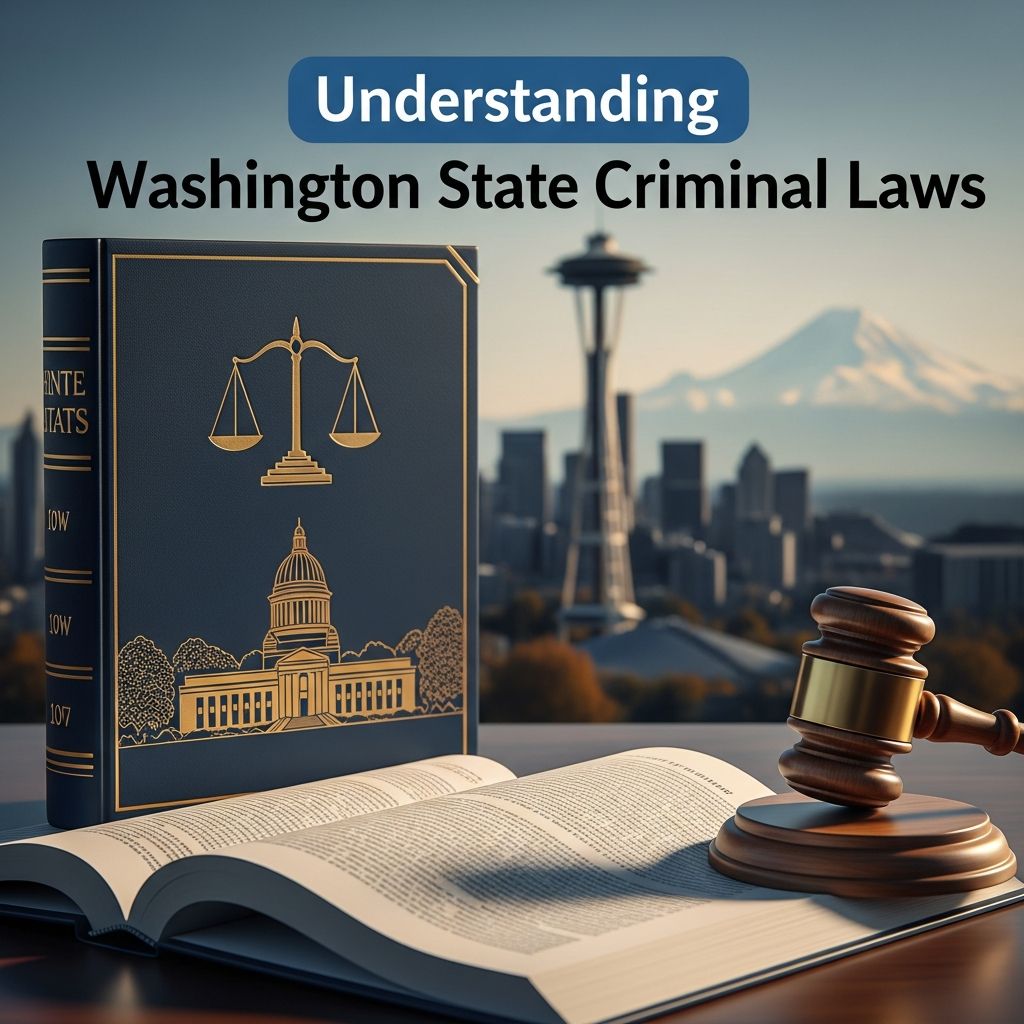
Guide to Washington State Criminal Laws and Penalties
Washington State has its own detailed criminal code that defines offenses, sets penalties, and outlines how criminal cases move through the courts. Much of this law is collected in the Revised Code of Washington (RCW), especially Titles 9 and 9A, which address crimes, punishments, and the modern criminal code.
This guide explains the basics of Washington criminal law so you can better understand how crimes are classified, what penalties may apply, and what rights and protections exist for people accused of a crime.
How Washington Defines a Crime
In Washington, a crime is generally an act or omission that violates a state criminal statute or local ordinance and is punishable by jail, prison, or a fine. The RCW provides specific definitions of each criminal offense, while additional guidance comes from court decisions and jury instructions.
Criminal laws serve several purposes, including:
- Protecting public safety by discouraging violent and dangerous conduct
- Deterring wrongdoing through the threat of fines, jail, or prison
- Punishing unlawful behavior when it does occur
- Rehabilitating offenders and promoting reentry after incarceration
- Providing restitution and some measure of justice to crime victims
Overview of the Washington Criminal Code (RCW Titles 9 and 9A)
Washington’s criminal rules are primarily organized into two core titles of the RCW:
- Title 9 RCW – Crimes and Punishments: Contains older criminal statutes and special categories such as firearms and weapons, gambling, obscenity, treason, nuisance, and sentencing provisions.
- Title 9A RCW – Washington Criminal Code: The modern criminal code that defines most commonly charged felony and misdemeanor offenses, including homicide, assault, theft, burglary, sex offenses, harassment, and cybercrime.
Other RCW titles also contain criminal provisions, such as traffic crimes in Title 46 and controlled substances offenses in Title 69.
Examples of Major Offense Categories in Title 9A
Title 9A organizes crimes by subject matter, including:
- Homicide (RCW 9A.32) – Murder, manslaughter, and related killings
- Assault and bodily harm (RCW 9A.36) – Varying degrees of physical injury or attempts
- Kidnapping and unlawful imprisonment (RCW 9A.40) – Nonconsensual confinement or abduction
- Sex offenses (RCW 9A.44) – Sexual assault and related crimes
- Harassment and threats (RCW 9A.46) – Stalking, serious threats, and similar conduct
- Arson, reckless burning, malicious mischief (RCW 9A.48) – Property damage and fire-related crimes
- Burglary and trespass (RCW 9A.52) – Unlawful entry into buildings or property
- Theft and robbery (RCW 9A.56) – Taking property or using force to steal
- Fraud and identity crimes (RCW 9A.60, 9A.58) – Forgery, false documents, identity theft
- Family offenses (RCW 9A.64) – Nonsupport, bigamy, and related conduct
- Public order and abuse of office (RCW 9A.76, 9A.80, 9A.84) – Obstructing officials, rioting, corrupt practices
- Cybercrime (RCW 9A.90) – Computer-related and online offenses
Classification of Crimes in Washington
Washington divides crimes into three main levels of seriousness:
- Felonies – Most serious offenses, punishable by more than one year of incarceration
- Gross misdemeanors – Intermediate-level offenses
- Simple (or ordinary) misdemeanors – Less serious, but still criminal, offenses
This classification affects where a case is filed, what penalties the court may impose, and how a conviction appears on a criminal record.
Felonies: Class A, B, and C
Under Washington law, felonies are broken into three classes, primarily based on the potential maximum punishment.
| Felony Class | Typical Maximum Penalty | General Examples* |
|---|---|---|
| Class A Felony | Up to life in prison and substantial fines | Serious violent offenses, including certain homicide and major sex crimes |
| Class B Felony | Up to 10 years in prison and significant fines | Certain types of burglary, mid-level assault, some major thefts |
| Class C Felony | Up to 5 years in prison and notable fines | Lower-level felonies such as some property or drug offenses |
*Specific classifications and penalties depend on the statute for each crime; the table is illustrative.
Misdemeanors and Gross Misdemeanors
Most less-serious crimes are classified as misdemeanors, which are still criminal convictions and can carry substantial consequences. According to the Washington State Bar Association:
- Gross misdemeanors – Punishable by up to 1 year in jail and/or up to a $5,000 fine.
- Simple misdemeanors – Punishable by up to 90 days in jail and/or up to a $1,000 fine.
Common examples include some lower-level assaults, certain driving-related offenses, shoplifting of smaller amounts, and disorderly conduct. Even though the potential jail time is shorter than for felonies, a misdemeanor conviction may affect employment, immigration status, housing, and licensing.
Sentencing Rules and the Sentencing Reform Act
For felonies, Washington uses a structured sentencing system under the Sentencing Reform Act of 1981 (RCW 9.94A). This law creates standard ranges for prison or jail time based on:
- The seriousness level of the current offense
- The defendant’s offender score (primarily prior felony history)
Except in special circumstances, courts are expected to sentence within the applicable standard range. Judges may also impose community custody (similar to probation), restitution, and various court costs as allowed by statute.
Factors That Can Increase or Decrease a Sentence
Washington law recognizes certain factors that can change a sentence, including:
- Mandatory minimums for specific crimes (such as certain violent or firearm-related offenses)
- Deadly weapon or firearm enhancements, which can add prison time on top of the standard range
- Aggravating factors (for example, particularly vulnerable victims or major economic offense patterns)
- Mitigating factors (such as a minor role in the offense or unusual circumstances)
For misdemeanors, sentencing is generally governed by the maximum penalties set for each class, and judges have more discretion within those limits.
Common Categories of Washington Criminal Offenses
While Washington law lists hundreds of specific crimes, many charges fall into several broad categories.
Crimes Against Persons
- Homicide – Includes various degrees of murder and manslaughter, defined in RCW 9A.32.
- Assault – Ranges from misdemeanor assault to serious felony assaults depending on the conduct and injuries.
- Kidnapping and unlawful imprisonment – Involve unlawfully restraining or moving a person.
- Sex offenses – Including rape, child molestation, and other sexual offenses governed by RCW 9A.44 and related titles.
Property and Financial Crimes
- Theft and robbery – Taking property, with robbery involving force or threat of force.
- Burglary and trespass – Unlawful entry into property or remaining unlawfully in a building.
- Malicious mischief and arson – Intentional property damage and fire-related crimes.
- Fraud and forgery – Creating or using false documents and misrepresentations for financial gain.
- Identity crimes – Including identity theft and misuse of identification documents.
Public Order, Weapons, and Government-Related Offenses
- Firearms and dangerous weapons – Possession, use, or sale of firearms is heavily regulated in RCW 9.41.
- Harassment, stalking, and threats – Targeting individuals with serious threats or repeated unwanted contact.
- Obstructing governmental operations – Interfering with law enforcement or court processes, including perjury.
- Bribery and official misconduct – Crimes involving abuse of public office and corrupt influence.
- Public disturbances – Disorderly conduct, unlawful assemblies, and related behavior.
Driving and Traffic Crimes
Many serious driving offenses are criminal, especially when they involve risk to others. These are generally found in Title 46 RCW, separate from Titles 9 and 9A, and may include:
- Driving under the influence (DUI)
- Reckless driving
- Hit-and-run involving property damage, injury, or death
Specific penalties depend on the statute, prior record, and whether injury or death occurred.
Drug and Controlled Substances Offenses
Drug crimes are largely contained in Title 69 RCW, including unlawful possession, distribution, manufacturing, and controlled-substances-related homicide. Punishments vary widely depending on the type and amount of substance, prior history, and involvement of minors.
The Criminal Case Process in Washington (High-Level Overview)
While every case is different, many Washington criminal cases follow similar stages. This overview is general and does not capture all possible procedures.
- Investigation – Law enforcement gathers information, interviews witnesses, and collects physical or digital evidence.
- Arrest or Summons – If there is probable cause, a person may be arrested or ordered to appear in court.
- Initial appearance and bail – The accused is informed of the charges, and issues like bail or release conditions are addressed.
- Charging decision – A prosecutor reviews reports and decides which criminal charges, if any, to file.
- Arraignment – The defendant enters a plea (usually not guilty at first) and a schedule is set.
- Pretrial proceedings – Discovery, motions, plea negotiations, and evaluation of evidence occur.
- Trial – If the case does not resolve by plea or dismissal, it may go to a judge or jury trial.
- Sentencing – If there is a conviction or guilty plea, the court imposes a sentence consistent with applicable statutes and sentencing ranges.
- Appeals and post-conviction – In some cases, a defendant can seek appellate review or other post-conviction relief.
Key Rights of People Accused of Crimes
Individuals accused of crimes in Washington have important constitutional and statutory rights, including:
- Right to remain silent and not incriminate oneself
- Right to an attorney, and to a court-appointed lawyer if unable to afford one in many criminal cases
- Right to a public trial and, in most serious cases, a jury trial
- Right to confront and cross-examine witnesses against them
- Right to present evidence and call witnesses in their defense
- Right to be presumed innocent until proven guilty beyond a reasonable doubt
These protections arise from both the U.S. and Washington Constitutions, as well as state statutes and court rules.
Collateral Consequences of a Criminal Conviction
Beyond jail, prison, or fines, a Washington criminal conviction may carry lasting effects. Depending on the offense and the person’s circumstances, possible collateral consequences include:
- Limits on employment and professional licensing
- Effects on immigration status for non-citizens
- Restrictions on firearm possession following certain convictions
- Barriers to housing and public benefits
- Obligations for restitution, fines, and fees
- Sex offender registration for qualifying sex offenses
Washington law provides some mechanisms to mitigate these effects, including restoration of civil rights and certain forms of record relief, but these options are limited and depend strongly on the type of conviction and a person’s criminal history.
Frequently Asked Questions (FAQs)
What is the difference between a Washington felony and a misdemeanor?
A felony in Washington is typically punishable by more than one year of incarceration and is classified as Class A, B, or C based on its seriousness. A misdemeanor is a lower-level offense with a maximum of 90 days in jail and a $1,000 fine, while a gross misdemeanor can carry up to one year in jail and a $5,000 fine.
Where are Washington criminal laws found?
Most general criminal laws are found in Title 9A RCW, known as the Washington Criminal Code, while older and special categories of crimes are contained in Title 9 RCW and other titles like Title 46 (traffic) and Title 69 (controlled substances).
How does Washington determine a felony sentence?
Felony sentences are largely determined under the Sentencing Reform Act in RCW 9.94A, which uses a grid based on the seriousness of the current offense and the offender’s criminal history to establish a standard sentencing range.
Can a criminal record in Washington ever be cleared or reduced?
Some Washington convictions may be eligible for vacating or record relief, and there are procedures for restoring certain rights, but eligibility depends on the type of offense, time since completion of the sentence, and other conditions. Legal advice is important to evaluate specific options.
Do I need a lawyer for a misdemeanor charge in Washington?
Even misdemeanors can result in jail time, fines, and long-term consequences for employment, housing, and immigration. Because of this, state bar and consumer resources strongly recommend consulting a qualified criminal defense attorney if you are facing any criminal charge.
References
- Title 9A RCW: Washington Criminal Code — Washington State Legislature. 2024-01-01 (current through session). https://app.leg.wa.gov/rcw/default.aspx?Cite=9A
- Title 9 RCW: Crimes and Punishments — Washington State Legislature. 2024-01-01 (current through session). https://app.leg.wa.gov/rcw/default.aspx?cite=9
- Revised Code of Washington – A Legal Guide to the Most Common Crimes — Black Law, PLLC. 2023-05-01. https://www.blacklawseattle.com/revised-code-of-washington-a-legal-guide-to-the-most-common-crimes/
- Types of Felonies: A Comprehensive Guide to Washington Felony Laws — BFQ Law. 2023-02-15. https://bfqlaw.com/washington/types-of-felonies-a-comprehensive-guide-to-washington-felony-laws-consequences-and-classifications/
- Criminal Law (Consumer Pamphlet) — Washington State Bar Association. 2011-02-01. https://www.wsba.org/docs/default-source/news-events/publications/consumer-pamphlets/criminal-law-0211.pdf
- Washington Criminal Law and Legal Issues Overview — LawInfo. 2022-06-01. https://www.lawinfo.com/resources/criminal-defense/washington/
Similar Articles








Read full bio of Sneha Tete