
Understanding the WARN Act: Layoff and Plant Closing Notice Rules
A practical employer and employee guide to federal WARN Act notice duties, coverage rules, exceptions, and enforcement.
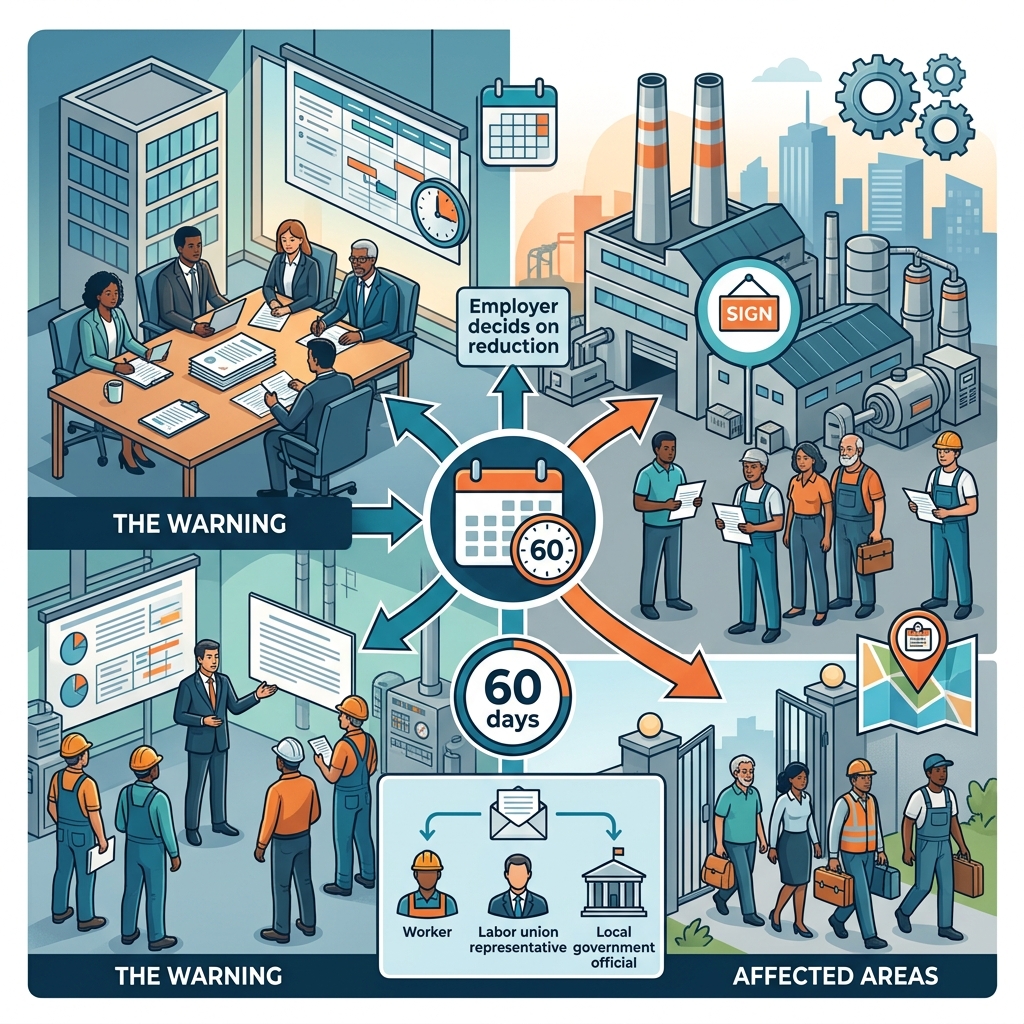
The Worker Adjustment and Retraining Notification Act, commonly called the WARN Act, is a federal labor law that requires certain employers to give advance written notice before significant layoffs or plant closings. Its core purpose is to give workers, their families, and communities time to prepare for job losses, seek new employment, and access retraining or support services.[10]
This article explains when WARN applies, what counts as a plant closing or mass layoff, who must receive notice, recognized exceptions, and what happens if an employer fails to comply.
Why the WARN Act Exists
When large employers shut down operations or lay off many employees with little or no warning, workers can face sudden financial crisis and local communities can experience serious economic disruption. Congress enacted WARN in 1988 to create a predictable notice period so that:
- Workers have time to search for other jobs or apply for retraining programs.
- Families can plan for income changes, insurance transitions, and relocation if needed.[10]
- State and local governments can mobilize rapid response services and workforce programs.[10]
- Communities can better adjust to the economic impact of a major employer’s departure.[10]
The law balances these protections with specific thresholds and exceptions so that only substantial closures and layoffs trigger the federal notice obligation.
Which Employers Are Covered by the WARN Act?
WARN does not apply to every business. It targets larger employers whose decisions can have broader economic effects. Under the federal statute, an employer is generally covered if it:
- Is a business enterprise (public or private), and
- Employs 100 or more employees, excluding those who have worked less than six months in the past 12 months and those who work less than 20 hours per week.
Part-time employees and very recent hires usually do not count toward the 100-employee threshold, though they may still be affected by a layoff and may have other rights under different laws.
| Employer size factor | How it is counted |
|---|---|
| Total employees | Includes full-time staff; generally excludes those employed less than 6 months in the last year and those working under 20 hours per week. |
| Minimum covered size | Usually 100 or more employees. |
| Business type | Applies to most private and some public employers; government agencies themselves may be treated differently depending on structure. |
Several states have their own “mini-WARN” laws with lower thresholds or stricter requirements. For example, some states apply notice duties to employers with fewer than 100 employees or require longer notice periods. Employers must consider both federal WARN and any applicable state laws.
What Events Trigger WARN Notice?
WARN focuses on two main types of events: plant closings and mass layoffs. Not every layoff or shutdown qualifies. The law uses specific numerical thresholds to decide when notice is required.
Plant Closings
A plant closing typically occurs when an employer shuts down an operating unit or an entire worksite, causing significant job losses. Under federal WARN, notice is generally required if:
- An entire employment site, or one or more facilities or operating units within a site, is shut down, and
- The shutdown results in an employment loss for 50 or more employees at that single site during any 30-day period, excluding certain short-service and part-time workers.
Plant closing rules are meant to cover situations like closing a factory, warehouse, or large office operation—not minor restructuring or temporary shutdowns.
Mass Layoffs
A mass layoff is a substantial reduction in workforce that does not necessarily involve closing the entire facility. Federal WARN notice is generally required if a covered employer conducts a layoff that:
- Results in an employment loss at a single site for 500 or more employees in a 30-day period; or
- Results in employment loss for 50–499 employees, and those workers constitute at least one-third of the active workforce at that site.
In calculating these numbers, employers must look at how many workers suffer an “employment loss,” not simply how many people receive a notice of restructuring or schedule changes.
The 90-Day Aggregation Rule
To prevent employers from avoiding WARN by spreading layoffs into small groups, the law aggregates separate but related job losses. If, within a 90-day span, multiple groups of terminations or layoffs each fall below WARN thresholds but together reach them, the events may be treated as a single plant closing or mass layoff unless the employer can show that they resulted from separate and independent causes.
What Counts as an “Employment Loss”?
WARN uses the term employment loss to determine who is affected and whether thresholds are reached. Under federal law, an employment loss generally includes:
- A termination of employment, other than for cause, voluntary resignation, or retirement.
- A layoff that extends beyond six months.
- A reduction in an employee’s hours of work of more than 50% in each month of a six-month period.
Shorter layoffs or hour reductions typically do not qualify as employment losses under WARN, though they may still raise issues under other labor and employment laws.
Who Must Receive WARN Notices?
When WARN is triggered, employers cannot simply tell workers informally. The law requires written notice to several parties, all at least 60 calendar days before the plant closing or mass layoff.[10]
- Affected employees or their representative
- If employees are represented by a union, the notice must be given to the bargaining representative.
- If there is no union, notice must be sent directly to each affected employee.
- State dislocated worker unit
- This is typically a division of the state labor or workforce agency that coordinates rapid response services.[10]
- Chief elected official of the local government
- For example, a mayor, county executive, or chair of a local governing board where the facility is located.
The U.S. Department of Labor has issued regulations explaining acceptable delivery methods, such as first-class mail, personal delivery, or inclusion in pay envelopes, as long as employees receive the notice on time.
Minimum Contents of a WARN Notice
The law and regulations require specific information to be included in written notices. While there is no mandatory federal form, a compliant notice typically includes:[10]
- The name and address of the employment site where the plant closing or mass layoff will occur.
- A statement that a plant closing or mass layoff is expected, with the anticipated date or 14-day period when the action will begin.
- The expected schedule for separations.
- Whether the planned action is permanent or temporary.
- Job titles of positions to be affected and the number of affected employees in each job classification.
- The name and phone number of a company official for further information.[10]
Some states now also require information about how the employer will coordinate services for laid-off workers, such as referrals to workforce development boards or training providers.
How Much Advance Notice Is Required?
The default rule is clear: covered employers must provide at least 60 calendar days of written notice before ordering a plant closing or mass layoff that triggers WARN.[10]
Notice is measured from the date workers receive the written communication to the date of their employment loss. If layoffs occur on different dates, notice must be timed so that each affected employee has the full 60 days before their own separation.
Recognized Exceptions to the 60-Day Requirement
WARN recognizes that some circumstances make it unreasonable or impossible to provide a full 60-day notice. In those cases, the law allows a shorter notice period, but the employer must still provide written notice as soon as practicable and explain in the notice why less than 60 days’ notice is being given.[10]
1. Faltering Company Exception
This exception applies only to plant closings (not mass layoffs) and is narrowly construed. An employer may shorten notice if it is actively seeking new capital or business to avoid or postpone the shutdown and reasonably believes in good faith that giving notice would preclude obtaining that capital or business.
The employer must be able to demonstrate efforts to secure financing or new work and show that early disclosure would have jeopardized those efforts.
2. Unforeseeable Business Circumstances
When the need for layoffs or closure is caused by business circumstances that were not reasonably foreseeable at the time notice would otherwise have been required, employers may reduce the notice period. Examples can include certain abrupt contract cancellations or unexpected major customer losses.
The key issue is whether a reasonably prudent employer in a similar situation would have anticipated the event and its impact at the time 60 days’ notice would have been required.
3. Natural Disasters
When a plant closing or mass layoff is the direct result of a natural disaster—such as a flood, earthquake, storm, or other comparable event—advance notice may not be possible.
In those cases, employers are expected to provide written notice as soon as practicable after the disaster and explain the connection to the natural event.
Temporary Projects and Short-Term Work
WARN does not require notice for the end of a job that was understood from the start to be temporary. If workers know their assignment is tied to completion of a specific project or the operation of a temporary facility, the project’s conclusion normally does not constitute a plant closing or mass layoff for WARN purposes.
Consequences of Failing to Comply with WARN
Employers that violate WARN may face significant financial liability. The statute authorizes civil remedies primarily in favor of affected employees, and in some cases, local governments.
Liability to Employees
An employer that fails to provide the required 60-day notice is generally liable to each affected employee for:
- Back pay for each day of violation, up to a maximum of 60 days, and
- Benefits under an employee benefit plan, including the cost of medical expenses that would have been covered, again up to 60 days.
Back pay is typically measured using the higher of the employee’s average regular rate of pay over the last three years or their final regular rate of pay.
Civil Penalties to Local Government
In addition to liability to employees, employers may owe a civil penalty of up to $500 per day for failing to provide required notice to the local government’s chief elected official. This penalty can sometimes be avoided if the employer promptly pays all affected employees their full back pay and benefits for the notice period.
Enforcement and Lawsuits
WARN is enforced primarily through private civil actions in federal court. The U.S. Department of Labor offers compliance assistance and guidance but does not directly enforce WARN through administrative penalties.[10]
Key features of enforcement include:
- Employees, or their representatives, may sue employers for violations.
- Courts may award attorneys’ fees to prevailing plaintiffs.
- Good-faith efforts to comply may reduce liability, but they rarely eliminate it entirely.
Practical Compliance Tips for Employers
Because WARN litigation can be costly and disruptive, employers facing possible plant closings or large layoffs should proactively manage compliance.
- Monitor workforce levels and timelines
Carefully track projected job losses over 30- and 90-day periods so you can identify when WARN thresholds might be reached.
- Plan early and conservatively
When in doubt, consider providing notice even if you are not certain that WARN applies; conditional notices are permitted when tied to a clearly described future event.
- Coordinate with state agencies
Contact the state dislocated worker unit or workforce agency early to align timing and content of notices and help connect employees with rapid response services.[10]
- Consult legal counsel
WARN calculations and exceptions can be complex, especially when multiple facilities, rolling layoffs, or restructuring are involved. Legal advice can help minimize risk.
- Document decision-making
If relying on an exception—such as unforeseeable business circumstances or a natural disaster—keep detailed records of the facts and timing that support your position.
Key Takeaways for Employees
Employees facing plant closings or mass layoffs often have limited time to react. Understanding WARN can help you assess whether your employer complied with the law and what remedies may be available.
- If you work for an employer with around 100 or more employees, and a large number of workers are being laid off or a facility is closing, ask whether WARN applies.
- Review any written notices carefully to see the timeline of layoffs and whether alternative positions are available.
- Contact your state workforce or labor department to learn about rapid response services, retraining opportunities, and unemployment insurance.[10]
- If you believe your employer failed to provide proper notice, consult a qualified employment attorney or legal aid organization to evaluate possible claims.
Frequently Asked Questions (FAQs)
Does WARN apply to small businesses?
Federal WARN generally applies only to employers with at least 100 employees, not counting certain part-time and recent hires. However, some states have their own mini-WARN statutes that cover smaller employers, so a business with fewer than 100 workers may still have notice obligations under state law.
Are part-time employees protected by WARN?
Part-time employees are usually excluded from the headcount for determining whether WARN applies, and from some threshold calculations. That said, they may still experience an employment loss when a plant closes or workforce is reduced, and can have rights under other federal or state laws.
Can an employer give conditional notice?
Yes. Employers may issue conditional WARN notices that state layoffs or shutdowns will occur if a specific event—such as the loss of a major contract or failure to obtain financing—takes place. The triggering event must be clearly described, and the resulting employment loss must occur within a relatively short time after the event.
Is WARN notice required if employees are offered transfers?
If employees are offered transfers to other sites under similar terms and conditions, and the new locations are within a reasonable commuting distance or the employees accept the offer, they may not have suffered an employment loss for WARN purposes. The specifics can be fact-intensive and may depend on regulations and case law.
Who enforces the WARN Act?
The U.S. Department of Labor provides guidance, regulations, and technical assistance, but it does not directly prosecute WARN violations.[10] Enforcement is primarily through private lawsuits in federal court brought by workers, their representatives, or local governments.
References
- Worker Adjustment and Retraining Notification Act (WARN) Regulations and Compliance Assistance — U.S. Department of Labor, Employment and Training Administration. 2024-02-01. https://www.dol.gov/agencies/eta/layoffs/warn
- Worker Adjustment and Retraining Notification Act (WARN) — Pennsylvania Department of Labor & Industry. 2023-07-10. https://www.pa.gov/agencies/dli/programs-services/workforce-development-home/warn-requirements
- Worker Adjustment and Retraining Notification Act (WARN Act) Overview — Legal Information Institute, Cornell Law School. 2022-11-15. https://www.law.cornell.edu/wex/worker_adjustment_and_retraining_notification_act_(warn_act)
- Worker Adjustment and Retraining Notification Act (WARN) Guidance — California Employment Development Department. 2025-01-05. https://edd.ca.gov/en/jobs_and_training/Layoff_Services_WARN/
- The WARN Act (Worker Adjustment and Retraining Notification Act) — Keller Rohrback L.L.P. 2023-04-20. https://www.kellerrohrback.com/the-warn-act-worker-adjustment-and-retraining-notification-act
Similar Articles








Read full bio of Sneha Tete




