
Understanding the WARN Act: Layoff Notice Rights
A practical guide to the federal WARN Act, explaining when layoff notices are required and what protections employees can expect.
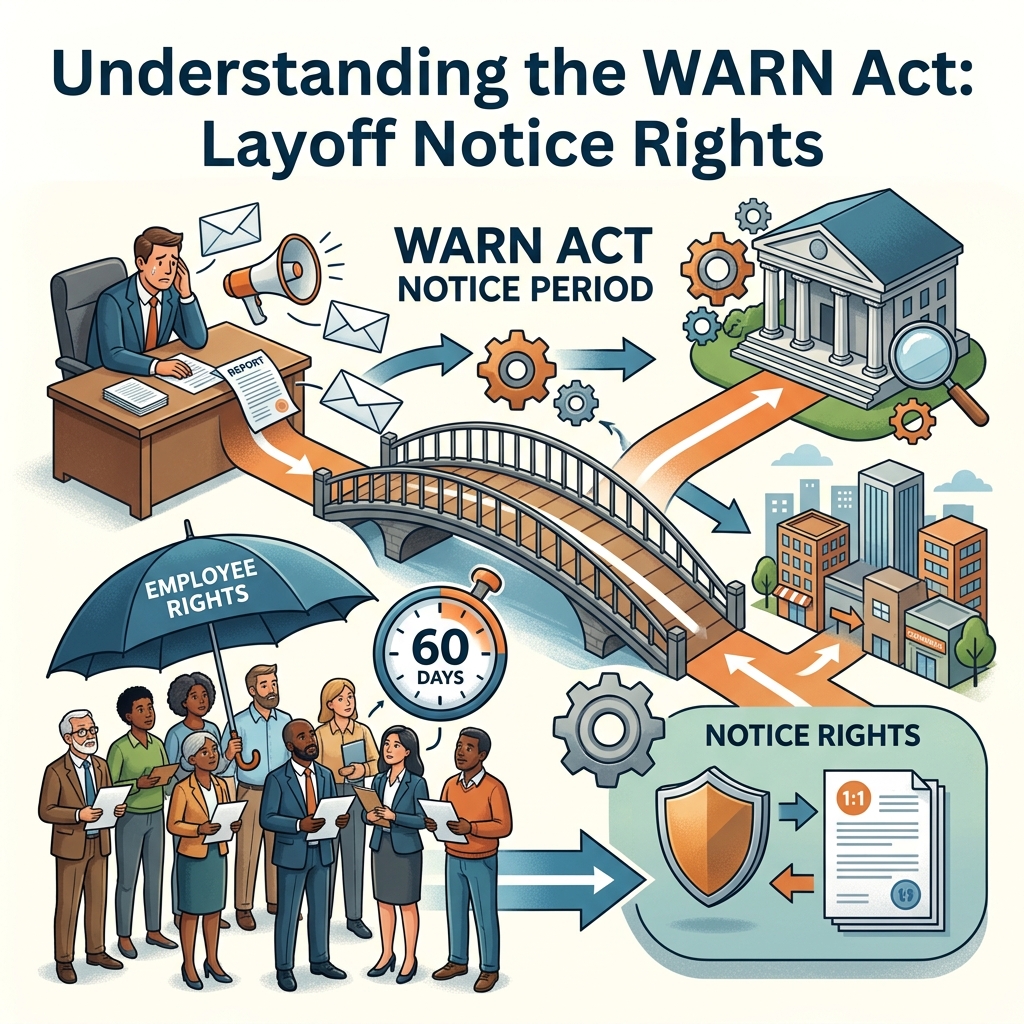
The federal Worker Adjustment and Retraining Notification (WARN) Act is a key U.S. labor law designed to give workers, their families, and communities advance warning of significant job losses due to plant closings and mass layoffs. This notice period is intended to provide time to prepare for unemployment, seek new work, and connect with retraining or support programs.
This article explains how the WARN Act works, who it covers, when notice is required, what the notice must include, common exceptions, and what employees can do if their rights are violated.
1. Core Purpose of the WARN Act
The WARN Act was enacted in 1988 to address the disruptive effects of sudden, large-scale job cuts. It does not prevent layoffs or plant closings, but it requires certain employers to give advance written notice before major workforce reductions take effect.
The law aims to:
- Protect workers from abrupt income loss by mandating a transition period.
- Support families in planning for financial changes and accessing benefits or services.
- Help communities prepare for local economic impacts and coordinate responses through state and local agencies.
To achieve these goals, the Act focuses on two major events: plant closings and mass layoffs, each defined by specific numerical thresholds.
2. Which Employers Are Covered?
The WARN Act does not apply to every business. It targets medium and large employers based on workforce size.
2.1 General Coverage Threshold
In general, the law applies to employers with 100 or more employees. However, the way employees are counted is important:
- Workers who have been employed fewer than 6 months in the preceding 12-month period may be excluded when determining coverage.
- Workers who average less than 20 hours per week may also be excluded from coverage calculations.
Despite these counting rules, many notices must still be sent to affected part-time or short-tenure employees when an event is covered.
2.2 Types of Covered Employers
Covered entities typically include:
- Private, for-profit companies with 100 or more qualifying employees.
- Nonprofit organizations operating in a commercial context and separately organized from regular government operations.
- Certain public or quasi-public entities engaged in commercial activities, if they meet workforce thresholds.
Regular federal, state, and local government bodies providing public services are generally not covered by the federal WARN Act’s requirements.
3. Who Is Protected Under the WARN Act?
The WARN Act provides notice protections to a broad range of workers at covered employers.
3.1 Employees Entitled to Notice
Workers entitled to advance notice include:
- Hourly employees affected by plant closings or mass layoffs.
- Salaried employees, including professional staff.
- Managers and supervisors, not just rank-and-file employees.
Legal definitions often tie WARN protections to employees working at least around 20 hours per week and with at least 6 months of service in the previous year, but notice may need to reach additional workers who are reasonably expected to lose their jobs.
3.2 Workers Who Are Not Covered
The Act does not extend notice rights to certain categories, such as:
- Business partners (as opposed to employees).
- Independent contractors or temporary agency workers who are not employees of the closing or laying-off entity.
- Regular government employees in agencies providing public services, under the federal WARN framework.
4. When Does WARN Require Notice?
WARN notice requirements are triggered only when employment losses reach specified thresholds. Two key concepts are central: plant closing and mass layoff.
4.1 Plant Closings
A plant closing typically involves shutting down an entire employment site, or at least one facility within that site, causing significant job loss. Under federal definitions, notice is generally required when:
- An employment site or facility is shut down; and
- The shutdown results in an employment loss for 50 or more employees during a 30-day period, excluding certain short-tenure or part-time workers.
4.2 Mass Layoffs
A mass layoff occurs when a large number of employees are laid off at a single site, even if the plant remains open. Federal WARN generally requires notice if:
- 500 or more employees at a single site will suffer employment loss during a 30-day period; or
- 50 to 499 employees will lose their jobs, and they make up at least 33% of the active workforce at that site.
4.3 Combining Layoffs Over Time
Employers cannot easily avoid WARN coverage by spreading layoffs into smaller groups. If two or more groups of workers experience employment loss within a 90-day period, and together they meet the thresholds for a plant closing or mass layoff, notice may be required unless the employer can show each group resulted from separate and distinct actions and causes.
4.4 What Counts as an “Employment Loss”?
The term employment loss under WARN is broader than simple termination. It can encompass:
- A permanent or long-term termination of employment.
- A layoff exceeding six months in duration.
- Reduction in hours of work of more than half during each month of a six-month period.
Understanding this definition is crucial, because employees may be affected even if they are not immediately terminated.
5. The 60-Day Notice Requirement
The cornerstone of the WARN Act is the requirement that covered employers provide at least 60 calendar days’ advance written notice before a qualifying plant closing or mass layoff goes into effect.
5.1 Recipients of WARN Notices
When the law is triggered, employers must send written notice to multiple parties:
- Employee representatives, such as unions or other bargaining agents, for represented workers.
- Individual employees who are affected, if they are not represented by a union.
- The state dislocated worker unit, a state-level workforce agency that assists affected employees.
- The chief elected official of the local government where the plant closing or layoff will occur (e.g., mayor or county executive).
5.2 Timing Rules
General timing requirements include:
- Notices must be served so that employees and other recipients receive them at least 60 days before the layoff or closing is effective.
- If job losses occur on a staggered schedule, employers must ensure each affected worker gets notice at least 60 days before their own job loss.
- Conditional notices may be allowed when job cuts depend on a future event (such as a failed sale), as long as the event is clearly described and likely to lead to job loss within a specified period.
5.3 Content of WARN Notices
The regulations under the WARN Act and related guidance set expectations for what a compliant notice should contain.[10] Typical elements include:
- Name and address of the employment site or facility where the closing or layoff will occur.
- Contact information for a company official who can answer questions.
- A statement indicating whether the action is permanent or temporary and, if relevant, whether the entire plant will close.
- The expected date of the first separation and the anticipated schedule for further separations.
- Job titles of affected positions and, where applicable, the names of employees currently holding those positions.
No specific form is mandated, but notices must be written and clear enough for recipients to understand the nature and timing of the employment loss.[10]
6. Exceptions and Special Situations
The WARN Act contains narrow exceptions that may permit shorter notice periods under specific, documented circumstances. These exceptions do not eliminate the duty to notify; they may only modify the timing.[10]
6.1 Overview of Common Exceptions
Typical categories of exceptions include situations such as:
- Unexpected business circumstances that were not reasonably foreseeable.[10]
- The need to seek capital or business in good faith, where giving notice would have prevented obtaining the funds needed to avoid or postpone shutdown.[10]
- Certain natural disasters or extraordinary events that directly cause employment loss.[10]
Even when an exception applies, employers must give notice as soon as it becomes practicable and explain why fewer than 60 days’ notice was provided.[10]
7. Consequences of Violating the WARN Act
Employers that fail to provide required WARN notices can face significant legal and financial consequences.
7.1 Liability to Employees
If a covered employer orders a plant closing or mass layoff without sufficient notice, it may be liable to affected employees for:
- Back pay for each day of violation, up to a maximum of 60 days.
- Benefits (such as the cost of maintaining health or other employee benefit plans) for the violation period, again typically capped at 60 days.
7.2 Penalties Involving Government Entities
Employers that fail to notify required government bodies may incur civil penalties. For example, they may owe up to $500 per day for each day they fail to provide notice to the appropriate unit of local government.
7.3 Enforcement and Lawsuits
WARN Act enforcement often occurs through civil actions filed in federal court by affected employees, unions, or local governments. The U.S. Department of Labor provides compliance assistance and regulatory guidance but does not generally adjudicate WARN claims.[10]
8. Interaction with State Mini-WARN Laws
Some states have enacted their own WARN-style laws, sometimes referred to as mini-WARN statutes, which may impose broader or stricter requirements than the federal Act.
For example, New York’s state WARN law lowers the employee threshold and may require notice of additional events, such as certain relocations. Employees and employers must therefore consider both federal and state law when evaluating notice obligations.
| Feature | Federal WARN Act | Example State Mini-WARN |
|---|---|---|
| Employer size threshold | Generally 100 or more employees | Often lower thresholds (e.g., 50 full-time employees in NY) |
| Events covered | Plant closings and mass layoffs | May add relocations or other events |
| Notice period | At least 60 days | May require equal or longer periods depending on state law |
9. Practical Steps for Employees
Workers facing a plant closing or mass layoff can take several practical steps to understand and assert their rights under the WARN Act.
9.1 Review Any Written Notice Carefully
- Check the effective dates of the layoff or closing.
- Confirm whether the notice was provided at least 60 days before your employment loss.
- Look for information on whether the action is permanent or temporary and whether the entire facility is closing.
9.2 Compare the Situation to WARN Thresholds
- Estimate how many employees at your site are losing jobs and within what time frame.
- Determine whether the event appears to be a plant closing or a mass layoff as defined by federal law.
- Consider whether multiple rounds of layoffs within 90 days might collectively trigger WARN.
9.3 Seek Guidance and Legal Advice
- Contact your union or employee representative if you are covered by a collective bargaining agreement.
- Reach out to your state’s dislocated worker unit or workforce development agency for help with retraining and job search assistance.
- Consult an employment law attorney if you believe your employer failed to comply with WARN requirements.
10. Key Takeaways About WARN Act Rights
- The WARN Act is a federal notice law for significant job losses due to plant closings and mass layoffs.
- It generally applies to employers with 100 or more employees, with specific rules about how workers are counted.
- Employees, their representatives, and certain government officials must receive written notice at least 60 days in advance of covered events.
- Violations can lead to employer liability for back pay, benefits, and civil penalties.
- State mini-WARN laws may expand protections beyond the federal baseline.
11. Frequently Asked Questions (FAQs)
Q1: Does every layoff require a WARN notice?
No. WARN applies only when a covered employer’s actions meet the thresholds for a plant closing or mass layoff as defined by federal law. Smaller layoffs or routine terminations generally do not trigger WARN.
Q2: Can an employer avoid WARN by staggering layoffs?
Not necessarily. If two or more groups of workers lose their jobs within a 90-day period and the combined numbers meet WARN thresholds, notice may still be required unless the employer can show each group resulted from separate and distinct causes.
Q3: Are part-time employees entitled to notice?
Part-time workers may not always be counted for determining whether WARN applies, but when a covered event occurs, notice often must be provided to all affected employees, including those with fewer hours or shorter tenure.
Q4: Does the WARN Act guarantee severance pay?
The WARN Act itself does not create a general right to severance pay. However, if an employer fails to give required notice, it can be liable for back pay and certain benefits for up to 60 days, which can function similarly to additional compensation for the violation period.
Q5: Where can I find official WARN regulations?
The U.S. Department of Labor publishes WARN information and regulations. The core regulatory text appears in 20 C.F.R. Part 639, and the Department’s Employment and Training Administration provides compliance assistance materials.[10]
References
- Worker Adjustment and Retraining Notification (WARN) Act – Compliance Assistance — U.S. Department of Labor, Employment and Training Administration. 2023-06-01. https://www.dol.gov/agencies/eta/layoffs/warn
- Worker Adjustment and Retraining Notification Act (WARN) | Wex — Legal Information Institute, Cornell Law School. 2023-01-10. https://www.law.cornell.edu/wex/worker_adjustment_and_retraining_notification_act_(warn)
- Worker Adjustment and Retraining Notification Act of 1988 — U.S. federal statute summary. 2022-11-15. https://en.wikipedia.org/wiki/Worker_Adjustment_and_Retraining_Notification_Act_of_1988
- WARN Act Basics — Klehr Harrison Harvey Branzburg LLP. 2021-09-20. https://klehr.com/services/litigation/labor-employment/warn-act/warn-act-basics/
- Worker Adjustment and Retraining Notification Act (WARN) Requirements — Pennsylvania Department of Labor & Industry. 2023-03-30. https://www.pa.gov/agencies/dli/programs-services/workforce-development-home/warn-requirements
- 20 C.F.R. Part 639 — Worker Adjustment and Retraining Notification — Electronic Code of Federal Regulations, Office of the Federal Register. 2024-02-01. https://www.ecfr.gov/current/title-20/chapter-V/part-639
- New York State Worker Adjustment and Retraining Notification (WARN) — New York State Department of Labor. 2022-08-10. https://dol.ny.gov/worker-adjustment-and-retraining-notification-warn
Similar Articles








Read full bio of medha deb




