
Understanding Virginia Criminal Trespass Laws
A practical guide to Virginia’s criminal trespass rules, penalties, defenses, and how they differ from civil trespass claims.
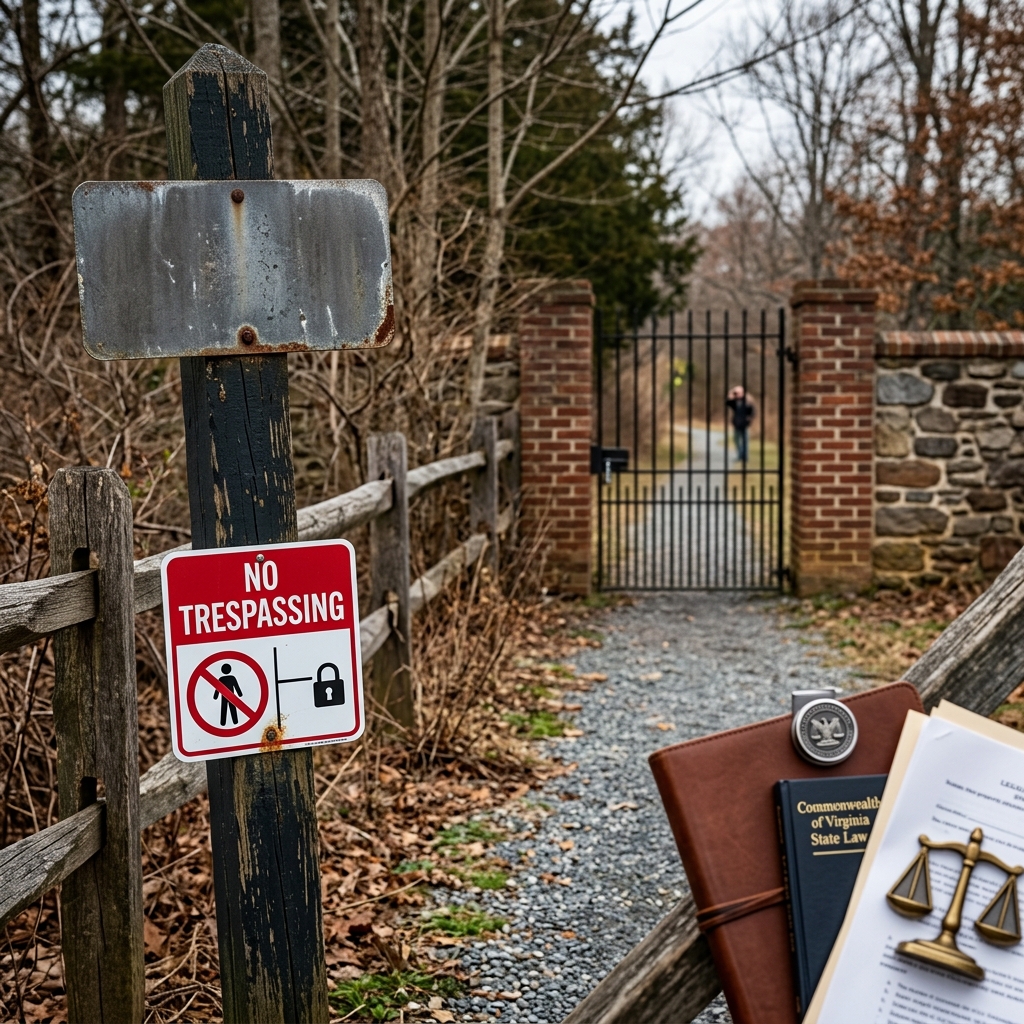
Virginia treats criminal trespass as a serious property crime, not a minor inconvenience. Under state law, entering or remaining on another person’s property after being told to stay away can lead to a criminal record, fines, and even jail time. This guide explains how criminal trespass works in Virginia, what prosecutors must prove, the possible penalties, and how these rules differ from civil trespass claims.
Overview of Criminal Trespass in Virginia
The central criminal trespass statute in Virginia is Virginia Code § 18.2-119, often referred to as “trespass after having been forbidden.” The focus of this law is not simply being on someone else’s land; it is being there without legal authority after receiving notice that you are not allowed to enter or remain.
In plain terms, criminal trespass generally involves four ideas:
- Someone else controls the property.
- You go onto or stay on that property.
- You do not have permission or legal authority to be there.
- You have been warned or put on notice that your presence is forbidden.
Because trespass is tied closely to property rights, Virginia courts view these cases as protecting the right of owners and lawful occupants to control who uses their land, buildings, and premises.
Key Elements the Commonwealth Must Prove
To obtain a conviction for criminal trespass under Va. Code § 18.2-119, the Commonwealth must establish specific elements beyond a reasonable doubt. These elements break down the offense into parts that a judge or jury can evaluate.
Presence on the Property of Another
First, the prosecution must show that the accused went upon or remained upon the lands, buildings, or premises of another without authority of law. This can include:
- Private homes and yards
- Commercial buildings and parking lots
- Farms, wooded areas, or other open land
- Common areas of apartment complexes and other multi-unit properties
It is not necessary that the accused cause damage or disturbance; simply being present without authority, combined with notice, can meet this element.
Lack of Permission or Legal Authority
Second, prosecutors must demonstrate that the person had no legal right or permission to be on the property at the relevant time. Legal authority might come from:
- Ownership of the property
- A lease, license, or other contractual right to be there
- Permission given by the owner or lawful occupant
- A court order granting access
If someone has valid permission, or an independent legal right to enter (for example, law enforcement acting under a lawful warrant), criminal trespass typically does not apply.
Notice that Entry or Remaining is Forbidden
The most distinctive feature of Virginia’s criminal trespass law is the requirement of notice. The accused must have been told or reasonably informed that they are not allowed to enter or remain on the property.
Under Va. Code § 18.2-119, notice can be provided in several ways:
- Oral notice by the owner, lessee, custodian, or another person lawfully in charge.
- Written notice directed to the individual.
- Posted signs stating that entry is forbidden, placed where they can be reasonably seen.
- Court orders (such as protective orders) that prohibit entry, once they have been served on the person.
Without proof of some form of notice, simply being on someone else’s land usually is not enough for a criminal trespass conviction under this statute.
Intent to Enter or Remain
Criminal trespass also involves an intentional act. Prosecutors typically must show that the accused deliberately entered or stayed on the property despite knowing or being told that doing so was forbidden.
Accidentally walking onto a neighbor’s yard in the dark or taking a wrong turn into a private driveway might not qualify if there is no intent to ignore warnings or posted signs.
How Notice is Communicated
Since notice is such an important part of criminal trespass, it is helpful to understand how Virginia law recognizes different forms of notice.
| Type of Notice | Who Can Give It | Key Features |
|---|---|---|
| Oral warning | Owner, lessee, custodian, property manager, or other lawful occupant | Directly tells the person not to enter or to leave the property. |
| Written notice | Same as above | Letter or document stating that entry is prohibited. |
| Posted signs | Owner or person with legal control, including easement holders | Signs must be placed where they may be reasonably seen. |
| Court order | Court of competent jurisdiction | Protective or restraining orders that bar someone from specific premises. |
Penalties for Criminal Trespass
Standard criminal trespass under Va. Code § 18.2-119 is classified as a Class 1 misdemeanor in Virginia. This is the most serious misdemeanor category under Virginia law.
A Class 1 misdemeanor trespass conviction can carry:
- Up to 12 months in jail
- A fine of up to $2,500
- A legal order or ongoing restriction prohibiting return to the same property
In addition, a criminal trespass conviction becomes part of the person’s record and may affect employment, housing, and other opportunities where background checks are used.
Enhanced Penalties for Bias-Motivated Trespass
Virginia law allows for harsher punishment if trespass is connected to discriminatory motives. If a person intentionally chooses the property based on characteristics such as race, religion, color, or ethnicity, the offense can be treated as a Class 6 felony instead of a misdemeanor.
In those circumstances, potential consequences may include:
- Up to 5 years in prison
- A minimum of 6 months in jail, with at least 30 days as a mandatory active sentence
This enhancement underscores the state’s interest in deterring property crimes driven by bias or targeted harassment.
Special Rules for Trespass on Certain Properties
While Va. Code § 18.2-119 forms the foundation of criminal trespass law, Virginia has additional statutes addressing specific kinds of property. These laws reflect heightened concerns for safety, public order, and institutional operation.
School Property and School Buses
Separate Virginia provisions address trespass on school grounds and vehicles. Entering school property or a school bus at night without authorization can be treated as a misdemeanor, with fines and potential jail time. Because schools house children and staff, authorities often respond quickly to unauthorized presence, especially outside normal operating hours.
Church and Religious Property
Virginia also has specific rules for churches and certain religious premises. Entering church property at night for purposes other than attending services or authorized meetings may be treated as a lower-level misdemeanor, while intentionally remaining on church property after being told to leave can rise to a Class 1 misdemeanor, bringing the same maximum penalties as general trespass.
Defenses and Lawful Reasons to Be on Property
Not every presence on another person’s property results in criminal liability. Virginia law, along with general criminal principles, recognizes a number of defenses and lawful explanations that may defeat a trespass charge.
Permission or Consent
The most straightforward defense is permission. If the owner or lawful occupant has given you approval to enter or remain on the premises, either expressly or implicitly, the basis for criminal trespass is usually absent.
Consent can be:
- Express – for example, “You can park in my driveway,” or a written guest policy.
- Implied – such as open doors, advertised business hours, or established custom of public access.
However, permission can be revoked. Once a person is told to leave and given reasonable time to do so, remaining on the property may expose them to criminal liability.
Lack of Notice
Because notice is a required element, demonstrating that you were never properly warned can be a major defense. If signs were hidden, missing, or unclear, or if no one with lawful authority ever told you that entry was forbidden, it may be difficult for the Commonwealth to prove trespass under § 18.2-119.
Mistake, Accident, or Emergency
Situations such as genuine mistakes (entering the wrong property), accidents, or emergencies may also undermine criminal intent. For instance, seeking shelter from dangerous weather or entering property to avoid immediate harm may support arguments that the person’s conduct should not be treated as criminal.
Legal Authority or Superior Right
Some individuals have a legal authority that permits entry even when others object. Examples include law enforcement executing valid warrants, emergency responders performing their duties, and certain government officials acting within the scope of lawful authority. In those cases, the “without authority of law” requirement may not be met.
Civil Trespass vs. Criminal Trespass
Virginia also recognizes civil trespass through common law, which is separate from criminal prosecution. Civil trespass allows a property owner to sue for damages or injunctive relief when someone unlawfully interferes with their exclusive possession of land.
Key Differences
| Feature | Civil Trespass | Criminal Trespass |
|---|---|---|
| Who brings the case? | Private property owner or possessor | The Commonwealth (prosecutor) |
| Primary purpose | Compensation or injunction for interference with property | Punishment and deterrence for unlawful entry |
| Type of intent required | May be based on intentional or even unintentional interference | Generally requires intentional entry or remaining after notice |
| Possible outcomes | Damages, court orders to stop the conduct | Fines, jail, criminal record |
In civil trespass, the property owner must prove unauthorized entry that interfered with their exclusive possession, but proof of explicit notice is not always required, and liability can arise from accidental actions. Criminal trespass, in contrast, focuses more on intentional disregard of warnings or lawful orders.
Practical Tips for Property Owners and Visitors
Understanding trespass rules helps both property owners and visitors avoid conflict and potential charges.
For Property Owners
- Use clear, visible signs if you want to restrict access to land, buildings, or specific areas.
- When giving oral warnings, identify yourself as the owner or person in charge and make the instruction to leave unambiguous.
- Consider following up repeated issues with written notice or, in serious cases, seeking a court order.
- Document incidents and notices if you anticipate potential enforcement or legal action.
For Visitors and Members of the Public
- Pay attention to posted signs, especially “No Trespassing” and similar warnings.
- If asked to leave property by someone with apparent authority, do so promptly to avoid possible charges.
- When in doubt about your right to be on premises, ask for clarification or obtain explicit permission.
- Seek legal advice if you receive a written notice or court order restricting your presence on particular property.
Frequently Asked Questions About Virginia Trespass
Can I be charged with trespass if I did not see the sign?
Signs must be posted where they can be reasonably seen to count as notice under Va. Code § 18.2-119. If a sign is hidden or obscure, a defense attorney may argue that you did not receive adequate notice. However, courts look at the overall circumstances, including whether a sign should have been noticed by a reasonable person.
Is trespassing always a criminal matter?
No. Trespass can lead to both civil and criminal issues. Minor or accidental intrusions often result in civil claims, if anything, while criminal trespass typically involves more deliberate disregarding of warnings or orders.
Can I go to jail for trespassing in Virginia?
Yes. Because standard criminal trespass is a Class 1 misdemeanor, it carries a possible sentence of up to 12 months in jail, although not every case results in incarceration. Jail time is more likely in repeat offenses or where aggravating factors are present.
Who is allowed to tell me to leave a property?
Virginia law recognizes notice from the owner, lessee, custodian, their agent, or other persons lawfully in charge of the premises, as well as those holding certain easements and rights-of-way. Property managers, security staff, and similar agents often fall into this category when acting within their duties.
How does a protective order relate to trespass?
If a court issues a protective or restraining order that forbids you from entering or remaining on specific property and you have been properly served with that order, entering or staying on that property can constitute criminal trespass under § 18.2-119.
References
- 18.2-119. Trespass after having been forbidden to do so — Commonwealth of Virginia, Legislative Information System. 2024-01-01. https://law.lis.virginia.gov/vacode/title18.2/chapter8/section18.2-119/
- Virginia Trespassing Laws: Descriptions and Penalties — Humbrecht Law. 2023-06-01. https://humbrechtlaw.com/criminal-charges-in-virginia/property-crimes-in-virginia/virginia-trespassing-laws/
- Virginia Trespassing Laws — Jad Sarsour Criminal Defense Attorney. 2023-05-15. https://novacriminalattorney.com/virginia-trespassing-laws/
- What You Need to Know About Trespassing in Virginia — Legal Defense. 2024-12-01. https://www.legaldefense.com/legal-blogs/2024/december/what-you-need-to-know-about-trespassing-in-virgi/
- Virginia: Common Law Trespass — Without My Consent. 2014-01-01. https://withoutmyconsent.org/50state/state-guides/virginia/common-law/
Similar Articles








Read full bio of Sneha Tete




