
Understanding Utah Overtime Laws for Workers and Employers
A practical guide to how overtime works in Utah, who qualifies, common exemptions, and how to protect your rights at work.
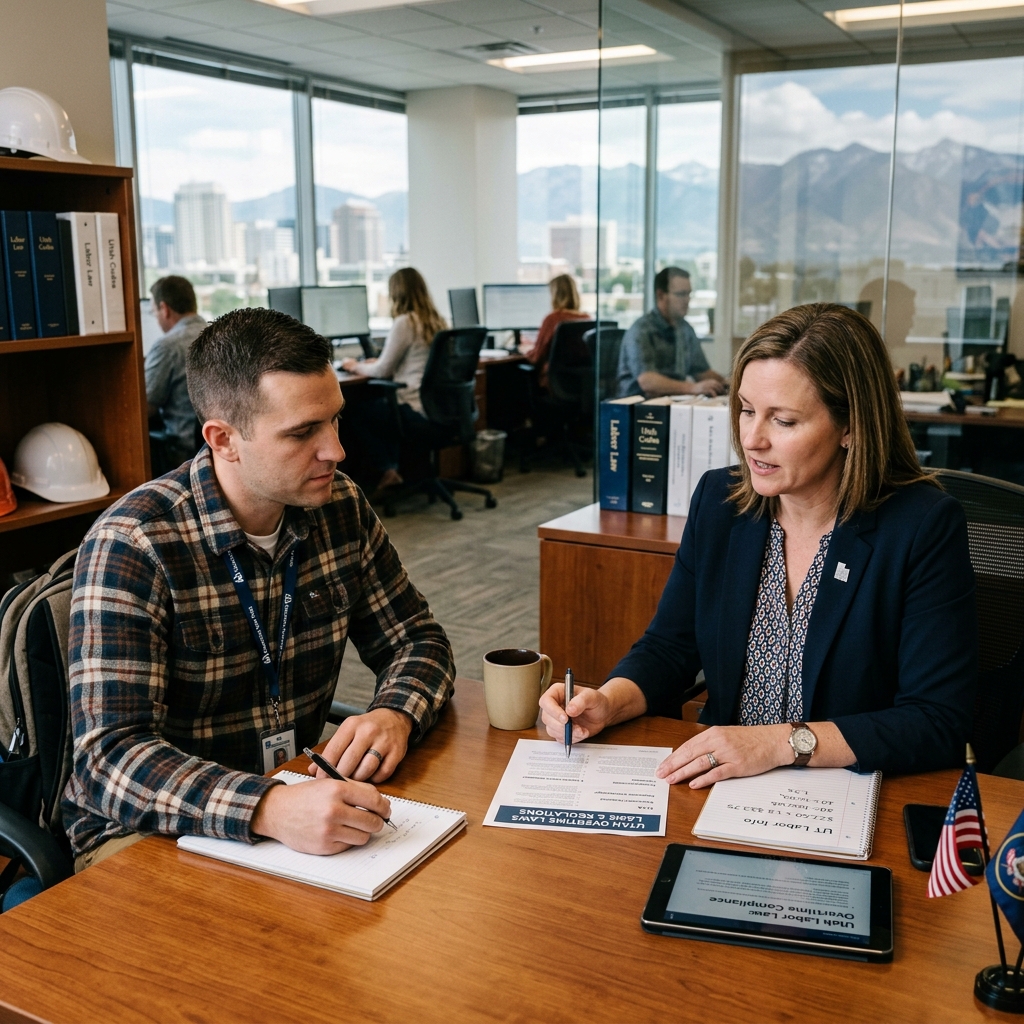
Utah overtime rules can be confusing, especially when you are trying to figure out whether long hours, weekends, or holidays should lead to extra pay. At the same time, employers must navigate both federal and state requirements to avoid costly wage disputes and penalties. This guide explains how overtime works in Utah, how the federal Fair Labor Standards Act (FLSA) interacts with state law, who is exempt from overtime, and what both workers and employers should know about calculating and enforcing overtime pay.
Big Picture: How Utah Treats Overtime
Utah does not create its own separate overtime pay rate or daily overtime rules. Instead, the state largely relies on the federal FLSA standard, which requires covered, non-exempt employees to receive at least 1.5 times their regular rate of pay for all hours worked over 40 hours in a single workweek.
- Weekly threshold: Overtime begins after 40 hours in a defined workweek.
- Rate of pay: At least time-and-a-half the employee’s regular rate.
- Workweek-based: Overtime is calculated by workweek, not by day.
- Both federal and state rules apply: Utah law aligns with the FLSA and recognizes a 40-hour workweek in its state code.
Because Utah overtime law closely matches federal requirements, any employer operating in the state should understand FLSA concepts and ensure their policies match both federal and state expectations.
What Counts as a “Workweek” in Utah?
Overtime is determined by looking at the hours worked in a specific workweek. Federal law defines a workweek as a fixed and regularly recurring period of 168 hours—seven consecutive 24-hour periods.
Important points about workweeks:
- A workweek does not have to match the calendar week.
- The employer can choose any start day and time, but it must be consistent.
- Overtime is calculated separately for each workweek; hours cannot be averaged across multiple weeks.
- Changing the workweek frequently to avoid overtime obligations can create legal problems.
Utah law, through Utah Code § 34-30-8, mirrors this weekly concept by stating that 40 hours constitute a working week for covered works and undertakings, and hours beyond that require overtime pay at one-and-one-half the employee’s regular rate.
Utah’s 40-Hour Rule and Basic Overtime Rights
Under Utah law and the FLSA, the core rule is straightforward: if a covered, non-exempt employee works more than 40 hours in a workweek, the employer must pay overtime for every hour beyond 40.
| Scenario | Weekly Hours | Overtime Required? |
|---|---|---|
| Employee works 38 hours total | 38 | No overtime |
| Employee works 45 hours total | 45 | Yes, 5 hours at 1.5x regular rate |
| Employee works 14 hours one day, 24 hours total in week | 24 | No overtime (daily hours alone do not trigger overtime) |
Unlike some states that require overtime after a certain number of hours per day, Utah relies solely on the weekly total to determine overtime eligibility.
Daily Overtime, Weekends, and Holidays: What Utah Does Not Require
Many workers assume that long days, weekend shifts, or holiday work automatically lead to overtime pay. Utah’s overtime framework, following federal rules, focuses instead on the total weekly hours.
- No daily overtime requirement: Utah does not require extra pay simply because an employee works more than eight hours in a single day, as long as the weekly total does not exceed 40 hours.
- Weekends and nights: Federal law does not require higher pay solely for working evenings, nights, Saturdays, or Sundays.
- Holidays: There is no mandatory double-time rule for holidays under Utah or federal law; any extra holiday pay depends on the employer’s own policy.
However, if work on a weekend or holiday pushes an employee’s weekly total over 40 hours, those hours still must be paid at the overtime rate.
How the “Regular Rate” of Pay Is Calculated
The overtime multiplier (1.5x) is applied to an employee’s regular rate of pay, not just the base hourly wage. The regular rate includes all remuneration for employment, with some exceptions.
Key elements that usually factor into the regular rate:
- Base hourly wage.
- Non-discretionary bonuses (such as performance or attendance bonuses).
- Commissions and incentive pay.
For hourly employees, overtime is typically 1.5 times the hourly rate. For salaried, non-exempt workers, the weekly salary is divided by the number of hours it is intended to cover (for example, 40), and that figure becomes the regular hourly rate used to compute overtime.
Exempt vs. Non-Exempt: Who Qualifies for Overtime?
Not every employee is entitled to overtime pay. Under the FLSA and Utah law, workers fall into two broad categories: exempt and non-exempt. Non-exempt employees are the ones who must receive overtime when they work more than 40 hours in a week.
Utah law and federal rules recognize several types of exemptions. Common categories include:
- Executive employees – Typically managers who supervise two or more employees and have significant authority over hiring, firing, or major decisions.
- Administrative employees – Office or non-manual workers whose primary duties involve independent judgment on matters of significance.
- Professional employees – Workers in learned or creative professions that generally require advanced knowledge or specialized education.
- Outside sales employees – Individuals who primarily work away from the employer’s place of business making sales.
- Certain computer-related employees – Some highly skilled technology workers, if they meet federal criteria.
Utah also identifies specific job sectors where employees may be exempt from overtime, such as certain agricultural workers, newspaper circulation employees, switchboard operators, some domestic workers, and particular camp or seasonal operations.
It is important to remember that exemptions are based on job duties and salary level, not simply job titles or the fact that an employee is paid a salary.
Special Groups: Minors, Domestic Workers, Agricultural and Seasonal Employees
Utah law lists several categories of workers that may be exempt from overtime or subject to different rules.
- Minors under 16: Certain young workers may fall outside standard overtime provisions, although federal child labor rules still limit the types and hours of work.
- Agricultural employees: Some agricultural workers are exempt, for example, if they work fewer than a specified number of man-days or as part of a family farm operation.
- Domestic workers: Certain in-home employees may be exempt, depending on the nature of the work and whether they are employed directly by households.
- Seasonal and camp employees: Workers at organized camps or non-profit educational organizations that operate less than seven months a year may not be covered under usual overtime rules.
Because exemptions can be technical and fact-specific, both workers and employers should review the actual statutory language—such as Utah Code § 34-30-8 and relevant federal regulations—or seek legal advice if classification is uncertain.
Interaction with Other Wage and Hour Rights in Utah
Overtime does not exist in isolation. It interacts with other wage and hour rules that apply in Utah, many of which come from federal law, including minimum wage and record-keeping requirements.
Some related points:
- Minimum wage: Utah follows the federal minimum wage, meaning most covered employees must be paid at least the federal rate per hour.
- Meals and breaks: Utah does not require meal or rest breaks for most adult workers, though federal law may treat short rest periods as compensable time.
- Record keeping: Employers must maintain certain wage and hour records for a minimum number of years under both federal and Utah law, which can be critical in overtime disputes.
These rules influence how overtime is calculated and verified, particularly when questions arise about whether an employee was properly compensated for all hours worked.
Employer Responsibilities Under Utah Overtime Rules
Employers in Utah must comply with both Utah statutes and federal FLSA requirements. Key responsibilities include:
- Accurately tracking all hours worked for non-exempt employees.
- Defining a consistent workweek for overtime calculations.
- Properly classifying workers as exempt or non-exempt based on duties and pay, not just job titles.
- Paying overtime at least at 1.5 times the regular rate for hours over 40 in a workweek.
- Maintaining required wage and hour records for the statutory period.
Some Utah agencies may also require prior authorization for overtime for certain public sector positions, underscoring the importance of internal policies that control when overtime is allowed and how it is documented.
Employee Rights and Options When Overtime Is Not Paid
Workers who believe they have not received the overtime pay they are entitled to have several options for enforcing their rights. Under the FLSA, employees can file complaints with the U.S. Department of Labor’s Wage and Hour Division or pursue civil actions to recover unpaid wages and, in some cases, additional damages.
Common steps for employees include:
- Reviewing pay stubs and time records to confirm hours worked and pay rates.
- Raising the issue with the employer or human resources department.
- Contacting the Wage and Hour Division of the U.S. Department of Labor to file a complaint if the issue is not resolved.
- Consulting an employment or overtime lawyer to explore legal remedies.
Utah workers are protected against retaliation for asserting lawful wage rights under federal law, meaning employers generally cannot fire, demote, or otherwise punish employees for complaining about unpaid overtime or participating in investigations.
Common Misunderstandings About Utah Overtime
Misconceptions about overtime can lead to lost wages for employees and legal exposure for employers. Some frequent misunderstandings include:
- “Salary means no overtime.” Being paid a salary does not automatically make an employee exempt. Many salaried workers are still entitled to overtime if they do not meet the duties and salary tests for exemption.
- “Overtime starts after eight hours in a day.” Utah does not have daily overtime rules; only hours over 40 in a week matter.
- “Weekends and holidays always pay more.” Extra pay for weekends or holidays is not legally required unless those hours push the total above 40 for the week.
- “Bonuses do not affect overtime.” Non-discretionary bonuses and commissions must be accounted for when calculating the regular rate.
Practical Tips for Navigating Overtime in Utah
Both employees and employers can benefit from practical strategies to ensure overtime is handled correctly.
For employees:
- Keep personal records of your hours worked, especially if you suspect discrepancies.
- Clarify with your employer how your workweek is defined and how overtime is calculated.
- Ask whether you are classified as exempt or non-exempt and why.
- Review company policies on holidays, weekends, and mandatory overtime.
For employers:
- Audit employee classifications to ensure that exempt status matches actual duties and salary levels.
- Train managers and payroll staff on overtime rules and record-keeping requirements.
- Establish clear written policies on authorization for overtime work.
- Regularly review timekeeping practices to ensure all compensable hours are captured.
Frequently Asked Questions About Utah Overtime
Does Utah have its own overtime rate separate from federal law?
No. Utah follows the federal FLSA standard, which requires overtime pay at least at 1.5 times the employee’s regular rate for hours worked beyond 40 in a workweek.
Is daily overtime required in Utah if I work more than eight hours in a day?
No. Utah does not mandate daily overtime. Only the total number of hours worked in a workweek matters for overtime calculations.
Are employers required to pay extra for weekend or holiday work?
Not automatically. Federal law does not require extra pay for weekends, nights, or holidays. However, if those hours push the weekly total over 40, overtime must be paid at the higher rate.
If I am paid a salary, can I still receive overtime?
Yes, if you are classified as non-exempt. Salary alone does not create an exemption. Eligibility depends on your job duties and salary level under the FLSA tests.
Where can I go for help if my employer refuses to pay overtime?
You can contact the U.S. Department of Labor’s Wage and Hour Division, review Utah statutes such as Utah Code § 34-30-8, or speak to an employment attorney about recovering unpaid wages and protecting against retaliation.
References
- Overtime Pay — U.S. Department of Labor, Wage and Hour Division. 2023-01-01. https://www.dol.gov/agencies/whd/overtime
- Utah Overtime Laws — FindLaw. 2024-01-01. https://www.findlaw.com/state/utah-law/utah-overtime-laws.html
- Utah Code § 34-30-8 – Forty-hour work week; Overtime at one and one-half regular rate — Utah Legislature. 2024-01-01. https://le.utah.gov/xcode/Title34/Chapter30/34-30-S8.html
- Utah State Labor Laws: What Employers Must Know — MovePlus Mobility. 2025-06-01. https://www.moveplusmobility.com/news-articles/utah-state-labor-laws-what-employers-must-know/
- Utah Overtime Laws: A Comprehensive Breakdown — Truein. 2024-05-01. https://truein.com/blogs/utah-overtime-laws
- Utah Code § 63A-17-502 – Overtime Authorization — Utah Legislature. 2024-01-01. https://le.utah.gov/xcode/Title63A/Chapter17/63A-17-S502.html
Similar Articles








Read full bio of medha deb




