
Understanding U.S. Immigration Marriage Fraud
A detailed look at how U.S. law defines, investigates, and penalizes sham marriages used to evade immigration rules.
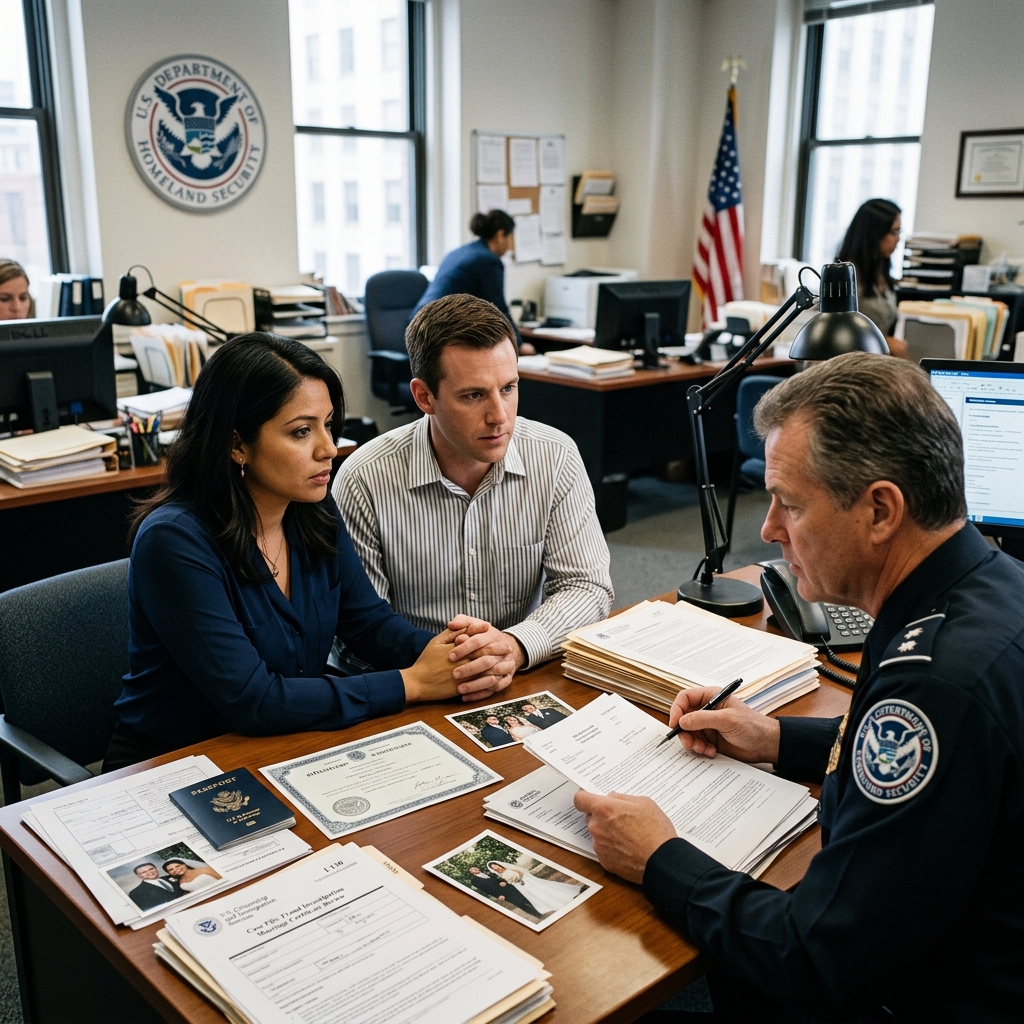
Marriage is one of the most common pathways for foreign nationals to obtain lawful permanent residence in the United States. At the same time, U.S. immigration law treats marriage fraud as a serious crime, with consequences that can permanently affect a person’s ability to live or even visit the country.
This article explains what constitutes marriage fraud, how immigration authorities investigate suspected sham marriages, the criminal and immigration penalties involved, and how legitimately married couples can demonstrate that their relationship is real and not an attempt to evade immigration laws.
What U.S. Law Means by Marriage Fraud
In the immigration context, marriage fraud refers to entering into a marriage for the primary purpose of evading U.S. immigration laws rather than to create a genuine life together as spouses. The focus is on the intent of the parties at the time of marriage.
- Sham marriage: A union where one or both partners agree to marry mainly to secure an immigration benefit, such as a green card.
- Fraudulent marriage: A broader term that includes sham marriages and other deceptive conduct surrounding marriage petitions, such as misrepresentation or concealed agreements.
Under 8 U.S.C. § 1325(c), it is a federal crime for an individual to knowingly enter into a marriage for the purpose of evading any provision of the immigration laws. The Immigration and Nationality Act (INA) further embeds protections against marriage fraud in its eligibility and petition provisions, including INA § 204(c), which permanently bars certain future petitions when fraud is found.
Common Types of Immigration Marriage Fraud
Marriage fraud can take multiple forms, but several patterns recur in enforcement actions and court decisions. While each case is fact-specific, authorities often see:
- Pay-for-marriage schemes
U.S. citizens or lawful permanent residents are paid money or given other benefits to marry foreign nationals solely so the latter can obtain immigration status. - Marriages of convenience
Two people agree to marry as a favor or business arrangement, fully aware they have no intent to form a lasting marital relationship. - Organized fraud rings
Groups of brokers or facilitators recruit U.S. citizens, prepare fraudulent paperwork, and coach participants on how to pass immigration interviews. - Hidden relationships
One spouse is already in a committed relationship with another person and uses a marriage to a citizen or resident purely as a gateway to later immigrate the true partner. - False documentation and lies
Couples submit fabricated leases, staged photographs, or false statements about cohabitation and finances to give the impression of a shared life.
Not every short-lived or troubled marriage is fraudulent. Immigration authorities look at whether the couple intended, when they married, to establish a life together as spouses. Later separation or divorce does not automatically equal fraud.
Legal Standards: When Is a Marriage Considered Valid for Immigration?
A marriage must meet both formal and substantive requirements to be recognized for immigration purposes:
| Requirement Type | Key Elements |
|---|---|
| Formal validity | The marriage must be legally valid where it took place: properly licensed, performed by an authorized official, and compliant with local law (age, consent, etc.). |
| Substantive bona fide intent | The parties must intend to build a genuine marital life together, not merely to obtain immigration benefits or money. |
The INA explicitly rejects the idea that simply holding a marriage certificate is enough. Even if the marriage is formally valid, immigration benefits can be denied if evidence shows the couple never planned to live as spouses in a real, ongoing relationship.
How Authorities Detect and Investigate Suspected Marriage Fraud
U.S. Citizenship and Immigration Services (USCIS), Immigration and Customs Enforcement (ICE), and in some cases the Department of Justice work together to identify and investigate suspected marriage fraud. Investigations typically involve a blend of document review, interviews, and independent verification.
Key Evidence Used in Fraud Determinations
When considering whether to deny a petition under INA § 204(c), USCIS generally requires substantial and probative evidence of an attempt or conspiracy to commit marriage fraud. Common types of evidence include:
- Admissions by either spouse that the marriage was arranged for immigration purposes.
- Proof of payment or compensation to one partner for entering the marriage.
- Lack of cohabitation with no plausible explanation, especially when paired with other indicators of a sham relationship.
- No marital behavior, such as no overlapping social life or representation of the couple as married to friends and family.
- Contradictory statements given by the spouses in separate interviews regarding their history, daily life, or personal details.
Speculation alone is not enough; officials need concrete facts showing an attempt or conspiracy to commit fraud. However, once such evidence appears in the immigration file, it can trigger lasting bars under the law.
Interview and Inspection Practices
In addition to reviewing paperwork, authorities may:
- Conduct in-person interviews with the couple, sometimes separately, to test consistency in their accounts.
- Request additional evidence such as joint leases, bank statements, insurance policies, or affidavits from friends and relatives.
- Perform site visits or home inspections when fraud is strongly suspected.
- Review prior immigration filings to identify patterns, such as repeated spousal petitions with similar facts.
An investigation may start with a routine concern at an interview or with a formal referral, but serious cases often involve coordination between USCIS fraud units and ICE investigators, especially when organized schemes are suspected.
Criminal Penalties for Marriage Fraud
Marriage fraud is treated as an immigration crime under federal law. The primary statute is 8 U.S.C. § 1325(c), added by the Immigration Marriage Fraud Amendments Act of 1986.
Under this provision:
- Knowingly entering into a marriage to evade immigration laws can lead to up to five years in federal prison.
- Offenders may be fined up to $250,000.
- Courts may impose both imprisonment and fines, depending on the circumstances.
Other statutes, such as 18 U.S.C. § 1546, may be involved when fraudulent documents or false statements are used as part of the scheme. In more complex cases, conspiracies, mail fraud, or other federal charges may also be added.
Criminal exposure is not limited to the foreign national. A U.S. citizen or permanent resident who knowingly participates in a sham marriage, accepts payment, or helps submit false documents can also be prosecuted.
Immigration Consequences: Deportation and Inadmissibility
In addition to criminal penalties, marriage fraud has far-reaching immigration consequences. These can be more severe in the long term than the criminal sentence itself.
Removal (Deportation)
Foreign nationals found to have engaged in marriage fraud can be placed in removal (deportation) proceedings. If an immigration judge determines that fraud occurred, the person may be ordered removed from the United States.
Deportation typically includes:
- Termination of any conditional or permanent resident status derived from the sham marriage.
- Loss of eligibility for most future immigration benefits.
- Potential bars to re-entry for many years or permanently, depending on grounds of inadmissibility.
Permanent Bar Under INA § 204(c)
One of the harshest immigration consequences is the permanent bar created by INA § 204(c). This provision instructs USCIS that it cannot approve any immigrant visa petition for a beneficiary who has previously entered into, attempted, or conspired to enter into a fraudulent marriage for immigration purposes.
Key features of the § 204(c) bar include:
- No time limit: The bar applies regardless of how long ago the alleged fraud occurred.
- Broad coverage: It blocks not only future family-based petitions but also certain employment-based petitions and even some self-petitions, including under VAWA.
- No discretionary waiver: USCIS cannot simply waive the bar based on sympathetic circumstances once a valid fraud finding is on record.
This means that a single determination of marriage fraud can effectively foreclose many pathways to permanent residence for the rest of the person’s life.
Proving a Genuine Marriage: Evidence of a Bona Fide Relationship
Because the law distinguishes sharply between genuine and sham marriages, couples seeking immigration benefits must present evidence that their relationship is real and not entered into solely for immigration purposes.
Typical Evidence USCIS Considers
Regulations and agency guidance identify several categories of documents that can help demonstrate the authenticity of a marriage:
- Joint property ownership or a mortgage showing shared responsibility.
- Leases or housing documents showing co-residence.
- Combined financial accounts, such as joint bank accounts, credit cards, or tax returns filed as a married couple.
- Children’s birth certificates listing both spouses as parents.
- Insurance policies naming one spouse as beneficiary for the other.
- Affidavits from friends or relatives with personal knowledge of the marriage and its history.
- Photos, travel records, and correspondence documenting the development of the relationship over time.
While no single piece of evidence is decisive, a consistent pattern of shared life and mutual commitment helps counter suspicion of fraud. Conversely, the absence of any overlapping life, combined with other red flags, may prompt closer scrutiny.
Conditional Residence and Ongoing Proof
Many spouses of U.S. citizens initially receive conditional permanent resident status, typically valid for two years. To remove conditions, the couple must file a joint petition and again show evidence that the marriage is bona fide, not a device for evasion of immigration laws.
This second stage provides another opportunity for USCIS to assess the relationship. If credible evidence of fraud appears at this point, conditions may not be removed, and removal proceedings can follow.
Long-Term Impact on Future Immigration Options
A finding of marriage fraud does not simply deny a single benefit; it can shape an individual’s immigration record indefinitely.
- Permanent record notation: Fraud findings become part of the person’s immigration file, accessible for future adjudications.
- Difficulties in nonimmigrant visas: Even applications for temporary visas may face heightened scrutiny or denial because of the perceived risk of further fraud.
- Limited relief options: Many discretionary forms of relief, such as certain waivers or humanitarian programs, may be harder to obtain when fraud is in the background.
- Impact on family: The inability to secure status can affect spouses, children, and other relatives who might otherwise have immigrated as derivatives or through future petitions.
Because of this long-term impact, anyone accused of marriage fraud or facing a § 204(c) issue should seek qualified legal advice. The consequences go far beyond a single application.
Frequently Asked Questions About Marriage Fraud
Does a quick divorce mean the marriage was fraudulent?
No. Immigration authorities focus on what the couple intended at the time of marriage. Relationships can fail for many reasons. A short marriage may raise questions, but it is not itself proof of fraud.
Can only the foreign national be charged with marriage fraud?
No. Both spouses can face criminal charges if they knowingly participate in a sham marriage to evade immigration laws, and facilitators or recruiters may also be prosecuted.
Is it possible to overcome a marriage fraud finding later?
In practice, it is extremely difficult. Under INA § 204(c), USCIS is barred from approving future immigrant visa petitions for a beneficiary with a valid fraud finding on record. Legal strategies focus on challenging the original finding or showing that the evidence did not meet the required standard, which often requires litigation or appeals.
What if my marriage is real but the evidence is limited?
Couples with unusual living arrangements or limited documentation should carefully explain their circumstances and provide whatever corroboration they can, such as affidavits, communication records, and proof of ongoing contact. Consulting an immigration attorney can help organize the evidence effectively.
How do authorities distinguish cultural or arranged marriages from fraud?
Arranged marriages and culturally traditional unions can be valid for immigration purposes if both parties genuinely intend to live as spouses. The issue is not the form of courtship but the intent behind the marriage. Evidence of shared life and mutual commitment is still important.
References
- TOP STORY: ICE leading nationwide campaign to stop marriage fraud — U.S. Immigration and Customs Enforcement. 2014-06-13. https://www.ice.gov/news/releases/top-story-ice-leading-nationwide-campaign-stop-marriage-fraud
- Surviving an Immigration Marriage Fraud Investigation — Brooklyn Law Review, Brooklyn Law School. 2011-01-01. https://brooklynworks.brooklaw.edu/cgi/viewcontent.cgi?article=1163&context=blr
- Marriage Fraud | 8 U.S. Code § 1325(c) — The Federal Criminal Attorneys. 2020-01-01. https://www.thefederalcriminalattorneys.com/marriage-fraud
- Practice Advisory: Sham Marriages and Marriage Fraud — Catholic Legal Immigration Network, Inc. (CLINIC). 2021-10-01. https://www.cliniclegal.org/resources/family-based-immigration-law/spousal-petitions/practice-advisory-sham-marriages-and
- Consequences of Marriage Fraud — MyAttorney USA. 2016-05-01. https://myattorneyusa.com/immigration-blog/immigration-to-the-usa/consequences-of-marriage-fraud/
- Immigration Marriage Fraud Lawyer Chicago — Kriezelman Burton & Associates. 2019-01-01. https://krilaw.com/services/family-immigration-lawyers-chicago/marriage-fraud/
Similar Articles








Read full bio of medha deb


