
Understanding Traffic Ticket Points and Their Impact
Learn how traffic ticket points work, how they affect your license and insurance, and what you can do to protect your driving record.
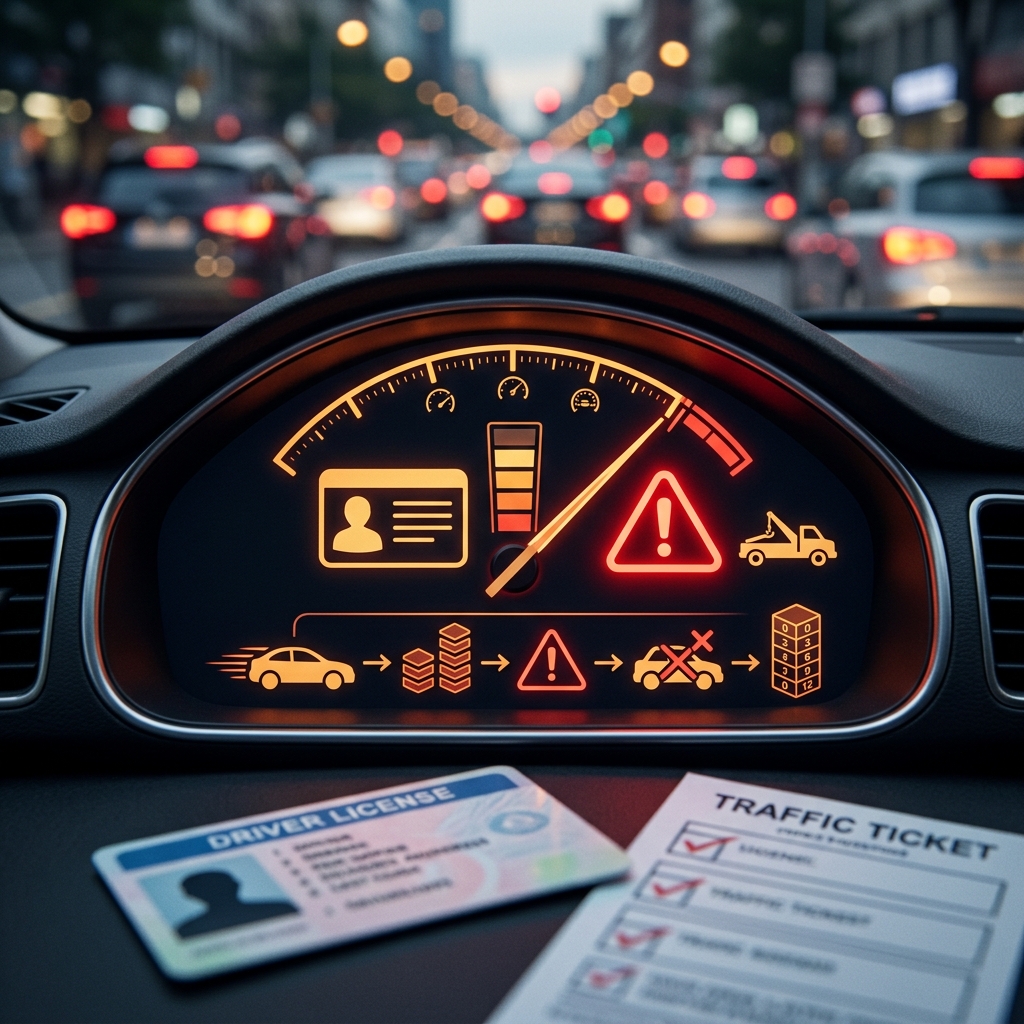
Across most of the United States, traffic ticket points are a central tool used by motor vehicle agencies and insurance companies to measure how risky a driver is on the road. While a single ticket may look harmless, the points attached to each violation can accumulate and lead to serious consequences, including license suspensions and substantial increases in auto insurance premiums.[10] This guide explains how point systems work, why they matter, and what you can do to limit the damage to your driving record.
What Are Traffic Ticket Points?
Traffic ticket points are numeric values that state driver licensing agencies assign to convicted traffic violations. Each time you are found guilty of a qualifying offense, the agency adds points to your driving record. These points reflect the seriousness of the violation and help authorities identify drivers who pose a higher risk to public safety.
Although point systems differ from state to state, they share several common goals:
- Encourage safer driving by penalizing repeated or serious violations.
- Flag high-risk drivers for closer monitoring or license suspension.[10]
- Support insurance risk assessments that influence how much you pay for coverage.
In nearly all systems, more severe violations carry more points. For example, driving under the influence (DUI), reckless driving, or leaving the scene of an accident typically results in higher point values than minor speeding or seat belt violations.
How Point Systems Differ by State
There is no single national standard for traffic ticket points. Instead, each state creates its own rules, point values, and thresholds for penalties. Some states use relatively low numerical values, while others use broader scales.
| State | Typical Point Scale | Sample Suspension Threshold | Time Frame |
|---|---|---|---|
| Florida | Points vary by offense; common values include 3, 4, and 6 points.[10] | 12 points | 12 months (30-day suspension).[10] |
| California | Most violations carry 1 or 2 points. | 6 points for commercial license holders | 12 months; 8 points in 24 months; 10 in 36 months. |
| New York | Point values assigned to specific violations; cumulative total tracked. | 11 points | 24 months. |
| South Carolina | Violations earn points that are later reduced over time. | Various thresholds, depending on total points and offense type. | Points cut in half after one year from violation. |
| Virginia | Demerit and safe driving points used together. | License actions vary based on accumulated demerit points. | Demerit points valid for two years. |
While the details differ, the pattern is similar nationwide: if you reach a specific point threshold within a certain period, your driving privileges may be suspended or restricted.[10]
How Points Are Assigned for Common Violations
Every state’s point chart is unique, but common traffic violations tend to be treated similarly. Less dangerous behaviors usually carry fewer points, while actions considered highly dangerous or likely to cause crashes carry more.
Lower-Point Violations
These are typically routine infractions that, while unlawful, are not regarded as extremely hazardous when they occur in isolation:
- Driving slightly above the speed limit (for example, under 15 mph over the limit in some states).
- Failure to obey a stop sign or traffic signal.
- Improper lane changes or illegal turns.
- Minor right-of-way violations.
In states like Florida and California, such offenses usually carry 1 to 3 points per violation.[10]
Higher-Point Violations
Serious violations that pose a substantial risk to others generate more points:
- Driving 15 mph or more above the speed limit.
- Reckless driving, such as aggressive weaving through traffic.
- Passing a stopped school bus.
- Leaving the scene of an accident, especially if injuries or property damage occur.
- Driving under the influence of alcohol or drugs.
These violations often add 4 or more points in Florida and can carry 2 points in California for particularly serious offenses like DUI or hit-and-run.[10]
When Points Lead to License Suspensions
Point systems are designed not only to record violations, but also to trigger administrative penalties when drivers reach defined thresholds. Accumulating too many points within a set timeframe can result in suspensions, probation, or other restrictions on your license.[10]
Illustrative Thresholds
The following examples illustrate how quickly repeated violations can threaten your ability to drive:
- Florida: 12 points in 12 months may lead to a 30-day suspension; 18 points in 18 months can trigger a 3‑month suspension; 24 points in 36 months may lead to a 1‑year suspension.[10]
- California: For certain driver classes, accumulating 6 points in 12 months, 8 in 24 months, or 10 in 36 months can result in suspension of driving privileges.
- New York: 11 points within a 24‑month period can lead to license suspension; accumulating 6 or more points in 18 months triggers a Driver Responsibility Assessment fee on top of fines.
In many states, license actions are administrative, meaning they are handled by the motor vehicle agency rather than the criminal courts. This can occur even if your underlying tickets were relatively minor when viewed individually.[10]
How Long Points Stay on Your Record
States also differ in how long points remain active on your driving record. A point “lifespan” may affect when your total resets and when older violations stop influencing your status.
- Florida: Points associated with convictions generally remain on the driver record for at least five years from the disposition date.[10]
- South Carolina: Points are reduced by half one year after the date of the violation, gradually lessening their impact over time.
- Virginia: Demerit points remain valid for two years from the offense date, while safe driving points can be accumulated to offset them.
Because points can linger for several years, the decisions you make about contesting tickets, attending approved courses, or adjusting driving habits can have long-term effects on your record.
Insurance Consequences of Traffic Points
Traffic ticket points do more than affect your license status. Insurance companies routinely review driving records and use violations and points as key indicators of risk. Drivers with multiple points are viewed as more likely to be involved in future claims, which is reflected in higher premiums.
While each insurer uses its own rating formulas, several patterns are common:
- Even a single moving violation can trigger a noticeable rate increase, especially for younger drivers.
- Multiple point-bearing violations within a short period often lead to substantial hikes or even non-renewal of coverage.
- Serious offenses, such as DUI or reckless driving, can move you into a high‑risk category that may require specialized or more expensive coverage.
Some industry analyses suggest that drivers with points on their records may pay significantly more for coverage for several years, compared to drivers with clean records. Because insurance impacts household budgets directly, the financial consequences of points can exceed the original fines by a wide margin.
Positive Point Systems and Safe Driving Incentives
Not all states use points solely as penalties. Some jurisdictions also award positive points for safe driving, which can offset or reduce the impact of violations.
- Virginia: In addition to demerit points, drivers can earn safe driving points for each full calendar year of violation‑free driving. Up to five safe points can be accumulated, and completing a driver improvement clinic can provide an extra five safe points.
Programs like these encourage drivers to adopt safer habits and provide a path to gradually repair their record after past mistakes.
Strategies to Manage and Reduce Traffic Points
If you receive a traffic ticket, you may have options to reduce or avoid points, depending on your state’s laws and the nature of the violation. Understanding these options early can help you protect your license and insurance costs.
1. Contesting the Ticket
- Pleading not guilty: You may have the right to challenge the citation in court, where the prosecution must prove the violation.
- Seeking dismissal or reduction: In some cases, tickets can be dismissed, or the charge may be reduced to a non‑point or lower‑point offense.
- Using legal representation: Experienced traffic attorneys are often familiar with local practices and may negotiate outcomes that minimize points.
2. Driver Improvement or Defensive Driving Courses
- Many states allow or require approved driving courses that can reduce existing points, prevent points from being added, or restore driving privileges after suspension.
- Courses may be offered online or in person and typically focus on safe driving techniques, hazard recognition, and legal responsibilities.
3. Maintaining a Clean Record Over Time
- Because points often decrease or expire after a certain period, avoiding new violations allows your total to fall below critical thresholds.
- Adopting safer habits—such as obeying speed limits, avoiding distractions, and planning trips to minimize stress—reduces your risk of future tickets and collisions.
Practical Tips to Avoid Point Accumulation
Preventing points is almost always easier than removing them. The following practical measures can help you avoid violations and protect your driving record:
- Know your state’s laws: Review official driver manuals and point system explanations from your state’s motor vehicle agency.[10]
- Watch your speed: Even modest speeding can add points and may push you toward suspension thresholds over time.
- Respect school zones and buses: Passing a stopped school bus or speeding in school areas often carries higher point values due to the risk to children.
- Avoid distractions: Using a phone, texting, or engaging in other distractions can contribute to violations and collisions that generate points.
- Plan your route: Allowing extra travel time and choosing safer routes can reduce stress and the temptation to speed or drive aggressively.
Frequently Asked Questions (FAQs)
Do all states use traffic ticket points?
Most states use some form of a point system to track violations and identify high‑risk drivers, although the exact structure and values differ across jurisdictions. A few states use alternative methods, such as counting violations without assigning numerical points.
Can I see how many points are on my record?
Yes. You can usually request a copy of your driving record from your state’s motor vehicle department, sometimes for a small fee. This record will list your recent violations and, where applicable, the points associated with each.
Will points from one state affect my license in another state?
States often share information through interstate compacts. If you receive a ticket while driving out of state, that conviction may be reported back to your home state, which may assign points according to its own rules. How this is handled depends on the specific agreements and statutes involved.
Can traffic points be removed before they expire?
In some states, you can reduce points by completing approved driver improvement or defensive driving courses, or by obtaining court‑approved reductions of the underlying charge. Other jurisdictions require you to wait until points age off your record. Always check your state’s official rules.
Do parking tickets add points to my license?
Generally, parking tickets are non‑moving violations and do not add points to your driving record. However, unpaid parking fines can lead to other administrative issues, such as registration holds or collection actions.
How do traffic points relate to car insurance increases?
Insurers review your driving record and treat point‑bearing violations as signals of higher risk. As a result, they may raise your premiums or classify you as a high‑risk driver, especially if you have multiple violations or serious offenses such as DUI or reckless driving.
Key Takeaways for Drivers
Traffic ticket points are more than numbers on a page. They determine whether you can keep driving, how much you pay for insurance, and how state agencies view your risk behind the wheel. By understanding your state’s system, contesting tickets wisely, and prioritizing safe driving, you can minimize the long‑term consequences of violations.
If you are facing a suspension or have accumulated several points in a short period, consider reviewing your record through your state’s official motor vehicle agency and, if appropriate, seek legal advice to explore options for reducing the impact on your life and livelihood.
References
- Driver’s License Points by State — FindLaw. 2023-05-01. https://www.findlaw.com/traffic/traffic-tickets/state-specific-points-systems.html
- Points System — South Carolina Department of Motor Vehicles (SCDMV). 2024-01-10. https://dmv.sc.gov/driver-services/points-system
- The New York State Driver Point System — New York State Department of Motor Vehicles. 2023-09-15. https://dmv.ny.gov/points-and-penalties/the-new-york-state-driver-point-system
- Points & Point Suspensions — Florida Department of Highway Safety and Motor Vehicles. 2023-08-20. https://www.flhsmv.gov/driver-licenses-id-cards/driver-license-suspensions-revocations/points-point-suspensions/
- Understanding California’s DMV Points System — Cutter Law P.C. 2022-11-30. https://cutterlaw.com/california-laws/dmv-points-system/
- The Points System — Virginia Department of Motor Vehicles. 2024-02-01. https://www.dmv.virginia.gov/licenses-ids/improvement/points/system
- The Florida Driver’s License Point System in 2024 — The Ticket Clinic. 2024-03-10. https://www.theticketclinic.com/blog/how-does-the-points-system-work-how-can-it-impact-your-florida-drivers-licenese/
Similar Articles








Read full bio of Sneha Tete


