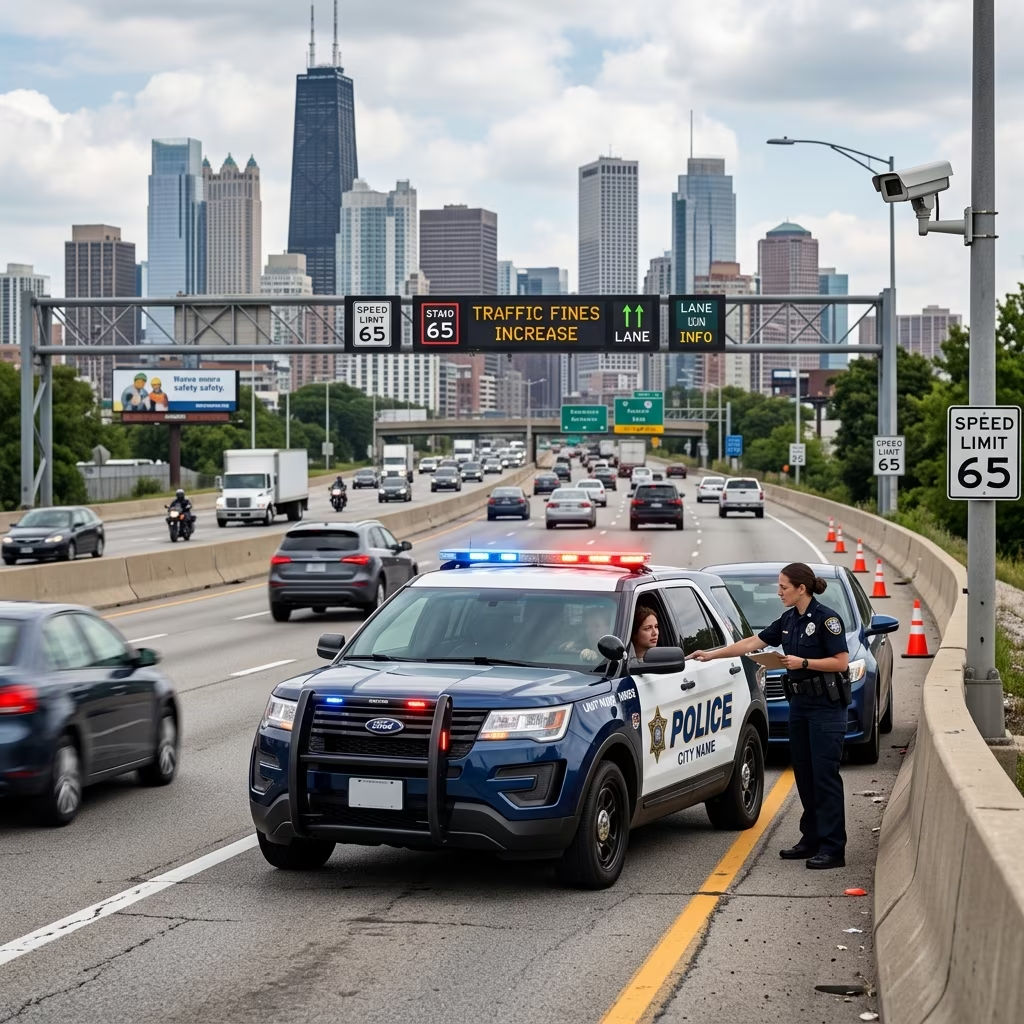
Traffic tickets may look simple on paper, but the consequences behind them can be complex and expensive. While many violations are treated as minor civil infractions, the fines, court costs, points on your license, and potential suspensions can affect your finances, ability to drive, and even, in serious cases, your freedom. This guide explains how traffic fines and penalties generally work in the United States, what factors influence the severity of punishment, and what options drivers typically have after receiving a ticket.
1. How Traffic Violations Are Classified
States categorize traffic violations in different ways, but most systems use three broad levels of seriousness.
- Civil infractions – Non-criminal violations such as ordinary speeding, failure to signal, or running a stop sign. These usually result in fines and points, but no jail.
- Misdemeanor offenses – More serious behavior such as reckless driving, driving under the influence (DUI), or driving with a suspended license. These can carry higher fines, probation, and possible jail time.
- Felony traffic offenses – The most serious charges, often involving serious injury, death, or repeated dangerous conduct (for example, felony DUI causing injury). These may lead to substantial fines, long-term license revocation, and prison.
Most tickets that typical drivers receive fall into the civil infraction category, but it is important to understand when a violation crosses the line into criminal territory.
2. Fines: The Immediate Financial Consequence
For many drivers, the most visible consequence of a ticket is the fine. However, the amount printed on a ticket is often only part of what you will pay once mandatory surcharges and fees are added.
2.1 Typical Fine Ranges
Fine amounts vary by state, offense, and prior record, but policy and practice studies show some common ranges:
- Many ordinary traffic tickets result in fines from about $75 to $400.
- Speeding tickets where the driver greatly exceeds the limit or speeds in sensitive areas (school or construction zones) can be significantly higher.
- Some states set escalating fines for repeat offenses within a short period, increasing the amount with each additional conviction.
2.2 Mandatory Fees and Surcharges
On top of the base fine, states often add statutory fees, court costs, or special surcharges dedicated to particular programs. These extras can dramatically increase what a driver actually pays.
- Fixed additional penalties for moving violations (for example, a flat extra amount added to every moving violation conviction).
- Additional amounts earmarked for court operations, emergency services, or local government budgets.[10]
- Higher total assessments when the violation is considered dangerous, such as running a red light or speeding excessively.
In practice, a ticket with a seemingly modest base fine can result in a final bill several times larger once these mandatory add-ons are included.
3. Points, Records, and License Consequences
Beyond the immediate fine, most states use a point system to track drivers’ behavior over time. Each moving violation adds points to a driver’s record. Accumulating too many points within a set period can trigger warnings, administrative hearings, or license suspension.
3.1 How Point Systems Typically Work
Details vary, but several common features appear in many state systems:
- Minor moving violations often carry a small number of points, such as 1 point for ordinary speeding or unsafe lane changes.
- Serious violations, like DUI or reckless driving, often add more points at once.
- If a driver accumulates a designated number of points over 12, 24, or 36 months, the motor vehicle agency may suspend or revoke the driver’s license.
Many systems are designed to allow for progressive responses: warning letters or educational materials for lower point levels, followed by hearings and potential suspension as the total grows.
3.2 Duration of Violations on Your Record
Traffic convictions usually remain on a driver’s record for a set number of years, which affects both state enforcement and insurance decisions.
- For many common violations, the record period is approximately three years, though this can vary by state.
- Serious offenses, such as DUI, may stay on the record for longer periods.
- Young drivers may face stricter rules, with some states imposing suspensions after a single serious ticket for drivers under 18.
3.3 When License Suspension Becomes a Risk
Most adult drivers will not have their license suspended after one ordinary moving violation. The risk grows when multiple tickets accumulate over time.
| Driver Situation | Typical Risk of Suspension |
|---|---|
| Single minor speeding ticket | Low risk; usually a fine and points only. |
| Several moving violations within a few years | Moderate to high risk; point thresholds may trigger suspension. |
| Serious offense (DUI, reckless driving) | High risk; suspension or revocation is common. |
| Young driver (under 18) with a single major violation | Higher risk; some states suspend with fewer offenses. |
4. Insurance Impacts of Traffic Tickets
Insurance companies rely heavily on driving records to set premiums. Repeated tickets signal higher risk, and insurers frequently respond with rate increases.
- One minor ticket may cause a small or no increase, depending on the insurer’s policies.
- Multiple violations, or any serious offense, can substantially raise premiums, sometimes for several years.
- Record-cleaning options, such as approved traffic school, can sometimes prevent a violation from appearing on the record used by insurers.
Because insurance costs are recurring, these increases can ultimately cost far more than the original fine.
5. Traffic School and Other Corrective Options
Many states provide ways for drivers to reduce or avoid some of the negative consequences of a traffic ticket, especially for less serious violations.
5.1 Attending Traffic School
Traffic school is one of the most common corrective measures available.
- Courses typically last six to eight hours and can sometimes be completed online.
- After successful completion, the violation may be removed from the driver’s record or the points may be reduced.
- States limit how often drivers can use traffic school to clear tickets, often once every one to two years.
- In some jurisdictions, attending traffic school may also reduce or eliminate the fine, while others require payment of both the fine and the course fee.
Traffic school is generally intended as an educational tool that reinforces safe driving habits while giving drivers a chance to limit long-term consequences.
5.2 Administrative and Educational Measures
Research on traffic enforcement shows that states use a spectrum of measures to respond to drivers with accumulating violations.
- Warning letters and informational brochures mailed to drivers with moderate point totals.
- Group or individual counseling sessions for repeat offenders.
- Administrative hearings to review a driver’s record and decide whether to suspend or restrict the license.
- Alternative sanctions, such as monitored driving restrictions or special license plate markings for persistent violators.
These tools are designed to correct behavior before it escalates into crashes that cause serious injury or death.
6. When Traffic Offenses Become Criminal
While civil tickets are common, some traffic behavior is treated as a crime, making the consequences significantly more severe.
6.1 Misdemeanor Traffic Offenses
In many states, certain traffic violations can be charged as misdemeanors.
- Examples include DUI, reckless driving, and driving with a suspended license.
- Consequences may include higher fines, probation, mandatory education programs, and up to a year in local jail.
- In some states, minor traffic offenses are classified as misdemeanors, which can lead to jail or probation even when no one was injured.
6.2 Felony-Level Traffic Crimes
Criminal responsibility can escalate further when violations cause serious harm.
- Causing severe injury or death while driving under the influence or at extreme speeds can lead to felony charges.
- Felonies may involve long-term imprisonment, large fines, and lengthy license revocations.
- States often reserve the harshest penalties for repeat offenders and crashes with severe outcomes.
7. Economic and Social Dimensions of Traffic Fines
Traffic fines are designed to deter unsafe driving, but they also raise important social and economic questions.[10]
7.1 Deterrence and Effectiveness
Studies of traffic enforcement indicate that increasing penalties does not always produce strong deterrent effects, especially for repeat or high-risk offenders.[10]
- Fines are more effective in settings with consistent, visible enforcement, such as fixed speed cameras.
- Public perception often treats common traffic violations as minor, reducing the psychological impact of fines.[10]
- Persistent offenders, especially those engaged in impaired driving, may not respond strongly to monetary penalties alone.[10]
7.2 Impact on Low-Income Drivers
Advocacy organizations and research centers have documented how fines and fees can disproportionately affect people with low incomes.
- Drivers who cannot afford to pay may face license suspensions, making it harder to work or fulfill family responsibilities.
- Unpaid fines can lead to additional penalties, including late fees or, in some jurisdictions, bench warrants and jail time.
- Long-term entanglement with court systems, debt, and repeated enforcement actions can result from what began as a minor traffic ticket.
These concerns have led some scholars and advocates to call for decriminalizing minor traffic offenses and reforming the use of fines and bench warrants.
8. Practical Steps After Receiving a Traffic Ticket
Drivers have several practical options when they receive a ticket, and the best choice depends on the type of violation, state law, and personal circumstances.
8.1 Common Response Options
- Pay the fine – This is often the simplest option for minor infractions, but it generally counts as admitting responsibility and will place the violation on your record.
- Request a hearing or contest the ticket – Drivers who believe the ticket was issued in error or that circumstances justify leniency may appear in court to challenge or explain the violation.
- Seek eligibility for traffic school – Where available, traffic school may reduce the impact on the record or insurance, particularly for first-time or low-level offenses.
- Consult a legal professional – In cases involving serious charges, potential jail time, or large financial consequences, professional legal advice can be important.
8.2 Questions to Ask Yourself
- Is this my first violation, or do I already have points on my record?
- Could this ticket push me close to a point threshold that risks suspension?
- Does my state offer traffic school or other programs to mitigate the impact?
- Is the alleged violation minor, or does it carry criminal consequences or high fines?
Answering these questions can help you choose a response that minimizes long-term harm while complying with legal requirements.
9. Frequently Asked Questions (FAQs)
9.1 Will I go to jail for an ordinary traffic ticket?
For a typical civil traffic infraction, jail is extremely unlikely. Jail time is generally reserved for criminal traffic offenses, such as DUI, reckless driving, or driving with a suspended license, or for situations where unpaid fines lead to further enforcement actions.
9.2 How long will a speeding ticket stay on my record?
In many states, common moving violations remain on a driver’s record for about three years, but the exact period is set by state law. Serious offenses can stay on the record longer.
9.3 Can traffic school keep my insurance rates from going up?
In jurisdictions where traffic school removes the violation from your record or reduces points, it can help prevent insurance rate increases. However, insurers differ in how they treat these programs, so you should check your policy or speak with your provider.
9.4 Do all states use a point system?
Most states use some form of point or demerit system to track driver behavior, though the details and thresholds vary. Even in systems without formal “points,” repeated violations can still trigger escalating administrative actions.
9.5 What happens if I cannot afford to pay my traffic fines?
Failing to pay may lead to additional financial penalties, license suspensions, or other enforcement actions, depending on local law. Some courts offer payment plans or alternative arrangements, and in serious situations, legal assistance or advocacy groups may help you explore available options.
References
- Consequences of Traffic Tickets — Justia. 2023-05-01. https://www.justia.com/traffic-tickets/consequences-of-traffic-tickets/
- Increasing Penalties – Speeding and Speed Management — National Highway Traffic Safety Administration (NHTSA). 2020-09-01. https://www.nhtsa.gov/book/countermeasures-that-work/speeding-and-speed-management/countermeasures/legislation-and-2
- Traffic fines and penalties — Florida Attorney General, My Florida Legal. 2015-04-14. https://www.myfloridalegal.com/ag-opinions/traffic-fines-and-penalties
- Types of Traffic Tickets and Penalties — Super Lawyers. 2022-06-10. https://www.superlawyers.com/resources/traffic-violations/types-of-traffic-tickets-and-penalties/
- The Drive to Jail: Why States Should Decriminalize Minor Traffic Offenses and Stop Using Bench Warrants to Enforce Traffic Laws — Fines and Fees Justice Center. 2019-05-01. https://finesandfeesjusticecenter.org/research/the-drive-to-jail-why-states-should-decriminalize-minor-traffic-offenses-and-stop-using-bench-warrants-to-enforce-traffic-laws/
- My Life Was Derailed By a Traffic Ticket — American Civil Liberties Union (ACLU). 2017-03-14. https://www.aclu.org/news/criminal-law-reform/my-life-was-derailed-by-a-traffic-ticket
- Traffic Fines — EBSCO Research Starters. 2018-01-01. https://www.ebsco.com/research-starters/economics/traffic-fines